




Intelligent, loyal, and athletic — a striking companion that combines the devotion of the Doberman with the brilliance of the Poodle.
🧠 QUICK SNAPSHOT
- Temperament: Loyal, intelligent, energetic
- Energy Level: High
- Size: Large
- Good With Families: Yes
- Trainability: Very high
- Grooming: Moderate to high
- Best For: Active families, experienced owners, companionship
📚 OVERVIEW
The Doberdoodle is a cross between a Doberman and a Poodle, creating an intelligent, athletic, and highly trainable companion. This hybrid often combines the Doberman’s loyalty and protective instincts with the Poodle’s exceptional intelligence and eagerness to learn.
Doberdoodles thrive in active households where they receive consistent training, regular exercise, and plenty of interaction with their family. They are affectionate with those they know and excel when given both physical and mental challenges.
✅ PROS & CONS
Pros
- Extremely intelligent and easy to train
- Loyal and devoted to family
- Athletic and versatile companion
- Often lower shedding than the Doberman
Cons
- Requires significant daily exercise
- Needs regular grooming
- Can become bored if under-stimulated
- Benefits from experienced training and early socialisation
Is a Doberdoodle a Good Family Dog?
Yes. A well-bred and properly socialised Doberdoodle can be an excellent family dog, particularly for active households wanting an intelligent, affectionate and highly trainable companion.
The Doberdoodle is a cross between a Doberman Pinscher and a Poodle, usually a Standard Poodle.
Both parent breeds are intelligent and strongly people-oriented, so Doberdoodles often form extremely close relationships with their families.
They’re generally large, energetic dogs, making early training and socialisation especially important.
How Much Exercise Does a Doberdoodle Need?
Most adult Doberdoodles need around 60–90 minutes of substantial exercise each day, with some individuals requiring more.
Both Dobermans and Standard Poodles are athletic working breeds.
Walking alone may not completely satisfy them. Running, retrieving, scent work, swimming, obedience and other mentally challenging activities can be excellent additions.
A bored Doberdoodle potentially combines a Doberman’s determination with a Poodle’s problem-solving ability — which isn’t necessarily a combination you want designing its own afternoon activities.
Is a Doberdoodle Easy to Train?
Doberdoodles are generally extremely intelligent and highly trainable.
Both Dobermans and Poodles rank among breeds renowned for learning quickly and working closely with people.
Positive reinforcement and structured training usually produce excellent results.
Their intelligence also means inconsistent rules can quickly be exploited, so training should begin early.
Does a Doberdoodle Shed?
A Doberdoodle can be low, moderate or relatively heavy shedding, depending on the coat inherited.
Dogs with strongly Poodle-like curly coats may shed relatively little.
Others inherit straighter or wavier coats that release considerably more hair.
Even puppies within the same litter can develop different adult coats.
Is a Doberdoodle Hypoallergenic?
No Doberdoodle can be guaranteed to be hypoallergenic.
A curly, low-shedding individual may distribute less hair and dander around the home than a Doberman.
However, dog allergens are also present in saliva and skin secretions.
Crossing a Doberman with a Poodle doesn’t automatically produce an allergy-friendly dog.
How Often Does a Doberdoodle Need Grooming?
Grooming requirements depend heavily on coat type.
Curly or dense wavy coats generally require brushing several times each week and professional grooming approximately every 6–8 weeks.
Straighter coats may need less clipping but can shed more.
Some mixed coats can both mat and shed, making them surprisingly labour-intensive.
What Health Problems Are Common in Doberdoodles?
Doberdoodles can potentially inherit health conditions from both Dobermans and Poodles.
Important concerns can include hip dysplasia, eye disorders, thyroid disease, bloat and inherited cardiac conditions.
Doberman ancestry makes dilated cardiomyopathy and von Willebrand disease particularly important considerations.
Standard Poodles also have their own inherited health risks, so health testing should cover both sides of the pedigree.
Are Doberdoodles Prone to Heart Problems?
Potentially, yes.
Doberman Pinschers have a particularly serious predisposition to dilated cardiomyopathy (DCM), a disease in which the heart muscle becomes abnormal and may fail to pump effectively.
Crossing with a Poodle doesn’t guarantee that inherited risk disappears.
Responsible breeding should therefore include appropriate cardiac screening of the Doberman line rather than assuming hybrid ancestry provides automatic protection.
What Is Dilated Cardiomyopathy in Doberdoodles?
Dilated cardiomyopathy causes the heart to become enlarged and less effective at pumping blood.
The condition is particularly important in Doberman Pinschers and can sometimes progress without obvious early symptoms.
Abnormal heart rhythms can also occur and may occasionally cause sudden collapse or death.
Veterinary screening can include echocardiography and ambulatory ECG monitoring such as a Holter monitor.
Can Doberdoodles Inherit von Willebrand Disease?
Yes. Dobermans have an inherited predisposition to von Willebrand disease, a bleeding disorder involving a protein needed for normal blood clotting.
Poodles can also be affected by inherited bleeding disorders depending on their genetic background.
DNA testing is available for relevant forms of von Willebrand disease.
Responsible breeders should know the status of breeding dogs rather than discovering the problem after puppies are produced.
Are Doberdoodles Prone to Bloat?
As a large, deep-chested cross, some Doberdoodles may be at increased risk of gastric dilatation-volvulus (GDV), commonly called bloat.
The stomach fills with gas and may rotate, creating a life-threatening emergency.
Signs can include repeated unsuccessful attempts to vomit, abdominal swelling, restlessness, drooling and rapid deterioration.
Suspected GDV requires immediate emergency veterinary treatment.
How Long Do Doberdoodles Live?
A Doberdoodle may commonly live around 10–14 years, although there isn’t enough standardised population data to establish a precise breed lifespan.
Size, genetics, cardiac health, body weight and veterinary care all influence longevity.
Health testing of both parent breeds is more meaningful than assuming a crossbreed will automatically outlive its parents.
How Big Does a Doberdoodle Get?
Doberdoodles are usually medium-large to large dogs, particularly when a Doberman is crossed with a Standard Poodle.
Many may weigh roughly 25–40 kg or more, but size can vary considerably.
Height, build and coat can make two dogs of similar weight look dramatically different.
There is no official Doberdoodle breed standard controlling adult size.
Is There a Mini Doberdoodle?
Some breeders advertise Mini Doberdoodles, generally involving a smaller Poodle or multigenerational breeding.
However, “Mini Doberdoodle” isn’t a recognised or standardised size category.
Crossing a large Doberman with a much smaller Poodle also doesn’t guarantee predictably miniature offspring.
Prospective owners should look at the actual parents rather than relying on marketing labels.
Is There Such a Thing as a Teacup Doberdoodle?
“Teacup Doberdoodle” isn’t an official or meaningful breed classification.
Dobermans are large athletic dogs, so producing extremely tiny dogs marketed under this name would generally require substantial multigenerational breeding away from a straightforward Doberman-Poodle cross.
Extreme miniaturisation can also create additional health concerns.
Size shouldn’t be prioritised over sound structure and health.
Can a Doberdoodle Live in an Apartment?
A Doberdoodle can live in an apartment if its substantial exercise and mental-stimulation needs are consistently met.
However, its size, energy and potential watchdog behaviour can make apartment living more challenging than with smaller companion breeds.
Access to a garden doesn’t eliminate the need for exercise either.
The important question isn’t simply how large the home is — it’s what the dog does every day.
Can a Doberdoodle Be Left Alone?
Adult Doberdoodles can learn to spend reasonable periods alone, but many are extremely people-oriented.
Dobermans are famous for forming intense attachments to their owners, while Poodles also thrive on human interaction.
Some Doberdoodles may therefore be susceptible to separation-related behaviour.
Independence should be taught gradually from puppyhood.
Do Doberdoodles Bark a Lot?
Doberdoodles can be alert and moderately vocal, particularly if they inherit strong Doberman watchdog instincts.
They may readily announce visitors or unfamiliar activity around the home.
Poodles can also be alert barkers.
Training can help distinguish between useful alerting and barking at every movement outside the window.
Are Doberdoodles Protective?
Some Doberdoodles can be naturally watchful and protective because of their Doberman ancestry.
However, protective behaviour is unpredictable in a crossbreed.
Owners shouldn’t deliberately encourage aggression or suspiciousness.
A family companion should first be stable, socialised and controllable. Its appearance alone is usually enough to make strangers reconsider entering a property uninvited.
Is a Doberdoodle a Good Guard Dog?
A Doberdoodle may make an effective watchdog and visual deterrent, but guarding ability isn’t guaranteed.
Dobermans were specifically developed for personal protection, while Poodles were sporting dogs.
A Doberdoodle can inherit different combinations of these behavioural traits.
Formal protection training should only be undertaken by experienced professionals with dogs of appropriate temperament.
Are Doberdoodles Aggressive?
Doberdoodles aren’t inherently aggressive.
Temperament depends on genetics, early socialisation, training, environment and individual personality.
Poorly bred Dobermans can develop fear or temperament problems, while poorly socialised large dogs of any ancestry can become difficult to manage.
Responsible breeding should prioritise stable temperament just as strongly as appearance.
Are Doberdoodles Good With Children?
Doberdoodles can be excellent with children when properly socialised.
They’re often affectionate and playful.
However, they’re usually large, energetic dogs capable of accidentally knocking over small children.
Supervision and respectful interactions remain important.
Children should never be expected to manage a powerful adolescent Doberdoodle by themselves.
Are Doberdoodles Good With Other Dogs?
Many Doberdoodles can live successfully with other dogs.
Early socialisation is particularly important because Dobermans can sometimes show dog selectivity, while individual Poodles vary as well.
Appropriate introductions and positive experiences help.
Sex, age, temperament and breeding line can all influence compatibility.
Are Doberdoodles Good With Cats?
Doberdoodles can live successfully with cats, especially when introduced while young.
Both parent breeds can have chase or prey instincts.
A familiar household cat may therefore be completely accepted while unfamiliar animals outdoors still trigger pursuit.
Controlled introductions are essential.
Do Doberdoodles Have a Strong Prey Drive?
Some Doberdoodles can have a moderate or strong chase instinct.
Dobermans were versatile working dogs with some historical vermin-control and protection functions, while Poodles descend from hunting retrievers.
Individual prey drive can vary dramatically.
Recall training should begin early.
Do Doberdoodles Like Water?
Many Doberdoodles enjoy swimming, particularly those inheriting strong Poodle characteristics.
The Poodle was originally developed as a water retriever.
Dobermans aren’t specialised swimming dogs, although many individuals enjoy water.
Dogs should still be introduced gradually and supervised until their swimming ability is known.
Are Doberdoodles Good at Fetch?
Many Doberdoodles are excellent retrieving dogs.
Poodle ancestry contributes centuries of retrieving ability, while both parent breeds are energetic and highly trainable.
Fetch can provide useful exercise and mental stimulation.
Some individuals may become so enthusiastic that the difficult part isn’t teaching them to retrieve — it’s explaining that the game eventually has to end.
Why Does My Doberdoodle Follow Me Everywhere?
Doberdoodles can be extremely people-oriented or “Velcro” dogs.
Dobermans are particularly famous for staying close to their owners, and Poodles also form strong human bonds.
Following someone from room to room can therefore be completely normal.
Owners should still teach independent relaxation to reduce the risk of separation problems.
Are Doberdoodles Cuddly?
Many Doberdoodles are surprisingly affectionate and cuddly despite their large size.
Dobermans often want substantial physical contact with their favourite humans.
Poodles can be equally affectionate.
The result may be a 30-kilogram dog entirely convinced that “lap dog” describes a personality rather than a size category.
Why Is My Doberdoodle So Energetic?
Both parent breeds are athletic working dogs.
Dobermans were developed for protection and versatile working roles, while Poodles were water retrievers.
A Doberdoodle therefore isn’t simply a curly-coated companion dog.
It may need substantial physical exercise combined with training, scent work, retrieving and problem-solving activities.
Are Doberdoodles Good Running Dogs?
Healthy adult Doberdoodles can potentially make excellent running companions.
Both parent breeds are athletic and capable of substantial exercise.
Structured running should wait until the dog’s bones and joints have matured.
Distance should then be increased gradually while considering temperature, surfaces and individual health.
Are Doberdoodles Intelligent?
Yes. A Doberdoodle potentially combines two exceptionally intelligent parent breeds.
Both Dobermans and Poodles are renowned for learning quickly, solving problems and responding well to advanced training.
However, intelligence doesn’t automatically make a dog easier to own.
An intelligent dog without enough stimulation can become extraordinarily efficient at inventing behaviours nobody requested.
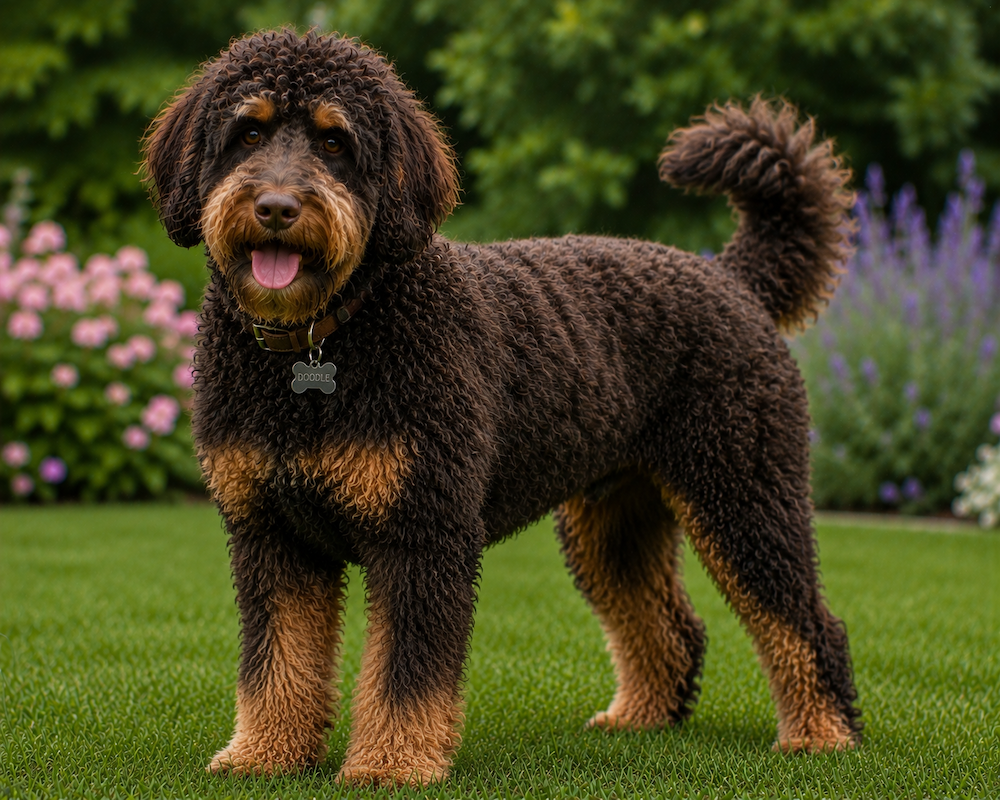
What Does a Doberdoodle Look Like?
There is no standard Doberdoodle appearance.
Some have tightly curled Poodle-like coats, while others are wavy or relatively straight.
Build can range from slender and athletic to more substantial.
Facial furnishings may create the classic “doodle” appearance, while other dogs retain a surprisingly Doberman-like head and body.
Can a Doberdoodle Look Like a Curly Doberman?
Yes. Some Doberdoodles inherit a Doberman-like athletic body combined with a wavy or curly coat.
Others look much more like large Poodle crosses.
Because Dobermans and Poodles differ substantially in coat genetics and appearance, first-generation puppies can be highly variable.
Even littermates may look surprisingly different.
What Colours Can Doberdoodles Be?
Doberdoodles can potentially occur in numerous colours, including black, brown, red, cream and combinations involving tan markings, depending on parental genetics.
Some may display markings reminiscent of a Doberman.
Poodle colour genetics can also cause certain coats to lighten as the dog matures.
Colour shouldn’t be prioritised over health and temperament.
Can a Doberdoodle Be Black and Tan Like a Doberman?
Yes. Some Doberdoodles can inherit black-and-tan patterning reminiscent of a Doberman Pinscher.
How clearly the markings appear depends on the combination of genes inherited from both parents.
Curly facial hair can make the pattern look quite different from that of a purebred Doberman.
Why Does My Doberdoodle’s Coat Change Colour?
Some Doberdoodles inherit progressive fading or greying tendencies from their Poodle ancestry.
A puppy born dark brown, black or red may become significantly lighter as it matures.
This can be completely normal.
The adult colour of a young Poodle cross isn’t always obvious from its puppy photographs.
Can a Doberdoodle Be Merle?
A straightforward purebred Doberman × Poodle cross shouldn’t naturally produce merle, because merle isn’t a standard naturally occurring pattern in either parent breed.
A dog marketed as a merle Doberdoodle therefore raises questions about additional ancestry somewhere in the pedigree.
Merle-to-merle breeding also carries significant risks of hearing and eye abnormalities in double-merle puppies.
Does a Doberdoodle Have Floppy or Upright Ears?
Doberdoodles naturally tend to have floppy ears.
Both uncropped Dobermans and Poodles have naturally hanging ears.
The famous upright ears seen on some Dobermans result from surgical cropping rather than the breed’s natural ear carriage.
A naturally bred Doberdoodle should therefore generally have drop ears.
Can Doberdoodles Have Cropped Ears?
A Doberdoodle is naturally born with floppy ears.
Cropping is a surgical alteration performed for cosmetic or traditional reasons rather than something required by Doberdoodle anatomy.
Ear cropping is prohibited or heavily restricted in many countries, including Australia.
There is no functional reason a companion Doberdoodle needs upright cropped ears.
Does a Doberdoodle Have a Long Tail?
Yes. Doberdoodles are naturally born with tails, usually long ones.
Both Dobermans and Poodles traditionally had tails docked in some countries, which can create confusion about their natural appearance.
Where docking is prohibited or no longer practised, both breeds have perfectly functional natural tails.
A Doberdoodle doesn’t naturally come with the short tail often seen in old images of Dobermans.
What Is an F1 Doberdoodle?
An F1 Doberdoodle is a first-generation cross between a Doberman Pinscher and a Poodle.
Usually the Poodle involved is a Standard Poodle because its size is compatible with the Doberman.
An F1 puppy receives approximately half its ancestry from each breed, but that doesn’t mean its visible characteristics will be exactly halfway between them.
What Is an F1B Doberdoodle?
An F1B Doberdoodle is generally produced by crossing an F1 Doberdoodle back to a Poodle.
This is often done to increase the likelihood of a curly, lower-shedding coat.
However, coat type, shedding and allergy suitability still aren’t guaranteed.
An F1B could technically be backcrossed to the Doberman instead, so buyers should confirm the actual parentage.
What Is an F2 Doberdoodle?
An F2 Doberdoodle is generally the offspring of two F1 Doberdoodles.
Second-generation crosses can produce considerable variation because genes inherited from the original breeds recombine in different ways.
Some puppies may strongly resemble one parent breed while others look very different.
Generation terminology describes ancestry, not guaranteed traits.
Is a Doberdoodle a Recognised Dog Breed?
No. The Doberdoodle is a designer crossbreed, not a recognised pedigree breed under major international kennel organisations.
There is no universally accepted standard for its size, coat, appearance or temperament.
Doberman Pinschers and Poodles are individually recognised breeds with established standards and health-testing programmes.
Is a Doberdoodle Healthier Than a Doberman?
Not necessarily.
Crossbreeding can increase genetic diversity, but hybrid vigour doesn’t automatically eliminate inherited disease.
A Doberdoodle can still inherit important Doberman health risks such as DCM and von Willebrand disease while also inheriting conditions from the Poodle.
Responsible health testing of both parents remains essential.
Is a Doberdoodle Healthier Than a Poodle?
Again, not automatically.
A Doberdoodle receives genetic material from both breeds, meaning it can inherit risks associated with either population.
Genetic diversity can sometimes reduce the likelihood of particular recessive conditions, but only when the relevant genetics actually support that outcome.
“Crossbreed” isn’t a substitute for health testing.
Is a Doberdoodle the Same as a Doodleman Pinscher?
Yes. Doberdoodle and Doodleman Pinscher are names commonly used for the Doberman Pinscher–Poodle cross.
Other variations include Doberman Doodle or Doberman Poodle Mix.
Because the cross isn’t an officially recognised breed, there is no single governing organisation controlling its name.
“Doberdoodle” is the most immediately understandable description.
What Were Dobermans Originally Bred For?
The Doberman was developed in Germany during the late 19th century as a protective working dog.
Its creator, Karl Friedrich Louis Dobermann, worked in occupations that reportedly included tax collecting and required him to travel carrying money.
He wanted an intelligent, courageous dog capable of accompanying and protecting him.
The resulting breed eventually became famous in police, military, security and service work.
What Were Poodles Originally Bred For?
Despite their elegant modern image, Poodles were originally developed as working water retrievers.
Their ancestors retrieved waterfowl for hunters.
Even the famous Poodle clip has roots in the breed’s working history, although many popular explanations about the precise purpose of every shaved area are probably oversimplified.
The Poodle’s intelligence and athleticism existed long before it became associated with elaborate show grooming.
Is the Doberdoodle a Working Dog?
The Doberdoodle isn’t an established working breed, but it combines ancestry from two highly capable working dogs.
Dobermans were developed for protection and later excelled in police and military work.
Poodles were hunting retrievers and subsequently succeeded in numerous performance roles.
A Doberdoodle can therefore have enormous potential for obedience, scent work, agility and other activities.
Why Is It Called a Doberdoodle?
The name Doberdoodle combines Doberman with the now-familiar “doodle” naming convention used for Poodle crosses.
Unlike Labradoodle or Goldendoodle, combining the complete breed names would produce the considerably less marketable “Dobermanpoodle.”
“Doberdoodle” quickly communicates the dog’s ancestry even though it isn’t an official breed name.
Who Created the First Doberdoodle?
There is no reliably documented individual who created the first Doberdoodle.
Dobermans and Poodles could have been crossed accidentally long before anyone began deliberately marketing the puppies under a designer name.
Purposeful breeding appears to belong to the wider modern popularity of Poodle crosses.
Specific claims about an inventor or exact founding year should therefore be treated cautiously unless supported by credible documentation.
Where Does the Doberdoodle Come From?
The Doberdoodle is a modern designer cross, and its precise place and date of origin aren’t well documented.
Its parent breeds have much clearer histories.
The Doberman was developed in Germany as an intelligent protective working dog, while the Poodle arose from European water-retrieving traditions and became particularly associated with Germany and France.
The result is an unusual combination: the alertness and athleticism of a Doberman mixed with the intelligence, retrieving heritage and potentially curly coat of a Poodle — creating a dog that may look like a giant teddy bear while possessing absolutely no intention of spending its life sitting decoratively on the sofa.