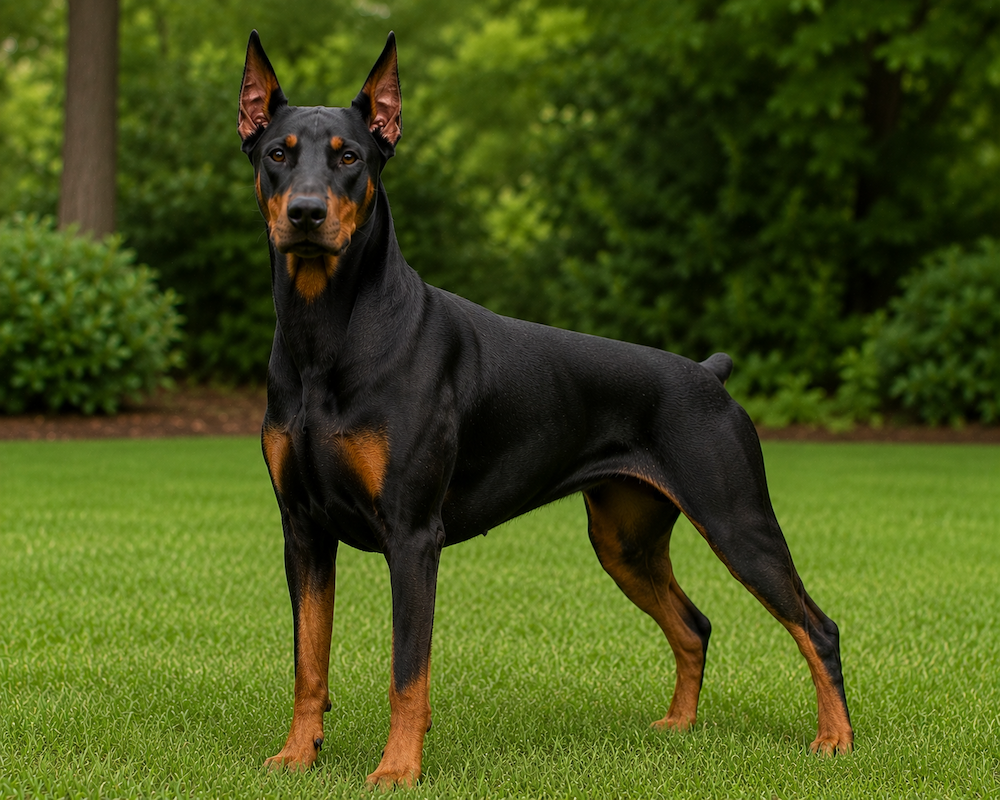







Intelligent, loyal, and exceptionally protective — a powerful companion renowned for its devotion, athleticism, and confidence.
🧠 QUICK SNAPSHOT
- Temperament: Loyal, intelligent, protective
- Energy Level: High
- Size: Large
- Good With Families: Yes
- Trainability: Very high
- Grooming: Low
- Best For: Active families, experienced owners, protection and companionship
📚 OVERVIEW
The Doberman is one of the world’s most respected working breeds, known for its intelligence, loyalty, and impressive athletic ability. Originally developed in Germany as a personal protection dog, the Doberman combines strength and courage with a surprisingly affectionate and family-oriented nature.
When properly trained and socialised, Dobermans are loving companions that form deep bonds with their family and are highly devoted to protecting those they care about.
✅ PROS & CONS
Pros
- Extremely intelligent and trainable
- Loyal and deeply devoted to family
- Excellent watchdog and guardian
- Athletic and versatile working dog
Cons
- Needs significant exercise and mental stimulation
- Requires early socialisation and training
- Can become destructive if bored
- Not ideal for owners seeking a low-maintenance breed
Is a Doberman a Good Family Dog?
Yes. A well-bred and properly socialised Doberman can be an excellent family dog, particularly for an active household prepared to provide training, exercise and companionship.
Dobermans are famously devoted to their families and often want to be involved in virtually everything their owners do.
They’re large, powerful and energetic, so early socialisation and consistent training are essential.
Despite their intimidating reputation, many family Dobermans are remarkably affectionate dogs.
How Much Exercise Does a Doberman Need?
Most adult Dobermans need around 90 minutes to two hours of physical activity each day, combined with mental stimulation.
They’re athletic working dogs rather than oversized couch potatoes.
Running, hiking, obedience, scent work, retrieving and dog sports can all provide useful outlets.
Simply leaving a Doberman in a backyard doesn’t satisfy its need to exercise and work with people.
Is a Doberman Easy to Train?
Yes. Dobermans are generally exceptionally intelligent and highly trainable.
They were deliberately developed to work closely with people and can learn complex behaviours quickly.
Positive reinforcement, consistency and clear boundaries usually produce excellent results.
Their intelligence also means undesirable habits can become established rapidly, so training should begin early.
Does a Doberman Shed?
Yes. Dobermans have short coats that shed moderately throughout the year.
The hairs are much less conspicuous than the large amounts of undercoat produced by breeds such as German Shepherds or Huskies, but they still end up on clothing and furniture.
Weekly brushing is usually sufficient for routine coat maintenance.
Is a Doberman Hypoallergenic?
No. Dobermans aren’t considered hypoallergenic.
They shed hair and produce allergens through saliva, skin and dander.
Their short coat makes grooming relatively easy but doesn’t make them suitable for everyone with dog allergies.
What Health Problems Are Common in Dobermans?
Important health concerns include dilated cardiomyopathy (DCM), von Willebrand disease, cervical vertebral instability or Wobbler syndrome, hypothyroidism, hip dysplasia and gastric dilatation-volvulus (GDV).
DCM is particularly significant because of its high prevalence within Doberman populations.
Responsible breeders should perform appropriate health and genetic screening rather than relying on appearance or pedigree alone.
Why Are Heart Problems Such a Concern in Dobermans?
Dobermans have a serious breed predisposition to dilated cardiomyopathy, or DCM.
The disease causes abnormalities of the heart muscle and can lead to heart failure or dangerous cardiac arrhythmias.
Some affected dogs remain outwardly normal during an extended occult phase.
This means a dog can appear fit and healthy while significant heart disease is developing.
What Is Dilated Cardiomyopathy in Dobermans?
Dilated cardiomyopathy is a disease in which the heart becomes abnormally enlarged and less effective at pumping blood.
Affected Dobermans may develop weakness, coughing, exercise intolerance, breathing difficulties, collapse or heart failure.
Abnormal heart rhythms can sometimes cause sudden death before obvious heart-failure symptoms develop.
Regular cardiac screening can therefore be particularly valuable in this breed.
What Is a Holter Test for a Doberman?
A Holter monitor is a portable electrocardiogram device worn by the dog, commonly for around 24 hours.
It continuously records the heart’s electrical activity while the Doberman goes about its normal day.
This can detect abnormal rhythms that might not appear during a brief veterinary examination.
Holter monitoring is frequently used alongside echocardiography when screening Dobermans for DCM.
What Is von Willebrand Disease in Dobermans?
Von Willebrand disease is an inherited bleeding disorder involving a protein needed for normal blood clotting.
Dobermans have a recognised predisposition to Type 1 von Willebrand disease.
Affected dogs can experience prolonged bleeding following injury or surgery, although severity varies considerably.
DNA testing can identify genetically affected dogs and carriers.
What Is Wobbler Syndrome in Dobermans?
Wobbler syndrome is a general term for cervical vertebral instability or compression affecting the spinal cord in the neck.
Dobermans are among the breeds predisposed to certain forms of the condition.
Signs can include an unsteady gait, weakness, neck pain and difficulty coordinating the limbs.
Diagnosis generally requires specialised veterinary assessment and imaging.
Are Dobermans Prone to Bloat?
Yes. Their deep-chested body shape places Dobermans among breeds at increased risk of gastric dilatation-volvulus (GDV).
The stomach fills with gas and can rotate, restricting blood flow.
Signs can include abdominal swelling, restlessness, drooling and repeated unsuccessful attempts to vomit.
GDV is an immediate veterinary emergency.
How Long Do Dobermans Live?
Dobermans commonly live around 10–12 years, although individuals can live longer.
Inherited heart disease is an important factor affecting longevity within the breed.
Responsible breeding, healthy body weight, regular exercise and preventive veterinary care can all influence lifespan.
How Big Does a Doberman Get?
Adult male Dobermans generally stand around 68–72 cm at the shoulder, while females are usually around 63–68 cm, depending on the breed standard.
Males commonly weigh roughly 40–45 kg, with females around 32–35 kg.
A Doberman should appear muscular and powerful but also athletic and elegant rather than excessively heavy.
Can a Doberman Live in an Apartment?
Yes. A Doberman can live successfully in an apartment if its substantial exercise and mental-stimulation requirements are met.
They’re often relatively settled indoors after adequate activity.
Their strong attachment to people can actually make indoor family life preferable to being isolated in a large backyard.
Size isn’t the main issue — exercise, training and management are.
Can a Doberman Be Left Alone?
Adult Dobermans can learn to spend reasonable periods alone, but many are extremely attached to their owners.
The breed’s tendency to remain physically close to people has earned it a reputation as a “Velcro dog.”
Long periods of isolation may contribute to separation-related behaviour, boredom or destructiveness.
Independence should be taught gradually from puppyhood.
Why Does My Doberman Follow Me Everywhere?
Following owners is extremely common Doberman behaviour.
The breed was developed to work closely beside and protect a human handler, and modern Dobermans often retain that intense focus on their people.
Many follow their owners from room to room and want physical contact whenever possible.
Closing the bathroom door may eventually be interpreted by your Doberman as a serious breach of security protocol.
Are Dobermans Cuddly?
Many Dobermans are extremely affectionate and cuddly with their families.
They frequently lean against people, climb onto laps and seek physical contact despite their considerable size.
This affectionate side can surprise people familiar only with the breed’s guard-dog image.
A Doberman can look intimidating to a stranger while simultaneously believing it belongs under a blanket with its owner.
Why Do Dobermans Lean on Their Owners?
Leaning is a common way for Dobermans to seek physical contact, attention and reassurance.
The breed often prefers being extremely close to its people.
A lean can also simply be a learned behaviour because it reliably produces pats.
It’s usually affection rather than an attempt to “dominate” the owner.
Are Dobermans Good With Children?
Well-socialised Dobermans can be excellent family companions for children.
They’re often affectionate, playful and protective of household members.
However, they’re large, energetic dogs capable of accidentally knocking over small children.
Interactions should be supervised, and both dog and child need to learn appropriate boundaries.
Are Dobermans Good With Other Dogs?
Dobermans can live successfully with other dogs, but dog selectivity and same-sex aggression can occur in some individuals and lines.
Early socialisation is important.
Compatibility depends on genetics, sex, age, training and individual temperament.
Owners shouldn’t assume that every sociable puppy will automatically enjoy every dog it encounters as an adult.
Are Dobermans Good With Cats?
Dobermans can live successfully with cats, particularly when raised with them and carefully introduced.
However, some individuals have substantial chase or prey drive.
A familiar household cat may be accepted while an unfamiliar cat running outside triggers a completely different response.
Supervised introductions are important.
Do Dobermans Have a Strong Prey Drive?
Some Dobermans have a moderate to strong prey or chase drive.
Their historical development involved versatile working dogs rather than specialised hunting alone, so intensity varies considerably.
Small fast-moving animals may trigger pursuit.
Early recall and impulse-control training are valuable.
Do Dobermans Bark a Lot?
Dobermans aren’t necessarily constant barkers, but they’re typically highly alert watchdogs.
They notice unusual activity and may quickly announce visitors.
A well-trained Doberman can learn when alert barking is appropriate.
Boredom and insufficient exercise can increase unnecessary barking.
Are Dobermans Naturally Protective?
Yes. Dobermans often possess strong natural protective and watchful instincts.
Protection was central to the breed’s original purpose.
However, a good family Doberman should be stable and controllable rather than indiscriminately suspicious or aggressive.
Owners generally don’t need to encourage protective behaviour — training should focus much more heavily on confidence, socialisation and control.
Is a Doberman a Good Guard Dog?
The Doberman is one of the world’s most famous guard and personal-protection breeds.
Its combination of intelligence, athleticism, responsiveness and natural vigilance made it highly effective in security roles.
For most pet owners, however, advanced protection training is unnecessary.
A large, alert Doberman standing quietly beside its owner already provides an impressive visual deterrent.
Are Dobermans Aggressive?
Dobermans aren’t inherently indiscriminately aggressive.
A responsibly bred Doberman should be confident, stable, responsive and controllable.
Genetics, socialisation, training, pain, fear and environment all influence behaviour.
Historically, breeders required courage and protective instincts, but an uncontrollable dog would have been a liability rather than an effective working partner.
Are Dobermans Dangerous Dogs?
A Doberman is a large, powerful dog capable of causing serious injury, so responsible ownership is essential.
That doesn’t mean every Doberman is dangerous.
Temperament varies between individuals and breeding lines, and appropriate socialisation and training matter enormously.
Their physical ability makes poor breeding or poor management more consequential than it might be with a tiny companion breed.
Are Dobermans Good Running Dogs?
Yes. Healthy adult Dobermans can be excellent running companions.
They’re athletic dogs built for speed and endurance.
Structured running should generally wait until the dog’s skeletal development is sufficiently mature.
Distance should then be increased gradually while considering temperature, surfaces and individual health.
Can Dobermans Swim?
Many Dobermans can swim, but they’re not specialised water dogs.
Some love swimming while others show little interest.
Their lean, muscular bodies don’t provide the same natural buoyancy as some retrievers.
Supervision and gradual introduction are sensible, particularly around deep or open water.
Do Dobermans Get Cold Easily?
Yes. Dobermans can be quite sensitive to cold weather.
Their short, thin coats provide limited insulation and they have relatively little protection from wind and low temperatures.
A coat can be useful during cold-weather walks.
Dobermans generally aren’t suitable for living permanently outdoors, particularly in cold climates.
Do Dobermans Handle Hot Weather Well?
Dobermans generally tolerate moderate warmth better than heavily coated breeds, but they’re still vulnerable to heat stress and heatstroke.
Exercise should be reduced during extreme heat.
Shade and fresh water must always be available.
A short coat doesn’t make any dog immune to dangerous temperatures.
What Colours Can Dobermans Be?
Recognised colours vary slightly between kennel organisations, but commonly include black, red or brown, blue and fawn/isabella, combined with characteristic rust-coloured markings.
Black and rust is probably the most familiar combination.
Blue and fawn are dilute colours and can be associated with coat and skin problems in some dogs.
What Is a Red Doberman?
A Red Doberman has a rich reddish-brown base coat with rust markings rather than the familiar black coat.
The colour results from recessive brown pigmentation genetics.
Red Dobermans are genuine purebred Dobermans and are recognised by major kennel organisations.
Their temperament and care requirements are fundamentally the same as other colours.
What Is a Blue Doberman?
A Blue Doberman carries dilution genetics that lighten black pigment into a slate-grey or blue appearance.
Blue is recognised by some kennel organisations.
However, dilute Dobermans can be predisposed to colour dilution alopecia, causing thinning hair and skin problems.
A fashionable colour shouldn’t take priority over health.
What Is an Isabella or Fawn Doberman?
Fawn — sometimes called Isabella — is essentially a diluted form of the red/brown colour.
It produces a pale beige or taupe appearance with lighter rust markings.
Like blue Dobermans, fawn individuals may have an increased risk of colour dilution alopecia.
Responsible breeding should prioritise health rather than rarity.
Are White Dobermans Albino?
So-called white Dobermans have a form of albinism caused by a genetic mutation affecting pigmentation.
They generally aren’t completely pigment-free in the simplistic sense people associate with classic albinism, but their condition substantially reduces pigmentation.
The original American white Doberman population traces back to a female named Padula’s Queen Sheba, born in 1976.
Are White Dobermans Healthy?
White or albino Dobermans can have increased problems associated with reduced pigmentation, particularly light sensitivity and susceptibility to sun damage.
Breeding specifically for this appearance is controversial.
Major Doberman organisations have raised welfare concerns about deliberately producing albino dogs.
Rarity should never be confused with desirable genetics.
What Is a Warlock Doberman?
“Warlock Doberman” isn’t a recognised type of Doberman.
The term is generally used as a marketing label for oversized Dobermans.
It probably gained popularity through confusion surrounding historical dogs and kennels carrying Warlock-related names.
Deliberately breeding Dobermans substantially beyond the standard can compromise the athletic structure the breed was designed to possess.
Is There a King Doberman or Giant Doberman?
No recognised King or Giant Doberman variety exists.
These are usually marketing terms for unusually large dogs.
Bigger isn’t automatically better.
The Doberman standard calls for an athletic balance of speed, endurance, power and agility rather than Mastiff-like bulk.
What Is the Difference Between an American and European Doberman?
“American” and “European” Doberman generally describe dogs bred under different kennel standards and breeding traditions, not separate breeds.
European lines are often perceived as somewhat heavier and more strongly influenced by working requirements.
American show lines may appear more refined.
However, enormous variation exists within both populations, and sweeping temperament claims should be treated cautiously.
Why Is It Called a Doberman Pinscher?
The breed was named after its creator, Karl Friedrich Louis Dobermann.
“Pinscher” is a German term historically associated with a type of dog used for functions including vermin control and guarding.
In some countries the breed is officially called simply the Dobermann, while “Doberman Pinscher” remains the standard name in others, particularly the United States.
Is It Spelled Doberman or Dobermann?
Both spellings are used.
The breed’s creator’s surname was Dobermann, with two Ns.
The Fédération Cynologique Internationale and many European countries use Dobermann.
The American Kennel Club uses Doberman Pinscher, with one final N.
So neither spelling is simply a typo — usage depends partly on location and registry.
Who Created the Doberman?
The breed was developed by Karl Friedrich Louis Dobermann in Germany during the late 19th century.
Dobermann lived in Apolda in the German state of Thuringia.
He wanted a courageous, intelligent and physically capable dog that could accompany and protect him during his work.
Unlike many breeds whose founders are lost to history, the Doberman literally carries its creator’s name.
Was Louis Dobermann Really a Tax Collector?
Yes. Louis Dobermann is widely documented as having worked as a tax collector, among several other municipal roles.
Collecting money while travelling between properties could expose someone to robbery or confrontation.
A powerful, loyal protection dog therefore had obvious practical value.
The breed’s origin is essentially one man’s answer to the question: “What dog would you want walking beside you while collecting money from people who don’t want to give it to you?”
Did Louis Dobermann Work at a Dog Pound?
Dobermann is also reported to have worked in roles involving dog catching or management of the local dog pound.
This may have given him access to a wide variety of dogs from which to select breeding stock.
Unfortunately, detailed breeding records weren’t preserved.
That is one reason the exact ancestry of the earliest Dobermans remains uncertain.
What Breeds Were Used to Create the Doberman?
The exact recipe is not definitively known because Louis Dobermann didn’t leave detailed breeding records.
Breeds and types frequently suggested as contributors include the German Pinscher, Rottweiler-type dogs, old German Shepherd-type dogs, Manchester Terrier and various working or hunting dogs.
Greyhound influence is also often discussed in later breed development.
Specific percentage claims should be treated cautiously.
Is the Doberman Related to the Rottweiler?
Rottweiler-type dogs are widely believed to have contributed to the early development of the Doberman, although exact ancestry can’t be reconstructed with certainty.
Both breeds developed in Germany and share guarding and working characteristics.
The modern Doberman, however, is lighter, faster and more refined in structure than the Rottweiler.
They’re distinct breeds with different historical specialities.
Why Were Dobermans Bred?
Dobermans were developed primarily as personal protection and working dogs.
Louis Dobermann wanted a dog that combined loyalty, courage, intelligence, athleticism and the ability to deter or confront threats.
Later breeders refined these characteristics.
The Doberman subsequently excelled in police, military, security, search and rescue, obedience and numerous other working roles.
Were Dobermans Police Dogs?
Yes. Dobermans became highly respected police and security dogs, particularly during the early and mid-20th century.
Their intelligence, speed, courage and trainability made them well suited to this work.
German Shepherds and Belgian Malinois later became more dominant in many modern police programmes, but the Doberman remains one of the breeds most historically associated with police work.
Were Dobermans Used in the Military?
Yes. Dobermans served in military roles during both World Wars and became particularly famous for their work with the United States Marine Corps during the Second World War.
They performed jobs including messenger work, sentry duty and warning troops about approaching danger.
Their wartime service became an important part of the breed’s history.
What Were the Devil Dogs of World War II?
Dobermans used by the United States Marine Corps in the Pacific became popularly associated with the nickname “Devil Dogs.”
They served alongside Marines in extremely dangerous conditions.
Their duties included carrying messages, guarding positions and alerting handlers to enemy activity.
The dogs’ courage helped create an enduring connection between the Doberman and the US Marine Corps.
What Happened to the Dobermans at the Battle of Guam?
Military working dogs, including many Dobermans, served during the 1944 Battle of Guam.
Twenty-five Marine war dogs died during the campaign.
A memorial at the National War Dog Cemetery on Guam honours these dogs and other military working dogs.
The Doberman statue at the site has become one of the most powerful reminders of the breed’s wartime service.
What Is the “Always Faithful” Doberman Memorial?
The National War Dog Cemetery in Guam features the famous “Always Faithful” memorial, depicting a Doberman.
It honours the military dogs that served and died during the liberation of Guam and commemorates the broader contribution of war dogs.
“Always Faithful” reflects the Marine Corps motto Semper Fidelis.
Why Are Dobermans’ Ears Cropped?
Dobermans naturally have soft, floppy ears.
Ear cropping historically became associated with the breed’s working appearance and was claimed to reduce vulnerability to injury during confrontations.
Today cropping is primarily cosmetic in companion dogs.
The procedure is prohibited or heavily restricted in many countries, including Australia.
Are Dobermans Born With Pointed Ears?
No. Doberman puppies are born with naturally floppy ears.
The famous upright pointed ears seen in many photographs result from surgical cropping followed by a lengthy process of supporting or “posting” the ears while they heal.
An uncropped Doberman’s natural ears fold down beside the head.
Why Are Dobermans’ Tails Docked?
Dobermans are naturally born with long tails.
Tail docking historically became part of the breed’s working tradition, with claims that shorter tails were less vulnerable to injury.
Today routine cosmetic docking is prohibited or restricted in many countries, including Australia.
Natural-tailed Dobermans provide a very different picture from the traditional cropped-and-docked silhouette.
What Does a Natural Doberman Look Like?
A completely natural Doberman has floppy ears and a long tail.
This surprises people who have primarily seen traditionally cropped and docked dogs in films or photographs.
Nothing about the Doberman’s genetics naturally produces upright ears or a tiny tail.
Underneath the traditional modifications is a considerably softer-looking dog.
Why Do Dobermans Look So Intimidating?
Several physical characteristics combine to create the Doberman’s imposing appearance: height, lean muscle, deep chest, long muzzle, dark colouring and an alert posture.
Cropped ears historically intensified that impression.
Their reputation as protection, police and military dogs reinforced the image.
Yet many owners discover that the formidable security dog is equally capable of becoming a blanket-stealing household shadow.
Are Dobermans One of the Smartest Dog Breeds?
Dobermans are widely regarded as exceptionally intelligent working dogs.
They learn commands rapidly, retain training well and can solve problems independently.
Popular canine-intelligence rankings often place them very highly, although intelligence can’t meaningfully be reduced to one universal league table.
Their real strength is the combination of intelligence, trainability and intense attention to their handler.
Why Did Dobermans Become Popular in Movies as Guard Dogs?
The Doberman’s distinctive silhouette and genuine protection history made it an obvious choice for film and television guard-dog roles.
A pair of sleek black-and-rust Dobermans could instantly communicate “this property is protected” without dialogue.
Unfortunately, repeated portrayals as aggressive security dogs also contributed to misconceptions about the breed’s temperament.
What Was The Doberman Gang?
The Doberman Gang was a 1972 film about a group of trained Dobermans used to rob a bank.
The premise produced several sequels and helped reinforce the breed’s pop-culture image as extraordinarily intelligent, trainable and slightly intimidating.
The plot was fictional, but the dogs’ ability to learn complex behaviours wasn’t entirely far-fetched.
Where Does the Doberman Come From?
The Doberman comes from Apolda, Germany, where Karl Friedrich Louis Dobermann began developing the breed during the late 19th century.
He wanted an intelligent, loyal, athletic protection dog capable of accompanying him while performing potentially dangerous work, including tax collection.
Later breeders refined his creation into one of the world’s most recognisable working dogs.
Behind the intimidating reputation is an unusual combination: a powerful guardian developed to protect a tax collector that somehow became one of the dog world’s most devoted Velcro companions — perfectly capable of watching the house while simultaneously following its owner to the bathroom.