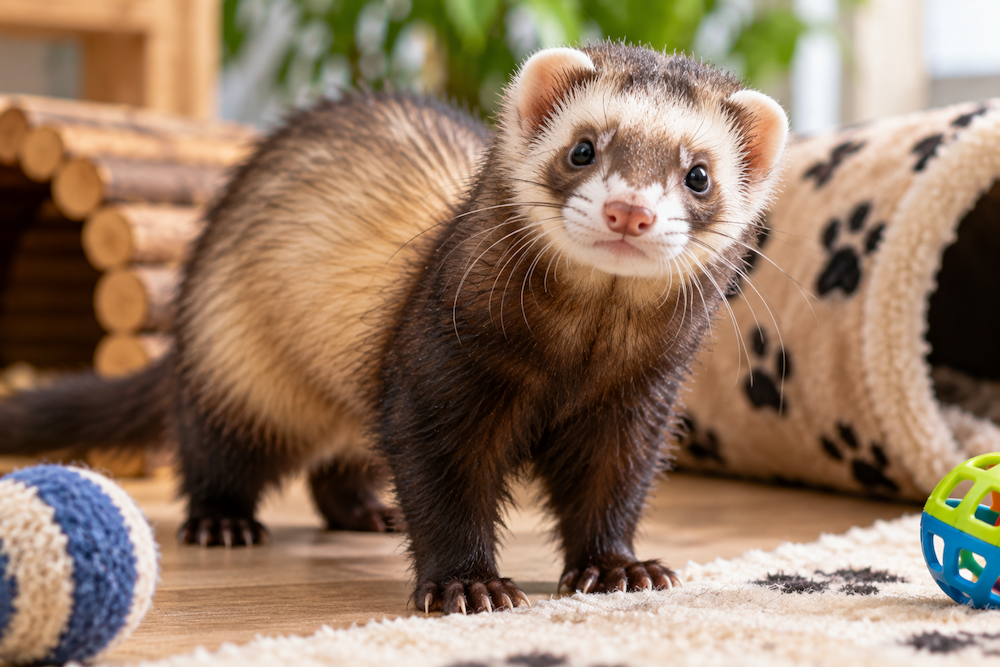







Playful, intelligent and endlessly curious, ferrets are small pets with enormous personalities — but their specialised diet, social needs and talent for getting into absolutely everything make them a bigger commitment than many people expect.
🧠 QUICK SNAPSHOT
| Trait | Ferret |
|---|---|
| Scientific Name | Mustela putorius furo |
| Pet Type | Small mammal / Mustelid |
| Domestication | More than 2,000 years |
| Typical Lifespan | Around 5–10 years |
| Adult Size | Roughly 35–60 cm including the tail |
| Typical Weight | Around 0.5–2 kg; males generally larger |
| Diet | Obligate carnivore |
| Activity | Highly active when awake; sleeps much of the day |
| Temperament | Curious, playful, mischievous and often affectionate |
| Housing | Secure enclosure plus substantial supervised exercise |
| Social Needs | Often enjoys compatible ferret companionship |
| Trainability | Intelligent and trainable |
| Beginner Friendly? | Moderate — needs specialised care |
| Special Requirement | Serious ferret-proofing! |
📚 OVERVIEW
If there were an Olympic event for getting somewhere an animal isn’t supposed to be, the ferret would be a strong contender for gold.
Domestic ferrets are members of the mustelid family, making them relatives of animals such as weasels, otters, badgers and mink.
Humans have kept ferrets for more than two thousand years, traditionally using their long, flexible bodies and hunting instincts to pursue rabbits and other quarry from underground burrows — a practice known as ferreting.
Today, ferrets are kept primarily as companion animals.
They’re extraordinarily curious.
A ferret will investigate bags, cupboards, boxes, blankets, tunnels, furniture and tiny openings that its owner was absolutely certain were too small for a ferret.
They’re also highly playful. Healthy ferrets frequently chase one another, wrestle, tunnel through blankets and perform the famous “weasel war dance” — an exuberant sequence of sideways hops, bouncing and twisting that can make the animal appear temporarily out of control.
Ferrets also sleep a lot, commonly spending 14–18 hours a day asleep. When they wake up, however, they can compress an impressive amount of chaos into the remaining hours.
Their care is more specialised than that of many small mammals. Ferrets are obligate carnivores with digestive systems designed for animal-based nutrition. They also require secure housing, daily exercise, enrichment, preventive veterinary care and extremely thorough ferret-proofing.
They’re certainly not the right pet for everyone.
But for owners who appreciate intelligence, curiosity and a considerable amount of mischief, few small animals are quite like a ferret.
✅ PROS & CONS
Pros
- Extremely playful and entertaining
- Intelligent and curious
- Often forms strong relationships with owners
- Can learn routines and simple behaviours
- Many enjoy playing with other compatible ferrets
- Generally quiet compared with many traditional pets
- Sleeps for substantial portions of the day
- Doesn’t require outdoor walks like a dog
- Fascinating natural behaviours
- Can be litter trained to some extent
- Huge personality in a relatively small animal
Cons
- Requires a specialised carnivorous diet
- Needs substantial daily exercise and enrichment
- Exceptional escape artist
- Home must be carefully ferret-proofed
- Can have a noticeable musky odour
- Veterinary care may require a ferret or exotic-pet veterinarian
- Can develop significant health problems
- May nip, particularly when young or poorly socialised
- Can damage or steal household objects
- Shouldn’t be trusted around small prey animals
- Ownership is restricted or regulated in some locations
- Not an ideal pet for very young children
Are Ferrets Good Pets?
Yes. Ferrets can make fun, affectionate and highly interactive pets for owners prepared for their specialised needs.
They’re particularly appealing to people who want a small companion animal that actively plays, explores and interacts with its environment.
However, they’re considerably more demanding than their small size suggests.
Are Ferrets Good Pets for Beginners?
They can be, but they’re not among the easiest beginner pets.
New owners need to understand their specialised diet, exercise requirements, veterinary needs and extraordinary ability to escape.
Doing substantial research before bringing one home is important.
Are Ferrets Good With Children?
Ferrets can live successfully with responsible older children under adult supervision.
Young ferrets may nip during play, while rough handling can injure the ferret or provoke defensive biting.
Very young children and ferrets aren’t generally an ideal combination without extremely close supervision.
How Long Do Ferrets Live?
Domestic ferrets commonly live around 5–10 years, although lifespan varies considerably.
Genetics, diet, veterinary care and breeding background can all influence longevity.
Owners should be prepared for several years of specialised care.
How Big Do Ferrets Get?
Adult ferrets are commonly around 35–60 cm long including the tail.
Males are usually noticeably larger and heavier than females.
Their elongated bodies make them look larger when stretched out than their relatively modest weight suggests.
How Much Do Ferrets Sleep?
Ferrets commonly sleep around 14–18 hours a day.
They can sleep remarkably deeply, sometimes remaining completely limp when picked up.
When awake, however, healthy ferrets can be intensely active.
Are Ferrets Nocturnal?
Not strictly.
Ferrets are often particularly active around dawn and dusk, although domestic ferrets can adjust their activity patterns considerably around their household.
Many learn when their owners normally wake, return home or begin playtime.
Do Ferrets Need a Cage?
Ferrets need a safe, secure home base, but they shouldn’t spend their entire lives confined to a small cage.
They require substantial opportunities every day to exercise, explore and play in a ferret-proofed environment.
Housing should include comfortable sleeping areas, litter facilities, water and enrichment.
How Much Exercise Does a Ferret Need?
Ferrets need several hours of safe activity and exploration each day.
Running, wrestling, tunnelling, climbing and investigating new objects provide both physical exercise and mental stimulation.
Simply leaving toys inside a cage isn’t an adequate substitute.
Can Ferrets Roam Freely in the House?
They can have supervised access to carefully ferret-proofed areas.
Allowing unrestricted access to an unprepared home can be dangerous.
Ferrets can squeeze through surprisingly small gaps, crawl inside furniture, chew unsuitable objects and disappear into spaces their owners didn’t realise existed.
How Do You Ferret-Proof a House?
Ferret-proofing means approaching your home as though you’re preparing for an extremely intelligent, flexible and determined toddler.
Owners need to secure small openings, reclining furniture, appliances, cupboards, electrical hazards, rubber objects, toxic substances and anything that could be swallowed.
Ferrets should also be prevented from accessing dangerous escape routes.
What Do Ferrets Eat?
Ferrets are obligate carnivores.
Their digestive systems are adapted to diets high in animal protein and fat and relatively low in carbohydrates and fibre.
An appropriately formulated complete ferret diet is generally preferable to improvising a diet from unsuitable human foods.
Can Ferrets Eat Dog Food?
Dog food generally isn’t appropriate as the primary diet for a ferret.
Ferrets have nutritional requirements that differ substantially from those of dogs.
Their food should be specifically suitable for an obligate carnivore with a short digestive tract.
Can Ferrets Eat Fruit and Vegetables?
Fruit and vegetables aren’t necessary components of a ferret’s natural carnivorous diet.
Their digestive systems aren’t designed to process large amounts of plant material or fibre.
Treats and dietary additions should therefore be chosen specifically with ferret nutrition in mind.
Do Ferrets Smell?
Yes. Ferrets naturally have a distinctive musky scent produced partly by oils in their skin.
Regularly cleaning bedding and litter areas can help manage odour.
Frequent bathing isn’t a good solution and can potentially encourage the skin to produce more oil.
Do Ferrets Need Baths?
Ferrets generally don’t require frequent bathing.
They’re capable of grooming themselves, and excessive bathing can dry the skin and interfere with its natural oils.
Keeping their bedding and environment clean is usually much more important for odour control.
Are Ferrets Affectionate?
Many are.
Some ferrets actively seek interaction with their owners, climb onto them, follow them around or fall asleep against them.
Others are far too busy investigating the room to spend much time cuddling.
Individual personalities vary considerably.
Do Ferrets Recognise Their Owners?
Ferrets can learn to recognise familiar people through scent, voice, appearance and routine.
Many respond differently to their regular caregivers than to unfamiliar people.
They can also learn that particular sounds or activities predict feeding or playtime.
Can Ferrets Learn Their Names?
Many ferrets can learn to associate their name with attention, food or play.
Positive reinforcement can encourage them to approach when called.
Whether they decide that responding is currently worth their time is another matter.
Can Ferrets Be Trained?
Yes. Ferrets are intelligent and capable of learning through positive reinforcement.
They can learn behaviours such as coming when called, using designated toilet areas and performing simple tricks.
Short training sessions generally work better than expecting prolonged concentration.
Can Ferrets Be Litter Trained?
Yes, to an extent.
Ferrets naturally tend to toilet in corners, which can make litter training easier.
Strategically positioned litter trays and consistent reinforcement can improve reliability, although owners shouldn’t necessarily expect the precision of a well-trained adult cat.
Do Ferrets Bite?
Ferrets can bite, particularly when they’re young, frightened, overstimulated or haven’t learned appropriate play behaviour.
Young ferrets often explore and play with their mouths.
Patient handling and reward-based training can help teach appropriate interaction.
Why Do Ferrets Steal Things?
Ferrets are famous for collecting and hiding objects.
Their curiosity and natural tendency to investigate and move items can result in secret stashes of toys, socks and other household treasures.
Checking a ferret’s favourite hiding places is often a useful first step when something mysteriously disappears.
What Is the Ferret Weasel War Dance?
The weasel war dance is an exuberant display in which a ferret hops sideways, arches its body, twists and bounces around.
Despite its dramatic name, it commonly indicates excitement and playful energy rather than aggression.
A dancing ferret may look completely uncoordinated — which is part of the entertainment.
What Does It Mean When a Ferret Dooks?
Dooking is a distinctive chuckling or clucking vocalisation often made by excited or playful ferrets.
It may occur during chasing, wrestling or the weasel war dance.
For many ferret owners, dooking is one of the characteristic sounds of a happy play session.
Can Ferrets Live Alone?
Some individual ferrets can live successfully without another ferret when they receive substantial interaction and enrichment from their owners.
However, many enjoy living and playing with compatible ferrets.
Compatibility matters, and introductions should be managed carefully.
Is It Better to Have One or Two Ferrets?
For many owners, two compatible ferrets can provide each other with valuable play and social interaction.
They can wrestle, chase and sleep together when their human family isn’t available.
However, two ferrets also mean greater food, veterinary, housing and cleaning costs.
Can Ferrets Live With Cats?
Some ferrets and cats can coexist successfully when carefully introduced and supervised.
Their personalities, size and previous experiences matter considerably.
Interactions should never simply be assumed to be safe because individual animals appear friendly initially.
Can Ferrets Live With Dogs?
Some ferrets can coexist with carefully selected dogs, but supervision is essential.
A large dog can seriously injure a ferret even during play, while dogs with strong prey drive may be particularly dangerous.
Compatibility must be assessed individually.
Can Ferrets Live With Rabbits, Hamsters or Rats?
They shouldn’t have direct access to small prey animals.
Ferrets are carnivorous predators with strong hunting instincts.
Rabbits, rodents, birds and similar animals can therefore be at serious risk, regardless of how friendly the ferret appears towards people.
What Health Problems Are Common in Ferrets?
Ferrets can develop several significant health conditions, including adrenal disease, insulinoma, dental disease and various cancers, along with other illnesses.
Regular veterinary examinations and rapid investigation of unusual behaviour, appetite or weight changes are important.
A veterinarian experienced with ferrets is highly desirable.
What Is Adrenal Disease in Ferrets?
Adrenal disease is an important health condition in domestic ferrets involving abnormal adrenal gland activity.
Possible signs can include progressive hair loss, skin changes, behavioural changes and enlargement of the vulva in females, among others.
Veterinary diagnosis and treatment are required.
What Is Insulinoma in Ferrets?
Insulinoma involves insulin-producing tumours of the pancreas that can cause dangerously low blood glucose.
Signs may include weakness, lethargy, excessive salivation, staring episodes, difficulty using the hind legs or seizures.
Suspected insulinoma requires veterinary attention.
What Is the Difference Between a Male and Female Ferret?
Male ferrets are called hobs, while females are called jills.
Young ferrets are known as kits.
Adult males are generally larger and more heavily built than females.
What Is a Group of Ferrets Called?
A group of ferrets is commonly called a business of ferrets.
It’s one of the more memorable collective nouns in the animal world — and anyone who has watched several ferrets simultaneously investigating a room may consider “business” an unusually appropriate description.
Where Do Ferrets Come From?
Domestic ferrets have been associated with humans for more than 2,000 years, although their precise domestication history remains debated.
They’re closely related to European polecats and were historically used to hunt rabbits and control vermin.
Their long, flexible bodies made them particularly effective at pursuing quarry underground.
What Were Ferrets Originally Bred For?
Ferrets were traditionally used for hunting animals from underground burrows, especially rabbits.
The practice became known as ferreting.
A ferret would enter the burrow system and encourage the quarry to emerge, where hunters could capture it.
Are Ferrets Legal to Own?
Ferret ownership laws vary significantly between countries and even between states, territories or local jurisdictions.
Some locations permit them freely, while others require permits or prohibit them entirely.
Prospective owners should therefore check their current local regulations before obtaining a ferret.
Are Ferrets Legal in Australia?
Ferret laws vary across Australia.
They’re kept as pets in several states and territories, but restrictions can apply and ferret ownership isn’t permitted everywhere.
Because regulations can change, prospective owners should check directly with their current state or territory authority before acquiring one.
Is a Ferret a Rodent?
No. Ferrets are not rodents.
They belong to the family Mustelidae, alongside animals such as weasels, otters, badgers and mink.
This distinction is particularly important when understanding their diet: unlike rats, mice and many other small pets, ferrets are obligate carnivores.
Is a Ferret a Good First Pet?
A ferret can be a rewarding first pet for someone willing to research its needs thoroughly, but it’s not necessarily an easy one.
Owners need to provide a specialised diet, veterinary care, substantial daily exercise, enrichment and extensive ferret-proofing.
Someone wanting a pet that spends most of its time quietly inside a cage should probably look elsewhere.
What Makes the Ferret Unique?
Ferrets have an unusual combination of characteristics.
They’re carnivorous hunters shaped like furry tubes, capable of sleeping most of the day and then waking with enough energy to reorganise an entire room.
They’ll tunnel through blankets.
They’ll wrestle with their friends.
They’ll perform the weasel war dance.
They may make happy little dooking noises while doing it.
And if you leave your socks, keys or favourite small object somewhere accessible, there’s a reasonable chance they’ll decide it belongs in their private collection.
Humans originally valued ferrets because their extraordinary bodies allowed them to pursue quarry underground.
Thousands of years later, that same curiosity and determination remain very much intact.
The rabbit hunting may have disappeared from the average household.
The ferret’s desire to investigate absolutely everything has not.
Discover why ferrets dook, dance, steal objects, squeeze into impossible spaces and have entertained humans for thousands of years.
Watch our Ferret video and discover what living with one of these extraordinary little predators is