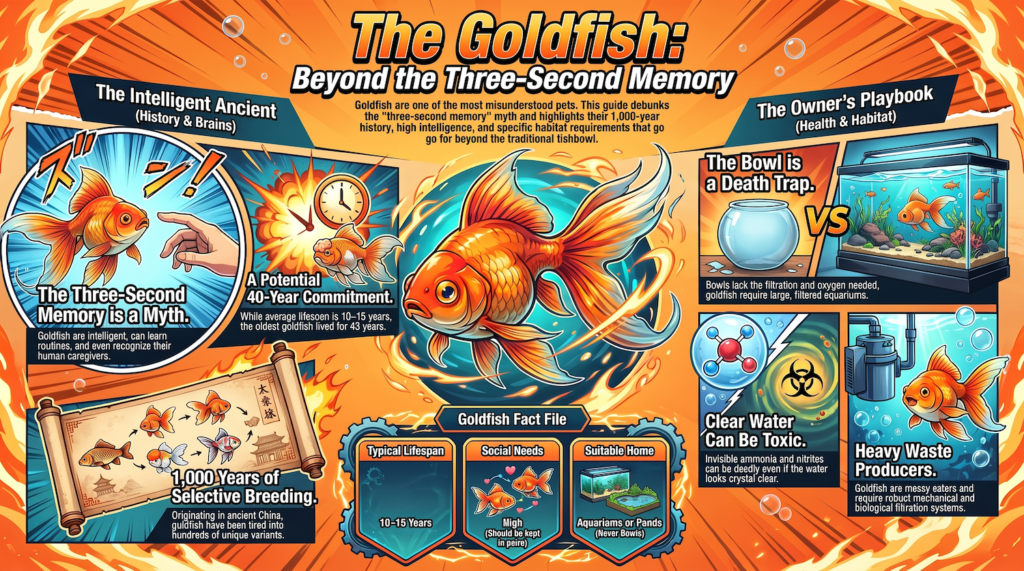
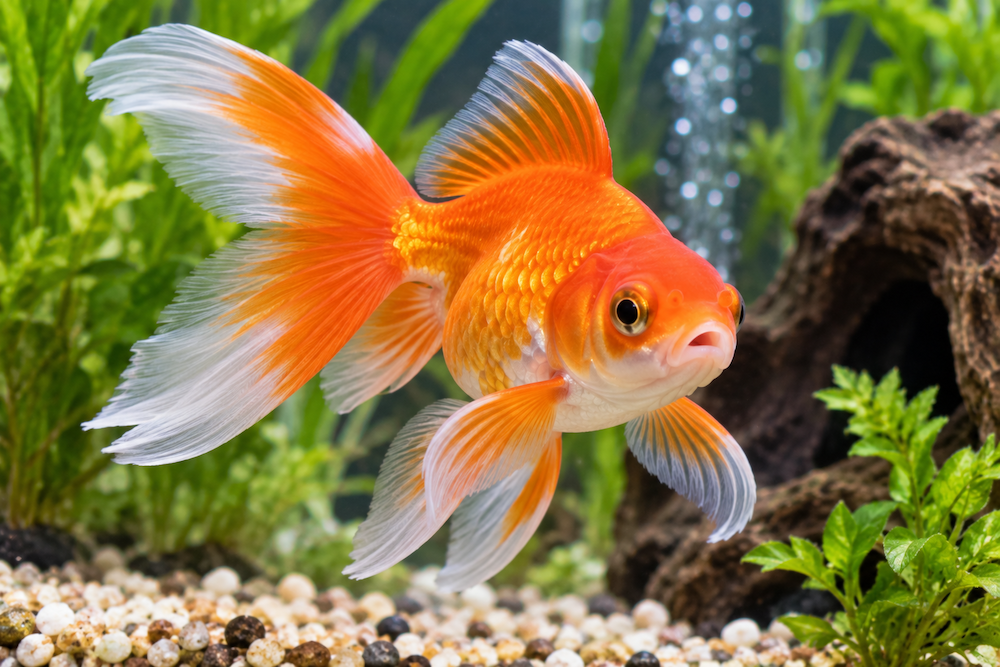







Beautiful, intelligent and far longer-lived than many people realise, goldfish are fascinating pets — but they need much more space than a traditional fishbowl.
🧠 QUICK SNAPSHOT
Temperament: Peaceful, social, curious
Activity Level: Moderate
Adult Size: Around 15–30+ cm depending on variety and conditions
Good With Families: Yes
Tank Size: Large aquarium or suitable pond, depending on variety
Difficulty: Moderate
Social Needs: Can live alone, but often interact well with compatible goldfish
Diet: Omnivorous
Water: Freshwater
Lifespan: Commonly 10–15+ years with good care; potentially 20+ years
Best For: Families and fishkeepers prepared to provide a properly filtered, spacious aquarium or pond
📚 OVERVIEW
Goldfish (Carassius auratus) are among the world’s most recognisable pets, but they’re also among the most misunderstood.
The image of a small orange fish swimming around a glass bowl has created the impression that goldfish are tiny, short-lived and extremely easy to keep.
In reality, a properly cared-for goldfish can become surprisingly large, live for many years and display complex social and learned behaviours.
Goldfish belong to the carp family and were domesticated in China more than a thousand years ago. Selective breeding eventually produced an extraordinary variety of forms, including the familiar streamlined Common and Comet Goldfish and elaborate fancy varieties such as Orandas, Ranchus, Ryukins, Fantails and Telescope Eyes.
Their care requirements also differ.
Streamlined single-tailed goldfish are powerful swimmers that can grow very large and are often better suited to ponds or extremely spacious aquariums. Fancy goldfish are usually slower swimmers and can be kept in large indoor aquariums, although their unusual body shapes can make some varieties more susceptible to health problems.
One rule applies to all of them:
A goldfish bowl is not an appropriate long-term home.
Goldfish produce substantial waste and require adequate water volume, filtration, oxygenation and regular water changes. Given those things, they can become engaging pets that recognise feeding routines, interact with their owners and live dramatically longer than the unfortunate carnival goldfish stereotype suggests.
✅ PROS & CONS
Pros
- Beautiful and available in many varieties
- Can live for many years with proper care
- Generally peaceful
- Fascinating behaviour
- Can learn feeding routines and recognise familiar cues
- Don’t require walking or grooming
- Suitable for people unable to keep furry pets
- Some varieties can live successfully in outdoor ponds
- Available in an enormous range of shapes, colours and fin types
- Can become surprisingly interactive with their keepers
Cons
- Need considerably more space than many new owners expect
- Produce a large amount of waste
- Require effective filtration
- Regular water testing and water changes are essential
- Bowls are unsuitable for long-term housing
- Common and Comet Goldfish can become very large
- Some fancy varieties are prone to health and buoyancy problems
- Poor water quality can quickly cause illness
- Setting up a proper aquarium can cost considerably more than the fish itself
- Potential lifespan creates a long-term commitment
Are Goldfish Good Pets?
Yes. Goldfish can make excellent pets for people prepared to provide a large, properly filtered aquarium or suitable pond.
They’re peaceful, attractive and more behaviourally interesting than many people expect.
The biggest mistake is treating them as disposable, low-maintenance pets simply because they’re inexpensive to buy.
How Long Do Goldfish Live?
Goldfish can commonly live for 10–15 years or longer when provided with appropriate care.
Some individuals survive for more than 20 years, and exceptional cases have lived considerably longer.
A goldfish dying after a few months isn’t experiencing a normal goldfish lifespan.
How Big Do Goldfish Get?
Goldfish can grow much larger than the tiny juveniles commonly sold in pet shops.
Fancy varieties may reach approximately 15–20 cm, while Common and Comet Goldfish can exceed 25–30 cm under good conditions.
Genetics, variety, diet, water quality and available space all influence growth.
Can Goldfish Live in a Bowl?
A traditional unfiltered goldfish bowl is not suitable as permanent housing.
Goldfish produce substantial waste, consume oxygen and need stable water conditions.
Small bowls make it extremely difficult to maintain adequate water quality, temperature stability and oxygenation.
A properly sized filtered aquarium provides a dramatically healthier environment.
What Size Tank Does a Goldfish Need?
Goldfish need much larger aquariums than their pet-shop size suggests.
There isn’t one perfect number because requirements depend on the variety, number of fish, filtration and aquarium dimensions.
Fancy goldfish require substantial swimming space and water volume, while Common and Comet Goldfish become so large and active that they’re frequently better suited to very large aquariums or ponds.
When planning a tank, size it for the adult fish rather than the juvenile you’re bringing home.
Do Goldfish Need a Filter?
Yes. Effective filtration is extremely important.
Goldfish produce significant quantities of waste, and biological filtration helps convert toxic ammonia and nitrite into less harmful nitrate.
A filter doesn’t eliminate the need for regular water changes, but maintaining healthy goldfish without adequate filtration is considerably more difficult.
Does a Goldfish Tank Need to Be Cycled?
Yes.
Before adding goldfish, an aquarium should ideally establish the beneficial bacteria responsible for the nitrogen cycle.
These bacteria process toxic ammonia produced by fish waste into nitrite and eventually nitrate.
Putting goldfish directly into an uncycled aquarium can expose them to dangerous ammonia and nitrite levels.
How Often Should You Change Goldfish Water?
Regular partial water changes are essential.
The appropriate frequency depends on tank size, stocking level, filtration and measured water chemistry, but many goldfish aquariums require weekly partial water changes.
Testing ammonia, nitrite and nitrate is more reliable than judging water quality simply by whether the aquarium looks clean.
What Water Temperature Do Goldfish Need?
Goldfish are generally considered cool-water fish.
Many varieties are comfortable at temperatures around the high teens to low 20s Celsius, although appropriate conditions vary with variety and circumstances.
More important than chasing one exact number is avoiding sudden temperature changes and extremes.
Do Goldfish Need a Heater?
Not necessarily.
In a temperature-stable indoor environment, many goldfish aquariums don’t require a heater.
However, a heater can sometimes be useful where room temperatures fluctuate significantly or where a particular fancy variety benefits from greater temperature stability.
Do Goldfish Need an Air Pump?
Not always, but good oxygenation is important.
A properly configured filter can create enough surface movement to promote gas exchange.
Air stones and pumps can provide additional aeration, particularly in warm conditions or heavily stocked aquariums.
What Do Goldfish Eat?
Goldfish are omnivores.
A high-quality goldfish pellet or other nutritionally complete goldfish food should form the basis of their diet.
Suitable vegetables and occasional supplementary foods can provide variety and enrichment.
Overfeeding is one of the most common mistakes in goldfish care.
How Often Should You Feed Goldfish?
Adult goldfish can generally be fed small portions once or twice daily, depending on the food, fish and conditions.
Only provide an amount they can consume without leaving significant uneaten food.
Excess food doesn’t just contribute to obesity — it decomposes and reduces water quality.
Can Goldfish Recognise Their Owners?
Goldfish can learn to associate particular people, movements and routines with feeding and other events.
Many will swim toward the front of the aquarium when a familiar person approaches.
Whether they conceptualise a human as an “owner” is another question, but their learning and recognition abilities are much more sophisticated than the old goldfish stereotypes suggest.
Do Goldfish Really Have a Three-Second Memory?
No.
The famous claim that goldfish can remember something for only three seconds is a myth.
Goldfish are capable of learning associations, remembering routines and being trained to perform simple tasks.
Their memory can persist far longer than a few seconds.
Can You Train a Goldfish?
Yes.
Goldfish can learn to follow targets, swim through hoops, respond to feeding cues and perform other simple behaviours using reward-based training.
This ability provides compelling evidence against the idea that they’re mindless pets with almost no memory.
Do Goldfish Get Lonely?
Goldfish are social fish and can interact with other goldfish, but they don’t necessarily need a companion in the same way that strongly social mammals or flocking birds do.
A goldfish can be kept alone successfully when its environmental and behavioural needs are met.
Compatible companions can nevertheless provide additional social stimulation.
How Many Goldfish Should Be Kept Together?
The number should be determined by adult fish size, aquarium dimensions and filtration capacity, not by how many small juveniles physically fit into the tank.
Two fancy goldfish may work well in an appropriately sized aquarium.
Several adult Common Goldfish, however, require an enormous amount of space and may be much better suited to a pond.
Can Goldfish Live With Other Fish?
Sometimes, but tank mates need to be chosen carefully.
Compatible fish must tolerate similar water conditions and shouldn’t be small enough to be swallowed or aggressive enough to injure the goldfish.
Fancy goldfish can also be poor competitors against fast-moving fish at feeding time.
Keeping compatible goldfish together is often the simplest option.
Can Fancy Goldfish Live With Common Goldfish?
It’s usually better to keep fancy goldfish with other fancy goldfish.
Common and Comet Goldfish are faster, stronger swimmers and may outcompete slower fancy varieties for food.
Their eventual size and housing requirements can also be substantially different.
What Is the Difference Between a Common Goldfish and a Comet Goldfish?
Both have streamlined bodies and single tails, but Comet Goldfish generally have longer, more deeply forked tails and more elongated fins.
Both are active, powerful swimmers that can grow much larger than many new owners expect.
They’re often excellent pond fish.
What Is a Fancy Goldfish?
“Fancy goldfish” describes selectively bred varieties with features such as double tails, rounded bodies, head growths, unusual eyes or modified fins.
Examples include Fantails, Orandas, Ranchus, Ryukins and Telescope Goldfish.
Some extreme physical features can also increase health and welfare challenges.
What Are the Most Popular Goldfish Varieties?
Popular varieties include:
- Common Goldfish
- Comet
- Shubunkin
- Fantail
- Oranda
- Ryukin
- Ranchu
- Black Moor
- Telescope
- Pearlscale
They differ significantly in body shape, swimming ability, adult size and care requirements.
Why Is My Goldfish Turning White?
Goldfish can change colour as they mature.
Genetics, age, lighting, diet and environmental conditions can all influence pigmentation.
A healthy colour change isn’t necessarily a problem, but sudden changes accompanied by abnormal behaviour, damaged skin or other symptoms should be investigated.
Why Is My Goldfish Sitting at the Bottom of the Tank?
Occasional resting can be normal, but persistent bottom-sitting can indicate a problem.
Possible causes include poor water quality, temperature problems, stress, infection or other illness.
Testing ammonia, nitrite, nitrate and other relevant water parameters should be one of the first steps when a goldfish suddenly behaves abnormally.
Why Is My Goldfish Gasping at the Surface?
Surface gasping can indicate low dissolved oxygen, poor water quality, gill damage or illness.
Check water parameters immediately and ensure adequate surface movement and aeration.
Persistent gasping shouldn’t simply be dismissed as normal goldfish behaviour.
Why Is My Goldfish Swimming Upside Down?
Abnormal buoyancy can have several causes and isn’t itself a single disease.
Digestive problems, internal disease, poor water quality and physical characteristics associated with some fancy goldfish can all contribute.
Persistent abnormal swimming requires investigation rather than repeatedly assuming the fish simply has “swim bladder disease.”
Do Goldfish Sleep?
Yes.
Goldfish rest rather than sleeping exactly as humans do. They may become relatively motionless, reduce their activity and hover close to the bottom or in a preferred part of the aquarium.
They don’t have eyelids, so they sleep with their eyes open.
Can Goldfish See in the Dark?
Goldfish need a normal light-dark cycle and shouldn’t be kept under aquarium lighting continuously.
They can function under relatively low light, but they don’t have magical night vision.
Providing darkness at night supports a normal daily rhythm.
Do Goldfish Have Teeth?
Yes — just not where you might expect.
Goldfish have pharyngeal teeth located toward the back of the throat, rather than obvious teeth lining their jaws.
These structures help crush and process food.
Can Goldfish Live in a Pond?
Yes. Many goldfish thrive in suitable outdoor ponds.
Common, Comet and Shubunkin Goldfish are particularly well suited because they’re strong swimmers and generally more robust than extremely modified fancy varieties.
A pond still requires appropriate water quality, depth, oxygenation and protection from predators.
Can Goldfish Survive Winter in a Pond?
In suitable climates and properly designed ponds, some goldfish can remain outdoors throughout winter.
As water cools, their metabolism slows considerably.
The pond must remain safe, sufficiently deep and adequately oxygenated, and local climate conditions need to be considered before attempting year-round outdoor keeping.
Why Should You Never Release Goldfish Into the Wild?
Pet goldfish should never be released into rivers, lakes or other natural waterways.
Released goldfish can survive, grow surprisingly large and contribute to ecological damage by disturbing sediments, consuming aquatic organisms and competing with native species.
An unwanted goldfish should be responsibly rehomed rather than released.
Where Do Goldfish Come From?
Goldfish were domesticated in China from wild crucian-carp relatives more than a thousand years ago.
People noticed naturally occurring fish with unusual yellow, orange and reddish colouring and selectively bred them.
Over centuries, this process transformed relatively ordinary-looking wild fish into the extraordinary range of goldfish seen today.
Are Goldfish Related to Carp?
Yes.
Goldfish belong to the family Cyprinidae, the large group commonly known as the carp and minnow family.
They’re closely related to crucian carp but are a distinct domesticated lineage with a very long history of selective breeding.
Were Goldfish Originally Gold?
No.
The wild ancestors of domestic goldfish were generally much less colourful, with greyish, brownish or olive colouring providing useful camouflage.
Unusual yellow, orange and reddish individuals appeared through genetic variation.
Humans selectively bred these colourful fish, eventually producing the familiar goldfish.
Why Do Goldfish Grow So Big in Ponds?
Goldfish don’t simply grow to the size of their container.
Their adult size is influenced by genetics, nutrition, water quality, health and environmental conditions.
Spacious ponds often provide excellent water volume, exercise and suitable conditions, allowing fish to reach sizes that surprise people accustomed to seeing stunted or juvenile goldfish in small aquariums.
🔘 Thinking About Getting a Goldfish?
A goldfish can cost only a few dollars to buy — but providing one with the life it deserves requires space, filtration, good water quality and a commitment that could last well over a decade.
Give a goldfish those things and it becomes something very different from the disposable “beginner fish” stereotype.
👉 Explore Goldfish Care & Pet Guides on EatWagLove