






Elegant, sensitive, and incredibly affectionate — a graceful companion that loves warmth and closeness.
🧠 QUICK SNAPSHOT
- Temperament: Affectionate, gentle, sensitive
- Energy Level: Moderate (with bursts of speed)
- Size: Small
- Good With Families: Yes
- Trainability: Moderate
- Grooming: Low
- Best For: Companionship, indoor living
📚 OVERVIEW
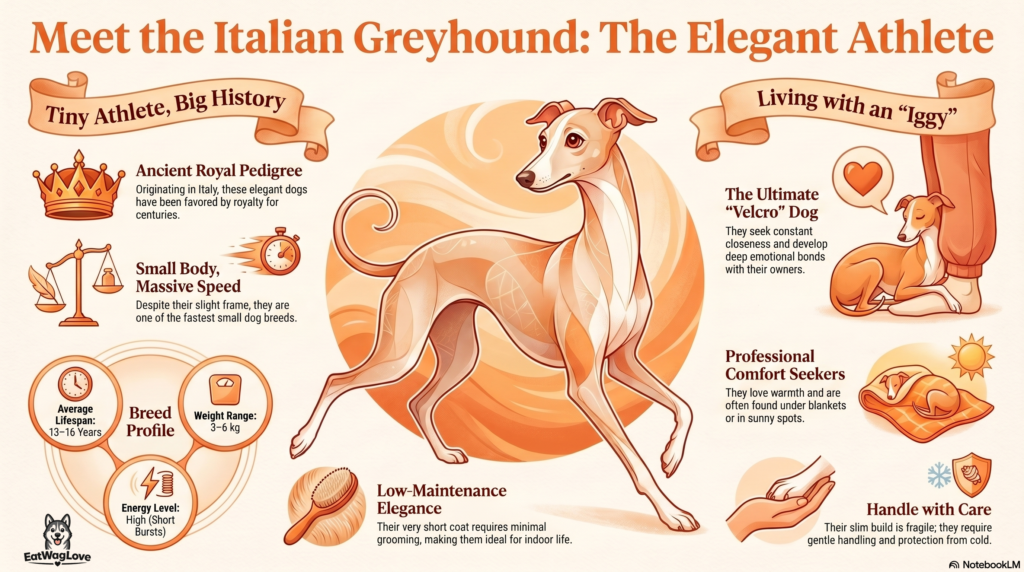
The Italian Greyhound is a small sighthound known for its slim, elegant build and loving nature. Despite their delicate appearance, they are surprisingly fast and enjoy short bursts of running.
They are deeply affectionate dogs that thrive on companionship and love being close to their owners.
✅ PROS & CONS
Pros
- Very affectionate and loyal
- Low grooming needs
- Great for indoor living
- Quiet and gentle nature
Cons
- Sensitive to cold weather
- Can be fragile
- May be shy or timid
- Needs companionship
Is an Italian Greyhound a Good Family Dog?
Yes, for the right family. Italian Greyhounds are typically affectionate, sensitive, playful and deeply attached to their people.
Their delicate build means they aren’t always ideal for homes with very young or boisterous children.
They generally thrive in households that treat them as genuine members of the family.
How Much Exercise Does an Italian Greyhound Need?
Most adults need around 30–60 minutes of daily exercise, plus opportunities for play.
They enjoy walking and explosive bursts of sprinting but don’t require the endurance exercise of many working breeds.
Once they’ve exercised, many are extremely enthusiastic about returning to the sofa.
Is an Italian Greyhound Easy to Train?
Italian Greyhounds are intelligent but can be sensitive, independent and easily distracted.
Positive reinforcement is essential.
Harsh correction can quickly damage confidence, while short, enjoyable training sessions tend to produce much better results.
Are Italian Greyhounds Difficult to Toilet Train?
They have a reputation for being challenging to house-train.
Their small bladder, dislike of cold or wet weather and sensitive temperament can all contribute.
A consistent routine, frequent opportunities to toilet and generous rewards are important, particularly during puppyhood.
Why Won’t My Italian Greyhound Go Outside in the Rain?
Because many Italian Greyhounds genuinely dislike cold, wet or windy weather.
Their extremely thin coat and low body fat provide little insulation.
An Italian Greyhound faced with heavy rain can suddenly develop remarkable confidence in the idea that toileting indoors is a perfectly reasonable alternative.
Are Italian Greyhounds Intelligent?
Yes.
They’re observant, quick learners and surprisingly good problem-solvers.
Their intelligence is less focused on constant obedience than breeds developed to follow complex human commands.
They can also become very good at training their owners.
Are Italian Greyhounds Stubborn?
They can appear stubborn, particularly when uncomfortable or uninterested.
They’re sensitive sighthounds rather than naturally hard-driving obedience dogs.
Motivation, patience and positive reinforcement are much more effective than confrontation.
Does an Italian Greyhound Shed?
Yes, but usually very little.
Their coat is extremely short, fine and low-maintenance, so loose hair is far less noticeable than with many breeds.
Occasional brushing or wiping is generally sufficient.
Is an Italian Greyhound Hypoallergenic?
No.
Although Italian Greyhounds shed relatively little, they still produce canine allergens through their skin and saliva.
Low shedding doesn’t automatically mean hypoallergenic.
How Often Should You Groom an Italian Greyhound?
Their coat requires very little grooming.
A gentle brush or grooming mitt once a week is usually enough.
Dental care, nail trimming and skin checks often require considerably more attention than the coat itself.
Do Italian Greyhounds Need Regular Baths?
Usually only when necessary.
Their short coat doesn’t trap large amounts of dirt, and excessive bathing can dry the skin.
A damp cloth can often deal with minor dirt between baths.
What Health Problems Are Common in Italian Greyhounds?
Important concerns include leg fractures, dental disease, patellar luxation, eye disorders and certain inherited neurological or autoimmune conditions.
Their fine skeletal structure makes injury prevention particularly important during puppyhood.
Responsible breeders should use appropriate health testing.
Why Do Italian Greyhounds Break Their Legs?
Italian Greyhounds have very slender limb bones, and puppies can be particularly vulnerable to fractures.
Jumping from furniture, being dropped, collisions during rough play or awkward landings can cause serious injury.
This doesn’t mean they should never run, but their environment should be managed sensibly.
Are Italian Greyhound Puppies More Likely to Break Their Legs?
Yes. The risk is particularly concerning during the rapid-growth puppy period.
Young Italian Greyhounds can be extraordinarily energetic without having much appreciation for their own physical limitations.
High furniture and slippery surfaces deserve special attention.
Can an Italian Greyhound Jump Off the Sofa?
Many can — but repeated jumping from high furniture isn’t ideal, particularly for puppies.
Providing steps or ramps can reduce impact.
Owners should also prevent puppies from launching themselves from arms, beds or other elevated surfaces.
Are Italian Greyhounds Prone to Dental Problems?
Yes. Dental disease is one of the breed’s major health concerns.
Their small jaws can contribute to crowded teeth and accumulation of plaque and tartar.
Daily tooth brushing and regular veterinary dental assessment are highly beneficial.
Do Italian Greyhounds Lose Their Teeth?
They can develop significant periodontal disease if dental care is inadequate, potentially resulting in tooth loss.
This isn’t something that should simply be accepted as inevitable.
Preventive dental care should begin when the dog is young.
Are Italian Greyhounds Prone to Patellar Luxation?
They can be.
Patellar luxation occurs when the kneecap moves out of its normal position.
Signs can include intermittent skipping, sudden lifting of a hind leg or persistent lameness.
How Long Does an Italian Greyhound Live?
Italian Greyhounds commonly live around 13–15 years, with some reaching their late teens.
Their small size contributes to considerably greater average longevity than giant sighthounds such as the Irish Wolfhound.
Good dental care can be particularly important to long-term health.
How Big Does an Italian Greyhound Get?
Italian Greyhounds typically stand around 32–38 cm at the shoulder and usually weigh approximately 3.5–6 kg.
They’re dramatically smaller than standard Greyhounds.
Despite their delicate appearance, they’re genuine athletic sighthounds.
Is the Italian Greyhound the Smallest Sighthound?
Yes. The Italian Greyhound is generally regarded as the smallest recognised sighthound breed.
It retains the characteristic deep chest, tucked abdomen, long legs and curved outline of much larger sighthounds in miniature form.
Is an Italian Greyhound a Miniature Greyhound?
It certainly resembles one, but it’s not simply a modern miniature version of the Greyhound.
The Italian Greyhound has a long history as a distinct small sighthound and companion breed.
Its ancestry extends back many centuries.
Is There a Mini Italian Greyhound?
The Italian Greyhound is already a very small breed.
There’s no officially recognised Miniature, Toy or Teacup Italian Greyhound.
Marketing extremely undersized dogs as “Teacup Italian Greyhounds” should raise concerns about health and responsible breeding.
Can an Italian Greyhound Live in an Apartment?
Yes. Italian Greyhounds are generally excellent apartment dogs.
They’re small, relatively quiet and often calm indoors after exercise.
Secure opportunities to run and regular walks are still important.
Do Italian Greyhounds Need a Backyard?
No.
A secure garden is useful but isn’t essential.
Their small size and indoor-oriented temperament make them suitable for urban living provided their exercise and toileting needs are met.
Can an Italian Greyhound Be Left Alone?
Some can learn to tolerate reasonable periods alone, but many become strongly attached to their owners.
They’re generally happiest with substantial companionship.
Gradual independence training is important from puppyhood.
Are Italian Greyhounds Prone to Separation Anxiety?
Yes, some are.
Their intense attachment to people can make separation difficult.
Owners should deliberately teach puppies that short periods alone are normal rather than allowing them to remain constantly attached to someone from the first day.
Are Italian Greyhounds Velcro Dogs?
Very often.
Many Italian Greyhounds want to be physically close to their favourite person for much of the day.
Following owners from room to room is common.
Are Italian Greyhounds Cuddly?
Extremely.
Many actively seek warmth and body contact, making blankets, laps and beds particularly attractive.
An Italian Greyhound often seems less interested in sitting beside its owner than in becoming part of the owner’s clothing.
Why Does My Italian Greyhound Sleep Under Blankets?
Warmth is the major reason.
Italian Greyhounds have very little body fat and an extremely thin coat.
Burrowing under blankets provides warmth while also satisfying their desire for close physical contact.
Is It Safe for an Italian Greyhound to Sleep Under Blankets?
Generally, a healthy dog can move in and out of loose, breathable bedding.
Owners should avoid heavy bedding that could trap the dog or create overheating.
Puppies also need protection from falling or jumping from high beds.
Do Italian Greyhounds Sleep a Lot?
Many do.
Like other sighthounds, they can alternate between explosive bursts of activity and impressive amounts of relaxation.
A warm Italian Greyhound curled under a blanket can remain remarkably committed to doing absolutely nothing.
Are Italian Greyhounds Good With Children?
They can be excellent with calm, respectful older children.
Very young children may accidentally injure such a delicate dog through dropping, squeezing or rough play.
The breed is generally better suited to children old enough to understand gentle handling.
Are Italian Greyhounds Good With Other Dogs?
Usually.
Many particularly enjoy living with other Italian Greyhounds or similarly gentle dogs.
Care is required around large, boisterous dogs because rough play can result in injury.
Why Do People Often Own More Than One Italian Greyhound?
The breed is highly social and often enjoys canine companionship.
Two Italian Greyhounds may sleep together, play together and keep each other company.
Owners also frequently joke that they’re addictive — acquiring one somehow makes a second seem perfectly reasonable.
Are Italian Greyhounds Good With Cats?
Many live very successfully with cats, particularly when raised together.
However, they’re genuine sighthounds and may chase unfamiliar small animals outdoors.
Individual prey drive varies.
Do Italian Greyhounds Have a Strong Prey Drive?
They can.
Despite their tiny size, they’re true sighthounds, and rapidly moving animals can trigger pursuit.
Their hunting instincts shouldn’t be underestimated simply because they spend much of the day under a blanket.
Are Italian Greyhounds Good Off Leash?
Caution is required.
Once a sighthound begins chasing something, recall can become extremely difficult.
Securely fenced areas are generally the safest places for unrestricted running.
Can Italian Greyhounds Escape Through Small Gaps?
Yes.
Their narrow bodies can fit through surprisingly small openings.
Secure fencing should be checked carefully at ground level as well as around gates.
Their speed makes an escape particularly concerning.
Do Italian Greyhounds Bark a Lot?
Usually they’re moderate barkers.
Some become effective little watchdogs and alert enthusiastically to visitors or unusual noises.
Excessive barking can also develop through boredom, anxiety or lack of training.
Are Italian Greyhounds Good Watchdogs?
They can be surprisingly alert.
Their hearing and awareness of movement often mean they notice visitors quickly.
Their ability to physically deter an intruder is obviously rather more limited.
Are Italian Greyhounds Protective?
They’re often deeply devoted but aren’t protection dogs.
Some may bark or become concerned when something unusual happens.
Their traditional roles were companionship and small-game coursing rather than guarding.
Are Italian Greyhounds Shy?
Some can be reserved or sensitive, but excessive fearfulness isn’t desirable.
Early positive socialisation is important.
Poorly socialised dogs can become overwhelmed by unfamiliar people, dogs, environments or noises.
Are Italian Greyhounds High-Energy Dogs?
They have energetic moments rather than needing constant activity.
Italian Greyhounds can sprint around at extraordinary speed and then spend hours asleep.
They’re often described as having two speeds: extremely fast and completely stationary.
Do Italian Greyhounds Get the Zoomies?
Absolutely.
Their famous bursts of frantic running can involve high-speed laps around rooms, gardens or furniture.
Because of fracture risk, puppies should have safe, non-slip spaces without dangerous obstacles.
How Fast Can an Italian Greyhound Run?
Italian Greyhounds are exceptionally fast for their tiny size and can reach roughly 40 km/h or more in a sprint, although individual speed varies.
Their long legs, flexible spine and deep chest are genuine sighthound adaptations.
They’re essentially tiny canine athletes.
Are Italian Greyhounds Good Running Dogs?
They enjoy running, but they’re primarily sprinters rather than endurance runners.
Healthy adults may accompany owners on moderate runs, but distance should be built gradually.
Extreme heat and cold also require consideration.
Are Italian Greyhounds Good Hiking Dogs?
Healthy adults can enjoy moderate hikes.
Their small size means owners can more easily carry them if necessary, but rough terrain, cold conditions and large temperature changes require planning.
A protective coat may be useful.
Do Italian Greyhounds Like Water?
Some do, but many aren’t enthusiastic.
Their low body fat and thin coat mean they become cold quickly.
They’re not specialised water dogs.
Can Italian Greyhounds Swim?
Most physically can swim, but that doesn’t mean they’re comfortable or safe in water.
Their slender build and susceptibility to chilling make close supervision essential.
A properly fitted canine life jacket can be useful around deeper water.
Do Italian Greyhounds Need Clothes?
In cold weather, often yes.
Their extremely thin coat and minimal body fat provide very little insulation.
A well-fitted jumper or coat is practical rather than purely fashionable.
Why Do Italian Greyhounds Get Cold So Easily?
They have a combination of small body size, very little body fat and an extremely short coat.
This makes heat retention difficult.
Many actively seek sunshine, blankets, heaters and warm human bodies.
Do Italian Greyhounds Like Hot Weather?
They generally tolerate warmth better than cold, but they’re still vulnerable to overheating.
Exercise should be moderated during extreme heat.
Sun exposure can also affect sparsely haired skin.
Why Does My Italian Greyhound Shake?
Shivering can result from cold, excitement, stress or anticipation.
Because the breed chills easily, temperature should be considered first.
Persistent unexplained trembling or shaking accompanied by other symptoms deserves veterinary attention.
Why Does My Italian Greyhound Sit in the Sun?
Warmth.
Italian Greyhounds frequently seek sunny locations because their thin coat provides minimal insulation.
A sunny patch on the floor can become valuable household real estate.
What Does an Italian Greyhound Look Like?
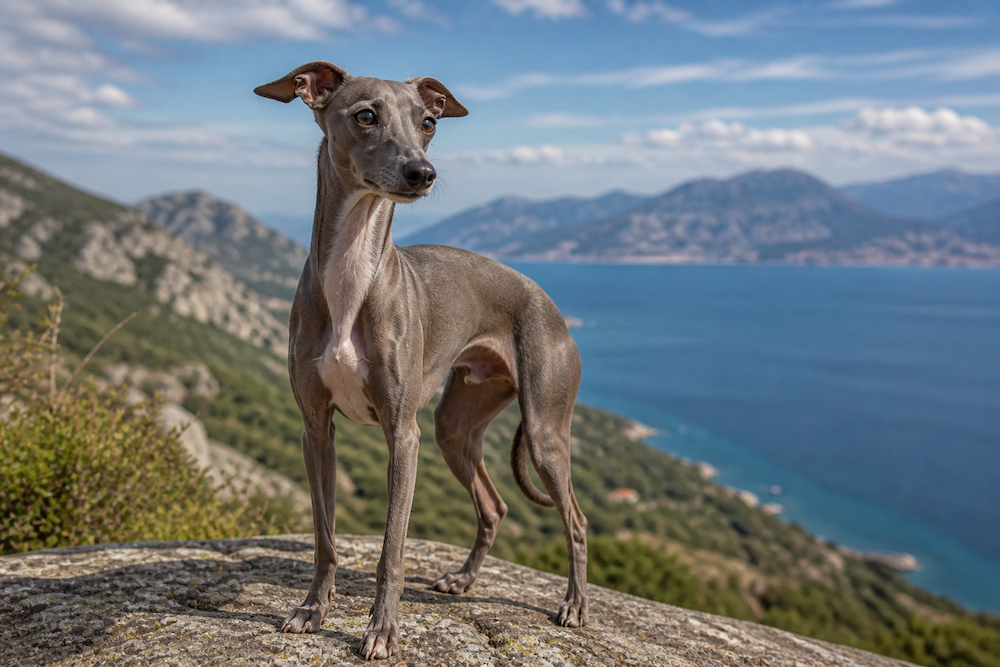
The Italian Greyhound has the classic sighthound outline in miniature: long slender legs, deep chest, tucked abdomen, narrow head, fine tail and graceful curved back.
Its coat is extremely short and smooth.
The overall impression should be elegant and athletic rather than fragile or weak.
What Colours Can Italian Greyhounds Be?
Colours vary by kennel-club standard and can include shades of black, blue-grey, fawn, red, cream and related dilutions, sometimes with white markings.
Colour terminology differs internationally.
Health and structure are far more important than fashionable colouring.
What Is a Blue Italian Greyhound?
“Blue” describes a diluted grey version of black pigmentation.
The colour can range from dark slate to lighter grey.
It doesn’t mean the coat is literally blue.
Can Italian Greyhounds Be Black?
Yes.
Black is a normal colour within the breed under various standards.
White markings may be permitted to different degrees depending on the kennel organisation.
Can Italian Greyhounds Be Cream?
Yes, under some breed standards and populations.
Colour acceptance differs between kennel clubs internationally.
Cream dogs have the same basic breed characteristics as darker Italian Greyhounds.
Can Italian Greyhounds Be Brindle?
Brindle isn’t accepted as a normal purebred Italian Greyhound colour under major traditional standards.
A brindle dog described as a purebred Italian Greyhound should therefore prompt questions about ancestry or identification.
Can Italian Greyhounds Be Merle?
Merle isn’t a traditional or recognised Italian Greyhound colour.
A merle dog advertised as an Italian Greyhound generally indicates other breed ancestry somewhere in the pedigree.
Merle-to-merle breeding also carries significant risks of hearing and eye abnormalities.
Why Do Italian Greyhounds Have Such Long Legs?
Long legs are part of the sighthound body plan.
They contribute to stride length, speed and efficient pursuit of moving prey.
Selective breeding for elegance probably further emphasised this characteristic in the miniature companion form.
Why Does an Italian Greyhound Have a Tucked-Up Belly?
The dramatic abdominal tuck is characteristic of sighthounds.
Combined with a deep chest and flexible athletic body, it contributes to an efficient running structure.
It should not be confused with unhealthy thinness.
How Thin Should an Italian Greyhound Be?
Italian Greyhounds are naturally very lean.
Some rib outline may be visible in a healthy dog, but body condition should still be assessed individually.
A veterinarian can help distinguish normal sighthound leanness from being genuinely underweight.
Why Do Italian Greyhounds Have Rose Ears?
The breed typically has small, fine rose-shaped ears that fold backwards.
When alert, the ears may change position dramatically.
This ear carriage contributes to the breed’s characteristic elegant expression.
Why Do Italian Greyhounds Sometimes Fold Their Ears Back?
Rose ears naturally fold backward when relaxed.
Excitement, attention or movement can cause them to change position.
This is normal breed anatomy rather than a sign of ear trouble.
Is an Italian Greyhound the Same as a Whippet?
No.
Whippets are substantially larger, generally weighing around 9–19 kg, compared with roughly 3.5–6 kg for many Italian Greyhounds.
Whippets were developed primarily as sporting and racing dogs, while Italian Greyhounds have a much longer history as tiny companion sighthounds.
Is an Italian Greyhound the Same as a Greyhound?
No.
Greyhounds are dramatically larger and were developed for coursing substantial game.
Italian Greyhounds share the sighthound body plan but have been selectively maintained at a much smaller size for centuries.
What Is the Difference Between an Italian Greyhound and a Whippet?
Size is the most obvious difference.
The Italian Greyhound is smaller, finer-boned and generally more delicate.
Whippets are larger, more robust and better suited to powerful sprinting, while Italian Greyhounds have a stronger historical association with companionship.
What Is the Difference Between an Italian Greyhound and a Miniature Pinscher?
They’re completely different breeds.
The Italian Greyhound is a sighthound with a curved, extremely fine build.
The Miniature Pinscher is a small pinscher-type dog with a more compact body, different movement and different working ancestry.
What Were Italian Greyhounds Originally Bred For?
Their exact earliest role isn’t completely certain.
Small Greyhound-type dogs were probably valued both as companions and hunters of small game.
Over centuries, companionship became increasingly central to the breed’s identity.
Did Italian Greyhounds Hunt Rabbits?
Small sighthounds could be used to pursue rabbits and other small game.
Their speed and visual hunting instincts make this plausible and historically documented in broader contexts.
However, the breed also has a very long history as an elite companion dog.
Are Italian Greyhounds Real Sighthounds?
Absolutely.
Their tiny size doesn’t change their fundamental anatomy and instincts.
They hunt primarily by spotting movement and pursuing it at speed, just like much larger sighthounds.
Where Does the Italian Greyhound Come From?
Despite its name, the breed’s deeper ancestry probably didn’t begin exclusively in Italy.
Small sighthound-type dogs existed around the Mediterranean for many centuries.
Italy became particularly important in refining and popularising these elegant little dogs during the Renaissance.
Is the Italian Greyhound Actually Italian?
Italy played an enormous role in the breed’s historical development and identity, particularly during the Renaissance.
However, archaeological and artistic evidence suggests small Greyhound-type dogs existed around the wider Mediterranean long before the modern breed was formalised.
So “Italian” reflects a major centre of development rather than necessarily the precise birthplace of every ancestral line.
How Old Is the Italian Greyhound Breed?
Small sighthounds resembling Italian Greyhounds have been depicted for well over 2,000 years.
However, resemblance in ancient art doesn’t prove those dogs were genetically identical to today’s pedigree breed.
The modern Italian Greyhound was standardised much later.
Did Italian Greyhounds Exist in Ancient Egypt?
Small slender sighthounds appear in ancient Egyptian art and archaeology.
Some resemble modern Italian Greyhounds, but identifying them as the exact modern breed would go beyond the evidence.
They demonstrate that small sighthound forms have existed for an extraordinarily long time.
Did Italian Greyhounds Exist in Ancient Greece?
Small Greyhound-like dogs were known in the ancient Mediterranean, including Greece.
Archaeological finds and artwork show slender small hounds centuries before modern pedigree breeding.
These dogs likely form part of the broader historical background of today’s breed.
Were Italian Greyhounds Found at Pompeii?
Small sighthound-type dogs are associated with archaeological evidence from the Roman world, and Italian Greyhound histories often reference finds from Pompeii and Herculaneum.
It’s safer to describe them as small Greyhound-like dogs rather than claim every ancient specimen was a modern Italian Greyhound.
Why Did Italian Greyhounds Become Popular in Renaissance Italy?
Their elegance, tiny size and suitability as indoor companions made them ideal status dogs among wealthy households.
Italian nobles became particularly associated with the little sighthounds.
Their prominence in Renaissance Italy eventually helped give the breed its modern name.
Were Italian Greyhounds Owned by Royalty?
Yes. Small Italian Greyhounds became fashionable among European royal and aristocratic households.
Their elegance and portability made them prestigious companions.
They appear repeatedly in portraits of wealthy and powerful people.
Did Catherine the Great Own Italian Greyhounds?
Catherine the Great of Russia is strongly associated with Italian Greyhounds and kept several small sighthounds.
Her affection for them helped reinforce the breed’s aristocratic reputation.
Dogs frequently appear in accounts and artwork connected with European royal courts.
Did Frederick the Great Own Italian Greyhounds?
Yes. Frederick the Great of Prussia was famously devoted to his Italian Greyhounds.
He reportedly kept numerous dogs and wanted to be buried close to them at Sanssouci.
This became one of the breed’s most memorable royal associations.
Was Frederick the Great Buried With His Italian Greyhounds?
Frederick wanted to be buried near his beloved dogs at Sanssouci.
Although his burial wishes weren’t immediately followed after his death, his remains were eventually reinterred at Sanssouci in 1991.
The graves of his dogs remain an unusual reminder of his attachment to them.
Did Queen Victoria Own Italian Greyhounds?
Queen Victoria owned and admired many dogs, and Italian Greyhounds were fashionable within European royal circles during her era.
The breed’s popularity in Victorian society reflected its long-standing association with aristocratic companionship.
Did Mary, Queen of Scots Own Italian Greyhounds?
Mary, Queen of Scots is frequently associated with small companion dogs, and Italian Greyhounds are often included in later breed histories.
Some dramatic stories about a dog accompanying her at her execution are difficult to verify precisely by modern breed identity.
The broader association with aristocratic small dogs is well established.
Why Do Italian Greyhounds Appear in So Many Old Paintings?
They were fashionable among wealthy European families, exactly the people most likely to commission portraits.
Artists also appreciated their elegant curves and distinctive silhouette.
As a result, small sighthounds appear in numerous Renaissance and later European paintings.
Did Famous Renaissance Artists Paint Italian Greyhounds?
Small sighthounds resembling Italian Greyhounds appear in works by prominent European artists.
Art is particularly useful for tracing the changing appearance and social role of these dogs.
However, dogs in old paintings shouldn’t automatically be identified as modern pedigree Italian Greyhounds.
Were Italian Greyhounds Status Symbols?
Yes.
Their small size, elegance and association with royal courts made them fashionable prestige companions.
Unlike farm dogs or large hunting packs, a tiny indoor sighthound could communicate that its owner had the resources to keep an animal primarily for companionship and beauty.
Why Is It Called an Italian Greyhound?
The name reflects the breed’s extraordinary popularity and development in Italy, particularly during the Renaissance.
Small sighthounds existed elsewhere, but Italian aristocratic culture became so strongly associated with them that “Italian Greyhound” eventually became the established English name.
What Is the Italian Name for the Italian Greyhound?
In Italy, the breed is called the Piccolo Levriero Italiano, essentially meaning “small Italian sighthound.”
The name accurately describes what the breed is: a miniature member of the sighthound family.
When Did Italian Greyhounds Arrive in Britain?
Small Italian Greyhounds were known among British aristocracy for centuries.
Their popularity increased through contact with continental European courts.
By the Victorian period, they were well established as a recognised companion breed.
When Was the Italian Greyhound Standardised?
The modern breed became increasingly standardised during the 19th century, alongside the growth of dog shows, kennel clubs and formal pedigree records.
Breeders began selecting toward a consistent size, structure and appearance.
Was the Italian Greyhound One of the Early Kennel Club Breeds?
Yes. Italian Greyhounds were established within organised dog showing relatively early.
Their long aristocratic history meant the breed was already familiar when modern kennel organisations developed.
Was the Italian Greyhound One of the Early AKC Breeds?
Yes.
The breed was recognised by the American Kennel Club in 1886, placing it among the earlier breeds registered in the United States.
Its American history therefore extends well beyond today’s renewed popularity.
Did Italian Greyhounds Nearly Disappear During the World Wars?
European populations suffered badly during both World Wars, as happened with many companion breeds.
Food shortages and social disruption made maintaining non-working dogs extremely difficult.
Dogs in Britain and North America helped preserve bloodlines used in post-war recovery.
Did Breeders Ever Make Italian Greyhounds Too Small?
Periods of extreme selection for tiny size created concerns about fragility and poor health.
Responsible breeding focuses on soundness and athletic function rather than producing the smallest possible dog.
A healthy Italian Greyhound should remain capable of running powerfully.
Why Is Extreme Miniaturisation Dangerous in Italian Greyhounds?
The breed already has very fine bones.
Selecting aggressively for ever-smaller size can increase concerns about skeletal fragility, dental crowding and other health problems.
Smaller isn’t automatically better.
Why Do Italian Greyhounds Look Fragile but Run So Fast?
Their structure is lightweight rather than weak by design.
Long legs, a deep chest, flexible spine and lean body create an efficient sprinting machine.
The problem is that fine bones can be vulnerable to unnatural impacts, particularly falls from furniture, even though they’re perfectly capable of powerful running.
Are Italian Greyhounds Fragile Dogs?
They’re more physically delicate than many similarly sized breeds, but “fragile” shouldn’t mean incapable.
A healthy adult Italian Greyhound should be athletic, fast and active.
The greatest concern is preventing high-impact accidents, particularly during puppyhood.
Why Do Italian Greyhounds Stand With One Front Leg Raised?
Many Italian Greyhounds occasionally adopt an elegant pose with one front paw raised.
It can reflect attention, anticipation or simply comfortable posture.
Persistent reluctance to bear weight on a limb, however, should never be dismissed as a breed quirk.
Why Do Italian Greyhounds Curl Into Tiny Balls?
Curling tightly conserves body heat and allows the dog to fit into warm protected spaces.
Their flexible bodies make the position particularly easy.
Add a blanket and the transformation from sighthound into cinnamon roll is complete.
Why Do Italian Greyhounds Love Laps So Much?
A human lap provides two things Italian Greyhounds value enormously: warmth and companionship.
Their history as aristocratic companion dogs reinforced a strong orientation toward close human contact.
For many, a lap isn’t simply somewhere to sit — it’s premium heated accommodation.
Why Are Italian Greyhounds Sometimes Called Iggies?
“Iggy” is a popular affectionate nickname for the Italian Greyhound.
Owners and breed enthusiasts commonly use the plural “Iggies.”
It has no special historical meaning; it’s simply a shortened form of the breed name.
Is an Italian Greyhound a Good First Dog?
It can be, particularly for someone wanting a very affectionate indoor companion.
However, owners need to be prepared for toilet-training challenges, dental care, cold sensitivity, separation issues and the risk of leg injuries.
Their tiny size doesn’t necessarily make them effortless dogs.
What Makes the Italian Greyhound Unique?
The Italian Greyhound combines two identities that seem almost contradictory.
It’s a genuine high-speed sighthound with hunting instincts and athletic anatomy, yet it has spent centuries living as an intimate companion to humans.
Few breeds can sprint around a garden like a miniature Greyhound and five minutes later insist on being wrapped in a blanket on someone’s lap.
Why Has the Italian Greyhound Survived for So Many Centuries?
Its appeal has remained remarkably consistent: elegance, affection, portability and athletic beauty.
Ancient Mediterranean societies valued small sighthounds, Renaissance nobles turned them into fashionable companions, European royalty embraced them, and modern owners continue to love essentially the same combination.
The surroundings changed from palaces to suburban homes, but the basic sales pitch barely needed updating.
Where Does the Italian Greyhound Come From?
The Italian Greyhound’s deeper history stretches far beyond modern Italy. Small sighthound-type dogs existed around the Mediterranean more than 2,000 years ago, appearing in archaeological evidence and art from ancient societies. We can’t confidently label every ancient little hound a modern Italian Greyhound, but they reveal an exceptionally old tradition of miniature sighthounds.
Italy became especially important during the Renaissance, when these elegant dogs became fashionable among nobles and wealthy families. Their prominence in Italian courts was so great that the country ultimately became permanently attached to the breed’s name. From Italy, they spread through Europe’s royal households and appear repeatedly in paintings alongside aristocrats.
Among their famous admirers was Frederick the Great of Prussia, whose devotion to his little sighthounds became legendary. The modern breed was later standardised through organised breeding and dog shows during the 19th century.
So despite looking like someone simply put a Greyhound through a shrinking machine, the Italian Greyhound has an extraordinary identity of its own: an ancient-style sighthound, Renaissance status symbol, royal lapdog and 40-km/h blanket enthusiast — all in a body weighing only a few kilograms.