






Small, colourful and generally easy to handle, the Leopard Gecko is one of the world's most popular pet reptiles. Its manageable size and calm temperament make it beginner-friendly, but correct heating, nutrition and housing are still essential.
🧠 QUICK SNAPSHOT
| Trait | Leopard Gecko |
|---|---|
| Scientific Name | Eublepharis macularius |
| Pet Type | Reptile / Gecko |
| Natural Range | Parts of South and Central Asia |
| Typical Lifespan | Around 10–20 years |
| Adult Size | Around 18–25 cm |
| Typical Weight | Roughly 45–100 g |
| Diet | Insectivore |
| Activity | Primarily crepuscular/nocturnal |
| Temperament | Usually calm and docile |
| Housing | Secure terrestrial enclosure |
| Social Needs | Generally best housed individually |
| Beginner Friendly? | Yes |
| Famous Feature | Spotted body and fat-storing tail |
📚 OVERVIEW
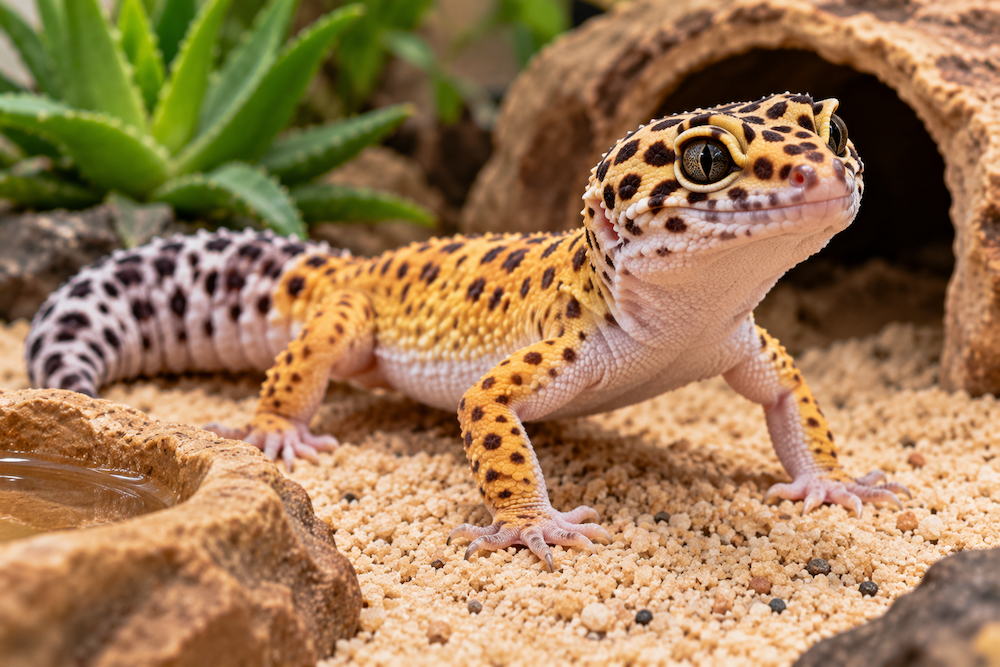
The Leopard Gecko (Eublepharis macularius) is a ground-dwelling lizard famous for its spotted appearance, chunky tail and surprisingly expressive face.
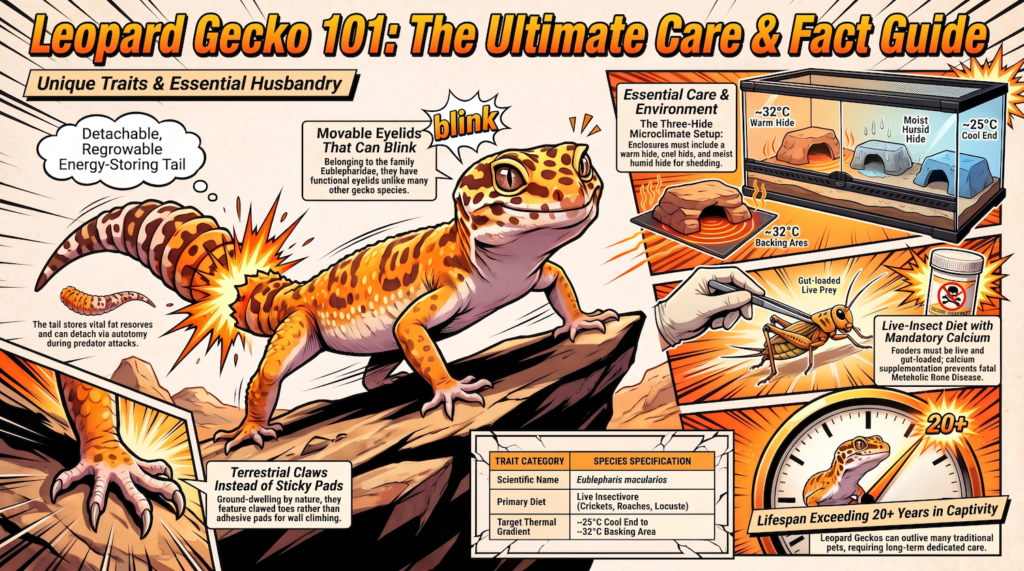
Unlike many geckos, Leopard Geckos have movable eyelids and lack the adhesive toe pads used by many other species to climb smooth surfaces. They’re built primarily for life on the ground.
Captive breeding has produced an enormous variety of colours and patterns known as morphs, ranging far beyond the classic yellow-and-black spotted appearance.
Their calm temperament and manageable size make them popular first reptiles, but they still require carefully controlled heating, suitable hides, appropriate supplementation and a diet of live insects.
With good care, a Leopard Gecko can potentially remain part of the family for 15 years or considerably longer.
✅ PROS & CONS
Pros
- Generally calm and easy to handle
- Manageable adult size
- Usually quiet
- Doesn’t require a huge enclosure
- Fascinating behaviour
- Available in many colours and patterns
- Relatively straightforward reptile care
- Can live for well over a decade
- Excellent choice for many first-time reptile keepers
Cons
- Requires live insects
- Needs carefully controlled heating
- Primarily active during evening and nighttime
- Requires calcium and nutritional supplementation
- Can drop its tail when severely stressed
- Veterinary care may require a reptile specialist
- Long lifespan creates a significant commitment
- Poor husbandry can cause serious health problems
Are Leopard Geckos Good Pets?
Yes. Leopard Geckos can make excellent pet reptiles.
They’re relatively small, generally docile and often become comfortable with gentle handling. Their care is also relatively manageable once the enclosure has been established correctly.
Are Leopard Geckos Good for Beginners?
Yes. Leopard Geckos are widely considered one of the better reptiles for beginners.
However, owners still need to understand heating, supplementation, shedding, feeding and enclosure management.
Beginner-friendly doesn’t mean maintenance-free.
How Long Do Leopard Geckos Live?
Leopard Geckos commonly live around 10–20 years in captivity, with some individuals living beyond 20 years.
Their potential lifespan makes them a considerably longer commitment than many small pets.
How Big Do Leopard Geckos Get?
Adult Leopard Geckos generally reach around 18–25 cm in total length.
Males are often somewhat larger and more robust than females.
Their relatively compact size is one reason they’re so popular with reptile keepers.
What Size Enclosure Does a Leopard Gecko Need?
Adult Leopard Geckos need enough floor space to explore and establish distinct warm and cool areas.
Because they’re primarily terrestrial, usable floor area is particularly important.
Bigger appropriately furnished enclosures can provide additional opportunities for exploration and enrichment.
What Temperature Does a Leopard Gecko Need?
Leopard Geckos require a temperature gradient, allowing them to move between warmer and cooler parts of their enclosure.
A thermostatically controlled heat source and accurate thermometers are essential.
Heating equipment should never be used without appropriate temperature control.
Do Leopard Geckos Need UVB?
Leopard Geckos can benefit from appropriate low-level UVB lighting, even though they aren’t primarily daytime basking reptiles.
UVB can support natural vitamin D3 production and calcium metabolism.
Lighting and supplementation should be planned together rather than considered separately.
What Do Leopard Geckos Eat?
Leopard Geckos are insectivores and require appropriately sized live insects.
Common feeders include crickets, roaches, locusts and suitable feeder larvae, depending on availability.
Providing dietary variety is preferable to relying exclusively on one insect.
How Often Do Leopard Geckos Eat?
Young Leopard Geckos generally eat more frequently than adults.
Healthy adults may be fed several times per week rather than every day, depending on age, body condition and diet.
Their weight and distinctive tail provide useful clues about overall body condition.
Do Leopard Geckos Need Calcium?
Yes. Proper calcium intake is essential.
Feeder insects may need appropriate supplementation, while correct husbandry helps support calcium metabolism.
Insufficient calcium can contribute to metabolic bone disease, a serious and potentially preventable condition.
Do Leopard Geckos Drink Water?
Yes.
Fresh water should always be available in a shallow, stable dish.
Even if owners rarely see their gecko drinking, this doesn’t mean water should be removed.
Do Leopard Geckos Like Being Held?
Many Leopard Geckos become comfortable with gentle, patient handling.
They’re generally better handled by allowing them to walk onto the hands rather than grabbing them from above.
Handling sessions should initially be short while the gecko becomes accustomed to its owner.
Do Leopard Geckos Bite?
They can bite, but well-socialised Leopard Geckos aren’t generally aggressive towards people.
Biting may occur if the animal is frightened, stressed or mistakes a finger for food.
Understanding body language and using calm handling greatly reduces the likelihood.
Can Leopard Geckos Drop Their Tails?
Yes. Leopard Geckos can deliberately detach their tails as an emergency defence mechanism, a process called autotomy.
The detached tail can continue moving, potentially distracting a predator while the gecko escapes.
The tail can regrow, but it usually doesn’t look exactly like the original.
Why Is a Leopard Gecko’s Tail So Fat?
The tail acts as an important fat and energy reserve.
A healthy Leopard Gecko often has a substantial tail, while significant unexplained thinning can indicate illness, inadequate nutrition or another problem.
Body condition should be assessed using more than tail size alone.
Do Leopard Geckos Have Eyelids?
Yes — and this distinguishes them from many familiar gecko species.
Leopard Geckos have movable eyelids, allowing them to blink and close their eyes.
Their genus name Eublepharis refers to this distinctive eyelid characteristic.
Can Leopard Geckos Climb Walls?
Not smooth vertical surfaces like many other geckos.
Leopard Geckos lack the specialised adhesive toe pads that allow species such as house geckos to climb glass and walls.
They can still climb rocks, branches and textured structures, so safe low-level climbing enrichment can be useful.
Are Leopard Geckos Nocturnal?
They’re commonly described as nocturnal, although crepuscular activity around dusk and dawn is also important.
Individual captive geckos may emerge at various times depending on lighting, feeding schedules and their environment.
Don’t expect the same daytime activity as a Bearded Dragon.
Why Does a Leopard Gecko Need a Humid Hide?
A humid hide provides a localised area of higher humidity that helps the gecko shed its skin successfully.
This is particularly important around the toes, where retained shed can cause serious problems.
The entire enclosure doesn’t need to be kept excessively humid.
Do Leopard Geckos Eat Their Shed Skin?
Yes. Leopard Geckos commonly eat their shed skin.
This is normal behaviour and may help recover nutrients while also removing evidence of the animal’s presence that could attract predators in the wild.
Owners may therefore rarely find an entire shed skin inside the enclosure.
Can Leopard Geckos Live Together?
Housing Leopard Geckos individually is generally the simplest and safest approach.
Males can fight seriously, while other combinations can still involve competition, stress or unintended breeding.
Leopard Geckos don’t require another gecko for companionship.
What Health Problems Are Common in Leopard Geckos?
Potential problems include metabolic bone disease, retained shed, parasites, impaction, nutritional disorders and reproductive problems.
Many health issues can be reduced through correct husbandry.
Changes in appetite, weight, movement, droppings or behaviour should be investigated promptly.
What Are Leopard Gecko Morphs?
A morph is a selectively bred variation in colour, pattern or other inherited appearance traits.
Decades of captive breeding have produced a huge range of Leopard Gecko morphs, including albino, patternless, tangerine and many combinations.
Some genetic lines can also be associated with health concerns, making responsible breeding important.
Where Do Leopard Geckos Come From?
Leopard Geckos naturally occur across parts of South and Central Asia, including dry and semi-arid habitats.
Rather than living on open desert sand alone, they use rocky terrain, burrows, crevices and sheltered microhabitats.
Their natural environment is more complex than the stereotypical image of a bare desert.
Are Leopard Geckos Legal to Keep as Pets?
Legality varies around the world.
Some countries or regions restrict or prohibit keeping Leopard Geckos, while they’re widely kept elsewhere.
Prospective owners should always check their local wildlife and exotic-pet regulations before obtaining one.
Is a Leopard Gecko a Good First Reptile?
Yes. For many people, the Leopard Gecko is an excellent first reptile.
It’s relatively small, generally calm and has manageable housing requirements.
The owner must still be comfortable providing live insects, controlled heating, supplements and potentially 15–20 years of care.
What Makes the Leopard Gecko Unique?
Leopard Geckos break several of the rules people associate with geckos.
They don’t have sticky feet for racing up glass.
They have eyelids and can actually blink.
And that enormous tail isn’t simply decorative — it’s an important energy reserve.
But their most dramatic trick is saved for emergencies.
If a predator grabs the tail, a Leopard Gecko can detach it and escape while the abandoned tail continues wriggling.
Eventually, a replacement grows.
Add their spotted appearance, almost permanent-looking smile and huge variety of captive-bred colours, and it’s easy to understand their popularity.
The Leopard Gecko may not climb your walls.
But for a small lizard that can blink, store lunch in its tail and leave that tail behind during an emergency, it has plenty of other tricks.
Discover why Leopard Geckos store fat in their tails, how they can deliberately drop them, why they have eyelids and what makes these little reptiles such popular pets.
Watch our Leopard Gecko video and discover what makes this remarkable little lizard so unusual.