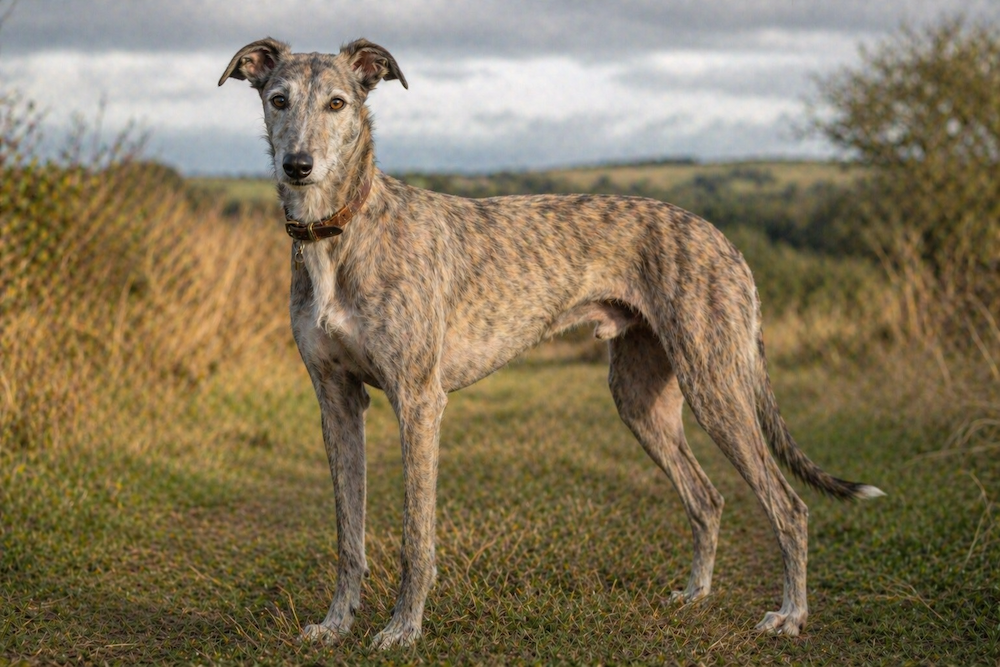







Fast, gentle, and incredibly loyal — a sleek companion built for speed and calm companionship.
🧠 QUICK SNAPSHOT
- Temperament: Gentle, calm, loyal
- Energy Level: Moderate (bursts of speed)
- Size: Medium to large
- Good With Families: Yes
- Trainability: Moderate
- Grooming: Low
- Best For: Families, relaxed homes with space
📚 OVERVIEW
The Lurcher is a crossbreed typically created by mixing a sighthound (like a Greyhound or Whippet) with another breed, resulting in a fast, agile dog with a calm indoor nature. They are known for their incredible speed outdoors and relaxed, laid-back temperament at home.
They form strong bonds with their owners and are often described as gentle and affectionate companions.
✅ PROS & CONS
Pros
- Calm and relaxed indoors
- Very loyal and affectionate
- Low grooming needs
- Fast and athletic
Cons
- Strong prey drive
- Needs secure areas to run
- Can be sensitive
- Requires space for exercise
Is a Lurcher a Good Family Dog?
Yes. Many Lurchers make gentle, affectionate, calm and deeply loyal family companions.
Temperament varies because a Lurcher isn’t one standardised breed. Most have sighthound ancestry combined with another sighthound or working breed, so personality depends heavily on the particular mix.
At home, many are surprisingly relaxed considering their extraordinary athletic ability.
What Is a Lurcher?
A Lurcher is traditionally a sighthound crossed with another breed or type of dog, particularly a working breed.
Greyhounds, Whippets and Deerhound-type dogs have commonly contributed the sighthound ancestry, while Collies and terriers are among the traditional crosses.
Modern usage can be broader, especially among rescue organisations.
Is a Lurcher a Breed?
No, not in the conventional pedigree sense.
“Lurcher” describes a type of dog rather than one closed, standardised breed.
There is therefore no single official Lurcher size, coat, colour or temperament.
What Breeds Make a Lurcher?
Traditional Lurchers can involve combinations such as:
Greyhound × Collie
Greyhound × Terrier
Whippet × Collie
Deerhound × Greyhound
Greyhound × Bull-type dog
mixtures involving several generations of working Lurchers
The possible combinations are enormous.
Is a Greyhound Cross Automatically a Lurcher?
In Britain and Ireland, many Greyhound crosses are commonly described as Lurchers.
Historically, however, the term carried a stronger association with dogs deliberately bred for coursing, hunting and poaching work.
Modern rescue usage is often broader.
Is a Lurcher the Same as a Longdog?
Not exactly.
Traditionally, a Longdog is a cross between two sighthound breeds, such as Greyhound × Deerhound.
A Lurcher more classically combines a sighthound with a non-sighthound working dog.
In everyday usage, however, the terms can overlap.
How Much Exercise Does a Lurcher Need?
Many adult Lurchers need around 60–90 minutes of daily exercise, although the exact requirement depends heavily on ancestry.
A Greyhound-heavy Lurcher may enjoy short explosive runs followed by hours of sleep.
A Collie-heavy Lurcher may require substantially more mental and physical activity.
Are Lurchers High-Energy Dogs?
Some are, but many aren’t.
Sighthound-heavy Lurchers often combine extreme speed with surprisingly low indoor energy.
Terrier or Collie ancestry can produce a considerably busier dog.
This variability is one reason knowing the dog’s ancestry is useful.
Are Lurchers Couch Potatoes?
Many are.
A Lurcher can sprint across a field at remarkable speed and then spend most of the afternoon asleep on a sofa.
This contrast between explosive athleticism and enthusiastic relaxation is one of the type’s most appealing characteristics.
Are Lurchers Easy to Train?
It depends on the cross.
Collie-influenced Lurchers can be extremely trainable, while sighthound-heavy dogs may be more independent.
Positive reinforcement, patience and particularly strong recall training are important.
Are Lurchers Intelligent?
Yes, although their intelligence can take different forms.
A Collie cross may show strong handler focus and rapid learning, while a traditional hunting Lurcher may excel at independent observation, pursuit and problem-solving.
They’re often considerably cleverer than their relaxed household behaviour suggests.
Are Lurchers Stubborn?
Some can appear stubborn.
Sighthounds were bred to make rapid decisions while pursuing moving quarry, so constant dependence on human instructions wasn’t always desirable.
A Lurcher may therefore understand a command without regarding immediate compliance as essential.
Does a Lurcher Shed?
Usually, but the amount varies enormously.
A short-coated Greyhound-type Lurcher may shed moderately, while a rough-coated Deerhound or Collie cross can shed considerably more.
There’s no single Lurcher coat type.
Is a Lurcher Hypoallergenic?
Generally, no.
Most Lurchers shed and produce normal canine allergens.
Because ancestry varies, it’s impossible to make one reliable hypoallergenic claim for all Lurchers.
What Type of Coat Does a Lurcher Have?
Almost anything is possible.
Lurchers can have short smooth coats, broken coats, wiry coats, rough shaggy coats or longer feathered coats.
Coat type is one of the clearest clues to the breeds behind an individual dog.
Do Rough-Coated Lurchers Need Grooming?
Yes.
Rough-coated dogs generally need regular brushing to remove dead hair and prevent tangles.
Some wiry coats may benefit from stripping or professional grooming.
Smooth-coated Lurchers usually require considerably less coat maintenance.
What Health Problems Are Common in Lurchers?
There isn’t one universal Lurcher health profile because they’re genetically diverse.
Potential problems depend on ancestry and can include orthopaedic disorders, heart disease, eye conditions, bloat, dental problems and breed-specific inherited diseases.
Large, deep-chested Lurchers may be at risk of gastric dilatation-volvulus.
Are Lurchers Healthier Than Purebred Dogs?
Not automatically.
Crossbreeding can increase genetic diversity, but it doesn’t prevent inherited disease.
A Lurcher can inherit health risks from every breed contributing to its ancestry.
Responsible breeding and appropriate health testing still matter.
Are Lurchers Prone to Bloat?
Large, deep-chested Lurchers can be at risk of gastric dilatation-volvulus (GDV).
This is a life-threatening emergency.
Owners of deep-chested dogs should know the warning signs and discuss individual risk with their veterinarian.
Are Lurchers Sensitive to Anaesthesia?
Sighthounds can have physiological characteristics that affect how certain drugs are handled.
Modern anaesthetic protocols are much safer than older approaches, but veterinarians should know when a dog has substantial Greyhound or other sighthound ancestry.
This doesn’t mean Lurchers can’t safely undergo anaesthesia.
How Long Does a Lurcher Live?
Many Lurchers live around 12–15 years, although size and ancestry make a substantial difference.
Large Deerhound-type crosses may have shorter average lifespans than smaller Whippet-based dogs.
Healthy weight and appropriate veterinary care remain important.
How Big Does a Lurcher Get?
There is no standard size.
A small Whippet-based Lurcher might weigh around 10–15 kg, while a large Greyhound or Deerhound cross can exceed 30–40 kg.
Height can range from medium-sized to extremely tall.
Is There a Miniature Lurcher?
Not as a recognised type.
A small Lurcher can certainly result from Whippet or smaller-breed ancestry.
“Miniature Lurcher” isn’t a standardised breed classification.
Can a Lurcher Live in an Apartment?
Many can.
Sighthound-heavy Lurchers are often remarkably calm indoors once appropriately exercised.
The practical considerations are size, access to safe exercise and whether the individual dog can settle when left alone.
Does a Lurcher Need a Large Backyard?
Not necessarily.
A garden is useful, but a huge yard doesn’t replace proper exercise.
Many Lurchers are perfectly content in modest homes if they receive regular walks and opportunities for safe running.
Can a Lurcher Be Left Alone?
Many adults can learn to tolerate reasonable periods alone.
However, rescue Lurchers may initially struggle with unfamiliar household routines, particularly if they previously lived in kennels.
Alone-time training should be introduced gradually.
Are Lurchers Prone to Separation Anxiety?
Some are.
Many form extremely strong bonds with their families.
Individual history can be especially important in rescued dogs that have experienced repeated moves or major changes in environment.
Are Lurchers Velcro Dogs?
Many can be surprisingly attached to their people.
Others retain more independent sighthound characteristics.
A common compromise is a dog that doesn’t constantly demand attention but insists on sleeping somewhere within visual range of its favourite person.
Are Lurchers Cuddly?
Many are extremely affectionate.
Sighthounds often enjoy warmth, soft bedding and close physical contact.
A large Lurcher can develop an impressive ability to occupy virtually an entire sofa while technically leaving its owner several centimetres of usable space.
Are Lurchers Good With Children?
Many are excellent with respectful children.
Their typically gentle nature can suit family life very well.
Large dogs can accidentally knock over small children, and any dog with an unknown rescue history should be introduced carefully.
Are Lurchers Good With Other Dogs?
Usually, although individual temperament varies.
Many have extensive experience around other dogs and communicate well.
Prey drive can sometimes create complications around very small dogs, particularly if they run.
Are Lurchers Good With Cats?
Some are, while others absolutely aren’t.
This is one of the most important areas where individual assessment matters.
A Lurcher with strong prey drive may regard a running cat as quarry, while another may live peacefully with cats for its entire life.
Can a Lurcher Live With Rabbits or Guinea Pigs?
Extreme caution is required.
Many Lurchers were deliberately bred to pursue rabbits and other small animals.
Even a dog that’s gentle with people may have exceptionally strong predatory behaviour around small pets.
Do Lurchers Have a Strong Prey Drive?
Many do.
Speed and pursuit ability are fundamental to their sighthound ancestry.
Terrier ancestry can increase hunting persistence even further.
Prey drive varies enormously between individuals but should never be casually dismissed.
Why Does My Lurcher Chase Everything That Moves?
Sighthounds are visually triggered hunters.
Rapid movement can activate the instinctive sequence of spotting, pursuing and catching prey.
For a traditional Lurcher, chasing wasn’t a behavioural defect — it was the reason the dog existed.
Are Lurchers Good Off Leash?
Some are, but reliable recall can be challenging.
Once a sighthound-type dog commits to chasing something, enormous distance can be covered extremely quickly.
Secure fenced areas are the safest places for many Lurchers to run freely.
How Fast Can a Lurcher Run?
Speed depends on ancestry.
A Greyhound-heavy Lurcher can be exceptionally fast, potentially approaching Greyhound-like speeds over short distances.
Exact figures for “the Lurcher” are meaningless because there is no single standardised Lurcher body type.
Are Lurchers Faster Than Greyhounds?
Generally, a pure racing Greyhound is difficult to beat for outright sprint speed.
Some Lurchers can be extremely fast, but traditional breeders often valued stamina, agility, intelligence and versatility rather than maximum straight-line speed alone.
Why Are Lurchers So Fast?
Their sighthound ancestry contributes long legs, flexible spines, deep chests, light bodies and powerful hindquarters.
Many use the double-suspension gallop, during which all four feet leave the ground twice during each stride cycle.
It’s an extraordinary piece of canine biomechanics.
Can Lurchers Jump High Fences?
Some can.
Athletic individuals may jump or climb surprisingly high barriers.
Secure fencing should account for both jumping ability and the motivation created by wildlife on the other side.
Are Lurchers Escape Artists?
They can be.
Prey drive can motivate a dog to exploit small gaps or clear fences that previously appeared perfectly adequate.
Some crosses also inherit considerable problem-solving ability.
Do Lurchers Dig?
Some do, particularly those with terrier ancestry.
Digging can also be triggered by interesting scents or attempts to get beneath fencing.
It’s less universally characteristic than chasing.
Do Lurchers Bark a Lot?
Many are relatively quiet.
Sighthound-heavy dogs often aren’t excessive barkers.
Collie or terrier influence can produce a considerably more vocal individual.
Are Lurchers Good Watchdogs?
Some will alert their owners to unfamiliar activity.
However, many are naturally quiet and relatively relaxed around visitors.
They’re not generally selected primarily for watchdog work.
Are Lurchers Good Guard Dogs?
Usually not.
Their size can be intimidating, but many have gentle, non-confrontational temperaments.
They were bred primarily to chase quarry rather than confront human intruders.
Are Lurchers Aggressive?
Aggression toward people isn’t a defining characteristic.
It’s important not to confuse high prey drive with aggression. A dog can be exceptionally gentle with humans while still being unsafe around small animals.
Individual temperament and history always matter.
Are Lurchers Friendly With Strangers?
Many are friendly or politely reserved.
Sighthound-heavy dogs can initially appear aloof without being fearful.
Rescue dogs may need time to gain confidence in unfamiliar situations.
When Does a Lurcher Calm Down?
Many become noticeably calmer between two and three years old.
Sighthound-heavy adults can become extraordinarily relaxed indoors.
Collie and terrier crosses may remain considerably busier.
Do Lurchers Get the Zoomies?
Absolutely.
Their version of the zoomies can involve rather more speed than most households were designed to accommodate.
An open field is considerably safer than a living room containing coffee tables.
Are Lurchers Good Running Dogs?
It depends on ancestry.
Greyhound-heavy Lurchers are primarily sprinters, while Collie, Saluki or other crosses may have greater endurance.
Conditioning should be gradual, and repetitive distance running should wait until physical maturity.
Are Lurchers Good Hiking Dogs?
Many are excellent hiking companions.
Athletic crosses can have impressive stamina.
Owners need to manage wildlife encounters carefully because a suddenly appearing rabbit can dramatically alter the direction of the hike.
Can Lurchers Swim?
Most can swim physically, but many sighthound-heavy individuals aren’t enthusiastic swimmers.
Their lean bodies and low body fat can also make cold water uncomfortable.
Life jackets can be useful for inexperienced dogs.
Do Lurchers Get Cold Easily?
Short-coated Lurchers often do.
Low body fat and thin coats provide limited insulation.
Many benefit from coats during cold, wet weather — particularly Greyhound- and Whippet-type individuals.
Can Lurchers Handle Hot Weather?
Many short-coated Lurchers cope reasonably well with moderate warmth, but strenuous exercise should still be avoided during extreme heat.
Running generates enormous body heat.
Fresh water, shade and cooler exercise periods remain essential.
Why Do Lurchers Love Soft Beds?
Sighthound ancestry often means relatively little body fat over prominent bones.
Hard floors can therefore be uncomfortable.
A Lurcher may consider one ordinary dog bed inadequate when there is clearly an entire human sofa available.
Why Does My Lurcher Sleep So Much?
Many sighthound-type dogs conserve energy between bursts of activity.
A healthy adult can therefore spend a surprisingly large proportion of the day resting.
Sleeping extensively isn’t inconsistent with being an exceptional athlete.
Why Does My Lurcher Sleep Upside Down?
Many Lurchers adopt the classic sighthound “roach” position, lying on their backs with legs pointing in improbable directions.
It generally indicates that the dog feels comfortable and secure.
It can also make a beautifully elegant animal look completely ridiculous.
Why Does My Lurcher Lean on Me?
Leaning is common among affectionate sighthound-type dogs.
It’s often simply a way of maintaining physical contact.
Some Lurchers appear to believe that leaning their entire body weight against a person’s legs is a particularly subtle expression of affection.
Why Does My Lurcher Chatter Its Teeth?
Sighthounds sometimes chatter their teeth when excited, anticipating something enjoyable or experiencing strong emotion.
It isn’t always a sign that the dog is cold.
Persistent chattering associated with pain or dental problems should obviously be assessed by a veterinarian.
Why Does My Lurcher Have Such a Deep Chest?
The deep chest provides space for a large heart and lungs supporting high-speed running.
It’s a classic sighthound characteristic.
It also contributes to the increased GDV risk seen in some deep-chested dogs.
Why Does My Lurcher Have Such a Small Waist?
The dramatic abdominal tuck is part of the classic sighthound body plan.
Combined with a deep chest, long legs and lean musculature, it creates an efficient structure for high-speed pursuit.
A healthy Lurcher should generally look leaner than many conventional pet dogs.
Is My Lurcher Too Thin?
Possibly — but sighthounds naturally carry less body fat than many breeds.
A visible outline of some ribs or hip structure may be normal depending on the individual.
Body condition should be assessed according to sighthound structure rather than assuming every visible rib means starvation.
What Does a Lurcher Look Like?
There is no single appearance.
Most have recognisable sighthound characteristics such as long legs, a deep chest, tucked abdomen and relatively narrow body, combined with features from another breed.
They can be smooth, rough, tiny, enormous or almost anything in between.
What Colours Can Lurchers Be?
Virtually any colour or pattern can occur.
Black, white, fawn, blue, brindle, red, cream, sable and parti-colour combinations are all possible.
Colour depends entirely on ancestry.
Can Lurchers Have Blue Eyes?
Yes, depending on the breeds behind them.
Blue eyes aren’t a defining Lurcher characteristic.
They may occur through particular ancestry or pigmentation genetics.
Can Lurchers Be Merle?
Yes, if merle exists within one of the contributing breeds, such as certain Collies.
Unlike a breed with a fixed standard, a merle Lurcher isn’t automatically evidence of inappropriate ancestry because Lurchers are intentionally crossbred.
Merle-to-merle matings should still be avoided because of associated health risks.
What Is a Bull Lurcher?
A Bull Lurcher generally combines sighthound ancestry with bull-type terrier ancestry, often involving breeds such as the Staffordshire Bull Terrier or related types.
They tend to be more powerfully built than many traditional Lurchers.
Historically, they were bred for strength, speed and hunting ability.
What Is a Collie Lurcher?
A Collie Lurcher combines sighthound ancestry, commonly Greyhound, with a working Collie type.
These dogs can combine sighthound speed with herding-dog intelligence, stamina and trainability.
They have long been highly regarded as versatile working Lurchers.
What Is a Bedlington Lurcher?
A Bedlington Lurcher usually combines Bedlington Terrier and sighthound ancestry, commonly Whippet or Greyhound.
The resulting dogs can be fast, athletic and persistent hunters, often with rough or broken coats.
They’ve long been associated with British working-dog culture.
What Is a Deerhound Lurcher?
A Deerhound-type Lurcher has Scottish Deerhound ancestry combined with another breed, often Greyhound.
These dogs can be very tall, rough-coated and exceptionally athletic.
Greyhound × Deerhound crosses are technically often described as Longdogs.
What Is a Saluki Lurcher?
A Saluki Lurcher combines Saluki ancestry with another breed or working Lurcher line.
Saluki influence can contribute stamina, heat tolerance, independence and exceptional pursuit ability.
These crosses can differ significantly from heavier British sighthound combinations.
What Is a Terrier Lurcher?
A Terrier Lurcher combines sighthound speed with terrier persistence and prey drive.
Different terriers produce very different dogs.
Traditional workers valued some of these crosses for hunting quarry requiring both speed and determination.
Why Were Collies Crossed With Greyhounds?
The aim was to combine the Greyhound’s speed and sight-hunting ability with the Collie’s intelligence, stamina and responsiveness to a handler.
This could produce an exceptionally versatile working dog.
It became one of the classic Lurcher combinations.
Why Were Terriers Crossed With Sighthounds?
Terriers could contribute toughness, persistence, scenting ability and determination.
The sighthound supplied speed.
The objective wasn’t appearance — it was creating a dog capable of performing particular types of work.
Where Does the Lurcher Come From?
The Lurcher is most strongly associated with Britain and Ireland, where sighthound crosses have been used for hunting and poaching for centuries.
Rather than emerging from one breeder or one formal programme, the type developed among people who selected dogs primarily for practical ability.
How Old Is the Lurcher?
Sighthound crosses have existed for many centuries.
However, it’s difficult to assign a precise creation date because Lurchers developed as working crossbreeds rather than registered pedigree dogs.
Their history predates modern kennel clubs.
Why Were Lurchers Created?
They were bred to create versatile hunting dogs combining the speed of a sighthound with useful characteristics from other working dogs.
Desired traits could include intelligence, stamina, toughness, trainability, scenting ability and stealth.
Different jobs produced different crosses.
Were Lurchers Poachers’ Dogs?
Very famously, yes.
Lurchers became strongly associated with poaching culture in Britain and Ireland, where quiet, fast dogs could catch rabbits and other game.
That reputation became so deeply embedded that the Lurcher is still sometimes called the traditional poacher’s dog.
Why Were Lurchers Good for Poaching?
They could be fast, quiet, intelligent and versatile.
A good Lurcher could locate and pursue quarry while working closely enough with its owner to remain manageable.
Unlike a large pack of hounds, one dog could also be transported and handled discreetly.
Did Lurchers Hunt Rabbits?
Yes.
Rabbits became one of the classic forms of quarry associated with Lurcher work.
Their speed and rapid acceleration made sighthound-based dogs particularly effective at catching animals in open ground.
Did Lurchers Hunt Hares?
Historically, yes.
Lurchers were used to pursue hares and other game.
Modern hunting laws vary considerably by jurisdiction, and some traditional forms of hunting with dogs are now prohibited.
Did Lurchers Hunt Deer?
Some larger Lurchers were historically used for deer.
Deerhound and Greyhound ancestry could produce dogs with the size and speed needed for larger quarry.
Modern legality depends on location and should never be assumed from historical practice.
Did Lurchers Hunt Foxes?
Certain powerful Lurcher crosses were historically used in fox hunting and other quarry work.
This wasn’t universal to all Lurchers.
Their working roles varied according to size, ancestry, region and the needs of their owners.
Why Is the Lurcher Associated With Travellers?
Lurchers have long been associated with Romani and Traveller communities in Britain and Ireland, where versatile working dogs were highly valued.
They could provide hunting ability while remaining practical household and travelling companions.
This connection forms an important part of Lurcher cultural history.
Were Lurchers Only Owned by Poor People?
No.
Their strongest folklore may involve poachers, rural workers and travelling communities, but sighthound crosses were useful to many people.
The history is more complicated than a simple rich-versus-poor division.
Were Greyhounds Once Restricted to the Upper Classes?
Medieval hunting rights and game laws often heavily favoured landowners and elites, and ownership or use of certain hunting dogs could be regulated.
Popular Lurcher folklore sometimes claims ordinary people created crosses specifically because they were legally forbidden from owning Greyhounds.
The real history of medieval dog and game laws is more complicated than this frequently repeated story.
Is It True That Commoners Weren’t Allowed to Own Greyhounds?
Not as a universal rule applying to everyone for centuries.
Historical forest and game laws could restrict hunting rights, and certain legal texts imposed controls involving Greyhounds.
But the popular story that “only nobles could legally own Greyhounds, so peasants invented the Lurcher” is an oversimplification.
Was the Lurcher Created to Get Around Medieval Greyhound Laws?
Possibly in some contexts, but there’s no evidence of one deliberate moment when people invented the Lurcher for that reason.
Crossing useful hunting dogs would have occurred for many practical reasons.
Restrictions on hunting likely contributed to the Lurcher’s poaching associations, but the neat origin story is too simplistic.
What Is the Forest Law Connection to Lurchers?
Medieval English forest law regulated hunting within royal forests and protected certain game for privileged use.
Dogs capable of catching deer or other protected animals could therefore become legally significant.
These restrictions form part of the historical background from which later poaching culture developed.
What Does the Word Lurcher Mean?
The exact origin of the word is debated.
One frequently proposed connection is with the Romani word lur, associated with stealing or thieving, fitting the dog’s later reputation as a poacher’s companion.
Other linguistic explanations have also been proposed, so the etymology shouldn’t be presented as completely settled.
Does Lurcher Mean “Thief Dog”?
That’s a colourful simplification.
The proposed Romani connection has encouraged interpretations such as “thief” or a dog associated with stealing game.
However, the precise etymology remains uncertain.
Why Were Lurchers Bred for Silence?
A dog used for discreet hunting or poaching benefited from working without constantly barking.
Sighthounds are naturally relatively quiet, making them well suited to this kind of work.
Stealth could be almost as useful as speed.
Why Didn’t Traditional Lurcher Breeders Care About Appearance?
Performance mattered far more.
A working dog needed to catch quarry, remain sound, cooperate with its owner and cope with local terrain.
Coat colour or perfectly standardised ears had little practical importance.
This is why Lurchers still show enormous physical diversity.
Were Lurchers Bred for Function Rather Than Pedigree?
Absolutely.
Traditional breeders selected dogs according to whether they could do the job.
A successful working cross could be bred onward regardless of whether its ancestry would satisfy a kennel-club breed register.
This performance-first philosophy remains central to Lurcher identity.
Why Isn’t the Lurcher Recognised by Major Kennel Clubs?
Because there is no single fixed breed standard or closed pedigree population.
A Lurcher is deliberately defined by crossbreeding and functional type.
Formalising one appearance would fundamentally change what the term historically means.
Could the Lurcher Ever Become a Recognised Breed?
A particular population could theoretically be standardised into a new breed over many generations.
However, doing so would create a defined breed derived from Lurchers rather than making every existing Lurcher one breed.
Variation is fundamental to the traditional type.
Are Lurchers Still Used as Working Dogs?
Yes.
Working Lurchers still exist, particularly in Britain and Ireland, although modern hunting legislation affects which activities are legal.
They also participate in lure coursing, racing, agility and other sports that provide outlets for their athletic ability.
Are Lurchers Good at Lure Coursing?
Excellent.
Lure coursing allows sighthound-type dogs to chase an artificial lure across a controlled course.
It provides an appropriate modern outlet for their instinctive pursuit behaviour.
Are Lurchers Good at Racing?
Many are exceptionally fast.
Informal Lurcher racing has a long following in Britain and Ireland, particularly at country shows and working-dog events.
Because crosses differ so dramatically, competition categories may separate dogs by size or type.
What Are Lurcher Shows?
Lurcher shows are particularly associated with British and Irish country events.
Dogs may compete in showing, racing and other activities.
Unlike pedigree conformation, judging can focus on traditional working type rather than conformity to one rigid kennel-club standard.
Why Are There So Many Lurchers in UK Rescues?
Several factors contribute, including the continued breeding of working and companion Lurchers, abandonment of dogs no longer wanted for work and the substantial sighthound population generally.
Their size and prey drive can also make some dogs harder to rehome.
Yet many adapt extraordinarily well to ordinary family life.
Are Rescue Lurchers Good Pets?
They can be outstanding pets.
Many are gentle, quiet indoors and enormously affectionate.
Prospective adopters should ask specifically about cat safety, prey drive, recall, separation behaviour and previous living experience, because these factors vary widely.
Why Do Some Rescue Lurchers Seem Frightened of Houses?
A dog raised primarily in kennels may have little experience with stairs, televisions, vacuum cleaners, glass doors or household appliances.
These aren’t signs of low intelligence.
The dog may simply be encountering an entirely new environment.
Do Lurchers Need Muzzles?
Not every Lurcher needs a muzzle.
For dogs with strong prey drive, however, a properly fitted basket muzzle can provide additional safety in appropriate situations.
Muzzle training should be positive, and wearing one doesn’t mean a dog is aggressive.
Why Do Lurchers Wear Wide Collars?
Sighthounds typically have long, narrow heads and necks.
A conventional narrow collar can be uncomfortable or easier to slip.
Wide sighthound collars and correctly fitted martingale-style collars distribute pressure more comfortably and improve security.
Can a Lurcher Slip Out of a Normal Collar?
Yes.
The head of a sighthound can be little wider than its neck, allowing some dogs to reverse out of conventional collars.
Secure equipment is particularly important for newly adopted dogs.
Why Are Lurchers So Commonly Brindle?
Brindle occurs in several breeds commonly found in Lurcher ancestry, including Greyhounds and bull-type dogs.
It can therefore appear frequently in particular Lurcher populations.
It’s only one of many possible colours.
Why Are Lurchers So Gentle Indoors?
Traditional hunting dogs needed enormous athletic ability outdoors but didn’t necessarily benefit from wasting energy constantly.
Sighthound ancestry often contributes a naturally relaxed household temperament.
The result can be a dog capable of breathtaking speed that treats getting off the sofa as an administrative inconvenience.
Why Are Lurchers Sometimes Called the Ultimate Crossbred Working Dog?
Because traditional breeders could combine traits according to the job rather than being restricted to one pedigree.
Speed could come from the Greyhound, intelligence from the Collie, toughness from a terrier or stamina from another sighthound.
The Lurcher was essentially purpose-built through selective crossbreeding.
Is a Lurcher a Good First Dog?
It can be.
Many are gentle, affectionate and surprisingly easy to live with.
A first-time owner must understand prey drive, secure exercise, recall limitations and the enormous variation between individual Lurchers.
A cat-tested adult rescue Lurcher with a known temperament can be very different from a young high-drive working cross.
What Makes the Lurcher Unique?
The Lurcher is unusual because its identity was never really about what it looked like.
For centuries in Britain and Ireland, people crossed fast sighthounds with other capable working dogs to produce whatever combination the job required. Greyhound speed might be combined with Collie intelligence, terrier determination or Deerhound size and stamina.
These dogs became deeply associated with rural workers, travelling communities and, most famously, poachers. They weren’t bred for ribbons or pedigree certificates. They were bred because they worked.
That functional history explains why one Lurcher can be a small smooth-coated Whippet cross while another is a huge shaggy Deerhound-type animal — and both can legitimately carry the same name.
Perhaps the greatest surprise comes when one enters a modern home.
A dog whose ancestors were designed to sprint across fields after quarry may immediately identify its preferred new occupation:
sleeping upside down on the softest sofa in the house while waiting for someone else to bring dinner.