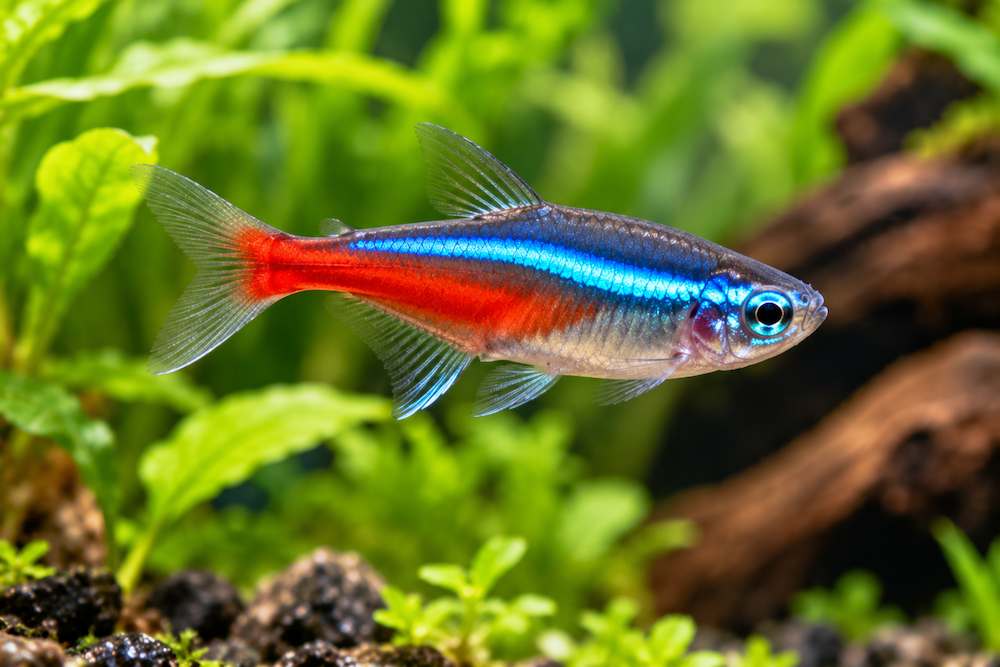







Tiny, peaceful and seemingly illuminated from within, the Neon Tetra is one of the world's most recognisable freshwater aquarium fish. Famous for its brilliant electric-blue stripe and vivid red colouring.
🧠 QUICK SNAPSHOT
| Trait | Neon Tetra |
|---|---|
| Scientific Name | Paracheirodon innesi |
| Pet Type | Freshwater tropical fish |
| Natural Origin | Amazon Basin of South America |
| Typical Lifespan | Around 3–5 years |
| Adult Size | Around 3–4 cm |
| Diet | Omnivore |
| Activity | Diurnal |
| Temperament | Peaceful and social |
| Water Type | Freshwater |
| Social Needs | High — schooling fish |
| Swimming Level | Mainly middle levels |
| Beginner Friendly? | Yes, once the aquarium is established |
| Famous Feature | Brilliant iridescent blue and red stripes |
📚 OVERVIEW
The Neon Tetra (Paracheirodon innesi) is a tiny tropical freshwater fish originating from the waterways of South America’s Amazon Basin.
Its extraordinary appearance comes from a brilliant iridescent blue stripe running along the body, contrasted against vivid red colouring towards the tail. When a school moves together through a planted aquarium, the effect can be spectacular.
Neon Tetras are peaceful social fish and shouldn’t normally be kept alone. A proper group allows them to display more natural schooling behaviour and can help them feel more secure.
They’re often recommended to new aquarium keepers, but there’s an important qualification: Neon Tetras do best in a mature, stable aquarium rather than a newly established tank experiencing rapidly changing water conditions.
✅ PROS & CONS
Pros
- Spectacular blue and red colouring
- Peaceful temperament
- Excellent community aquarium fish
- Small adult size
- Beautiful schooling behaviour
- Relatively straightforward diet
- Works wonderfully in planted aquariums
- Suitable for beginners with an established tank
Cons
- Shouldn’t be kept alone
- Sensitive to unstable water conditions
- Needs a properly cycled aquarium
- Tiny size limits suitable tank mates
- Can become stressed in inadequate groups
- Poor water quality can quickly cause problems
- Susceptible to several fish diseases
- Not ideal for brand-new, unstable aquariums
Are Neon Tetras Good Pet Fish?
Yes. Neon Tetras are excellent aquarium fish for people wanting a small, peaceful and colourful species.
Their behaviour is particularly impressive when they’re kept in an appropriately sized group.
Are Neon Tetras Good for Beginners?
Yes, with one important qualification.
Neon Tetras are relatively straightforward to care for, but they can be sensitive to sudden changes in water conditions.
They’re better introduced into a properly cycled, stable aquarium than used to establish a brand-new tank.
How Long Do Neon Tetras Live?
Neon Tetras commonly live around 3–5 years in captivity, although lifespan varies with genetics, nutrition and aquarium conditions.
Consistently good water quality is one of the most important factors supporting long-term health.
How Big Do Neon Tetras Get?
Adult Neon Tetras usually reach only around 3–4 cm long.
Their small size allows a school to create an impressive visual display without requiring the enormous aquarium needed by larger schooling species.
How Many Neon Tetras Should Be Kept Together?
Neon Tetras are schooling fish and should be kept in a proper group rather than individually or as a pair.
Six is often regarded as a minimum starting point, but larger groups can produce more natural behaviour and a far more impressive schooling effect when aquarium size permits.
Why Do Neon Tetras Need to Live in Schools?
Schooling provides security.
For a tiny fish that naturally lives around many others of its own kind, being isolated can be stressful.
A larger group also allows the coordinated swimming behaviour that makes Neon Tetras so fascinating to watch.
What Do Neon Tetras Eat?
Neon Tetras are omnivores.
A good-quality appropriately sized tropical fish food can form the basis of their diet, supplemented with suitable small frozen or live foods for variety.
Because their mouths are tiny, food needs to be appropriately sized.
How Often Should Neon Tetras Be Fed?
Small portions once or twice daily can suit many aquariums.
The fish should consume the food promptly.
Overfeeding can contribute to poor water quality, so more food isn’t necessarily better care.
What Temperature Do Neon Tetras Need?
Neon Tetras are tropical fish and generally do well in warm, stable water in the low-to-mid 20s°C.
Avoid rapid temperature fluctuations.
The needs of every species in a community aquarium should be considered when selecting the final temperature.
Do Neon Tetras Need a Heater?
In environments where aquarium water won’t naturally remain within an appropriate stable tropical range, a heater is generally required.
A reliable aquarium thermometer should be used to monitor the actual water temperature.
Do Neon Tetras Need a Filter?
Yes.
A suitable filter provides mechanical water movement and, importantly, supports the beneficial bacteria responsible for biological filtration.
These bacteria help process potentially toxic waste products produced within the aquarium.
Do Neon Tetras Need a Cycled Aquarium?
Yes.
A properly cycled aquarium has established populations of beneficial bacteria capable of processing ammonia and nitrite.
Neon Tetras can be sensitive to poor or unstable water quality, making an established biological cycle particularly important.
Do Neon Tetras Like Plants?
Yes. A planted aquarium can provide an excellent environment for Neon Tetras.
Plants create cover, shaded areas and visual security, while darker surroundings can make their remarkable colours appear even more dramatic.
They should still have open areas for swimming.
Why Do Neon Tetras Glow?
Neon Tetras don’t actually produce their own light.
Their spectacular blue stripe is iridescent, meaning microscopic structures interact with and reflect incoming light.
The result can make the fish appear almost electrically illuminated as it changes position.
Do Neon Tetras Glow in the Dark?
No.
Despite their neon appearance, they’re not bioluminescent and don’t generate light.
Their brilliant stripe needs external light to create its characteristic shimmering effect.
Why Do Neon Tetras Lose Their Colour at Night?
Neon Tetras can appear noticeably duller when resting or when aquarium lighting is off.
Their brilliant colours may become much less obvious during darkness and then intensify again after normal daytime activity resumes.
A temporary nighttime colour change can therefore be normal.
Can Neon Tetras Live With Other Fish?
Yes. They’re popular community fish because of their peaceful temperament.
Good companions are generally small, non-aggressive species with compatible water requirements.
Their tiny size means large predatory fish are unsuitable.
Can Neon Tetras Live With Guppies?
They can sometimes share an aquarium successfully when water conditions and other requirements are compatible.
However, the ideal water chemistry preferences of the two species aren’t identical, so the aquarium should be managed within conditions suitable for both.
Can Neon Tetras Live With Bettas?
Sometimes.
A calm Betta may coexist successfully with Neon Tetras in an appropriately sized and structured aquarium, but individual Betta temperament varies considerably.
Any signs of chasing or aggression need to be taken seriously.
Do Neon Tetras Fight?
They’re generally peaceful, although occasional chasing or minor social interactions can occur.
Persistent aggression can be associated with inappropriate group size, inadequate space or other environmental stressors.
Why Are My Neon Tetras Hiding?
Hiding can result from stress, insufficient group size, inappropriate tank mates, bright lighting or unsuitable water conditions.
Newly introduced fish may also hide temporarily while becoming accustomed to their environment.
Why Is My Neon Tetra Swimming Alone?
An individual may temporarily separate from the school, but persistent isolation can sometimes indicate stress or illness.
Check water quality and watch carefully for changes in colour, appetite, breathing or swimming behaviour.
What Is Neon Tetra Disease?
Neon Tetra disease is a serious condition associated with the parasite Pleistophora hyphessobryconis.
Affected fish may develop symptoms including colour loss, abnormal swimming, body changes and progressive deterioration.
Similar symptoms can have other causes, so suspected disease should be assessed carefully rather than diagnosed from one sign alone.
Why Is My Neon Tetra Losing Colour?
Colour loss can occur because of stress, darkness, poor water conditions or illness.
Normal nighttime fading should improve when the fish becomes active again.
Persistent colour loss accompanied by behavioural changes deserves investigation.
What Is the Difference Between a Neon Tetra and a Cardinal Tetra?
The two species look remarkably similar.
The easiest visual clue is usually the red stripe.
In the Neon Tetra, red colouring mainly covers the rear portion of the body. In the Cardinal Tetra, the red stripe extends much farther forward along the body.
Can Neon Tetras Breed in an Aquarium?
Yes, but breeding Neon Tetras is more challenging than keeping them.
They are egg scatterers, and successful breeding generally requires carefully managed water conditions.
Adults may eat eggs, so breeders typically use a dedicated setup.
Where Do Neon Tetras Come From?
Neon Tetras originate from freshwater habitats within South America’s Amazon Basin, particularly dark or shaded forest waterways.
Their brilliant reflective colouring is especially striking against these naturally subdued environments.
Should Neon Tetras Ever Be Released Into the Wild?
No.
Aquarium fish should never be released into natural waterways.
Released animals may die, spread disease or potentially affect native ecosystems.
If fish can no longer be kept, responsible rehoming should be arranged instead.
Are Neon Tetras Good First Fish?
Yes — particularly once the aquarium itself is ready.
That’s the important distinction.
The Neon Tetra may be beginner-friendly, but a brand-new aquarium isn’t automatically fish-friendly.
Establish the biological cycle, stabilise the environment and then introduce an appropriate group.
Healthy water comes before beautiful fish.
What Makes the Neon Tetra Unique?
Turn off the aquarium lights and the Neon Tetra looks like a tiny fish.
Turn them back on and something remarkable happens.
Electric blue suddenly flashes across its body.
But the fish isn’t producing light.
Microscopic structures within its reflective stripe manipulate incoming light, creating that extraordinary neon-like appearance.
Now multiply the effect.
One Neon Tetra is beautiful.
Ten moving together can look like tiny streaks of blue light travelling through the aquarium.
And schooling isn’t simply for our enjoyment.
For a fish only a few centimetres long, there’s safety in numbers. Coordinated movement can make it harder for a predator to focus on one individual.
So that spectacular aquarium display has much deeper origins.
It’s colour, communication and survival wrapped into one tiny fish.
The Neon Tetra doesn’t need to glow in the dark. In the light, it already looks electric.
Discover why Neon Tetras appear to glow, why their colours change at night, how schooling helps these tiny fish survive and how to tell a Neon Tetra from its famous Cardinal Tetra cousin.
Watch our Neon Tetra video and discover what makes this tiny freshwater fish one of the aquarium world’s most spectacular sights.