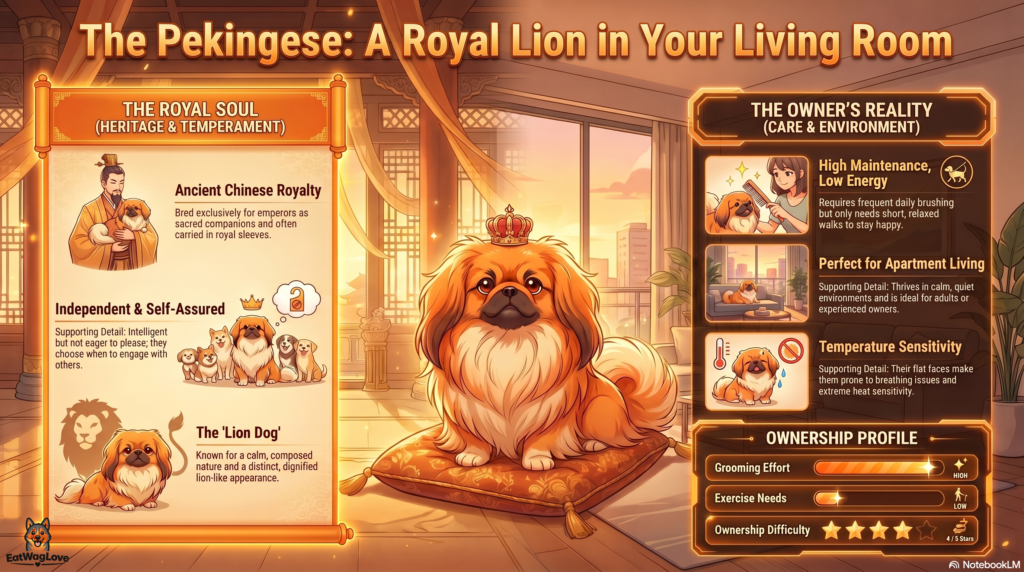







Regal, loyal, and full of character — a small companion with a proud and independent spirit.
🧠 QUICK SNAPSHOT
- Temperament: Loyal, independent, affectionate
- Energy Level: Low
- Size: Small
- Good With Families: Yes (with gentle handling)
- Trainability: Moderate to low
- Grooming: High
- Best For: Calm households, companionship
📚 OVERVIEW
The Pekingese is an ancient breed with a royal history, originally bred to be companions for Chinese nobility. Known for their distinctive long coat and proud posture, they carry themselves with confidence and dignity.
They form strong bonds with their owners but tend to be more independent than many other small breeds.
✅ PROS & CONS
Pros
- Loyal and devoted
- Low exercise needs
- Great for quieter homes
- Unique and regal appearance
Cons
- High grooming requirements
- Can be stubborn
- Sensitive to heat
- Needs gentle handling
Is a Pekingese a Good Family Dog?
Yes. A Pekingese can be an affectionate, loyal and devoted family companion, particularly in a relatively calm household.
They’re famous for their dignified, independent personality and often form extremely strong bonds with their owners. However, they’re less tolerant of rough handling than many larger family breeds.
The Pekingese suits people looking for a small companion with plenty of personality rather than a highly energetic dog.
Are Pekingese Good With Children?
Pekingese can live happily with respectful children, but they’re generally better suited to older children.
Their small size makes them vulnerable to accidental injury, and some Pekingese dislike rough handling or being constantly picked up.
Young children should always be supervised around them.
How Much Exercise Does a Pekingese Need?
Most Pekingese need around 20–40 minutes of gentle exercise each day, divided into manageable walks and play sessions.
They’re considerably less energetic than many terriers or sporting breeds.
Because of their flat faces, strenuous exercise and hot-weather activity should be avoided.
Is a Pekingese Easy to Train?
Pekingese are intelligent but can be independent and strong-minded.
They were developed primarily as companions rather than dogs expected to follow constant working commands.
Positive reinforcement and short, interesting training sessions usually work best.
Are Pekingese Difficult to Toilet Train?
They can sometimes take longer to house train than highly biddable working breeds.
Consistency, frequent opportunities outside and positive reinforcement are important.
Their small bladders also mean puppies need frequent toilet breaks.
Does a Pekingese Shed?
Yes. Pekingese can shed quite heavily, particularly if they have a full traditional coat.
Their long outer coat is combined with a dense undercoat.
Regular brushing removes loose hair before it accumulates around the home or forms tangles.
Is a Pekingese Hypoallergenic?
No.
Pekingese aren’t considered hypoallergenic and can shed substantial amounts of hair.
Like other dogs, they also produce allergens through skin flakes and saliva.
How Often Should You Groom a Pekingese?
A full-coated Pekingese should generally be brushed several times each week, with some dogs benefiting from daily attention.
Particular care is needed around the ears, legs, tail and other areas prone to tangling.
Facial folds, eyes, nails and teeth also require regular care.
Can You Give a Pekingese a Short Haircut?
Yes. Many pet Pekingese are kept in shorter trims because they’re easier to maintain.
A short pet trim won’t produce the traditional show appearance, but it can substantially reduce grooming demands.
The skin still needs protection from excessive sun and temperature extremes.
What Health Problems Are Common in Pekingese?
Important health concerns include brachycephalic obstructive airway syndrome (BOAS), eye problems, patellar luxation, spinal disease, heart conditions and dental disease.
Their prominent eyes are particularly vulnerable to injury, while their short muzzle can cause breathing and heat-regulation difficulties.
Responsible breeding should prioritise functional breathing, healthy eyes and sound structure rather than increasingly exaggerated features.
Do Pekingese Have Breathing Problems?
Some do.
The Pekingese is a brachycephalic, or flat-faced, breed, which can result in narrowed airways and BOAS.
Warning signs include persistent noisy breathing, excessive panting, gagging, exercise intolerance, disturbed sleep or difficulty recovering after activity.
Breathing difficulty shouldn’t simply be accepted as normal because the dog is a Pekingese.
Why Do Pekingese Snore?
Their shortened facial structure can make snoring relatively common.
However, loud snoring combined with laboured breathing, sleep disruption, gagging or exercise intolerance can indicate an airway problem.
A veterinarian should assess significant respiratory symptoms.
Are Pekingese Prone to Eye Problems?
Yes.
Their large, prominent eyes can be vulnerable to corneal ulcers, trauma, dry eye and other ophthalmic problems.
Hair and facial folds around the eyes should be kept clean, and squinting, redness, cloudiness or excessive discharge deserves prompt veterinary attention.
Are Pekingese Prone to Back Problems?
They can be.
Their body structure can increase susceptibility to spinal problems, including intervertebral disc disease (IVDD).
Maintaining a healthy weight and reducing repeated high-impact jumping may help protect the spine and joints.
How Long Does a Pekingese Live?
Pekingese commonly live around 12–14 years, with some living longer.
Maintaining healthy weight, good dental care and appropriate veterinary monitoring can contribute to longevity.
Breathing and structural health are particularly important.
How Big Does a Pekingese Get?
Pekingese are small dogs, commonly weighing around 3–6 kg and standing approximately 15–23 cm tall.
Their enormous coat can make them look considerably larger than the body underneath.
Despite their size, they should feel surprisingly solid rather than extremely fragile.
Is There a Teacup Pekingese?
There is no officially recognised Teacup Pekingese variety.
The term is commonly used as a marketing description for unusually small dogs.
Extreme miniaturisation can increase risks such as fragile bones, dental crowding and other health problems.
What Is a Sleeve Pekingese?
“Sleeve Pekingese” is a historical term associated with exceptionally small Pekingese.
According to breed tradition, very small dogs could be carried in the large sleeves of robes within China’s imperial court.
The term survives today, but Sleeve Pekingese isn’t a separate modern breed.
Can a Pekingese Live in an Apartment?
Yes. The Pekingese can make an excellent apartment dog.
They require relatively little physical space and don’t need enormous amounts of exercise.
Owners still need to provide daily walks, play, companionship and mental stimulation.
Can a Pekingese Be Left Alone?
Adult Pekingese can usually learn to tolerate reasonable periods alone.
However, they’re companion dogs that often become strongly attached to particular people.
Gradual independence training from puppyhood can help prevent excessive dependence.
Are Pekingese Cuddly?
Many are very affectionate, particularly with their favourite people.
However, some prefer affection on their own terms rather than being constantly handled.
The breed often combines genuine devotion with an unusually independent personality for such a small companion dog.
Do Pekingese Bark a Lot?
They can be quite vocal.
Pekingese are alert dogs and often bark when people approach the home or when something unusual happens.
Early training can help prevent alert barking from becoming excessive.
Are Pekingese Aggressive?
Aggression isn’t a desirable breed characteristic, but Pekingese can be confident, independent and assertive.
Poor socialisation, fear or repeatedly ignoring a dog’s boundaries can contribute to defensive behaviour.
Their small size shouldn’t be used as an excuse to neglect normal training and socialisation.
Are Pekingese Good With Other Dogs?
Many are, particularly when properly socialised.
Their confidence can occasionally lead them to challenge dogs much larger than themselves.
Interactions with powerful dogs should therefore be supervised carefully.
Are Pekingese Good With Cats?
Generally, they can be.
Pekingese were primarily bred as companions rather than high-prey-drive hunting dogs.
Careful introductions and early socialisation can make them suitable companions for cats.
Can Pekingese Handle Hot Weather?
Not particularly well.
Their flat faces and heavy coats make heat management especially important.
During hot Australian weather, exercise should be restricted to cooler periods, with reliable access to shade, water and air-conditioned or otherwise cool indoor areas.
Do Pekingese Like Cold Weather?
Their dense double coat gives them considerably better protection against cold than heat.
Many tolerate cool conditions well.
Their small size still means prolonged exposure to extreme cold isn’t appropriate.
What Does a Pekingese Look Like?
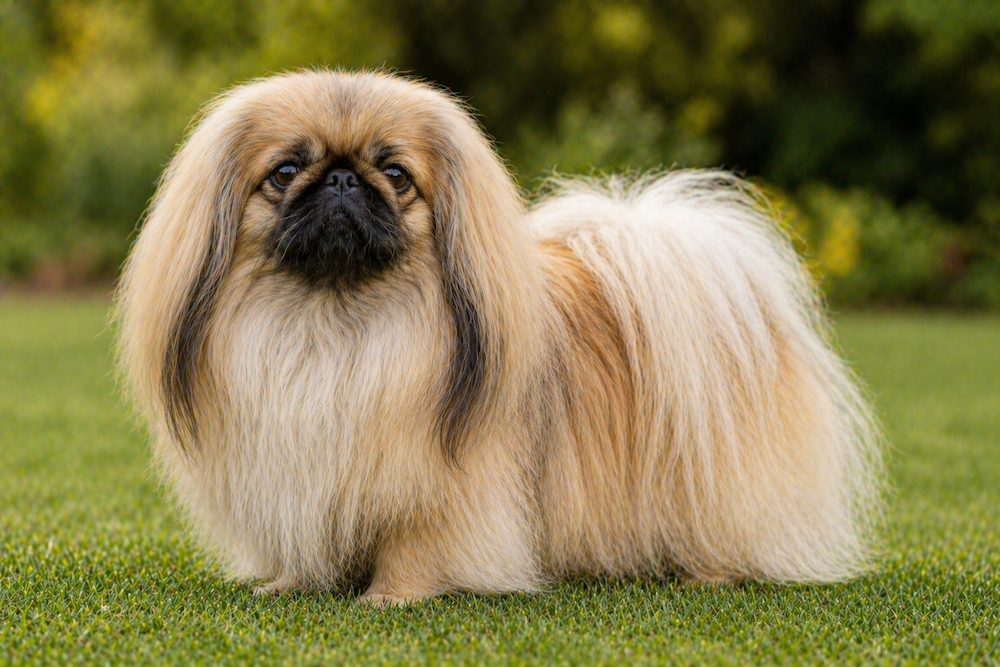
The Pekingese is a small, compact dog with a broad head, short muzzle, large eyes, long flowing coat and heavily feathered tail carried over the back.
The hair around the shoulders can form a distinctive mane, contributing to the breed’s famous lion-like appearance.
Despite its tiny stature, the traditional Pekingese should have a sturdy, substantial body.
Why Does a Pekingese Look Like a Lion?
The Pekingese’s broad head and heavy mane of hair around its neck and shoulders create a striking resemblance to a small lion.
That appearance became deeply connected with Chinese symbolism and breed folklore.
The resemblance also contributed to historical names such as Lion Dog.
What Colours Can Pekingese Be?
Pekingese occur in a very wide variety of colours, including red, fawn, cream, black, grey, sable and parti-colour combinations.
Black facial masks are common.
Colour is far less important than health, structure and temperament when choosing a dog.
Can a Pekingese Be White?
Yes.
White and very pale cream Pekingese occur.
As with any dog, pigmentation and hearing or eye health should be considered independently rather than assuming a particular colour automatically indicates a problem.
What Is the Difference Between a Pekingese and a Shih Tzu?
Both are small Asian companion breeds, but they’re distinct breeds with different histories and structure.
The Pekingese generally has a broader, flatter face, heavier front and more pronounced lion-like appearance, while the Shih Tzu typically has a somewhat different body shape and coat presentation.
Both require substantial grooming and can experience brachycephalic health problems.
What Is the Difference Between a Pekingese and a Japanese Chin?
Both are ancient East Asian companion breeds, but they’re distinct.
The Japanese Chin is generally lighter and more refined in build, while the Pekingese is more substantial and characteristically lion-like.
Their historical development also occurred through different royal and aristocratic traditions.
Where Does the Pekingese Come From?
The Pekingese comes from China, where small lion-like companion dogs were associated with the imperial court for centuries.
Dogs of this general type were highly prized and selectively bred as palace companions.
The modern Western pedigree population developed after Pekingese were taken from China to Britain during the 19th century.
Is the Pekingese an Ancient Dog Breed?
The Pekingese has a genuinely long history as part of China’s tradition of small imperial companion dogs.
Genetic research also places the breed among dog populations with deep historical roots.
However, today’s precisely standardised pedigree Pekingese is a much more recent creation than the ancient dogs from which it developed.
Why Were Pekingese Kept by Chinese Royalty?
Their primary role was companionship within the imperial court.
Small lion-like dogs held considerable cultural prestige and were closely associated with elite households.
Unlike many European breeds, the Pekingese wasn’t developed primarily to hunt, herd livestock or guard farms.
Its job was essentially to be an important companion.
Why Is the Pekingese Called a Lion Dog?
Buddhist lions held important symbolic significance in Chinese culture, despite actual lions not being native to China.
Small dogs were selectively bred and celebrated for their lion-like appearance.
The Pekingese’s mane, broad head and confident bearing made the association particularly strong.
Is the Pekingese Related to the Tibetan Spaniel or Shih Tzu?
These breeds share broader historical connections among the small companion dogs of China and Tibet.
Exactly how ancient populations contributed to each modern breed is difficult to reconstruct.
They shouldn’t simply be treated as different sizes or coat variations of one breed, however; each developed its own modern identity.
How Did the Pekingese Come to Europe?
The major turning point occurred in 1860, when British and French forces entered Beijing during the Second Opium War.
Several Pekingese were found within the imperial palace complex and taken to Britain.
These dogs became important to the breed’s subsequent development and popularity in the West.
Did Queen Victoria Own a Pekingese?
Yes.
One of the Pekingese taken to Britain in 1860 was presented to Queen Victoria, who named the dog Looty.
Looty became one of the most historically famous early Pekingese in Britain and helped draw attention to the previously little-known Chinese palace dogs.
Did a Pekingese Survive the Titanic?
Yes. A Pekingese named Sun Yat-Sen, owned by Henry and Myra Harper, was among the dogs known to have survived the sinking of the Titanic in 1912.
The dog escaped with its owners aboard a lifeboat.
It’s one of the more remarkable and well-documented stories associated with the breed.
Why Does My Pekingese Follow Me Everywhere?
The Pekingese was bred for centuries primarily as a human companion.
Strong attachment to an owner is therefore completely consistent with its historical purpose.
Many choose a favourite person and become particularly devoted to them.
Why Does My Pekingese Sit and Stare at Me?
Pekingese are observant companion dogs that become very good at reading household routines.
Staring may be a request for attention, food, a walk or simply a way of monitoring what their favourite person is doing.
Their dignified expression can make even an ordinary request appear surprisingly serious.
Why Is My Pekingese So Stubborn?
What owners describe as stubbornness often reflects the breed’s independent temperament.
Pekingese weren’t developed to take constant instructions from a handler in the way many working breeds were.
They can learn very quickly while still deciding whether cooperation is currently worthwhile.
Is a Pekingese a Good Dog for Older People?
Often, yes.
Their small size, moderate exercise needs and affectionate temperament can make them excellent companions for older owners.
Grooming requirements, veterinary considerations and the risk of tripping over a small dog that follows closely should still be considered.
Is a Pekingese a Good First Dog?
Potentially, yes.
Pekingese don’t require enormous amounts of exercise and can adapt well to smaller homes.
First-time owners should nevertheless be prepared for extensive grooming, dental care, independent behaviour and potentially significant brachycephalic health issues.
What Makes the Pekingese Unique?
Few dogs have a history quite like the Pekingese.
For centuries, its ancestors lived not on farms or hunting estates but within the world of China’s imperial court. Their job was companionship, and their lion-like appearance became intertwined with Chinese cultural symbolism.
The breed’s tiny size could be deceptive.
Historical accounts celebrated extremely small “sleeve dogs”, while larger palace dogs developed the broad head, mane and extraordinary self-confidence still associated with the Pekingese.
Then history changed dramatically.
In 1860, Pekingese taken from Beijing’s imperial palace reached Britain. One was presented to Queen Victoria and became known as Looty, helping introduce the breed to the Western world.
The modern Pekingese still carries something of that palace-dog personality.
It can be loving without being submissive, tiny without behaving fragile, and intelligent without feeling any particular obligation to obey every instruction.
Its physical exaggerations also mean modern breeding has an important responsibility: healthy breathing, functional movement and sound eyes should matter more than producing the flattest possible face or heaviest possible coat.
The Pekingese was bred to resemble a little lion.
After centuries of being treated like royalty, nobody seems to have convinced it otherwise.