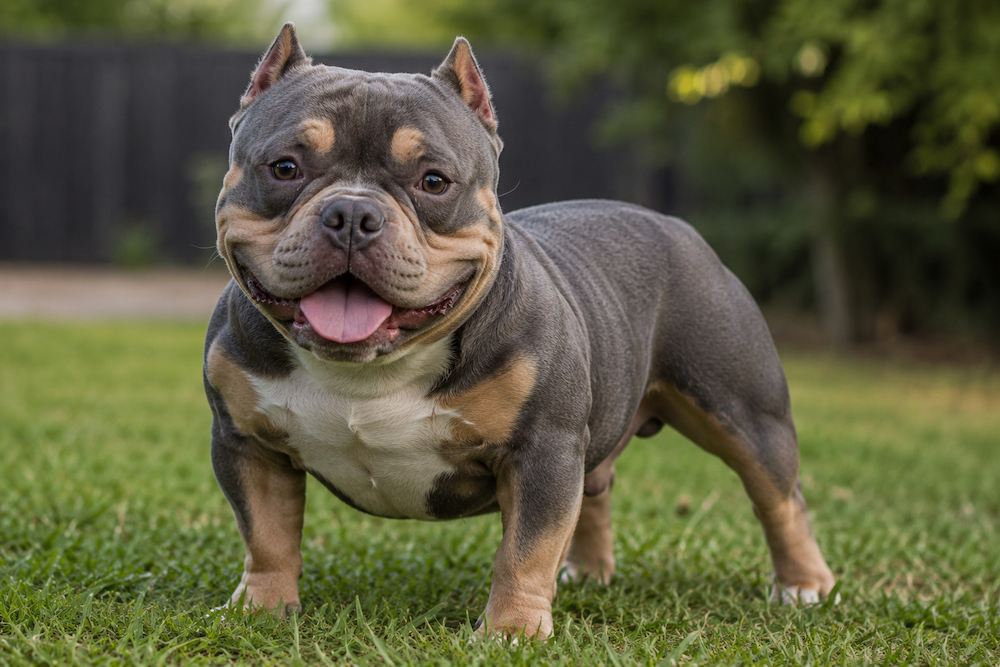







Compact, muscular, and incredibly affectionate — a powerful-looking dog with a gentle, family-friendly nature.
🧠 QUICK SNAPSHOT
- Temperament: Friendly, loyal, affectionate
- Energy Level: Moderate
- Size: Small to medium (compact build)
- Good With Families: Yes
- Trainability: Moderate
- Grooming: Low
- Best For: Families, companionship, indoor living
📚 OVERVIEW
The Pocket Bully is a smaller version of the American Bully, bred for a compact size while maintaining a strong, muscular build. Despite their tough appearance, they are known for their gentle and affectionate personality.
They are highly people-oriented dogs that thrive on attention and companionship.
✅ PROS & CONS
Pros
- Very affectionate and people-focused
- Great with families and children
- Compact but strong build
- Low grooming requirements
Cons
- Needs proper training and socialisation
- Can be stubborn
- Requires responsible ownership
- May face breed restrictions in some areas
Is a Pocket Bully a Good Family Dog?
A well-bred and well-socialised Pocket Bully can be an affectionate, confident and people-oriented family companion.
Despite its powerful appearance, the American Bully was developed primarily as a companion breed rather than specifically for traditional working or fighting roles.
Temperament still varies between individual dogs, so responsible breeding, early socialisation and consistent training are important.
Are Pocket Bullies Good With Children?
They can be very good with children when properly bred, trained and socialised.
Pocket Bullies are compact but extremely muscular, so they can accidentally knock over small children during enthusiastic play.
As with any powerful dog, interactions with young children should be supervised.
How Much Exercise Does a Pocket Bully Need?
Most Pocket Bullies benefit from around 45–60 minutes of moderate daily exercise, although individual needs vary.
Walks, controlled play and training sessions are generally better than prolonged high-impact exercise.
Their heavy, muscular build means they’re not designed for extreme endurance activity.
Is a Pocket Bully Easy to Train?
Generally, yes.
Pocket Bullies are often intelligent, food-motivated and strongly interested in their owners.
Early obedience training is particularly important because even a relatively short Pocket Bully can be physically powerful.
Positive reinforcement and consistency usually produce the best results.
Does a Pocket Bully Shed?
Yes, but generally only lightly to moderately.
Their coat is short, smooth and relatively easy to maintain.
Regular brushing can remove loose hairs and help keep the skin and coat healthy.
Is a Pocket Bully Hypoallergenic?
No.
Pocket Bullies aren’t hypoallergenic.
Although their short coat requires relatively little grooming, they still produce allergens through skin flakes, saliva and other secretions.
How Often Should You Groom a Pocket Bully?
Usually once a week is sufficient for coat care.
Regular nail trimming, ear cleaning when needed and dental care are also important.
Dogs with pronounced skin folds may need additional cleaning to prevent irritation or infection.
What Health Problems Are Common in Pocket Bullies?
Potential concerns include hip and elbow dysplasia, patellar problems, skin allergies, eye conditions and certain heart problems.
Some exaggerated Bully lines can also experience breathing, spinal and mobility problems.
Health varies substantially because breeding practices within the wider Bully community aren’t uniform. Prospective owners should prioritise health-tested parents and functional structure rather than extremely exaggerated appearance.
Do Pocket Bullies Have Breathing Problems?
Some do, particularly dogs bred with very short muzzles, broad heads and exaggerated facial structure.
A healthy Pocket Bully shouldn’t struggle to breathe during normal activity.
Persistent noisy breathing, poor heat tolerance, exercise intolerance or prolonged recovery after exercise should be investigated by a veterinarian.
How Long Does a Pocket Bully Live?
Pocket Bullies are often reported to live around 10–13 years, although reliable large-scale lifespan data specifically for the Pocket variety are limited.
Genetics, body condition, structural health and responsible breeding can all have substantial effects on longevity.
How Big Does a Pocket Bully Get?
The term Pocket refers primarily to height, not an extremely tiny dog.
Under the American Bully Kennel Club (ABKC) standard, adult male Pocket Bullies are generally under 17 inches (43 cm) but no less than 14 inches (36 cm) at the withers. Females are generally under 16 inches (40 cm) but no less than 13 inches (33 cm).
They can still be remarkably heavy and muscular for their height.
When Is a Pocket Bully Fully Grown?
Most reach close to their adult height at around 12–18 months, but they may continue developing muscle and filling out until approximately two to three years old.
Trying to force rapid muscular development through excessive feeding or inappropriate exercise can place unnecessary strain on developing joints.
Is a Pocket Bully the Smallest American Bully?
Within the ABKC’s established American Bully size varieties, Pocket is the shortest recognised variety.
However, terms such as Micro Bully, Exotic Bully and Nano Bully are also widely used by breeders and sellers.
These shouldn’t automatically be treated as simply smaller versions of the recognised Pocket American Bully.
Is a Pocket Bully the Same as a Micro Bully?
No.
“Micro Bully” is commonly used for dogs bred to be even shorter and more exaggerated than Pocket Bullies, but it isn’t simply another name for the established Pocket variety.
Extremely short legs, oversized heads and exaggerated body proportions can also create additional health and welfare concerns.
Is There a Teacup Pocket Bully?
There is no standard Teacup Pocket Bully variety.
Terms such as “teacup”, “nano” and “micro” are often marketing descriptions used for exceptionally small Bully-type dogs.
Smaller doesn’t automatically mean healthier or more valuable.
Can a Pocket Bully Live in an Apartment?
Yes, provided its exercise and training needs are met.
Their relatively short stature makes them physically manageable in smaller homes, although they’re much heavier and stronger than many similarly tall dogs.
Daily outdoor exercise remains essential.
Can a Pocket Bully Be Left Alone?
Adult Pocket Bullies can learn to tolerate reasonable periods alone, but many are strongly people-oriented.
Insufficient exercise, boredom or excessive isolation can contribute to destructive behaviour.
Gradual independence training is useful from puppyhood.
Are Pocket Bullies Cuddly?
Many are extremely affectionate.
The American Bully was developed heavily around companionship, and many individuals actively seek physical contact with their owners.
It’s worth remembering that a muscular dog attempting to become a lap dog doesn’t necessarily accept that the lap has a maximum weight capacity.
Do Pocket Bullies Bark a Lot?
Generally, they’re not known as exceptionally vocal dogs.
Individuals may bark at visitors, unfamiliar noises or when excited.
Excessive barking is more likely to reflect individual temperament, boredom or environment than an essential Pocket Bully characteristic.
Are Pocket Bullies Aggressive?
Aggression toward people isn’t the desired temperament of the American Bully.
A properly bred American Bully should be confident, stable and companion-oriented.
However, breed labels never guarantee individual behaviour. Genetics, socialisation, training and previous experiences all matter, and a physically powerful dog requires responsible handling regardless of breed reputation.
Are Pocket Bullies Good With Other Dogs?
Many can live successfully with other dogs, particularly when socialised carefully from puppyhood.
Individual compatibility varies, and some dogs may become selective as they mature.
Because Pocket Bullies are physically powerful, owners should take early socialisation and controlled introductions seriously.
Are Pocket Bullies Good With Cats?
Some live very successfully with cats, particularly when raised together.
Prey drive varies between individuals and bloodlines.
Introductions should be gradual and supervised rather than assuming compatibility based solely on breed.
Can Pocket Bullies Handle Hot Weather?
Care is required in hot weather.
Their muscular build can generate considerable heat, while dogs with shortened muzzles may be less efficient at cooling themselves through panting.
During hot Australian conditions, exercise should be scheduled for cooler parts of the day.
Can Pocket Bullies Swim?
Some can swim, but they shouldn’t automatically be assumed to be strong swimmers.
A broad chest, heavy musculature and relatively short legs can make swimming difficult for some individuals.
Close supervision and a properly fitted canine flotation vest are sensible around deep water.
What Does a Pocket Bully Look Like?
A Pocket Bully should be a short, compact, heavily muscled dog with a broad chest, substantial head and powerful overall appearance.
Importantly, “Pocket” shouldn’t mean distorted.
Extreme features that interfere with breathing, movement, vision or normal physical function shouldn’t be considered desirable simply because they create a more dramatic appearance.
What Colours Can Pocket Bullies Be?
Pocket Bullies occur in a very wide variety of colours and patterns, including black, blue, fawn, red, chocolate, brindle and combinations with white.
Colour terminology can become particularly complicated in Bully breeding.
Health, temperament and sound structure should take priority over fashionable or supposedly “rare” colours.
Can a Pocket Bully Be Merle?
Merle Pocket Bullies do exist, although merle has been controversial within Bully breeding and recognition systems.
The major health concern occurs when two merle dogs are bred together, substantially increasing the risk of puppies inheriting two copies of the merle variant and associated hearing and eye abnormalities.
Colour breeding should never take priority over health.
What Is the Difference Between a Pocket Bully and an American Bully?
A Pocket Bully is an American Bully.
“Pocket” describes a height variety rather than an entirely separate breed.
It should retain the fundamental characteristics of the American Bully while standing shorter than the standard-sized variety.
What Is the Difference Between a Pocket Bully and an American Pit Bull Terrier?
They’re distinct breed populations.
The American Pit Bull Terrier (APBT) is generally more athletic, lighter and functionally built, while the American Bully was developed later with a heavier, broader companion-dog appearance.
The APBT contributed importantly to the American Bully’s ancestry, but the modern American Bully shouldn’t simply be described as a short Pit Bull.
What Is the Difference Between a Pocket Bully and a Staffordshire Bull Terrier?
They’re different dogs with different breed histories.
The Staffordshire Bull Terrier is an established British breed with its own standard and lineage.
The Pocket Bully is a size variety of the much more recently developed American Bully.
Their compact muscular appearance can cause confusion, but one isn’t simply another name for the other.
What Is the Difference Between a Pocket Bully and an Exotic Bully?
The terms aren’t interchangeable.
The Pocket Bully belongs to the established American Bully type and is principally defined by its shorter height.
“Exotic Bully” is generally used for more heavily exaggerated Bully-type dogs developed through separate breeding directions, often featuring extremely short stature, broad bodies and more pronounced physical features.
Where Does the Pocket Bully Come From?
The Pocket Bully comes from the broader American Bully, which was developed in the United States during the late 20th century.
American Pit Bull Terrier and American Staffordshire Terrier bloodlines played major roles in its development, with breeders selecting progressively for a broader, heavier companion dog.
Other bulldog-type influences have also been associated with portions of the wider American Bully population.
The Pocket variety was subsequently developed around the same general type at a shorter height.
Why Was the American Bully Created?
The American Bully was developed primarily to produce a powerful-looking but companion-oriented dog.
Breeders emphasised substantial bone, broad heads, muscular bodies and confident temperament.
Over time, different size varieties emerged, including the Pocket type.
Is the Pocket Bully a Purebred Dog?
This depends partly on what is meant by “purebred”.
The American Bully is recognised as a breed by organisations including the United Kennel Club (UKC) and specialist Bully registries, with Pocket recognised as a variety within some systems.
However, recognition differs between kennel organisations internationally, and the American Bully isn’t recognised by every major national kennel club.
Is a Pocket Bully a Pit Bull?
Calling every Pocket Bully a “Pit Bull” is imprecise.
American Pit Bull Terriers contributed substantially to American Bully ancestry, and both belong to the broader family of bull-type dogs.
However, the American Bully has been developed as a separate modern breed with a substantially different desired structure and emphasis.
Is a Pocket Bully Legal in Australia?
This is an important question because Australian dog laws can involve breed identification, import restrictions and state or territory legislation concerning restricted dogs.
The legal treatment of a dog can depend on its actual breed, ancestry, identification and jurisdiction rather than simply what a breeder calls it.
Anyone importing, buying or moving interstate with an American Bully-type dog should check the current federal import requirements and the rules applying in their state or territory rather than relying on the label “Pocket Bully”.
Is a Pocket Bully a Good First Dog?
Potentially, but it requires commitment.
Pocket Bullies can be affectionate and trainable, but they’re physically powerful dogs despite their short stature.
A first-time owner should be prepared for early socialisation, obedience training, careful weight management and potentially significant health considerations depending on the dog’s breeding.
What Makes the Pocket Bully Unique?
The most important thing to understand about the Pocket Bully is hidden in its name.
Pocket doesn’t mean tiny.
It describes a shorter American Bully that should retain the substantial body, broad head and muscular appearance associated with the breed.
The American Bully itself is relatively modern, emerging in the United States from bull-type dog populations with major American Pit Bull Terrier and American Staffordshire Terrier influence. Breeders increasingly selected for a powerful appearance combined with a companion-oriented temperament.
That eventually produced several different sizes and styles.
Unfortunately, demand for increasingly dramatic dogs has also encouraged some breeders to push beyond functional structure — producing extremely short legs, enormous heads, excessively broad bodies or very short muzzles.
That’s why prospective owners should distinguish a functional Pocket American Bully from increasingly exaggerated “Micro”, “Nano” or Exotic types.
The best Pocket Bully shouldn’t merely look powerful.
It should still be able to breathe, walk, run, play and live comfortably like a dog.