






Cute, energetic, and full of personality — a striking companion with a playful spirit and bold attitude.
🧠 QUICK SNAPSHOT
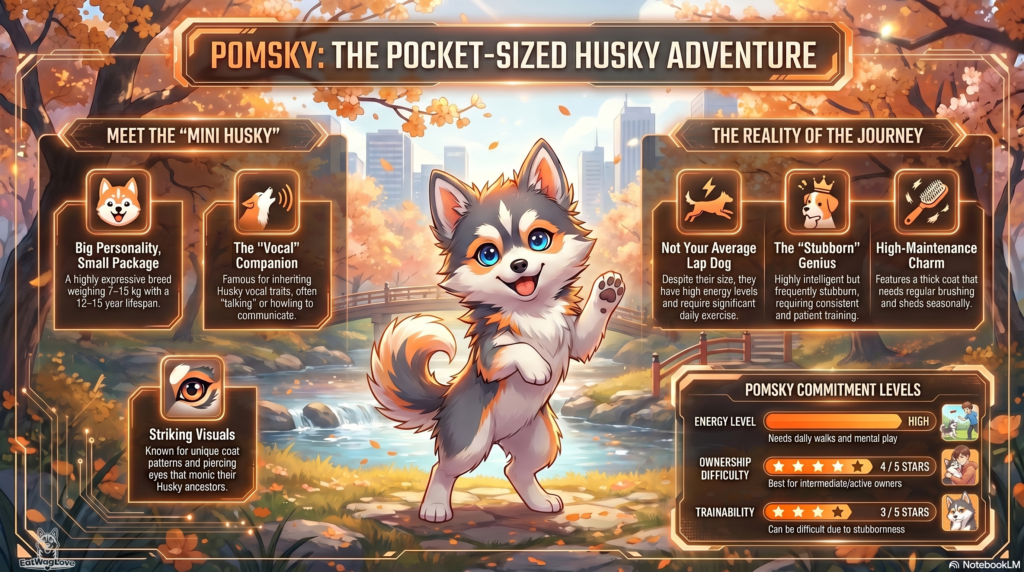
- Temperament: Playful, intelligent, alert
- Energy Level: High
- Size: Small to medium
- Good With Families: Yes
- Trainability: Moderate
- Grooming: Moderate to high
- Best For: Active owners and engaged households
📚 OVERVIEW
The Pomsky is a cross between a Pomeranian and a Siberian Husky, known for its striking looks and lively personality. Often resembling a miniature Husky, they are energetic, curious, and love being involved in daily life.
They are intelligent but can have a stubborn streak, making consistent interaction important.
✅ PROS & CONS
Pros
- Unique and eye-catching appearance
- Playful and energetic
- Loyal and engaging personality
- Compact size with big-dog presence
Cons
- Can be stubborn to train
- High energy levels
- Needs regular grooming
- Requires attention and stimulation
Is a Pomsky a Good Family Dog?
Yes. A Pomsky can be an affectionate, playful and intelligent family dog, particularly for an active household.
The Pomsky is a cross between a Siberian Husky and a Pomeranian, so temperament can vary considerably. Some are outgoing and highly energetic like Huskies, while others inherit more of the Pomeranian’s companion-dog personality.
Early socialisation and consistent training are important because both parent breeds can be independent.
Are Pomskies Good With Children?
Generally, yes, particularly with respectful children.
Larger Pomskies can be energetic and boisterous, while exceptionally small individuals may be vulnerable to rough handling.
Because Pomskies vary greatly in size, supervision should be based on the individual dog rather than assuming every Pomsky will behave the same way.
How Much Exercise Does a Pomsky Need?
Most Pomskies need around 60–90 minutes of daily exercise, although requirements vary significantly.
Dogs strongly influenced by their Siberian Husky ancestry may need considerably more activity than people expect from a relatively small dog.
Walking, running, games, training and puzzle activities can all help keep them physically and mentally satisfied.
Is a Pomsky a High-Energy Dog?
Usually, yes.
The Siberian Husky is an endurance working dog, while the Pomeranian is also surprisingly lively.
Combining them can produce a relatively compact dog with considerably more energy than its cute appearance suggests.
Is a Pomsky Easy to Train?
Pomskies are intelligent but aren’t necessarily easy to train.
Both Huskies and Pomeranians can be independent thinkers, and a Pomsky may quickly understand a command without always deciding to follow it.
Positive reinforcement, consistency and interesting training sessions work best.
Are Pomskies Difficult to Toilet Train?
They can be, particularly smaller individuals.
Consistency and frequent toilet opportunities are important during puppyhood.
A Pomsky that inherits the Husky’s independent streak may require additional patience, but there’s no reason a properly trained Pomsky can’t become reliably house trained.
Do Pomskies Shed a Lot?
Yes. Most Pomskies are moderate to very heavy shedders.
Both parent breeds have dense double coats, and seasonal shedding can be substantial.
Anyone considering a Pomsky primarily because of its attractive fluffy coat should also be prepared for that coat to appear regularly on clothing, furniture and floors.
Are Pomskies Hypoallergenic?
No.
Pomskies aren’t considered hypoallergenic.
They generally shed considerably, and dog allergens are also produced through saliva and skin secretions.
How Often Should You Groom a Pomsky?
Most Pomskies need brushing several times a week, increasing to daily during periods of heavy seasonal shedding.
Their dense undercoat can trap loose hair and develop tangles.
Regular nail trimming, dental care and ear checks should also form part of routine grooming.
Should You Shave a Pomsky?
Routine shaving isn’t recommended.
Most Pomskies inherit a double coat that provides insulation and protection.
Shaving can interfere with normal coat regrowth and doesn’t provide a reliable solution to shedding or hot-weather management.
What Health Problems Are Common in Pomskies?
Because the Pomsky is a crossbreed, it can inherit conditions occurring in either parent breed.
Potential concerns include hip dysplasia, patellar luxation, eye disorders, dental disease and certain hereditary neurological or joint conditions.
Responsible breeders should health-test both the Siberian Husky and Pomeranian parents rather than assuming crossbreeding automatically prevents inherited disease.
How Long Does a Pomsky Live?
Pomskies commonly live around 12–15 years, although reliable long-term population data are more limited than for established breeds.
Size, genetics, body weight, health screening and veterinary care can all influence lifespan.
How Big Does a Pomsky Get?
Pomsky size is highly variable.
Many adults weigh roughly 7–14 kg, but individuals can fall outside this range depending on their parents and breeding generation.
This variation isn’t surprising when one parent breed may weigh only a few kilograms while the other commonly weighs more than 20 kg.
When Is a Pomsky Fully Grown?
Most Pomskies reach close to their adult height by around 12 months, although larger individuals may continue filling out until 18 months or beyond.
Their adult coat may also continue developing after physical growth has slowed.
Is There a Mini Pomsky?
“Mini Pomsky” is commonly used by breeders, but it isn’t a universally standardised official size.
Because Pomskies already vary considerably, terms such as Mini, Toy and Micro Pomsky can mean different things between breeders.
Prospective owners should ask for actual adult weights and health information rather than relying on a size label.
Is There a Teacup Pomsky?
There is no universally recognised Teacup Pomsky variety.
The term generally describes dogs deliberately bred toward exceptionally small size.
Extreme miniaturisation can increase risks including fragile bones, dental crowding and other health problems.
Can a Pomsky Live in an Apartment?
Yes, but only if its exercise and mental-stimulation needs are met.
Their physical size can suit apartment living, but their energy, shedding and vocal behaviour can make them challenging neighbours.
A bored Pomsky in an apartment can be considerably more disruptive than a well-exercised larger dog.
Can a Pomsky Be Left Alone?
Adult Pomskies can learn to tolerate reasonable periods alone, but some struggle with extended isolation.
Siberian Huskies are highly social dogs, and Pomeranians also tend to form close relationships with their owners.
Gradual independence training is useful from puppyhood.
Are Pomskies Cuddly?
Many are extremely affectionate.
However, individual Pomskies vary from dedicated lap dogs to more independent companions.
Their Pomeranian ancestry may encourage lap-dog behaviour, while their Husky ancestry can produce a dog that’s affectionate without constantly needing physical contact.
Do Pomskies Bark a Lot?
Some do, although barking isn’t the only sound owners may encounter.
Pomeranians can be enthusiastic barkers, while Siberian Huskies are famous for howling, whining and “talking.”
A Pomsky can inherit an impressive selection from both sides.
Do Pomskies Howl?
Many do.
Howling and other vocalisations are strongly associated with Siberian Huskies.
Some Pomskies inherit the famous Husky tendency to produce an extraordinary range of conversational noises.
Are Pomskies Aggressive?
Aggression isn’t an expected characteristic of a well-bred, properly socialised Pomsky.
However, temperament isn’t completely predictable in any crossbreed.
Genetics, early socialisation, training and individual experience all influence adult behaviour.
Are Pomskies Good With Other Dogs?
Generally, yes.
Siberian Huskies traditionally worked alongside other dogs, while well-socialised Pomeranians can also be highly sociable.
Individual compatibility still matters, particularly if a Pomsky develops resource guarding or dog-selective behaviour.
Are Pomskies Good With Cats?
Some are, particularly when raised with cats.
However, Siberian Huskies can have strong prey drive, and this characteristic can appear in Pomsky offspring.
Careful introductions and supervision are important, especially around unfamiliar cats and small animals.
Do Pomskies Have a High Prey Drive?
Some do.
The Siberian Husky side can contribute a strong instinct to chase small animals.
Individual Pomskies vary considerably, but owners shouldn’t assume that smaller size means weaker prey drive.
Are Pomskies Good Off Leash?
They can be challenging.
Siberian Huskies are famous for independent exploration and aren’t generally renowned for perfect off-leash reliability.
A Pomsky that inherits those characteristics may suddenly find a distant smell or running animal much more compelling than its owner’s recall.
Secure areas are safest.
Are Pomskies Escape Artists?
Some absolutely are.
Huskies are famous for digging, climbing and finding weaknesses in fences, and Pomskies can inherit this determination.
Secure fencing is particularly important for individuals with strong Husky characteristics.
Can Pomskies Handle Hot Weather?
Care is required in hot conditions.
Their dense double coats and potential Husky ancestry make strenuous exercise during high temperatures inappropriate.
During Australian summers, walks should be scheduled for cooler parts of the day with reliable access to water, shade and a cool indoor environment.
Do Pomskies Like Cold Weather?
Generally, yes.
Both Siberian Huskies and Pomeranians have dense Spitz-type double coats.
Many Pomskies therefore cope extremely well with cool conditions and may become noticeably more energetic when temperatures fall.
What Does a Pomsky Look Like?
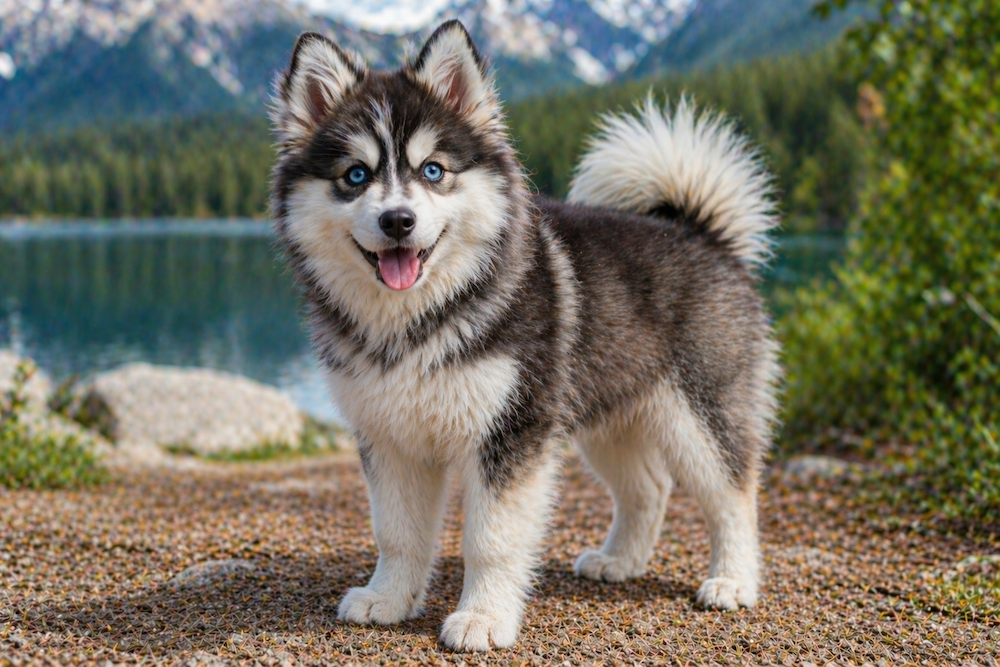
Pomskies commonly resemble small, fluffy Spitz dogs, often with erect ears, thick double coats and plumed tails.
Some strongly resemble miniature Huskies, while others look much more like oversized Pomeranians.
Because they’re a crossbreed, there’s no single guaranteed Pomsky appearance.
Do Pomskies Have Blue Eyes?
They can.
Siberian Huskies can have blue, brown or differently coloured eyes, and these traits can appear in Pomskies.
Some Pomskies have two blue eyes, while others have brown eyes or one eye of each colour.
What Colours Can Pomskies Be?
Pomskies occur in many colours and patterns, including black and white, grey and white, red, cream, brown, sable and combinations of these colours.
Husky-style facial markings are particularly popular but aren’t guaranteed.
A Pomsky doesn’t need to resemble a miniature black-and-white Husky to be genuine.
What Is the Difference Between a Pomsky and a Siberian Husky?
The most obvious difference is size.
A Siberian Husky is an established medium-sized working breed, while a Pomsky is a Siberian Husky × Pomeranian cross developed primarily as a companion.
Pomskies are generally much smaller but can retain Husky characteristics including high energy, shedding, prey drive, vocalisation and independence.
What Is the Difference Between a Pomsky and a Pomeranian?
A Pomeranian is an established toy Spitz breed, while the Pomsky combines Pomeranian and Siberian Husky ancestry.
Pomskies are generally larger, more athletic and potentially more demanding than Pomeranians.
They may also inherit Husky-style colouring, blue eyes and stronger endurance.
Is a Pomsky a Purebred Dog?
No.
The Pomsky is a cross between a Siberian Husky and a Pomeranian rather than a traditional recognised purebred breed.
Dedicated Pomsky breeding organisations are working toward greater consistency, but Pomskies can still vary considerably in size, coat and temperament.
What Does F1 Pomsky Mean?
An F1 Pomsky has one Siberian Husky parent and one Pomeranian parent.
This creates approximately 50% ancestry from each breed.
It doesn’t mean the puppy will physically look exactly halfway between a Husky and Pomeranian.
What Is an F1B Pomsky?
An F1B Pomsky is generally produced by crossing an F1 Pomsky back to one of its parent breeds, often a Pomeranian when breeders are seeking smaller dogs.
The exact characteristics remain variable.
Generation labels describe ancestry rather than guaranteeing size, coat, eye colour or temperament.
How Are Pomeranians Bred With Siberian Huskies?
Because of the enormous size difference between the parent breeds, responsible first-generation breeding requires particular care.
Traditionally, the Siberian Husky is used as the mother and the Pomeranian as the father, with artificial insemination commonly used rather than natural mating.
Using a tiny Pomeranian female to carry puppies sired by a much larger Husky could create serious reproductive risks.
Where Does the Pomsky Come From?
The Pomsky is a modern designer cross that became widely known during the early 2010s, particularly in North America.
Interest grew rapidly online because people were attracted to the idea of a smaller companion with Husky-like appearance.
There isn’t a single universally documented breeder who can reliably be credited as the sole creator of the Pomsky.
Why Were Pomskies Created?
The main attraction was producing a smaller companion dog with characteristics associated with the Siberian Husky, combined with the compact size of the Pomeranian.
The difficulty is that genetics don’t work like a photo-editing tool.
Breeding a Husky to a Pomeranian doesn’t guarantee a perfectly scaled-down Husky.
Is a Pomsky Healthier Than a Purebred Dog?
Not automatically.
Crossbreeding can increase genetic diversity, but Pomskies can still inherit health problems from either parent breed.
Responsible breeding requires appropriate health screening of both the Siberian Husky and Pomeranian lines, along with careful attention to structure and temperament.
Is a Pomsky a Good First Dog?
Potentially, but prospective owners shouldn’t choose one simply because it looks like a miniature Husky.
Pomskies can be intelligent and affectionate, but they may also be high-energy, vocal, heavy-shedding, independent and difficult off leash.
An owner prepared for training, grooming and substantial daily activity can find them excellent companions.
What Makes the Pomsky Unique?
The Pomsky sounds wonderfully simple on paper:
Take a Siberian Husky and make it smaller using a Pomeranian.
The reality is much more interesting.
Both parent breeds are Spitz dogs, so erect ears, dense double coats and plumed tails fit together surprisingly naturally. The enormous difference in size, however, creates tremendous variation.
One Pomsky may genuinely resemble a miniature Husky.
Another may look like an unusually large Pomeranian.
One may inherit brilliant blue Husky eyes and endless energy. Another may inherit the Pomeranian’s tiny-dog confidence and enthusiasm for announcing everything happening outside.
And that’s the most important thing prospective owners need to understand.
A Pomsky isn’t a guaranteed miniature Husky.
It’s a combination of two different breeds whose genes can be shuffled in many different ways.
Sometimes that creates the tiny Husky look people dreamed about.
Sometimes it creates a fluffy little dog that talks like a Husky, sheds like a Husky and has somehow acquired the Pomeranian’s belief that it owns the house.