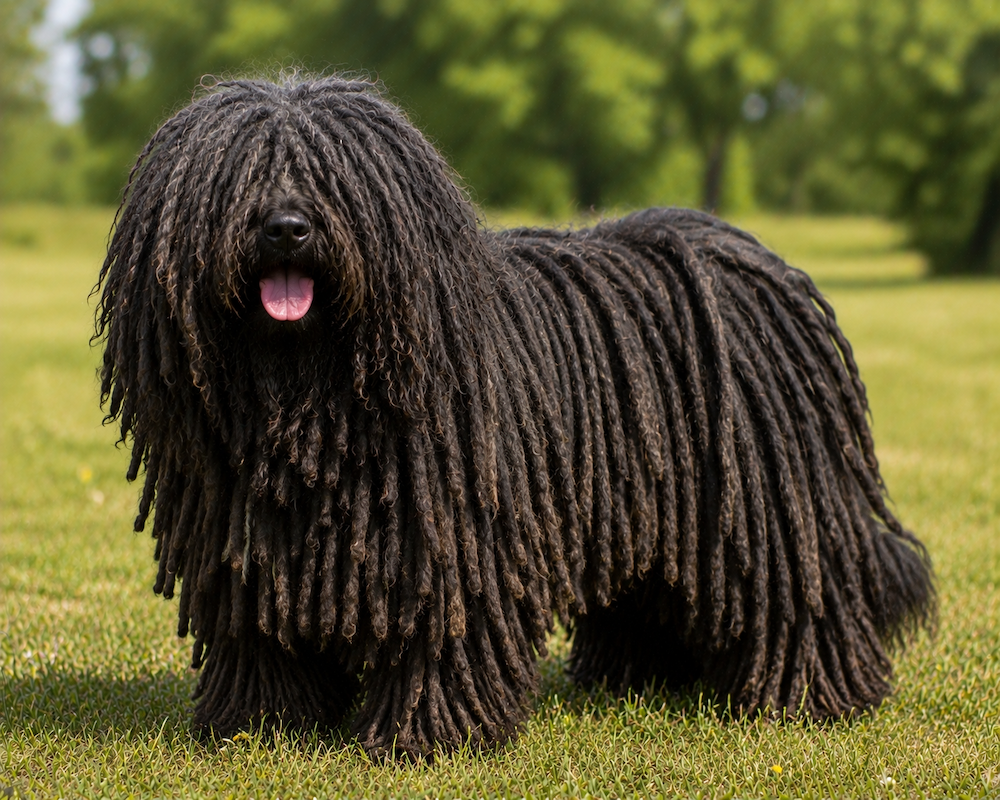







Intelligent, energetic, and unmistakably unique — an agile Hungarian herding dog famous for its extraordinary corded coat.
🧠 QUICK SNAPSHOT
- Temperament: Intelligent, loyal, energetic
- Energy Level: High
- Size: Medium
- Good With Families: Yes
- Trainability: High
- Grooming: High
- Best For: Active families, experienced owners, dog sports
📚 OVERVIEW
The Puli is an ancient Hungarian herding breed best known for its distinctive naturally corded coat. For centuries, these agile and intelligent dogs worked alongside shepherds, using their speed, quick reactions, and independent thinking to manage livestock.
Beneath the Puli’s remarkable coat is an athletic and energetic dog with a strong personality. Pulik form close bonds with their families and thrive when given plenty of exercise, mental stimulation, and opportunities to use their intelligence.
✅ PROS & CONS
Pros
- Highly intelligent and trainable
- Loyal and devoted to family
- Athletic and agile
- Distinctive low-shedding coat
Cons
- Corded coat requires specialised maintenance
- Needs significant daily exercise and mental stimulation
- Can be reserved with strangers
- Strong herding instincts may need careful management
Is a Puli a Good Family Dog?
Yes. The Puli can be a loyal, intelligent, playful and deeply devoted family dog, particularly in an active household.
This Hungarian herding breed tends to form strong bonds with its family and often remains alert to everything happening around the home.
Its high intelligence and working instincts mean it needs considerably more stimulation than its unusual mop-like appearance might suggest.
Are Pulis Good With Children?
Generally, yes, especially when raised and socialised with children.
Pulis can be playful, energetic and protective of their family. However, their herding instincts may occasionally lead them to chase or attempt to control running children.
Early training helps establish appropriate behaviour.
How Much Exercise Does a Puli Need?
Most Pulis need around 60–90 minutes of daily exercise, along with mental stimulation.
Walking, running, training, agility, scent games and interactive play are all useful.
Despite its extraordinary coat, the Puli is an athletic working dog, not a sedentary companion.
Is a Puli Easy to Train?
Pulis are extremely intelligent and learn quickly, but they can also be independent.
They were developed to make decisions while working livestock, so they aren’t necessarily dogs that blindly follow every instruction.
Positive reinforcement, variety and consistent training usually produce the best results.
Does a Puli Shed?
A mature corded Puli generally sheds very little loose hair around the home because shed hairs tend to become trapped within the cords.
However, this doesn’t make the coat maintenance-free.
Managing a properly corded coat requires considerable time and knowledge.
Is a Puli Hypoallergenic?
Pulis are sometimes promoted as hypoallergenic because of their low level of loose shedding, but no dog is completely hypoallergenic.
Dog allergens are also found in saliva and skin secretions.
People with allergies should spend time around adult Pulis before deciding whether the breed is suitable.
Why Does a Puli Have a Corded Coat?
The Puli’s famous cords form when its soft, woolly undercoat naturally intertwines with its coarser outer coat.
As the coat matures, these sections can be carefully separated into individual cords.
The resulting coat provided useful protection for a working sheepdog exposed to demanding weather and outdoor conditions.
How Do You Groom a Puli?
Puli grooming is unusual because a corded coat isn’t brushed like an ordinary dog’s coat.
As cords begin developing, owners need to separate them manually to prevent the entire coat from forming large mats.
The cords must also be checked regularly for debris and skin problems. Some owners instead keep companion Pulis in a shorter clipped coat for easier maintenance.
How Do You Bathe and Dry a Puli?
Bathing a fully corded Puli can be a substantial job.
The dense cords can absorb large amounts of water and must be rinsed thoroughly to remove shampoo.
Drying is especially important because damp cords can remain wet for a very long time. The coat needs to be dried completely to reduce the risk of odour and skin problems.
What Health Problems Are Common in Pulis?
Potential health concerns include hip dysplasia, patellar luxation and inherited eye disorders, including progressive retinal atrophy.
Responsible breeders should use appropriate hip and eye screening and any relevant genetic testing available for their breeding lines.
Overall, the Puli is generally considered a relatively robust working breed.
How Long Does a Puli Live?
Pulis commonly live around 12–16 years.
Many remain energetic and active well into later life.
Healthy weight, regular exercise, good dental care and responsible breeding can all contribute to longevity.
How Big Does a Puli Get?
The Puli is a medium-small dog, generally standing around 36–45 cm tall and weighing approximately 10–15 kg.
The enormous coat can make the dog look substantially larger than it really is.
Underneath all those cords is a surprisingly lean and athletic herding dog.
When Is a Puli Fully Grown?
Most Pulis reach close to their adult height at around 12 months, although physical and mental development continues beyond this.
Their coat takes considerably longer to reach its spectacular mature appearance.
Full-length cords can take several years to develop.
Can a Puli Live in an Apartment?
Yes, provided its exercise and mental-stimulation requirements are properly met.
The Puli isn’t particularly large, but it is active, alert and potentially vocal.
Apartment owners need to provide sufficient outdoor activity and train excessive barking from an early age.
Can Pulis Be Left Alone?
Adult Pulis can learn to tolerate reasonable periods alone, but they’re strongly attached to their families.
They’re working dogs accustomed to having responsibilities and can become bored without sufficient activity.
Regular long periods of isolation aren’t ideal for the breed.
Do Pulis Bark a Lot?
They can.
Pulis are naturally alert dogs and historically needed to notice changes around livestock and property.
Without training, this can translate into frequent alert barking in a modern home.
Are Pulis Protective?
Yes. Pulis can be naturally watchful and protective of their family and territory.
They’re often reserved or cautious around unfamiliar people rather than immediately treating every stranger as a friend.
Early socialisation is important so natural watchfulness doesn’t develop into excessive suspicion.
Are Pulis Good With Other Dogs?
Generally, yes, particularly when properly socialised.
Pulis can live successfully with other dogs and often enjoy active play.
Their confident personality and herding tendencies can sometimes make them somewhat bossy, so good socialisation remains important.
Are Pulis Good With Cats?
Many Pulis can live successfully with cats, particularly when raised with them.
Their herding instincts may cause them to chase or attempt to control other animals, although this differs from the intense predatory behaviour seen in some hunting breeds.
Early introductions generally provide the best results.
Do Pulis Have a Strong Herding Instinct?
Yes. Herding behaviour remains an important characteristic of the breed.
Some Pulis may circle people or animals, chase movement or attempt to keep family members together.
Providing appropriate outlets through training, dog sports and structured activities can help channel these instincts productively.
Are Pulis Fast and Athletic?
Yes — surprisingly so.
Underneath the huge corded coat is a quick, agile and athletic sheepdog capable of rapid changes of direction.
Pulis can perform extremely well in agility and other dog sports, often surprising people who assume all that hair must make them slow.
What Does a Puli Look Like Without Its Cords?
Without its famous long cords, the Puli looks much more like the compact, athletic herding dog it actually is.
A clipped Puli has a relatively lean body, long legs for its overall size and an agile build.
The spectacular coat can hide much of the dog’s true physical structure.
What Colours Do Pulis Come In?
Black is the colour most strongly associated with the Puli, but recognised colours vary by kennel organisation and can also include white and shades of grey, among others.
The dense corded coat can also change somewhat in appearance as the dog matures.
What Is the Difference Between a Puli and a Komondor?
The easiest difference is size.
The Puli is a much smaller Hungarian herding dog, while the Komondor is a very large livestock guardian.
Both can develop spectacular corded coats, but their traditional jobs were different: the Puli primarily moved and managed livestock, while the Komondor protected flocks from predators.
Is a Puli the Same as a Hungarian Sheepdog?
The Puli is a Hungarian sheepdog, but it isn’t the only Hungarian herding breed.
Hungary also produced breeds such as the Pumi and Mudi, as well as large livestock guardians including the Komondor and Kuvasz.
Each developed somewhat different working characteristics.
Where Does the Puli Come From?
The Puli comes from Hungary, where dogs of this type became highly valued for managing sheep and other livestock.
Its deeper ancestry is difficult to document precisely, and claims that today’s Puli has remained unchanged for thousands of years go beyond what historical evidence can reliably establish.
What is clear is that the breed became an important part of traditional Hungarian pastoral life.
What Were Pulis Originally Bred For?
Pulis were primarily bred to herd and manage livestock, particularly sheep.
Their agility allowed them to move quickly around flocks, while their intelligence enabled them to work with considerable independence.
They often worked in an environment where larger guardian dogs could provide protection while the smaller, agile Puli concentrated on moving the animals.
Is a Puli a Good First Dog?
A Puli can suit a committed first-time owner, but it isn’t among the easiest beginner breeds.
Its intelligence, energy, barking, herding instincts and specialised coat care can all require substantial effort.
Someone attracted primarily by the extraordinary coat should make sure they’re equally enthusiastic about living with an energetic working sheepdog underneath it.
What Makes the Puli Unique?
The Puli may have one of the most deceptive appearances in the dog world.
At first glance, it can look like a walking collection of dreadlocks.
Underneath them is something completely different: a quick, agile and highly intelligent Hungarian sheepdog developed to control livestock.
Its famous cords aren’t merely a modern fashion statement. They develop from the interaction between the Puli’s woolly undercoat and coarser outer coat, eventually creating one of the most recognisable canine coats in the world.
But the coat can also hide just how athletic the breed is.
A Puli can run, jump, turn rapidly and excel at activities such as agility — sometimes looking less like a mop and more like a mop that has suddenly been fitted with a racing engine.