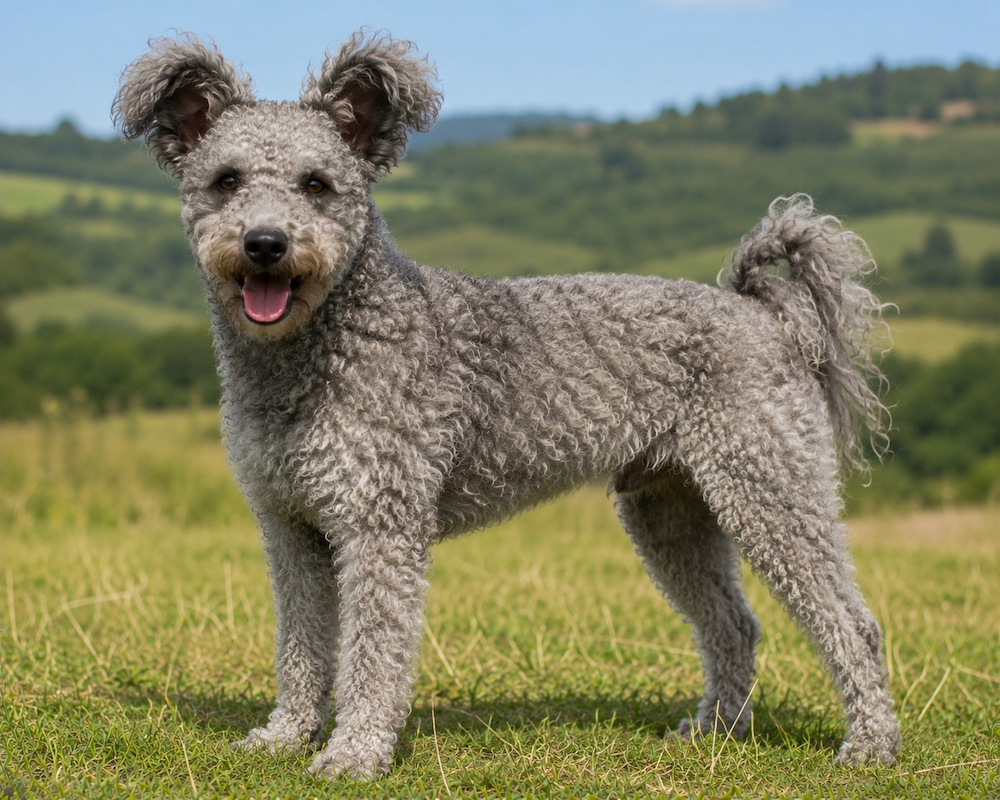







Lively, intelligent, and full of character — an energetic Hungarian herding dog with a sharp mind and unmistakable expression.
🧠 QUICK SNAPSHOT
- Temperament: Intelligent, lively, alert
- Energy Level: High
- Size: Medium
- Good With Families: Yes
- Trainability: Very high
- Grooming: Moderate
- Best For: Active families, dog sports, experienced owners
📚 OVERVIEW
The Pumi is an energetic Hungarian herding breed known for its distinctive semi-erect ears, curly coat, and lively personality. Developed to herd livestock in challenging conditions, the Pumi is agile, quick-thinking, and always ready for action.
These intelligent dogs form strong bonds with their families and thrive in active homes where they receive plenty of physical exercise and mental stimulation. Their enthusiasm and athleticism also make them excellent competitors in agility, obedience, and other canine sports.
✅ PROS & CONS
Pros
- Exceptionally intelligent and trainable
- Loyal and affectionate with family
- Highly athletic and agile
- Low-shedding coat
Cons
- Needs significant daily exercise
- Requires plenty of mental stimulation
- Can be very vocal
- May try to herd people or other pets
Is a Pumi a Good Family Dog?
Yes. The Pumi can be an affectionate, lively and highly intelligent family dog, particularly for active households.
This Hungarian herding breed tends to form close relationships with its family and enjoys being involved in daily activities. However, its high energy and working instincts mean it needs considerably more exercise and mental stimulation than many dogs of a similar size.
Are Pumis Good With Children?
Generally, yes, particularly when properly socialised.
Pumis are playful and energetic, which can make them entertaining companions for older children.
Their strong herding instincts can sometimes produce chasing, circling or attempts to control running children, so early training is important.
How Much Exercise Does a Pumi Need?
Most Pumis need around 60–90 minutes of daily exercise, together with plenty of mental stimulation.
Walking, running, agility, scent games, obedience and interactive play are excellent outlets.
This is a genuine working breed that can become frustrated or destructive when its physical and mental needs aren’t met.
Is a Pumi Easy to Train?
Yes. Pumis are extremely intelligent and quick learners.
They tend to enjoy interactive training and can excel in obedience, agility and herding activities.
However, their intelligence comes with an independent, energetic personality, so repetitive training can quickly become boring. Short, varied and reward-based sessions generally work best.
Does a Pumi Shed?
Pumis are generally low-shedding dogs.
Their distinctive coat consists of curly and wavy hair that tends to retain loose hairs rather than dropping large amounts around the home.
Low shedding doesn’t mean no grooming, as the coat still requires regular maintenance.
Is a Pumi Hypoallergenic?
The Pumi is sometimes described as hypoallergenic because it sheds relatively little, but no dog is completely hypoallergenic.
Allergens are also produced through saliva and skin secretions.
People with dog allergies should spend time around adult Pumis before deciding whether the breed is suitable.
How Often Should You Groom a Pumi?
The Pumi’s coat generally needs regular combing every few weeks, followed by wetting or bathing so its characteristic curls can reform.
The coat is traditionally maintained by trimming rather than extensive sculpting.
Allowing it to become neglected can result in tangles and mats.
What Health Problems Are Common in Pumis?
The Pumi is generally considered a relatively healthy breed, but potential concerns include hip dysplasia, patellar luxation and degenerative myelopathy.
Responsible breeders should use appropriate health screening and genetic testing relevant to their breeding lines.
Routine veterinary care, healthy weight and regular exercise remain important throughout life.
How Long Does a Pumi Live?
Pumis commonly live around 12–15 years, with some living longer.
Their functional working-dog build contributes to generally good physical capability.
Responsible breeding, appropriate exercise and maintaining a healthy weight can all support longevity.
How Big Does a Pumi Get?
The Pumi is a medium-small dog.
Adults generally stand around 38–47 cm tall and weigh approximately 8–15 kg, with males typically larger than females.
Their fluffy curly coat can make them appear somewhat heavier than they actually are.
When Is a Pumi Fully Grown?
Most Pumis reach close to adult height at around 12 months, although they may continue filling out beyond this.
Mental maturity can take longer.
Young Pumis often retain considerable puppy-like enthusiasm well into early adulthood.
Can a Pumi Live in an Apartment?
Yes, but only if its considerable exercise and stimulation requirements are met.
The Pumi’s moderate size suits smaller homes, but energy and barking can make apartment living challenging.
An active owner prepared to provide substantial daily exercise can make it work.
Can Pumis Be Left Alone?
Adult Pumis can learn to tolerate reasonable periods alone, but they’re active dogs that thrive on interaction and having something to do.
Long periods without exercise or stimulation can lead to barking, destructive behaviour or frustration.
Teaching independence gradually from puppyhood is helpful.
Do Pumis Bark a Lot?
Pumis can be very vocal dogs.
Alert barking was useful in their traditional work, and many modern Pumis remain quick to announce unusual activity.
Training from an early age is important, particularly in suburban homes or apartments.
Are Pumis Protective?
Pumis are naturally alert and watchful, but they aren’t traditional livestock guardian dogs.
They may be reserved with unfamiliar people and quick to alert their family when something unusual happens.
Good socialisation helps prevent natural watchfulness from developing into excessive suspicion or barking.
Are Pumis Good With Other Dogs?
Generally, yes.
Well-socialised Pumis often enjoy interacting with other dogs and can be enthusiastic playmates.
Their confident personality and herding tendencies can occasionally make them somewhat bossy, so early socialisation remains valuable.
Are Pumis Good With Cats?
Pumis can live successfully with cats, especially when raised with them.
Their herding instincts may cause them to chase moving animals or attempt to control their movements.
Careful introductions and training are therefore important.
Do Pumis Have a Strong Herding Instinct?
Yes. Herding instinct remains an important part of the Pumi’s character.
Some individuals naturally circle, chase or attempt to control moving animals and people.
Activities such as herding, agility and structured training can provide productive outlets for these behaviours.
Are Pumis Good at Agility?
Yes. The Pumi is particularly well suited to agility.
They’re fast, agile, intelligent and highly responsive, with an athletic build that allows rapid changes of direction.
Pumis can also perform well in obedience, rally, herding and other canine sports that combine physical activity with problem solving.
What Does a Pumi Look Like?
The Pumi is a compact, athletic dog with a curly or wavy coat, elongated muzzle and distinctive semi-erect ears.
Its ears are one of its most recognisable features, standing upright at the base while the tips fold forward.
The overall expression is alert, inquisitive and often slightly mischievous.
What Colours Do Pumis Come In?
Pumis occur in several colours, including grey, black, white and fawn, depending on the breed standard.
Grey is particularly associated with the breed, and grey adults are generally born much darker before gradually lightening as they mature.
Colour shouldn’t be prioritised over health, temperament and functional structure.
What Is the Difference Between a Pumi and a Puli?
Both are Hungarian herding breeds, but they’re quite different in appearance.
The Puli is famous for its long corded coat, while the Pumi has a shorter curly or wavy coat and distinctive semi-erect ears.
The Pumi also tends to have a more terrier-like appearance and particularly lively temperament, although it remains fundamentally a herding dog.
What Is the Difference Between a Pumi and a Mudi?
Both are intelligent Hungarian herding breeds.
The Pumi typically has a curly coat and characteristic tipped ears, while the Mudi has fully erect ears and a different wavy or curly coat pattern.
Both are highly active working dogs capable of herding and dog sports, but they’re distinct breeds.
Is a Pumi a Terrier?
No. Despite its terrier-like appearance and lively personality, the Pumi is fundamentally a Hungarian herding breed.
Historical development may have involved influence from terrier-like and other European herding dogs, which probably contributed to its appearance and energetic temperament.
Its traditional job, however, centred on managing livestock.
Where Does the Pumi Come From?
The Pumi comes from Hungary, where it developed as a versatile livestock-working dog.
Its development was closely connected with Hungarian herding dogs, particularly Puli-type dogs, along with other European herding influences introduced over centuries.
By the early 20th century, the Pumi was being formally distinguished from the Puli as its own breed.
What Were Pumis Originally Bred For?
Pumis were bred to herd and manage livestock, including sheep, cattle and pigs.
Their quick reactions, agility, intelligence and willingness to use their voice made them useful for controlling animals considerably larger than themselves.
That working history explains much of the modern Pumi’s energy, alertness and confidence.
Is a Pumi a Good First Dog?
A Pumi can suit a committed first-time owner, but it isn’t an especially easy beginner breed.
Its high energy, intelligence, barking and herding instincts require consistent training and substantial daily activity.
For someone interested in training and dog sports, however, those same characteristics can make the Pumi extremely rewarding.
What Makes the Pumi Unique?
The Pumi looks a little like someone combined a curly-coated sheepdog with an extremely surprised terrier.
Those extraordinary ears are partly responsible.
They stand upright at the base but bend forward at the tips, giving the Pumi its permanently alert and inquisitive expression.
But the appearance can be misleading.
The Pumi isn’t really a terrier at all. It’s an agile Hungarian livestock dog developed to move sheep, cattle and even pigs, using speed, intelligence, persistence and plenty of voice.
That history remains obvious in modern Pumis.
They notice movement. They notice sounds. They notice strangers. They notice what other animals are doing.
And if something isn’t happening?
A Pumi is quite capable of finding something that should be.