






Strong, independent, and athletic — a powerful companion with a calm and loyal nature.
🧠 QUICK SNAPSHOT
- Temperament: Loyal, independent, confident
- Energy Level: High
- Size: Large
- Good With Families: Yes
- Trainability: Moderate
- Grooming: Low
- Best For: Active owners, experienced homes
📚 OVERVIEW
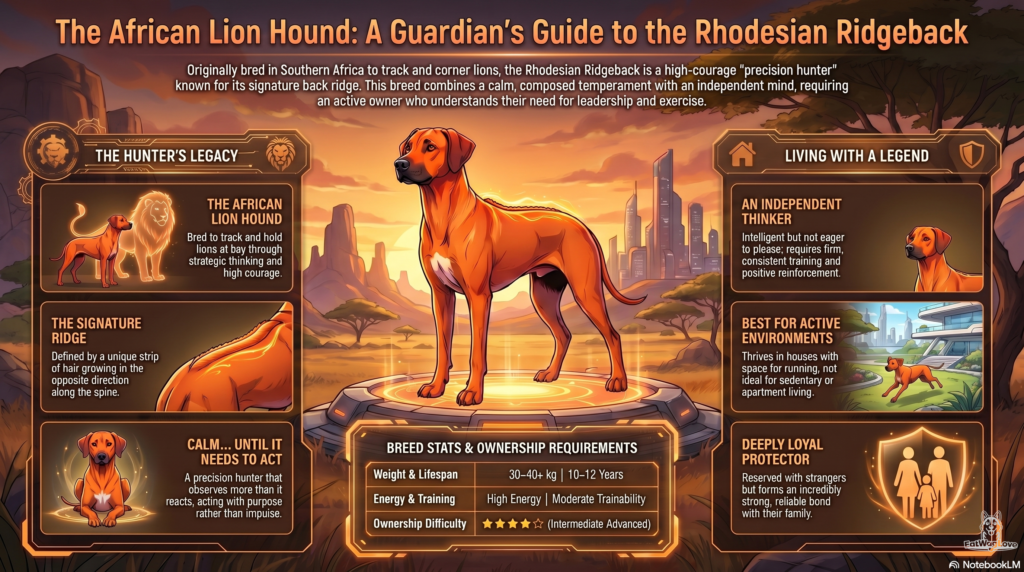
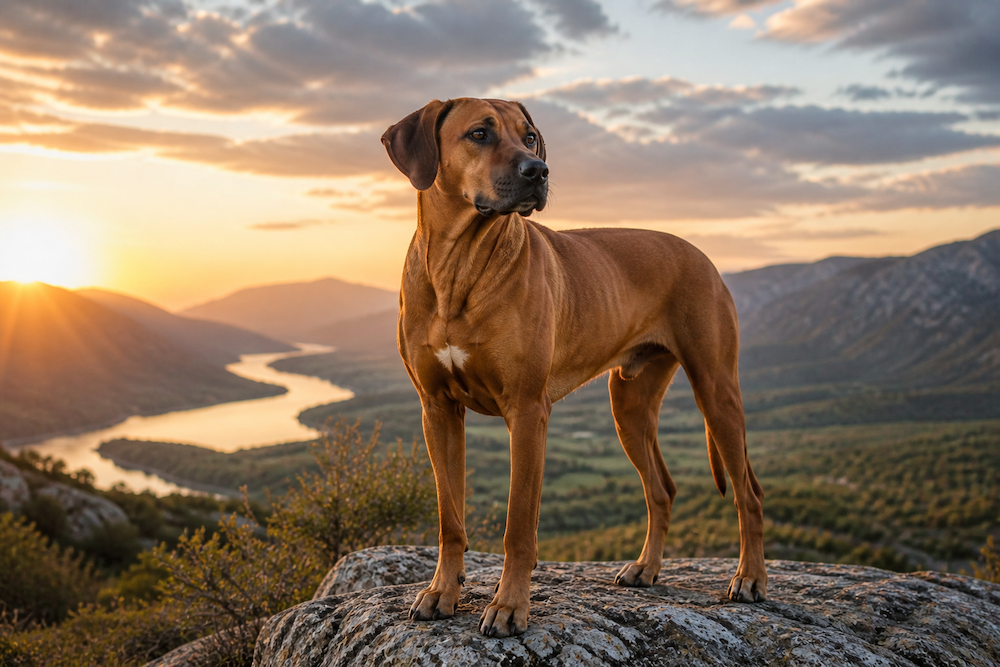
The Rhodesian Ridgeback is a powerful and athletic breed originally developed in Africa to hunt large game, including lions. Its most distinctive feature is the ridge of hair running along its back.
They are known for their independence and strength, balanced by a calm and affectionate nature with their family.
✅ PROS & CONS
Pros
- Loyal and protective
- Strong and athletic
- Low grooming needs
- Calm indoors when exercised
Cons
- Strong-willed and independent
- High exercise requirements
- Needs consistent training
- Strong prey drive
Is a Rhodesian Ridgeback a Good Family Dog?
Yes. Rhodesian Ridgebacks can be loyal, affectionate and devoted family dogs, particularly with experienced owners.
They’re large, powerful and independent dogs with a strong hunting background, so early training and socialisation are important.
At home, mature Ridgebacks are often surprisingly calm and affectionate despite their athletic ability.
Are Rhodesian Ridgebacks Good With Children?
Generally, yes, especially when raised with children and properly socialised.
Ridgebacks can be affectionate and protective of their family, but their size and strength mean they can accidentally knock over small children.
Interactions with young children should always be supervised.
How Much Exercise Does a Rhodesian Ridgeback Need?
Most healthy adult Rhodesian Ridgebacks need around 60–90 minutes of exercise each day.
They enjoy long walks, running, hiking and opportunities to explore.
Mental stimulation is also important, particularly because Ridgebacks were developed to think and work with considerable independence.
Are Rhodesian Ridgebacks Easy to Train?
Rhodesian Ridgebacks are intelligent but not always easy to train.
They’re independent dogs that were bred to make decisions while hunting rather than constantly wait for instructions.
Consistent positive reinforcement and early training work best. Harsh methods can damage trust without making the dog more cooperative.
Do Rhodesian Ridgebacks Shed?
Yes, but usually not excessively.
Their short, dense coat sheds moderately throughout the year and is relatively easy to maintain.
Weekly brushing helps remove loose hair and keeps the coat healthy.
Are Rhodesian Ridgebacks Hypoallergenic?
No.
Rhodesian Ridgebacks aren’t considered hypoallergenic.
They shed hair and produce the same saliva and skin-associated allergens that can trigger reactions to other dogs.
How Often Should You Groom a Rhodesian Ridgeback?
Rhodesian Ridgebacks are low-maintenance dogs when it comes to grooming.
Weekly brushing is usually sufficient for their short coat, along with routine nail trimming, ear checks and dental care.
Bathing is generally only necessary when the dog becomes dirty or develops an odour.
What Health Problems Are Common in Rhodesian Ridgebacks?
Important health concerns can include hip and elbow dysplasia, dermoid sinus, certain thyroid disorders, eye conditions and some inherited neurological problems.
Dermoid sinus is particularly associated with Ridgebacks and related ridged dogs.
Responsible breeders should use appropriate health screening and understand the genetics and welfare issues associated with the ridge.
What Is Dermoid Sinus in a Rhodesian Ridgeback?
Dermoid sinus is a congenital defect involving an abnormal tube-like connection in the skin and underlying tissues, most commonly along the back or neck.
It can become infected and, in some cases, extend more deeply toward the spine.
Affected puppies require veterinary assessment, and surgical treatment may be recommended.
How Long Do Rhodesian Ridgebacks Live?
Rhodesian Ridgebacks commonly live around 10–12 years, although some live longer.
Genetics, healthy weight, exercise, preventive veterinary care and responsible breeding all influence longevity.
How Big Does a Rhodesian Ridgeback Get?
Rhodesian Ridgebacks are large dogs.
Adult males generally stand around 63–69 cm tall and commonly weigh approximately 36 kg, while females are typically around 61–66 cm and approximately 32 kg, although individuals vary.
They should appear powerful and athletic rather than excessively bulky.
When Is a Rhodesian Ridgeback Fully Grown?
Most Rhodesian Ridgebacks reach close to their adult height at around 12–18 months.
They may continue developing muscle and filling out until approximately two years of age or beyond.
Behavioural maturity can take longer, and adolescent Ridgebacks can be particularly energetic and independent.
Can a Rhodesian Ridgeback Live in an Apartment?
Potentially, yes, but it requires commitment.
Adult Ridgebacks can be surprisingly relaxed indoors once properly exercised, but they’re large athletic dogs that need substantial daily activity.
Access to a garden is useful but doesn’t replace walks, training and opportunities to explore.
Can Rhodesian Ridgebacks Be Left Alone?
Adult Ridgebacks can learn to tolerate reasonable periods alone.
They’re often more independent than highly dependent companion breeds, but they still form strong attachments to their families.
Long periods of isolation without exercise or stimulation can lead to boredom and destructive behaviour.
Are Rhodesian Ridgebacks Protective?
Yes. Rhodesian Ridgebacks tend to be naturally watchful and protective of their homes and families.
They can be reserved with strangers and don’t necessarily greet everyone as a potential new friend.
Early socialisation is particularly important so natural confidence doesn’t develop into inappropriate suspicion or aggression.
Do Rhodesian Ridgebacks Bark a Lot?
Generally, no.
Rhodesian Ridgebacks aren’t typically known as excessive barkers and may be relatively quiet around the home.
They can certainly bark when something attracts their attention, and their size gives them an impressive voice when they do.
Are Rhodesian Ridgebacks Good With Other Dogs?
They can be, particularly with good early socialisation.
Some adult Ridgebacks can be confident or selective around unfamiliar dogs, especially dogs of the same sex.
Their size and strength make responsible socialisation and control particularly important.
Are Rhodesian Ridgebacks Good With Cats?
Some can live successfully with cats, especially when raised with them.
However, Rhodesian Ridgebacks have a strong hunting heritage and potentially significant prey drive.
A Ridgeback that accepts its own household cat may still chase unfamiliar cats or other small animals outdoors.
Do Rhodesian Ridgebacks Have a High Prey Drive?
Yes. Strong prey drive can be an important characteristic of the breed.
Rhodesian Ridgebacks descend from dogs used for hunting large game and other quarry across southern Africa.
Moving wildlife can therefore be extremely tempting, making secure fencing and reliable management important.
Are Rhodesian Ridgebacks Good Off Leash?
They can be challenging off leash.
Even a well-trained Ridgeback may become intensely interested in wildlife and decide to pursue it.
Recall training should begin early, but secure fenced areas are the safest off-leash option for dogs with particularly strong hunting instincts.
Can Rhodesian Ridgebacks Handle Hot Weather?
Rhodesian Ridgebacks generally cope with warm conditions better than many heavy-coated or short-muzzled breeds.
Their short coat and southern African development are advantages in warmer climates.
However, no dog is immune to heat stress, and strenuous exercise should still be avoided during very hot Australian weather.
What Is the Ridge on a Rhodesian Ridgeback?
The breed’s famous ridge is a strip of hair running along the back in the opposite direction from the surrounding coat.
Breed standards describe a clearly defined, symmetrical ridge beginning behind the shoulders and containing two matching crowns or whorls.
The ridge is inherited genetically and is the feature that gave the breed its modern name.
Are Rhodesian Ridgebacks Born Without a Ridge?
Yes. Some purebred Rhodesian Ridgebacks are born ridgeless.
They can still have the temperament and ancestry of a Rhodesian Ridgeback, but they don’t meet the traditional show standard requiring the characteristic ridge.
Importantly, the ridge is a cosmetic breed characteristic rather than something the dog needs to function normally.
What Colours Do Rhodesian Ridgebacks Come In?
The characteristic colour is wheaten, ranging from light wheaten through to red wheaten.
Small amounts of white may occur on the chest and toes under breed standards.
The breed’s relatively narrow colour range contributes to its highly recognisable appearance.
Why Are Rhodesian Ridgebacks Called Lion Dogs?
Rhodesian Ridgebacks became famous for their historical involvement in hunting lions in southern Africa, leading to names such as African Lion Hound or Lion Dog.
However, the dogs weren’t normally expected to kill lions.
Their role was to track, pursue and keep the lion occupied or at bay while avoiding its attacks until human hunters arrived.
Were Rhodesian Ridgebacks Bred to Kill Lions?
No. The popular idea that individual Ridgebacks were bred to attack and kill lions is misleading.
Dogs used in lion hunting relied on speed, agility, courage and teamwork to track and distract dangerous quarry while keeping out of reach.
Trying to physically overpower an adult lion would have been an extraordinarily poor survival strategy for a dog.
Where Does the Rhodesian Ridgeback Come From?
The modern Rhodesian Ridgeback developed in southern Africa, particularly the region that became Rhodesia, now Zimbabwe.
European settlers crossed imported dogs with local African dogs that included distinctive ridged individuals.
Over generations, dogs were selected for endurance, hunting ability, guarding qualities and suitability for difficult African conditions.
What Breeds Created the Rhodesian Ridgeback?
The Rhodesian Ridgeback developed from African ridged dogs combined with several European dog types brought to southern Africa.
Historical accounts associate its development with dogs including Greyhound-type hounds, mastiff-type dogs, pointers and other hunting and working breeds.
Because development occurred over generations before modern pedigree records, presenting the Ridgeback as a simple mixture of a few precisely known breeds would be misleading.
Is a Rhodesian Ridgeback a Good First Dog?
Usually, the Rhodesian Ridgeback is better suited to an owner comfortable managing a large, powerful and independent dog.
A committed first-time owner can succeed with good training and socialisation, but the breed’s strength, prey drive and independent nature can be challenging.
It’s very different from owning a dog bred primarily to follow instructions or provide companionship.
What Makes the Rhodesian Ridgeback Unique?
The famous backwards-growing strip of hair gets most of the attention, but the Rhodesian Ridgeback’s working history is even more remarkable.
These dogs developed in southern Africa to cope with heat, difficult terrain and dangerous game.
Their association with lion hunting created one of the biggest myths about the breed: that Ridgebacks were dogs that killed lions.
That wasn’t the point.
Survival depended on being athletic and intelligent enough to track a lion, pressure it and avoid getting caught by it while hunters followed. Reckless dogs weren’t necessarily brave dogs — they were dogs unlikely to survive very long.
That history helps explain the modern Ridgeback.
It’s powerful but athletic, courageous but often calculated, affectionate with its family but capable of thinking independently.
And then there’s that unmistakable ridge running backwards along its spine.
It makes the breed instantly recognisable.
But underneath it is the characteristic that mattered far more to the hunters who developed these dogs:
knowing when to chase — and being smart enough not to get caught.