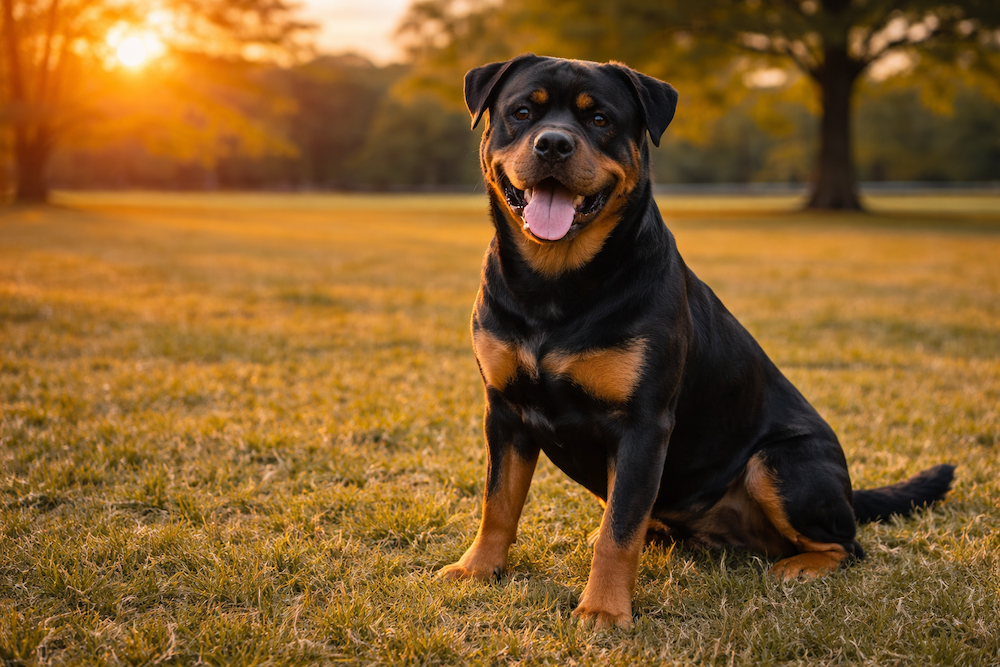







Powerful, loyal, and protective — a confident companion for experienced owners.
🧠 QUICK SNAPSHOT
- Temperament: Loyal, Protective, Confident
- Energy Level: High
- Size: Large
- Good with Families: Yes (with training)
- Training Difficulty: Moderate
📚 OVERVIEW
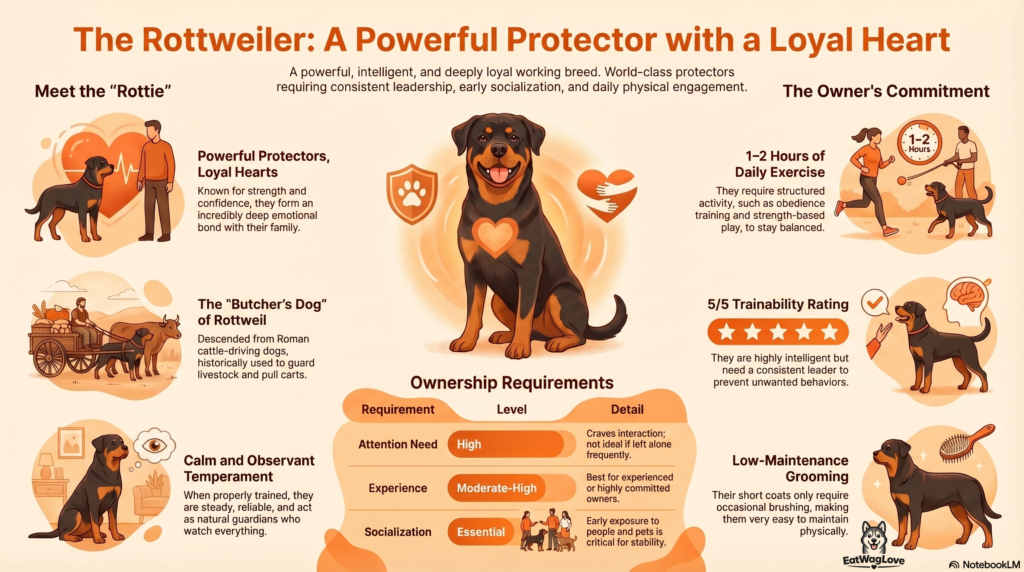
Rottweilers are strong, confident dogs with a long history as working and guarding animals. Known for their loyalty and protective instincts, they form strong bonds with their families and can be excellent companions when properly trained and socialised.
✅ PROS & CONS
Pros
- Extremely loyal and protective
- Confident and courageous
- Strong bond with family
Cons
- Requires experienced handling and training
- Needs regular exercise and structure
- Can be misunderstood without proper socialisation
Is a Rottweiler a Good Family Dog?
Yes. A well-bred, properly trained Rottweiler can be a loyal, affectionate and devoted family dog.
Rottweilers form strong bonds with their families and are often calmer and more affectionate at home than their imposing appearance suggests.
However, they’re large, exceptionally powerful dogs with natural guarding instincts, making early socialisation and consistent training essential.
Are Rottweilers Good With Children?
Rottweilers can be excellent with children when properly socialised and raised around them.
Many are patient, affectionate and protective of their family’s children.
Their size and strength mean they can accidentally knock over small children, so interactions should always be supervised.
How Much Exercise Does a Rottweiler Need?
Most healthy adult Rottweilers need around 60–90 minutes of daily exercise.
Walks, hiking, retrieving, training and structured games are good options.
They also need mental exercise. Rottweilers are working dogs and usually thrive when given training, problem-solving activities or a job to perform.
Are Rottweilers Easy to Train?
Rottweilers are highly intelligent and trainable, but they require consistency.
They were developed as working dogs capable of making decisions, so they can be confident and strong-minded.
Positive reinforcement, clear boundaries and early obedience training are particularly important because an untrained adult Rottweiler is an extremely powerful animal.
Do Rottweilers Shed a Lot?
Rottweilers are moderate shedders.
Their short double coat sheds throughout the year, with heavier seasonal shedding often occurring as the weather changes.
Weekly brushing usually keeps the coat manageable, with more frequent brushing during heavier shedding periods.
Are Rottweilers Hypoallergenic?
No.
Rottweilers aren’t considered hypoallergenic and shed both hair and dander.
People with significant dog allergies should spend time around adult Rottweilers before considering ownership.
How Often Should You Groom a Rottweiler?
Rottweilers are relatively low-maintenance dogs to groom.
Weekly brushing is usually sufficient, along with regular nail trimming, ear checks and dental care.
Their short coat normally requires bathing only when necessary.
What Health Problems Are Common in Rottweilers?
Important health concerns include hip and elbow dysplasia, osteosarcoma, certain heart conditions, eye disorders and cruciate ligament problems.
Rottweilers can also be affected by inherited conditions such as juvenile laryngeal paralysis and polyneuropathy (JLPP).
Responsible breeders should perform appropriate health and genetic screening before breeding.
How Long Do Rottweilers Live?
Rottweilers commonly live around 9–11 years.
As with many large breeds, their lifespan is generally shorter than that of small dogs.
Maintaining a lean body condition, appropriate exercise and regular veterinary care are particularly important.
How Big Does a Rottweiler Get?
Rottweilers are large, powerful dogs.
Adult males generally stand around 61–69 cm tall and commonly weigh approximately 50–60 kg, while females are typically around 56–63 cm and 35–48 kg.
They should be muscular and substantial without becoming excessively heavy.
When Is a Rottweiler Fully Grown?
Rottweilers usually reach close to their adult height by around 18 months, but may continue developing muscle and filling out until two or three years old.
Mental maturity can also take considerable time.
A large adolescent Rottweiler may therefore have an adult-sized body while still possessing a distinctly puppy-like brain.
Can a Rottweiler Live in an Apartment?
Yes, potentially.
Rottweilers can be relatively calm indoors when adequately exercised, so a large garden isn’t essential.
However, apartment owners must be committed to daily exercise, training and enrichment. The dog’s size and potential alert barking also need consideration.
Can Rottweilers Be Left Alone?
Adult Rottweilers can learn to tolerate reasonable periods alone.
Despite their tough reputation, they’re often extremely attached to their families and generally prefer being involved in household life.
Regularly leaving a Rottweiler isolated for long periods can contribute to boredom and behavioural problems.
Are Rottweilers Protective?
Yes. Rottweilers have strong natural guarding instincts.
They’re typically confident, watchful and devoted to their families, and may be reserved around unfamiliar people.
A well-socialised Rottweiler shouldn’t be encouraged to view every stranger as a threat. Stable temperament and good judgement are far more valuable than indiscriminate aggression.
Are Rottweilers Aggressive?
Rottweilers aren’t automatically aggressive, but they’re powerful dogs with guarding instincts that require responsible management.
Genetics, breeding, socialisation, training and individual temperament all influence behaviour.
Because mistakes involving a dog of this size can have serious consequences, choosing stable breeding lines and providing extensive early socialisation are especially important.
Do Rottweilers Bark a Lot?
Rottweilers aren’t generally considered excessive barkers.
Many are naturally watchful and may bark when something unusual occurs around the home.
Their guarding temperament means they often have less reason to bark continuously than highly excitable alert breeds, although individuals vary.
Are Rottweilers Good With Other Dogs?
They can be, especially when properly socialised from puppyhood.
Some adult Rottweilers can become selective with unfamiliar dogs, and same-sex tension can occur in some individuals.
Early socialisation and responsible introductions are important.
Are Rottweilers Good With Cats?
Many Rottweilers can live successfully with cats, particularly when raised with them.
Individual prey drive varies, and their enormous size means chasing behaviour shouldn’t be ignored.
Careful introductions and supervision are important.
Do Rottweilers Have a High Prey Drive?
Prey drive varies between individual Rottweilers.
They weren’t developed primarily as specialised hunting dogs, but some will chase wildlife or smaller animals.
Training and secure management remain important, particularly around unfamiliar animals.
Are Rottweilers Good Guard Dogs?
Yes. Rottweilers are naturally well suited to guarding.
Their size, confidence, watchfulness and intimidating appearance provide considerable deterrence without owners needing to encourage aggressive behaviour.
A stable family Rottweiler should be controllable, well socialised and capable of distinguishing ordinary situations from genuine threats.
What Colours Do Rottweilers Come In?
The classic Rottweiler is black with clearly defined rust, mahogany or tan markings.
These markings typically appear above the eyes, on the muzzle, chest, legs and beneath the tail.
Reputable breed standards don’t recognise the huge range of “rare colours” sometimes advertised commercially.
What Is the Difference Between a German and American Rottweiler?
“German Rottweiler” and “American Rottweiler” aren’t separate breeds.
Both are Rottweilers.
Differences people notice usually result from breeding lines, kennel-club standards and selection practices, rather than two distinct varieties.
A Rottweiler born in Germany may be bred under different registration and breeding requirements from one born in the United States, but nationality doesn’t create a separate breed.
What Is the Difference Between a Rottweiler and a Doberman?
Rottweilers and Dobermans are both German working breeds with guarding ability, but they’re physically very different.
Rottweilers are heavier, broader and more powerfully built, while Dobermans are generally taller-looking, leaner and more streamlined.
Their historical working roles also developed differently.
Why Were Rottweilers Bred?
Rottweilers were developed as versatile working dogs used particularly for driving and guarding livestock and protecting property.
They later became associated with pulling carts for butchers and transporting goods.
Their combination of physical strength, intelligence and guarding instinct made them valuable multipurpose working dogs.
Where Do Rottweilers Come From?
The Rottweiler developed in Germany, particularly around the town of Rottweil.
Its ancestors were associated with cattle-driving and livestock-working dogs used throughout Europe.
The breed became closely connected with Rottweil’s livestock trade, eventually giving rise to the name Rottweiler Metzgerhund, or “Rottweil butcher’s dog.”
Were Rottweilers Used by Butchers?
Yes. Rottweilers became famously associated with butchers in and around Rottweil.
The dogs helped drive cattle and could pull carts carrying meat and other goods.
Historical accounts also associate them with guarding their owners and property, making them useful working companions in the livestock and meat trades.
Is a Rottweiler a Good First Dog?
A Rottweiler usually isn’t the easiest choice for an inexperienced owner.
They’re intelligent and trainable, but their size, physical strength, guarding instincts and confidence mean training mistakes can become difficult to manage.
A committed first-time owner with professional training support can succeed, but this is a breed where early education matters enormously.
What Makes the Rottweiler Unique?
The Rottweiler’s modern reputation focuses heavily on guarding, but its history tells a much broader story.
These weren’t dogs developed simply to stand behind fences looking intimidating.
Rottweilers helped move cattle, guard livestock, protect property and pull loaded carts. Their association with the butchers of Rottweil became so strong that they were known as the Rottweiler Metzgerhund — the Rottweil butcher’s dog.
That history required much more than physical power.
A useful working dog needed intelligence, confidence, endurance and the ability to cooperate with people while controlling livestock considerably larger than itself.
Those characteristics remain visible in the modern breed.
A good Rottweiler can be powerful enough to make a stranger think twice, yet affectionate enough to spend the evening convinced that its 50-kilogram body belongs on someone’s lap.
And that may be the most important thing to understand about the breed:
Behind one of the dog world’s most formidable appearances is often an extremely devoted family dog that has absolutely no idea how large it is.