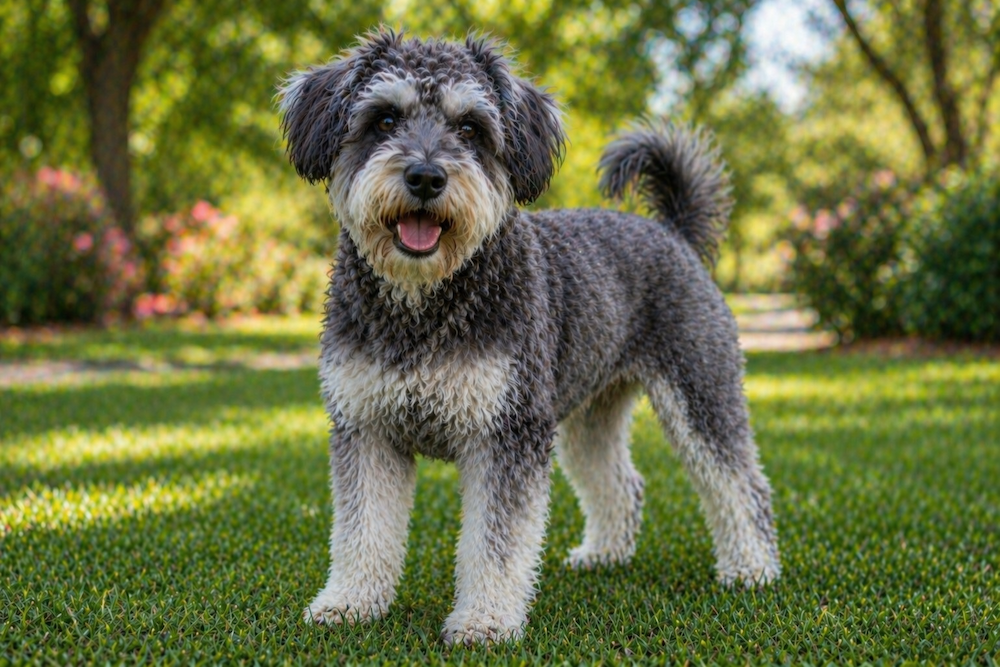






Smart, playful, and full of character — a lively companion that loves attention and interaction.
🧠 QUICK SNAPSHOT
- Temperament: Intelligent, playful, loyal
- Energy Level: Moderate to high
- Size: Small to medium
- Good With Families: Yes
- Trainability: High
- Grooming: Moderate
- Best For: Families, active homes, companionship
📚 OVERVIEW
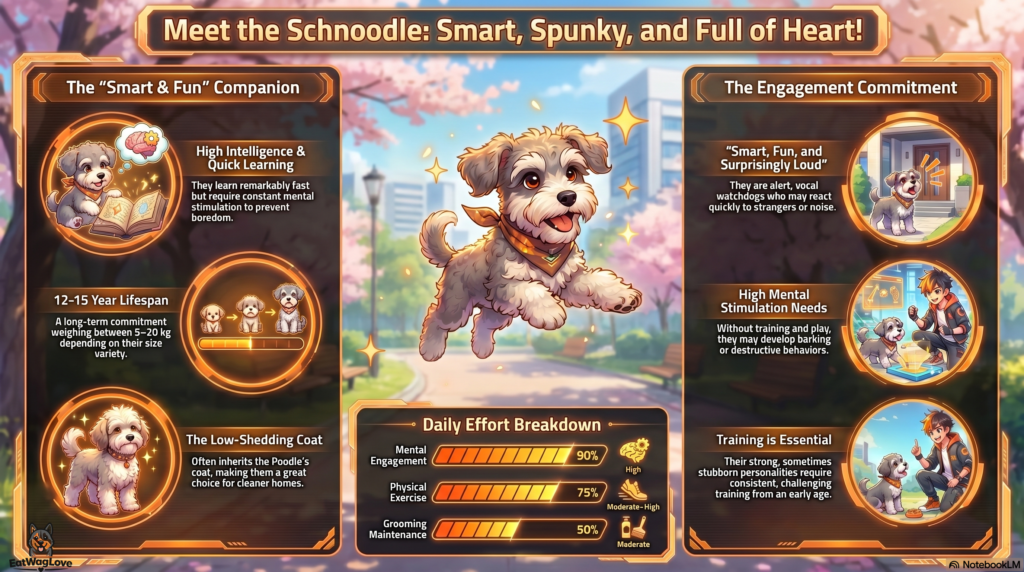
The Schnoodle is a cross between a Schnauzer and a Poodle, combining intelligence with a fun, energetic personality. They are known for their loyalty and love being part of family life.
They are highly social dogs that enjoy attention and thrive in interactive environments.
✅ PROS & CONS
Pros
- Very intelligent and trainable
- Loyal and affectionate
- Low shedding (varies by coat)
- Adaptable to different home environments
Cons
- Needs regular grooming
- Can be energetic and demanding
- Requires attention and interaction
- May develop separation anxiety
Is a Schnoodle a Good Family Dog?
Yes. Schnoodles can make affectionate, intelligent and playful family dogs.
As a Schnauzer–Poodle cross, temperament can vary depending on the parents and the individual dog. Many are people-oriented, energetic and highly trainable.
Their size and activity requirements can also vary considerably because both Schnauzers and Poodles come in multiple sizes.
Are Schnoodles Good With Children?
Generally, yes.
Well-socialised Schnoodles are often playful and affectionate with children, although smaller Schnoodles can be vulnerable to rough handling.
Larger Schnoodles may be better suited to active families but can accidentally knock over very young children during enthusiastic play.
How Much Exercise Does a Schnoodle Need?
Most Schnoodles need around 45–90 minutes of daily exercise, depending on their size, age and inherited temperament.
Walks, games, training and interactive activities are ideal.
Both Poodles and Schnauzers are intelligent working breeds, so mental exercise is just as important as physical activity.
Are Schnoodles Easy to Train?
Usually, yes.
Schnoodles can inherit the high intelligence and trainability of the Poodle along with the alertness and problem-solving ability of the Schnauzer.
Some can also inherit an independent or stubborn streak, so positive, consistent training from an early age is recommended.
Do Schnoodles Shed?
Many Schnoodles are low-shedding, but this isn’t guaranteed.
A Schnoodle may inherit more of the Poodle’s curly coat, more of the Schnauzer’s wiry coat or something between the two.
Even puppies from the same litter can eventually develop noticeably different coats.
Are Schnoodles Hypoallergenic?
No dog is completely hypoallergenic, and a Schnoodle cannot be guaranteed to be allergy-friendly.
Some individuals shed very little and may be better tolerated by certain people with allergies.
However, allergens are also present in saliva and skin secretions, so crossing two relatively low-shedding breeds doesn’t guarantee a hypoallergenic puppy.
How Often Should You Groom a Schnoodle?
Most Schnoodles need brushing several times a week and professional grooming approximately every six to eight weeks, depending on coat type and length.
Curlier coats can mat surprisingly quickly if neglected.
Regular ear care, nail trimming and dental hygiene should also form part of their grooming routine.
What Health Problems Are Common in Schnoodles?
Potential health concerns depend partly on the size and health history of the parent dogs.
Problems can include hip dysplasia, patellar luxation, eye disorders, skin problems, epilepsy and certain endocrine conditions.
Schnoodles aren’t automatically healthier simply because they’re crossbred. Health testing of both parents remains important.
How Long Do Schnoodles Live?
Schnoodles commonly live around 12–16 years, although size can make a significant difference.
Smaller dogs often live longer than larger dogs, so a Miniature Schnoodle may have a different expected lifespan from a Giant Schnoodle.
Genetics, weight, diet and veterinary care also influence longevity.
How Big Does a Schnoodle Get?
There is no single standard Schnoodle size.
A Miniature Schnauzer crossed with a Toy or Miniature Poodle can produce a relatively small dog, while Standard Poodle and Giant Schnauzer ancestry can produce a dramatically larger Schnoodle.
Adult weight can therefore range from roughly 5 kg to well over 30 kg depending on the parents.
What Is a Mini Schnoodle?
A Mini Schnoodle is generally produced using a Miniature Schnauzer and a Toy or Miniature Poodle.
They’re among the most popular Schnoodle sizes because they combine a relatively compact body with the active, intelligent personality associated with the cross.
Because Schnoodles aren’t a standardised breed, adult size still varies.
What Is a Giant Schnoodle?
A Giant Schnoodle usually has Giant Schnauzer and Standard Poodle ancestry.
These dogs can be substantially larger, stronger and more demanding than Mini Schnoodles.
They require appropriate training, exercise and socialisation and shouldn’t simply be regarded as an oversized version of a small companion Schnoodle.
Can a Schnoodle Live in an Apartment?
Smaller Schnoodles can adapt very well to apartment living when given enough exercise.
Larger Schnoodles require considerably more room and activity.
Barking can also become an issue because Schnauzers are naturally alert dogs, so early training is particularly valuable in apartments.
Can Schnoodles Be Left Alone?
Adult Schnoodles can learn to tolerate reasonable periods alone, but many are strongly attached to their families.
A bored Schnoodle may bark, chew or invent its own entertainment.
Gradual alone-time training combined with exercise and enrichment can help prevent separation-related problems.
Do Schnoodles Bark a Lot?
Some do.
Schnauzers have a strong history as alert watchdogs, and Schnoodles can inherit their tendency to announce visitors, unfamiliar noises and activity outside the home.
Training from puppyhood can help prevent alert barking from becoming excessive.
Are Schnoodles Affectionate?
Yes. Many Schnoodles are extremely affectionate and form close relationships with their owners.
They often enjoy being involved in everyday family activities and may follow favourite people around the house.
Individual dogs vary, but strong human attachment is common.
Are Schnoodles Good With Other Dogs?
Generally, yes.
Early socialisation and positive experiences with other dogs can help produce a sociable adult.
Individual temperament still matters, particularly because Schnauzers can be confident and assertive dogs.
Are Schnoodles Good With Cats?
Many Schnoodles can live successfully with cats, especially when introduced carefully or raised together.
However, Schnauzers historically performed vermin-control work, so some Schnoodles may inherit a noticeable prey drive.
This can make smaller pets more challenging.
Are Schnoodles High-Energy Dogs?
Schnoodles are usually moderately to highly energetic, although this varies considerably with size and parentage.
A Mini Schnoodle bred primarily from companion lines may have different requirements from a large Schnoodle with Giant Schnauzer ancestry.
Most need considerably more stimulation than simply being allowed into the backyard.
Are Schnoodles Smart?
Yes. Intelligence is one of the Schnoodle’s strongest characteristics.
Poodles rank among the most trainable dog breeds, while Schnauzers are intelligent working dogs with strong problem-solving abilities.
A Schnoodle can therefore learn extremely quickly — including how to exploit inconsistent household rules.
What Is an F1 Schnoodle?
An F1 Schnoodle is a first-generation cross between a Schnauzer and a Poodle.
It doesn’t mean the puppy will inherit exactly 50% of the visible characteristics of each breed.
Genetics don’t divide coat, temperament, shedding and appearance neatly in half, so substantial variation can occur within an F1 litter.
What Is an F1B Schnoodle?
An F1B Schnoodle is generally produced by crossing an F1 Schnoodle back to one of its parent breeds, most commonly a Poodle.
This is sometimes done in an attempt to produce a more predictable curly or low-shedding coat.
However, coat type and allergy suitability still can’t be guaranteed.
What Is the Difference Between a Schnoodle and a Labradoodle?
Both are Poodle crosses, but their other parent breeds are very different.
A Labradoodle combines Labrador Retriever and Poodle ancestry, while a Schnoodle combines Schnauzer and Poodle ancestry.
Schnoodles may consequently display more watchdog behaviour and Schnauzer-like alertness, while Labradoodles often show stronger retriever characteristics.
Is a Schnoodle a Recognised Dog Breed?
The Schnoodle isn’t generally recognised as a standardised pedigree breed by major international kennel clubs.
It’s a cross between Schnauzers and Poodles, and appearance, size, coat and temperament can consequently be less predictable than in an established breed with a tightly defined standard.
Where Did the Schnoodle Come From?
Schnauzer–Poodle crosses have existed for decades, but the Schnoodle became increasingly popular as intentionally bred Poodle crosses gained attention, particularly from the late 20th century onwards.
Unlike many established pedigree breeds, there isn’t a single universally documented founder or exact creation date for the Schnoodle.
Is a Schnoodle a Good First Dog?
Often, yes.
Schnoodles can be intelligent, affectionate and highly trainable, making them potentially rewarding first dogs.
Prospective owners should still be prepared for regular grooming, daily exercise, possible barking and considerable variation between individual Schnoodles.
Choosing the right size and carefully assessing the parent dogs are especially important.
What Makes the Schnoodle Unique?
The Schnoodle combines two breeds that are both considerably more capable than their hairstyles might suggest.
Poodles were developed as working water retrievers and are famously intelligent.
Schnauzers were versatile German working dogs valued for jobs including guarding property and controlling vermin.
Put those genetics together and you can end up with a curly little dog that looks like a cuddly toy but has spent the entire morning monitoring the neighbourhood, learning how the cupboard opens and working out which family member is easiest to manipulate for snacks.
There is one important catch.
Because the Schnoodle is a cross rather than a standardised breed, there isn’t one guaranteed Schnoodle package. Size, coat, shedding and personality can all vary.
And with everything from Miniature to Giant Schnauzers and Toy to Standard Poodles potentially appearing in the family tree, even the word “Schnoodle” doesn’t tell you how much dog you’re getting.
The parents do.