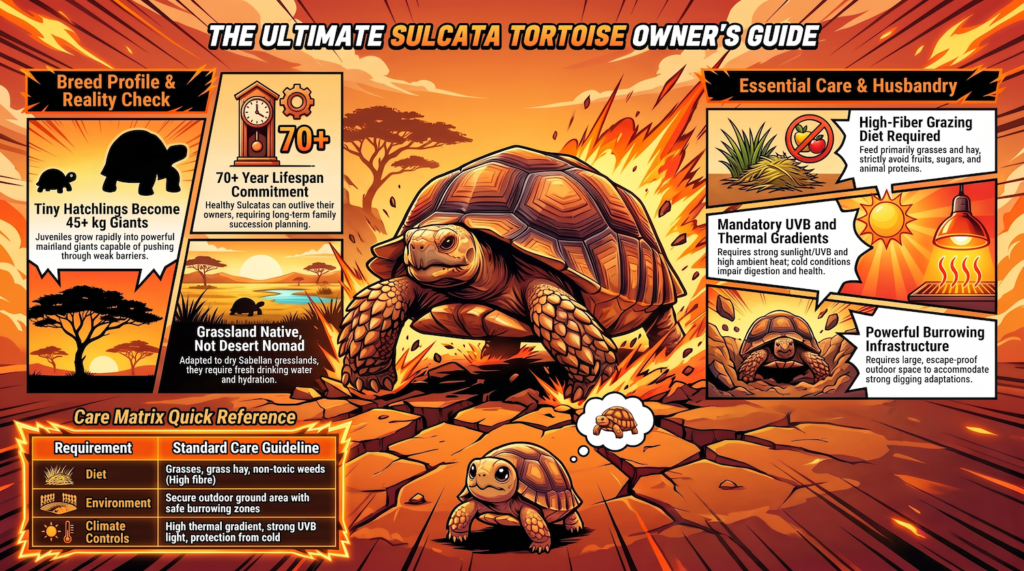
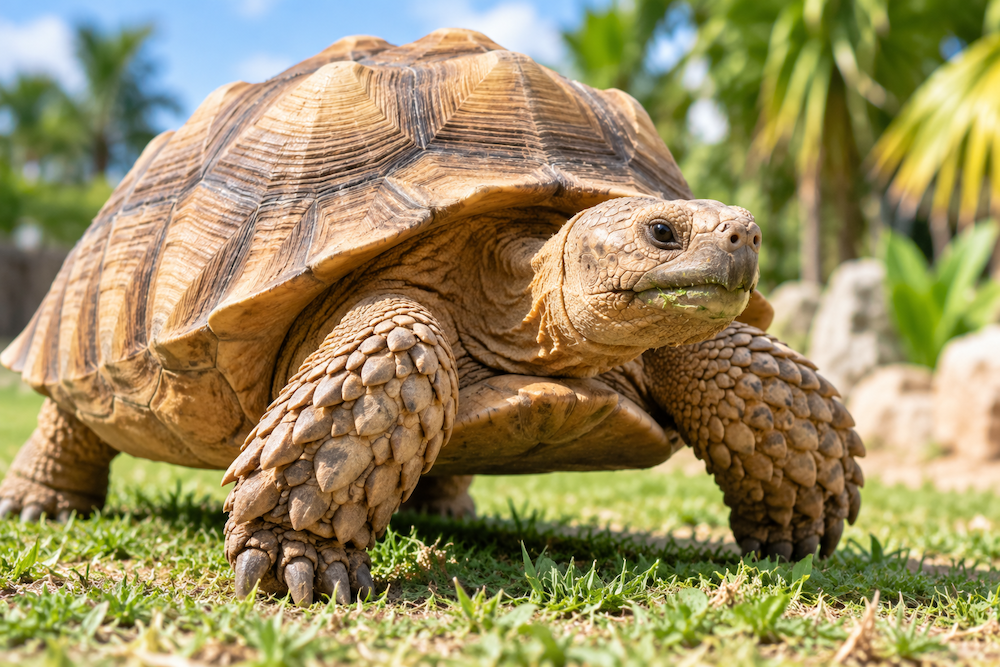







Massive, powerful and surprisingly full of personality, the Sulcata Tortoise is a remarkable African giant famous for its impressive size, extraordinary digging abilities and incredible lifespan.
🧠 QUICK SNAPSHOT
Trait | Sulcata Tortoise |
|---|---|
Scientific Name | Centrochelys sulcata |
Other Names | African Spurred Tortoise, African Sulcata Tortoise |
Pet Type | Large Reptile / Tortoise |
Natural Origin | Sahel region of Africa |
Typical Lifespan | 50–80+ years |
Adult Size | Approximately 60–80 cm shell length |
Adult Weight | Commonly 30–70 kg; exceptionally large individuals can exceed 90 kg |
Shell Colours | Sandy yellow, tan, brown and golden |
Diet | Herbivore |
Activity | Diurnal |
Temperament | Curious, determined, generally calm but powerful |
Noise Level | Very quiet |
Social Needs | Solitary; companionship not required |
Grooming | Minimal; regular shell, skin and nail checks |
Housing | Very large, secure outdoor enclosure with heated shelter |
Temperature | Basking area approximately 35–40°C |
Humidity | Age-dependent; juveniles require appropriate humidity and hydration |
Exercise Needs | High; extensive walking and grazing space |
Beginner Friendly? | No |
Famous Feature | Third-largest living tortoise species and extraordinary burrowing ability |
📚 OVERVIEW
The Sulcata Tortoise is one of the largest tortoise species in the world and the largest native to mainland Africa. Its scientific name, Centrochelys sulcata, refers to the distinctive grooves and sculptured appearance of its shell.
Native to the Sahel region along the southern edge of the Sahara Desert, Sulcata Tortoises are adapted to challenging environments with intense heat, seasonal rainfall and limited vegetation. Their powerful legs and impressive claws allow them to excavate deep burrows that provide protection from extreme temperatures.
Although hatchlings are small and appealing, Sulcatas grow into enormous, heavy reptiles capable of pushing through weak fencing, digging beneath barriers and rearranging their surroundings.
Their care requires extensive secure outdoor space, specialised heating, a high-fibre grazing diet, appropriate hydration and lifelong planning. Their extraordinary size and longevity make them unsuitable for most households, despite their fascinating personalities.
✅ PROS & CONS
👍 Pros
Extraordinary size and impressive appearance
Fascinating natural behaviours
Remarkably long lifespan
Curious and active personalities
Generally quiet animals
Enjoy natural grazing and exploration
Distinctive sculptured shells
Rewarding for experienced reptile keepers
👎 Cons
Grow extremely large and heavy
Require extensive outdoor space
Can damage fencing and landscaping
Need specialised heating and shelter
May outlive their original owners
Expensive long-term maintenance
Powerful enough to cause accidental injuries
Unsuitable for most beginners
Are Sulcata Tortoises Good Pets?
Yes, but only for owners with extensive space, appropriate facilities and a genuine long-term commitment.
Sulcata Tortoises are fascinating animals with distinctive personalities and impressive natural behaviours.
However, their enormous adult size, digging abilities and exceptional lifespan make them unsuitable for most households.
Are Sulcata Tortoises Good for Beginners?
No.
Sulcata Tortoises are generally not recommended for beginner reptile keepers.
Their rapid growth, substantial space requirements and specialised environmental needs demand considerable experience and preparation.
How Long Do Sulcata Tortoises Live?
Sulcata Tortoises can live for 50–80 years or longer.
Some may exceed 100 years, although verified records of extreme ages are limited.
Their longevity means owners must consider who will care for the tortoise in future decades.
How Big Do Sulcata Tortoises Get?
Adult Sulcatas commonly reach approximately 60–80 cm in shell length.
Exceptionally large individuals may grow even bigger.
They’re the third-largest living tortoise species, behind the Galápagos and Aldabra giant tortoises.
How Much Do Sulcata Tortoises Weigh?
Adult Sulcatas commonly weigh approximately 30–70 kg.
Large males can become considerably heavier, with exceptional individuals exceeding 90 kg.
Their size and strength make secure housing essential.
How Fast Do Sulcata Tortoises Grow?
Young Sulcatas can grow surprisingly quickly under suitable conditions.
However, growth rates vary with genetics, diet, temperature and overall health.
Owners should plan for a very large adult rather than relying on the hatchling’s small initial size.
Are Sulcata Tortoises Friendly?
Sulcata Tortoises can become accustomed to familiar caregivers and daily routines.
Some approach people when expecting food or interaction.
However, they’re not affectionate in the same way as mammals and should always be treated as powerful reptiles.
Do Sulcata Tortoises Recognise Their Owners?
Sulcatas can learn to associate familiar people with food and predictable activities.
They may approach when a caregiver enters their enclosure.
Their responses demonstrate learning and familiarity, although they shouldn’t be interpreted as human-like emotional attachment.
Do Sulcata Tortoises Like Being Petted?
Some tolerate gentle touching, particularly around the shell or neck.
Others may withdraw or become uncomfortable.
Handling should be limited, especially as adults become extremely heavy and difficult to lift safely.
Are Sulcata Tortoises Aggressive?
Sulcatas are generally not aggressive towards humans, but they can be territorial or forceful.
Large individuals may push, ram or bite, particularly around food or other tortoises.
Their considerable strength means even accidental contact can cause injury.
Can Two Sulcata Tortoises Live Together?
Sometimes, but group housing requires extensive space and careful management.
Adult males can become highly territorial and may fight or ram one another.
Solitary housing is often the safest option, particularly for inexperienced owners.
What Size Enclosure Does a Sulcata Tortoise Need?
Adult Sulcatas need very large outdoor enclosures.
At least 100 square metres of usable outdoor space is a practical planning target for an adult, with substantially more space preferred.
Secure fencing, digging protection, grazing areas and temperature-controlled shelter are essential.
Can Sulcata Tortoises Live Indoors?
Hatchlings and juveniles can be maintained indoors in appropriately designed enclosures.
However, adult Sulcatas are generally too large for ordinary indoor reptile housing.
In colder climates, they may require a substantial heated building connected to secure outdoor space.
Can Sulcata Tortoises Live Outside?
Yes, in suitable climates.
Outdoor housing allows natural grazing, walking and digging behaviours.
However, Sulcatas require protection from cold, prolonged damp conditions and extreme weather.
What Temperature Do Sulcata Tortoises Need?
Sulcatas need access to a suitable temperature gradient.
A basking area of approximately 35–40°C is commonly recommended, with cooler areas available for thermoregulation.
Heated shelter is essential when outdoor temperatures fall below appropriate levels.
Do Sulcata Tortoises Hibernate?
No.
Sulcata Tortoises do not naturally hibernate or brumate.
They’re adapted to warm African environments and must be protected from dangerously low temperatures.
Allowing them to become excessively cold can cause serious illness.
Do Sulcata Tortoises Need UVB Lighting?
Yes.
Sulcatas require adequate UVB exposure to support vitamin D3 production and healthy calcium metabolism.
Natural sunlight is highly beneficial when conditions are suitable.
Indoor enclosures require properly installed reptile UVB lighting.
What Do Sulcata Tortoises Eat?
Sulcatas are primarily grazing herbivores.
Their diet should consist largely of appropriate grasses, grass hay and safe fibrous weeds.
Suitable leafy plants can provide variety, but high-sugar fruits and excessive protein should be avoided.
Can Sulcata Tortoises Eat Fruit?
Fruit is generally unsuitable as a regular part of a Sulcata’s diet.
Their digestive systems are adapted to fibrous, low-sugar vegetation.
Excessive fruit can contribute to digestive disturbances.
Do Sulcata Tortoises Need Water?
Yes.
Despite living in dry environments, Sulcatas require access to fresh drinking water.
Hatchlings and juveniles are particularly vulnerable to dehydration and benefit from appropriate humidity and regular shallow soaking.
Adult tortoises also need reliable hydration.
Why Do Sulcata Tortoises Dig Burrows?
Burrowing is a natural survival behaviour.
In their African habitat, Sulcatas excavate shelters that help protect them from extreme surface temperatures.
Captive adults can dig substantial tunnels, making enclosure security particularly important.
Can Sulcata Tortoises Escape?
Yes.
Sulcatas are powerful diggers and can push against surprisingly strong barriers.
Weak fencing, unsecured gates and shallow foundations may allow escapes.
Enclosures should be designed specifically for large, determined tortoises.
What Causes Shell Pyramiding in Sulcata Tortoises?
Shell pyramiding occurs when the shell’s scutes develop an unusually raised appearance.
It is associated with inappropriate growth conditions, including inadequate humidity during development and other husbandry factors.
Proper hydration, suitable humidity, balanced nutrition and controlled growth help support healthy shell development.
What Health Problems Are Common in Sulcata Tortoises?
Potential concerns include metabolic bone disease, respiratory infections, dehydration, shell abnormalities, parasites and injuries.
Poor heating, inadequate UVB exposure and inappropriate nutrition can contribute to serious illness.
Regular veterinary examinations by a reptile-experienced veterinarian are important.
Are Sulcata Tortoises Endangered?
The Sulcata Tortoise is classified as Endangered on the IUCN Red List.
Wild populations face threats including habitat degradation, overgrazing and collection for trade.
Responsible captive breeding and avoiding wild-caught animals are important conservation considerations.
Are Sulcata Tortoises Legal to Keep as Pets?
Ownership regulations vary significantly between countries and regions.
Sulcatas are kept legally in some countries, but wildlife trade controls and local restrictions may apply.
In Australia, private ownership of exotic tortoise species such as the Sulcata is generally prohibited, so local regulations must be checked before considering ownership.
What Makes the Sulcata Tortoise Unique?
Imagine a tortoise that starts life small enough to fit in your hand but eventually becomes heavier than many adult humans.
That’s the extraordinary Sulcata Tortoise.
These magnificent reptiles are the third-largest living tortoise species on Earth and the largest found naturally on mainland Africa.
Their enormous size is impressive, but their survival adaptations are even more remarkable.
Sulcatas inhabit the challenging Sahel region, where temperatures can become extreme and rainfall is highly seasonal.
To survive these conditions, they use their powerful front legs and enormous claws to excavate deep burrows.
These underground shelters provide a more stable environment than the scorching surface above.
Their name also reflects a distinctive physical feature.
The word sulcata refers to grooves or furrows, describing the sculptured appearance of their shells.
Their heavily armoured bodies and thick, scaled legs give them an almost prehistoric appearance.
But perhaps their most astonishing characteristic is their lifespan.
A healthy Sulcata may live for many decades, potentially outliving the person who originally acquired it.
And despite their slow-moving reputation, these tortoises can be remarkably determined.
They may patrol their territories, investigate unfamiliar objects and push against obstacles with extraordinary strength.
Their grazing behaviour also plays an ecological role in their native habitat, where they consume grasses and other vegetation.
The Sulcata Tortoise isn’t simply a giant reptile — it’s a powerful, ancient-looking survivor with extraordinary adaptations and a lifespan that can span generations.