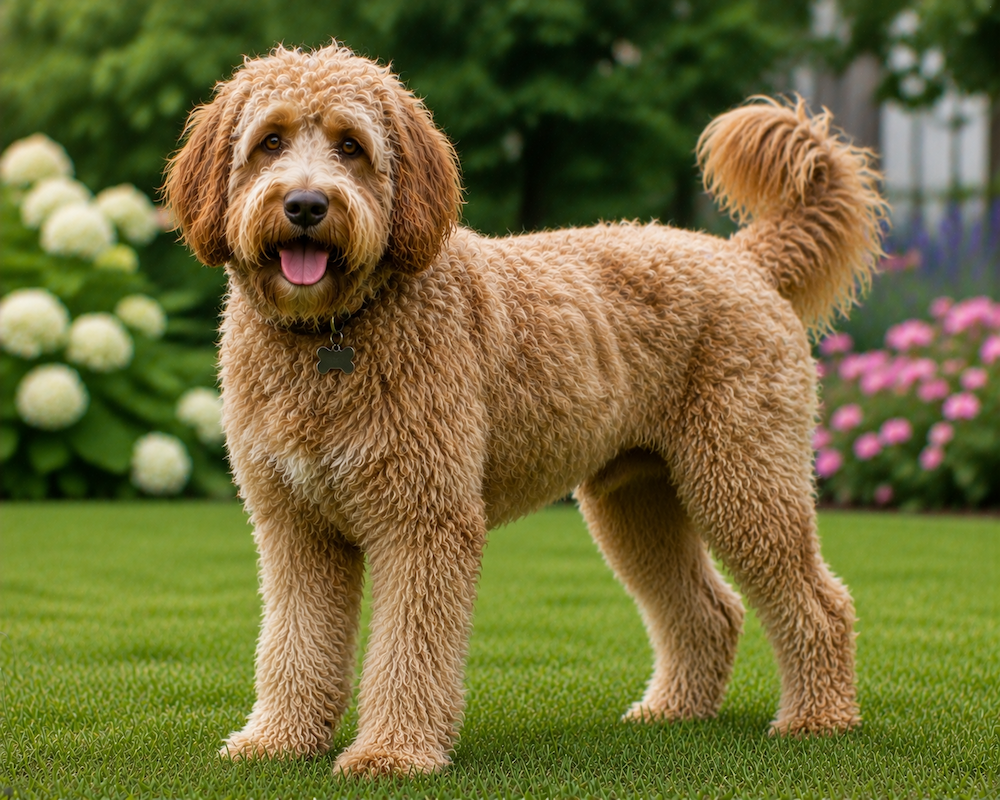







Intelligent, affectionate, and full of fun — a playful companion that combines the charm of the Soft Coated Wheaten Terrier with the brilliance of the Poodle.
🧠 QUICK SNAPSHOT
- Temperament: Friendly, intelligent, playful
- Energy Level: High
- Size: Medium
- Good With Families: Yes
- Trainability: High
- Grooming: High
- Best For: Active families, companionship, allergy-conscious owners
📚 OVERVIEW
The Whoodle is a cross between a Soft Coated Wheaten Terrier and a Poodle, producing a lively, intelligent, and affectionate companion. Known for their soft, fluffy coats and outgoing personalities, Whoodles are highly social dogs that thrive on being part of family life.
These energetic companions love learning, playing, and exploring. With the right balance of exercise, training, and affection, the Whoodle becomes a loyal and entertaining family member.
✅ PROS & CONS
Pros
- Extremely affectionate and family-oriented
- Highly intelligent and easy to train
- Often low shedding depending on coat type
- Friendly with children and other pets
Cons
- Requires regular grooming and coat maintenance
- Needs plenty of daily exercise
- Can develop separation anxiety
- May become bored without mental stimulation
Is a Whoodle a Good Family Dog?
Yes. Whoodles can make affectionate, intelligent and energetic family dogs.
A Whoodle is a cross between a Soft Coated Wheaten Terrier and a Poodle. Because it’s a crossbreed, temperament, size and coat characteristics can vary considerably between individual dogs.
Are Whoodles Good With Children?
Generally, yes. Whoodles are often playful, affectionate and enthusiastic companions for children.
They can be energetic and boisterous, particularly when young, so supervision around smaller children is sensible.
Early socialisation and training are important.
How Much Exercise Does a Whoodle Need?
Most Whoodles need around 60–90 minutes of exercise each day, together with regular mental stimulation.
Walking, retrieving, swimming, scent games and interactive training can all provide useful outlets.
They’re generally active dogs rather than low-energy companion pets.
Are Whoodles Easy to Train?
Usually, yes.
Poodles are exceptionally trainable, while Soft Coated Wheaten Terriers are intelligent but can have a more independent terrier personality.
A Whoodle may therefore learn very quickly while occasionally deciding it has a better idea.
Positive, consistent training usually works best.
Do Whoodles Shed?
Many Whoodles are low-shedding, but this isn’t guaranteed.
Both parent breeds are relatively low shedding, although a Whoodle’s coat can vary considerably in texture and maintenance requirements.
Individual puppies may inherit different combinations of coat genes.
Are Whoodles Hypoallergenic?
Whoodles are often marketed as hypoallergenic, but no Whoodle can be guaranteed to be allergy-friendly.
Low shedding may reduce the amount of hair distributed around the home, but dog allergens are also present in saliva and skin secretions.
People with allergies should spend time around the individual dog before making a decision.
How Often Should You Groom a Whoodle?
Whoodles usually require substantial grooming.
Their coat should generally be brushed several times a week, and curly or longer coats may need daily attention to prevent matting.
Professional grooming is commonly required approximately every six to eight weeks.
What Health Problems Are Common in Whoodles?
Potential health concerns include hip dysplasia, eye disorders, skin conditions, Addison’s disease and inherited kidney or protein-losing diseases associated with Wheaten lines.
Other conditions inherited from either parent breed may also occur.
Crossbreeding doesn’t automatically eliminate genetic disease, so health testing of both parents remains important.
How Long Do Whoodles Live?
Whoodles commonly live around 12–15 years, although lifespan varies with size, genetics and overall health.
Smaller Whoodles may potentially live longer than larger individuals.
Healthy weight, exercise, dental care and preventive veterinary care can help support longevity.
How Big Does a Whoodle Get?
Whoodle size varies considerably because different sizes of Poodle can be used.
Many Standard Whoodles weigh approximately 14–27 kg, although individuals can fall outside this range.
Mini Whoodles are usually smaller.
There is no official Whoodle breed standard establishing exact adult dimensions.
What Is a Mini Whoodle?
A Mini Whoodle is generally a Whoodle bred using a Miniature Poodle rather than a Standard Poodle, or through subsequent generations intended to produce smaller dogs.
Because the Whoodle isn’t a standardised breed, terms such as “Mini Whoodle” aren’t defined consistently between breeders.
The size of the actual parents is a better guide than the label alone.
What Does a Whoodle Look Like?
Whoodles commonly have soft, wavy or curly coats, floppy ears and an expressive, shaggy or teddy-bear-like face.
Some resemble curly-coated Wheatens, while others look much more Poodle-like.
Appearance can vary substantially even between puppies from the same litter.
Can a Whoodle Live in an Apartment?
Potentially, yes.
Smaller Whoodles can adapt particularly well to apartment living if their exercise and mental-stimulation needs are met.
Larger and more energetic Whoodles may be better suited to homes providing easier access to outdoor exercise.
Can Whoodles Be Left Alone?
Whoodles are generally people-oriented dogs and may not enjoy being left alone for long periods.
Both parent breeds can form strong relationships with their families.
Gradual independence training from puppyhood can help reduce the risk of separation-related problems.
Do Whoodles Bark a Lot?
It varies.
Wheatens can be alert and enthusiastic, while Poodles are highly observant dogs, so some Whoodles can be fairly vocal.
Adequate exercise, mental stimulation and early training can help manage excessive barking.
Are Whoodles Affectionate?
Yes. Whoodles are typically very affectionate and people-oriented.
Many enjoy cuddling, following family members around and participating in household activities.
Their sociable nature is one reason they’ve become popular companion dogs.
Are Whoodles Good With Other Dogs?
Generally, yes.
Well-socialised Whoodles are often playful and sociable with other dogs.
Early positive experiences are important, particularly because individual dogs may inherit different degrees of terrier confidence or assertiveness.
Are Whoodles Good With Cats?
Many Whoodles can live successfully with cats, particularly when introduced while young.
However, the Soft Coated Wheaten Terrier has terrier ancestry, so some Whoodles may inherit a noticeable chase or prey drive.
Individual temperament matters.
Do Whoodles Have a High Prey Drive?
Some do.
The Wheaten Terrier side can contribute an instinct to pursue small animals, while the strength of this behaviour varies considerably between individual Whoodles.
Early recall training and appropriate management around wildlife are useful.
Are Whoodles High-Energy Dogs?
Generally, yes. Whoodles are usually active, playful and athletic dogs.
They’re unlikely to be satisfied with simply spending the entire day indoors.
Daily exercise combined with training, play and mental challenges usually produces a happier companion.
Are Whoodles Smart?
Yes. Whoodles can be extremely intelligent.
Poodles are renowned for their trainability and problem-solving abilities, while Soft Coated Wheaten Terriers are clever working terriers.
The combination can produce a dog that learns both desirable and undesirable behaviours remarkably quickly.
Do Whoodles Like Water?
Many Whoodles enjoy water, particularly those inheriting the Poodle’s enthusiasm for swimming and retrieving.
However, individual preferences vary.
Their coat should be properly dried and checked for tangles after swimming.
What Colours Do Whoodles Come In?
Whoodles can occur in numerous colours, including cream, wheaten, apricot, red, brown, black and combinations of these colours.
Coat colour can also change as the dog matures.
The Wheaten parent’s characteristic coat itself typically becomes lighter as the dog grows from puppyhood into adulthood.
What Is an F1 Whoodle?
An F1 Whoodle is a first-generation cross between a Soft Coated Wheaten Terrier and a Poodle.
The term describes the dog’s parentage but doesn’t guarantee a particular coat, size or temperament.
Genetic inheritance isn’t an exact 50/50 division of visible characteristics.
What Is an F1B Whoodle?
An F1B Whoodle is usually produced by crossing an F1 Whoodle back to a Poodle.
This may increase the likelihood of some Poodle-like coat characteristics.
However, an F1B Whoodle still isn’t guaranteed to be non-shedding or hypoallergenic.
What Is the Difference Between a Whoodle and a Goldendoodle?
A Whoodle combines a Soft Coated Wheaten Terrier and Poodle, while a Goldendoodle combines a Golden Retriever and Poodle.
Whoodles may inherit more classic terrier characteristics, including independence and prey drive.
Goldendoodles are generally influenced more strongly by the Golden Retriever’s retrieving and sporting background.
What Is the Difference Between a Whoodle and a Wheaten Terrier?
A Soft Coated Wheaten Terrier is an established pedigree breed from Ireland.
A Whoodle is a Wheaten Terrier–Poodle cross, so its coat, size, appearance and temperament are less predictable.
Some Whoodles strongly resemble Wheatens, while others inherit considerably more Poodle-like characteristics.
Is a Whoodle a Recognised Dog Breed?
No. The Whoodle isn’t generally recognised as a standardised pedigree breed by major kennel clubs.
There is therefore no official breed standard defining its exact size, appearance, coat or temperament.
Responsible breeding remains important regardless of whether a dog is purebred or crossbred.
Where Did the Whoodle Come From?
Deliberate Whoodle breeding became more visible as Poodle crosses increased in popularity.
However, there isn’t a reliably documented single breeder, location or date responsible for creating the Whoodle.
Wheaten Terrier–Poodle crosses may have existed informally long before the Whoodle name became popular.
Is a Whoodle a Good First Dog?
A Whoodle can be a good first dog for an active owner prepared for significant grooming.
They’re generally affectionate, intelligent and trainable, but owners should expect regular exercise, coat maintenance, mental stimulation and potentially some independent terrier behaviour.
What Makes the Whoodle Unique?
The Whoodle combines two breeds whose stylish appearances can hide their serious working backgrounds.
The Poodle developed from highly capable water-retrieving dogs.
The Soft Coated Wheaten Terrier developed as a versatile Irish farm dog expected to tackle jobs ranging from vermin control to guarding and general farm work.
Put those two backgrounds together and you can get a soft, curly teddy-bear-looking dog containing a surprisingly impressive amount of working-dog intelligence and energy.
That means a Whoodle may learn a new command remarkably quickly.
Unfortunately, the same brain can also be applied to considerably more important questions, such as:
“How exactly does this cupboard door open?”