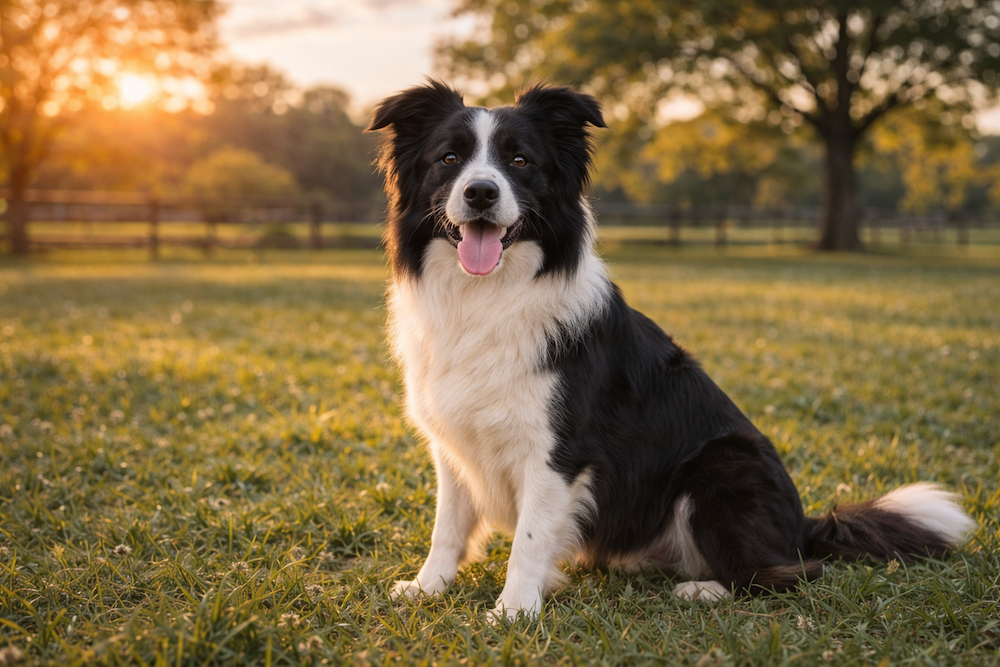







Highly intelligent, energetic, and driven — the ultimate dog for active and dedicated owners.
🧠 QUICK SNAPSHOT
- Temperament: Intelligent, Energetic, Focused
- Energy Level: Very High
- Size: Medium
- Good with Families: Yes (with active households)
- Training Difficulty: Easy
📚 OVERVIEW
Border Collies are widely regarded as the most intelligent dog breed. Originally bred for herding livestock, they are highly focused, energetic, and responsive. They excel in working roles, sports, and active homes where they can use both their mind and body.
✅ PROS & CONS
Pros
- Extremely intelligent and trainable
- Great for active lifestyles and dog sports
- Loyal and highly responsive
Cons
- Needs constant mental and physical stimulation
- Can become destructive if bored
- Not suited to low-activity households
Is a Border Collie a Good Family Dog?
Yes, a Border Collie can be an excellent family dog for an active household, but its intelligence and working drive make it more demanding than many breeds.
Border Collies often form extremely close bonds with their families and can be affectionate, playful and highly responsive. However, their herding instincts may lead them to stalk, chase or attempt to herd running children.
They need substantial physical exercise and mental stimulation every day.
For the right household, they’re extraordinary companions. For someone simply wanting a relaxed pet, a Border Collie can feel rather like hiring a brilliant employee and then forgetting to give them a job.
How Much Exercise Does a Border Collie Need?
Most adult Border Collies need around 90 minutes to two hours of meaningful exercise each day, although individual working lines can require considerably more stimulation.
Running, hiking, retrieving, agility, herding, scent work and other dog sports can all provide useful outlets.
However, simply exhausting a Border Collie physically isn’t always the answer.
Training, problem-solving and opportunities to use its brain are equally important.
Owners should also teach relaxation. Constantly providing increasingly intense exercise can create an exceptionally fit dog that still hasn’t learned how to switch off.
Is a Border Collie Easy to Train?
Border Collies are exceptionally trainable and widely regarded as one of the most intelligent dog breeds.
They can learn commands, routines and complex behavioural sequences remarkably quickly.
Positive reinforcement and short, varied training sessions generally work extremely well.
However, extreme intelligence doesn’t automatically make a dog easy to own.
Border Collies can learn unwanted behaviours just as quickly as desirable ones and are remarkably good at noticing patterns in their owner’s behaviour.
Sometimes you’re training the Border Collie.
Sometimes the Border Collie is quietly training you.
Does a Border Collie Shed?
Yes, Border Collies shed throughout the year, with heavier seasonal shedding from their double coat.
Both rough-coated and smooth-coated Border Collies shed.
Regular brushing helps remove loose undercoat, prevent tangles and reduce the amount of hair distributed around the home.
Rough-coated dogs generally require somewhat more grooming, particularly around feathering on the legs, chest and tail.
Border Collies aren’t considered hypoallergenic.
What Health Problems Are Common in Border Collies?
Border Collies can be affected by several inherited health conditions.
Hip dysplasia and inherited eye disorders are important concerns.
The breed is also associated with genetic conditions including Collie Eye Anomaly (CEA), neuronal ceroid lipofuscinosis (NCL) and trapped neutrophil syndrome (TNS). DNA testing is available for several inherited disorders.
Epilepsy can also occur within some lines.
Responsible breeders should combine genetic testing with appropriate eye and orthopaedic screening rather than relying on DNA testing alone.
How Long Do Border Collies Live?
Border Collies typically live around 12–15 years, with some living longer.
Genetics, body condition, exercise, nutrition and preventive veterinary care all influence longevity.
Maintaining an appropriate weight is particularly important for protecting joints and mobility.
Mental enrichment should continue as dogs age, even when strenuous physical activity needs to be reduced.
Many elderly Border Collies remain intensely interested in what their owners are doing — retirement isn’t necessarily a concept they understand.
Can a Border Collie Live in an Apartment?
A Border Collie can live in an apartment with an exceptionally committed owner, but it isn’t usually the easiest breed for apartment life.
The main issue isn’t simply physical space.
Border Collies need exercise, training, mental stimulation and opportunities to engage in meaningful activities.
Their sensitivity to movement and sound can also make busy communal environments challenging for some individuals.
A large backyard isn’t automatically enough either.
A bored Border Collie with a huge garden is still a bored Border Collie.
Can a Border Collie Be Left Alone?
Border Collies can learn to spend reasonable periods alone, but they generally don’t thrive when routinely isolated for long working days.
They’re highly intelligent, active and often strongly attached to their owners.
Without sufficient stimulation, boredom can contribute to barking, destructive behaviour, repetitive activities or attempts to escape.
Puppies should gradually learn independence and, importantly, how to settle without constant entertainment.
Teaching a Border Collie to do nothing occasionally can be surprisingly valuable training.
Do Border Collies Bark a Lot?
Border Collies can be fairly vocal, although barking varies considerably between individuals.
Excitement, frustration, boredom and sensitivity to movement can all trigger barking.
Some bark while working livestock or participating in energetic games, while others are relatively quiet.
Training should encourage calm responses rather than allowing barking to become the dog’s default reaction to stimulation.
Adequate physical and mental activity can also reduce boredom-related vocalisation.
Are Border Collies Good With Other Dogs?
Border Collies can be very good with other dogs, particularly when properly socialised.
However, their intense movement, staring and herding behaviour can confuse dogs unfamiliar with that communication style.
Some Border Collies prefer working or interacting with people rather than playing extensively with unfamiliar dogs.
Individual personality varies enormously.
Early socialisation should emphasise calm, appropriate interactions rather than simply exposing the puppy to as many dogs as possible.
Are Border Collies Good With Cats?
Border Collies can live very successfully with cats, particularly when raised alongside them.
However, movement can trigger their herding instincts.
A Border Collie may stare, stalk or attempt to control where a cat moves without necessarily intending to harm it.
Persistent herding can still be stressful for the cat.
Early training should teach the dog to disengage and relax around feline housemates, while cats should have dog-free areas available.
Why Do Border Collies Stare at You?
Border Collies are famous for their intense stare, commonly known as “the eye.”
This behaviour is strongly connected with their livestock-herding style.
Border Collies use body position, movement and intense visual pressure to influence sheep without needing constant physical contact.
Some dogs display a stronger eye than others.
The behaviour can also appear around toys, people or other animals.
That famous Border Collie stare isn’t simply an unusually serious facial expression — it’s part of the equipment that made the breed such an extraordinary sheepdog.
Why Do Border Collies Crouch When Herding?
Border Collies often move in a distinctive low, stalking crouch while working livestock.
This behaviour is related to the predatory motor patterns from which herding behaviour developed.
Selective breeding preserved useful components such as orienting, stalking and controlled pursuit while greatly modifying other predatory behaviours.
Combined with the Border Collie’s intense “eye,” the crouched approach allows the dog to exert pressure on sheep and influence their movement.
It’s one of the most recognisable working styles in the dog world.
Why Do Border Collies Try to Herd Children, Cars or Bicycles?
Border Collies can attempt to herd almost anything that moves because movement can activate behaviours selected for generations in working sheepdogs.
Children running, cyclists, joggers and even vehicles can become intensely interesting.
A dog may stalk, circle, chase or occasionally nip in an attempt to control movement.
Vehicle chasing is particularly dangerous and should never be dismissed as harmless breed behaviour.
Training should redirect these instincts towards safe activities such as herding, agility, controlled retrieving or other structured work.
Why Are Border Collies So Intelligent?
Border Collies were selectively bred to perform complex work while responding closely to human direction.
A working dog needs to read livestock, interpret whistles and verbal commands, respond to subtle handler signals and make independent decisions at considerable distances.
Generation after generation, dogs capable of doing this work were highly valued.
The result is extraordinary trainability, memory and sensitivity to patterns.
However, canine intelligence isn’t a single measurable quality, and different breeds excel at different tasks.
Border Collies are particularly remarkable for working intelligence, responsiveness and rapid learning.
How Many Words Can a Border Collie Learn?
Some exceptional Border Collies have demonstrated the ability to learn hundreds of object names, and one famous dog pushed that number beyond one thousand.
The best-known example is Chaser, a Border Collie studied by researchers in the United States.
Chaser learned the names of more than 1,000 individual toys and objects and demonstrated that she could distinguish object names from commands involving those objects.
This doesn’t mean every Border Collie will learn a thousand words.
Chaser underwent extensive training, but her achievements provided a remarkable demonstration of canine learning and memory.
Who Was Chaser the Border Collie?
Chaser was a Border Collie famous for her extraordinary understanding of words and object names.
Her owner, psychology professor John Pilley, spent years systematically teaching her the names of toys.
Research involving Chaser demonstrated that she could identify more than 1,000 objects by name and understand categories and combinations of words in ways that attracted international scientific attention.
Chaser became one of the world’s best-known examples of canine cognition.
Her story helped transform the Border Collie’s reputation for intelligence from owner folklore into something researchers could investigate experimentally.
Who Was Old Hemp and Why Is He Important?
Old Hemp is one of the most important dogs in Border Collie history and is often regarded as a foundational ancestor of the modern breed.
He was born in Northumberland, England, in 1893 and belonged to shepherd and breeder Adam Telfer.
Old Hemp became famous for an unusually calm, controlled herding style that relied heavily on presence and “eye” rather than excessive barking or movement.
His working ability made him highly sought after for breeding.
Many later Border Collies trace ancestry back to him, giving one extraordinary sheepdog an enormous influence over the development of the breed.
What Is the Difference Between a Border Collie and a Rough Collie?
Border Collies and Rough Collies share British herding ancestry, but they’re distinct breeds developed along different paths.
Border Collies were selected intensely for working sheep, producing an athletic dog famous for its crouching style, “eye” and extraordinary responsiveness.
Rough Collies became more standardised for appearance and companionship while retaining their herding heritage.
Rough Collies are generally larger and have the distinctive long, narrow head and abundant coat associated with dogs such as Lassie.
Not every long-haired black-and-white sheepdog is a Border Collie, and Lassie wasn’t one either.
Are All Border Collies Black and White?
No. Border Collies occur in many colours and patterns.
Black and white is probably the most recognisable combination, but Border Collies can also be red and white, blue, lilac, sable, tricolour, merle and other recognised colours.
Working ability historically mattered far more to shepherds than achieving one particular coat colour.
Colour genetics can also have health implications. Breeding two merle dogs together significantly increases the risk of puppies being born with hearing or vision abnormalities.
Appearance should therefore never take priority over health, temperament and working soundness.
Where Does the Name Border Collie Come From?
The name reflects the breed’s strong association with the border country between England and Scotland.
Shepherds throughout this region developed highly capable sheepdogs adapted to demanding terrain and livestock work.
The word “collie” has been associated with Scottish sheepdogs for centuries, although its exact linguistic origin remains debated.
The term “Border Collie” became established relatively recently compared with the much older working-dog tradition behind the breed.
What Were Border Collies Originally Bred to Do?
Border Collies were developed primarily to herd and manage sheep.
Their job required far more than simply chasing livestock.
A skilled sheepdog had to gather scattered animals, move flocks through gates, separate individuals and respond to commands delivered from considerable distances.
Dogs needed stamina, intelligence, responsiveness and the ability to make independent decisions.
These traits remain extraordinarily strong in modern Border Collies.
Even one that has never seen a sheep can inherit behavioural machinery developed through generations of highly specialised livestock work.
Where Does the Border Collie Come From?
The Border Collie developed in the British Isles, particularly the borderlands of Scotland and England, from generations of working sheepdogs.
Rather than being created through one carefully planned breed-development programme, these dogs evolved through practical selection by shepherds.
Working ability mattered above almost everything else.
A major milestone came with the founding of the International Sheep Dog Society in 1906, which maintained working sheepdog records and promoted trials.
Old Hemp, born in 1893, became particularly influential in the ancestry of modern dogs.
The Border Collie we recognise today is therefore the product of something very simple but extraordinarily demanding: generations of shepherds repeatedly breeding the dogs that were best at the job.