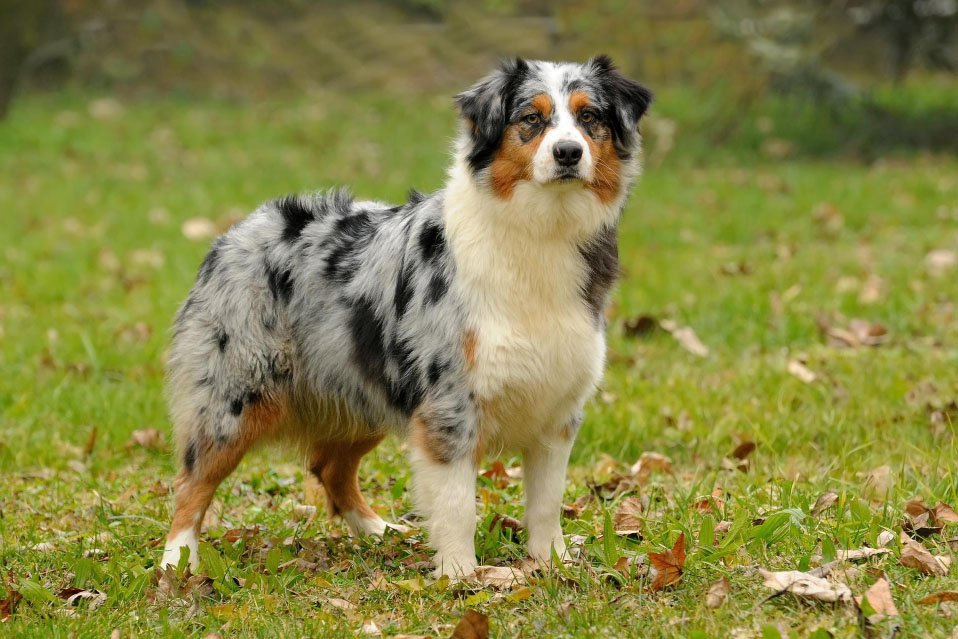







Smart, energetic, and always ready to work — the perfect companion for active lifestyles.
🧠 QUICK SNAPSHOT
- Temperament: Intelligent, Energetic, Loyal
- Energy Level: Very High
- Size: Medium
- Good with Families: Yes (active homes)
- Training Difficulty: Easy
📚 OVERVIEW
Australian Shepherds are highly intelligent working dogs known for their energy and strong work ethic. Originally bred for herding, they are quick learners and excel in activities like agility, obedience, and outdoor adventures. They form strong bonds with their owners and thrive in active environments.
✅ PROS & CONS
Pros
- Extremely intelligent and trainable
- Great for active lifestyles
- Loyal and responsive
Cons
- Needs constant mental and physical stimulation
- Can become destructive if bored
- Not suited to low-activity homes
Is an Australian Shepherd a Good Family Dog?
Yes, an Australian Shepherd can be an excellent family dog, particularly for active households prepared to provide substantial exercise, training and mental stimulation.
Often called an Aussie, the breed tends to form very strong relationships with its family and usually wants to be involved in whatever its people are doing.
Aussies can be excellent with children, although their herding instincts may cause them to chase, circle or occasionally nip at the heels of running kids.
Early socialisation and training are important.
For an active family wanting an intelligent and highly interactive companion, the Aussie can be outstanding. For someone wanting a dog content with a short daily stroll, there are considerably easier choices.
How Much Exercise Does an Australian Shepherd Need?
An adult Australian Shepherd generally needs around one to two hours of exercise every day, with highly driven working-line dogs potentially requiring more.
Physical exercise alone isn’t enough.
Aussies were developed to think while working, so training, scent games, puzzle activities and dog sports can be just as important as walking and running.
Many excel at agility, obedience, herding, flyball and other demanding activities.
Simply trying to physically exhaust an Aussie can create an increasingly fit dog that still needs mental stimulation.
The real goal is to exercise the brain as well as the legs.
Is an Australian Shepherd Easy to Train?
Yes, Australian Shepherds are generally exceptionally trainable.
They’re intelligent, observant and usually highly responsive to their handlers, which is why Aussies excel in activities ranging from herding and obedience to agility and trick training.
Positive reinforcement and varied training sessions usually produce excellent results.
However, their intelligence means they also notice inconsistencies quickly.
Without clear guidance, an Aussie may begin making its own decisions about what everyone should be doing.
Training should start early and include calmness and impulse control rather than focusing exclusively on exciting activities.
Aussies don’t usually have difficulty learning.
The challenge is making sure you’re teaching them the things you actually want them to remember.
Does an Australian Shepherd Shed?
Yes, Australian Shepherds shed moderately throughout the year and often heavily during seasonal coat changes.
They have a double coat consisting of a weather-resistant outer coat and insulating undercoat.
Brushing several times each week can help remove loose hair and prevent tangles, particularly around the ears, legs and feathering.
During periods when the undercoat is being shed, more frequent brushing may be necessary.
Their coat doesn’t normally require shaving and generally shouldn’t be routinely clipped extremely short.
Australian Shepherds aren’t hypoallergenic.
If you own one, it’s reasonable to expect that some portion of your Aussie will eventually accompany you on your clothing.
What Health Problems Are Common in Australian Shepherds?
Australian Shepherds can be affected by several inherited health conditions.
Hip and elbow dysplasia can occur, along with inherited eye disorders including progressive retinal atrophy and hereditary cataracts.
The breed can also carry the MDR1 gene variant, which can cause dangerous sensitivity to certain medications.
Epilepsy is another concern within some Australian Shepherd lines.
Responsible breeders should perform appropriate orthopaedic, ophthalmic and genetic testing.
Particular care is also required with merle breeding. Breeding two merle dogs together significantly increases the risk of puppies inheriting serious hearing and vision abnormalities.
Health testing should always matter more than producing fashionable colours or unusual eye combinations.
How Long Do Australian Shepherds Live?
Australian Shepherds typically live around 12–15 years, although individual lifespan varies.
Genetics, body condition, nutrition, exercise and preventive veterinary care all influence longevity.
Maintaining a healthy weight is particularly important for protecting joints throughout life.
As Aussies age, intense exercise may need to be reduced, but mental stimulation remains valuable.
Many retain their enthusiasm for training and participation well into their senior years.
An older Aussie may no longer want to spend the entire afternoon running.
It may still want to supervise exactly what everyone else is doing.
Can an Australian Shepherd Live in an Apartment?
An Australian Shepherd can live in an apartment, but only if its substantial exercise and mental-stimulation needs are consistently met.
Aussies don’t necessarily require acreage.
What they require is activity.
An owner providing long walks, training, enrichment and regular outdoor adventures may successfully keep an Aussie in a smaller home.
However, barking, high energy and sensitivity to activity outside the apartment can create additional challenges.
A large backyard doesn’t automatically solve the problem either. An Aussie left alone in a garden without meaningful interaction can become just as bored as one in an apartment.
Space is useful; engagement is essential.
Can Australian Shepherds Be Left Alone?
Australian Shepherds generally don’t thrive when routinely left alone for very long periods.
They were developed to work closely with people and tend to form strong attachments to their families.
Without sufficient exercise, companionship and stimulation, some Aussies may develop excessive barking, destructive behaviour or other signs of distress and boredom.
Puppies should gradually learn that reasonable periods alone are normal.
Providing exercise and enrichment before absences can help.
An Aussie doesn’t necessarily need someone beside it every minute of the day, but a lifestyle involving ten hours alone followed by a short walk is unlikely to suit the breed well.
Do Australian Shepherds Bark a Lot?
Australian Shepherds can be fairly vocal, although barking levels vary between individuals.
Their herding and watchdog heritage makes them naturally alert to movement and changes in their environment.
Some bark when excited, playing, working or alerting their owners to unfamiliar people.
Boredom can also increase barking.
Early training can help teach when vocalisation is appropriate and when the dog should settle.
Adequate physical and mental stimulation often makes a significant difference.
An Aussie with nothing to do may eventually decide that monitoring the entire neighbourhood is its new job.
Are Australian Shepherds Good With Other Dogs?
Australian Shepherds are generally capable of getting along very well with other dogs, particularly when properly socialised.
Many enjoy playing and can live successfully in multi-dog households.
Their herding instincts can occasionally cause them to chase or attempt to control other dogs, which not every canine companion appreciates.
Early socialisation helps puppies learn appropriate communication and play behaviour.
Individual temperament remains important, and introductions to new household dogs should always be managed carefully.
Are Australian Shepherds Good With Cats?
Many Australian Shepherds can live successfully with cats, particularly when raised with them and taught appropriate boundaries.
However, their strong response to movement can lead to chasing or herding behaviour.
A running cat may be particularly tempting.
Training should discourage chasing from the beginning, and cats should have safe elevated areas where they can escape unwanted attention.
An Aussie may genuinely like the family cat while simultaneously believing that the cat would benefit from more organised movement around the house.
Why Do Australian Shepherds Try to Herd People?
Australian Shepherds may attempt to herd people because controlling movement is deeply rooted in their working heritage.
Typical behaviours can include circling, blocking movement, staring intensely, chasing and occasionally nipping toward heels.
Running children can be especially likely to trigger these instincts.
Owners shouldn’t punish a dog simply for possessing inherited behaviour, but inappropriate herding should be redirected.
Training, structured games and activities such as herding trials or dog sports can provide better outlets.
The dog isn’t necessarily being aggressive.
It may simply have concluded that the family is a badly organised flock requiring professional assistance.
Why Do Some Australian Shepherds Have Blue Eyes?
Australian Shepherds can have blue, brown, amber or differently coloured eyes, and some dogs even have more than one colour within the same eye.
Blue eyes are particularly associated with the merle pattern, although blue eyes can also occur in some non-merle Aussies.
Heterochromia — having eyes of different colours — is also seen in the breed.
Blue eyes themselves don’t automatically mean a dog has poor vision.
However, breeding two merle dogs together increases the risk of serious developmental abnormalities affecting hearing and sight.
The Aussie’s extraordinary range of eye colours is one reason the breed has such a distinctive appearance.
What Is a Double Merle Australian Shepherd?
A double merle Australian Shepherd is a dog that has inherited two copies of the merle variant, typically because two merle-patterned dogs were bred together.
Double-merle puppies frequently have large amounts of white in their coats.
More importantly, they’re at significantly increased risk of deafness and serious eye abnormalities, including impaired vision or blindness.
Not every double-merle dog will have the same disabilities, but the elevated risk makes merle-to-merle breeding a major welfare concern.
Responsible breeding requires understanding the genetics involved rather than pairing dogs simply because their colours are attractive.
Do Australian Shepherds Have Tails?
Yes. Australian Shepherds can be born with full-length tails, naturally short bobtails or intermediate tail lengths.
A genetic variant responsible for natural bobtails occurs within the breed.
Historically, tails were also docked in some countries, contributing to the widespread image of an Aussie without a long tail.
Tail-docking laws now vary considerably around the world and cosmetic docking is prohibited or restricted in many jurisdictions, including Australia.
Therefore, seeing an Australian Shepherd with a beautiful full tail is completely normal.
The breed name may be confusing, but the tail doesn’t have to be missing too.
Is the Australian Shepherd Actually From Australia?
Despite its name, the Australian Shepherd was developed primarily in the United States, not Australia.
Its ancestry is complicated and includes shepherd dogs associated with European immigrants and livestock movements that passed through Australia before reaching America.
American ranchers developed the dogs further into the versatile stock-working breed recognised today.
The “Australian” name became attached to these dogs through those historical associations, even though the modern breed itself was largely shaped in the American West.
So one of the most memorable facts about the Australian Shepherd is wonderfully simple:
America developed a dog and called it Australian.
What Were Australian Shepherds Originally Bred to Do?
Australian Shepherds were developed as versatile livestock-herding dogs, particularly on ranches in the western United States.
They needed intelligence, endurance and the ability to control livestock while responding closely to their handlers.
Their versatility made them useful with different types of stock and across large properties.
Aussies later became closely associated with rodeos, horse shows and Western ranch culture, where their intelligence and trainability attracted considerable attention.
Those working instincts remain extremely strong in many modern dogs.
The beautiful coat and unusual eyes may attract people to the breed, but underneath them is fundamentally a working dog designed to spend its day solving problems on the move.