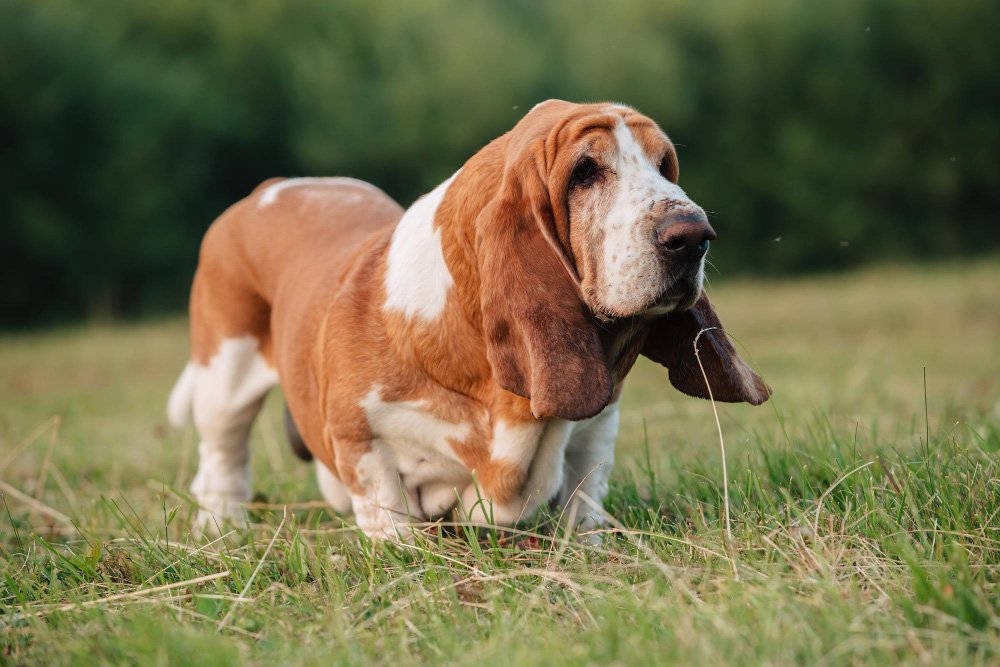







Laid-back, loyal, and full of character — a gentle companion with a powerful nose.
🧠 QUICK SNAPSHOT
- Temperament: Gentle, Loyal, Laid-back
- Energy Level: Low to Moderate
- Size: Medium
- Good with Families: Excellent
- Training Difficulty: Moderate
📚 OVERVIEW
Basset Hounds are easily recognised by their long ears, droopy eyes, and short legs. Originally bred for scent tracking, they have an incredible sense of smell and a calm, easygoing nature. They are affectionate companions that enjoy relaxed environments and family life.
✅ PROS & CONS
Pros
- Very gentle and great with families
- Calm and easygoing personality
- Loyal and affectionate
Cons
- Strong scent drive can make recall difficult
- Can be stubborn during training
- Prone to weight gain and ear issues
Is a Basset Hound a Good Family Dog?
Yes, the Basset Hound is generally an excellent family dog, known for being affectionate, patient and easygoing.
Bassets typically enjoy being around people and can be particularly good with respectful children. Despite their famously mournful expression, they’re often cheerful, sociable dogs with a surprisingly playful sense of humour.
They generally prefer companionship to spending long periods alone and often become deeply attached to their families.
Their laid-back personality shouldn’t be mistaken for complete obedience, however. Basset Hounds are independent scent hounds with definite opinions.
A Basset may love the entire family enormously while still believing that following an interesting smell is more urgent than anything you’re saying.
How Much Exercise Does a Basset Hound Need?
An adult Basset Hound generally needs around 45–60 minutes of moderate exercise each day.
Daily walks are important because Bassets can gain weight easily, and excess weight places additional strain on their long backs and short legs.
They don’t need intense running or strenuous exercise, but they shouldn’t be allowed to become permanent couch potatoes either.
Scent-based games are particularly enjoyable because the breed was developed to track animals using its extraordinary nose.
Exercise should be carefully managed while puppies are developing, particularly avoiding excessive jumping and repeated stair climbing.
Those short legs may suggest a leisurely lifestyle, but the Basset Hound was originally a genuine working hunting dog.
Is a Basset Hound Easy to Train?
Basset Hounds are intelligent but independent, so they’re not usually considered one of the easiest breeds to train.
They were developed to follow scent trails with relatively little direction from humans. That independence remains deeply embedded in the modern breed.
Food rewards and positive reinforcement can be extremely effective.
Training sessions should be short and interesting because repetitive exercises may quickly lose their appeal.
Recall deserves particular attention. Once a Basset finds an exciting scent trail, the rest of the world can suddenly become much less important.
A Basset Hound isn’t incapable of understanding your command.
Sometimes it has simply received more compelling information through its nose.
Does a Basset Hound Shed?
Yes, Basset Hounds shed moderately throughout the year, despite having relatively short coats.
Regular brushing once or twice each week helps remove loose hair and keeps the coat healthy.
Their coat itself is fairly easy to maintain, but other grooming requirements deserve attention.
The breed’s long ears need regular checking and cleaning because limited airflow can encourage moisture and infections.
Skin folds should also be monitored and kept clean and dry where necessary.
Bassets can also drool considerably.
So although professional coat grooming may be minimal, the Basset Hound definitely shouldn’t be confused with a maintenance-free dog.
What Health Problems Are Common in Basset Hounds?
Basset Hounds can be affected by several health problems associated partly with their distinctive body shape.
Hip and elbow dysplasia, eye disorders and ear infections can occur.
Their long backs and short legs can make spinal problems particularly concerning, while obesity places additional stress on the spine and joints.
Basset Hounds are also among the deep-chested breeds at risk of gastric dilatation-volvulus (GDV or bloat), a potentially fatal emergency requiring immediate veterinary treatment.
Responsible breeding, appropriate exercise and keeping the dog lean are particularly important.
Their exaggerated appearance is charming, but owners should understand that structure and health are closely connected.
How Long Do Basset Hounds Live?
Basset Hounds typically live around 10–13 years, although some live longer.
Maintaining a healthy body weight is one of the most important things owners can do to support longevity.
Extra kilograms place unnecessary strain on their joints, spine and cardiovascular system.
Regular exercise, appropriate nutrition, dental care and routine veterinary checks are also important.
Owners should pay particular attention to changes in mobility as their Basset ages.
Why Do Basset Hounds Have Such Long Ears?
The Basset Hound’s extraordinarily long ears aren’t just decorative — they’re believed to help its scent-tracking work.
As the dog moves with its nose close to the ground, the ears sweep around vegetation and soil, helping disturb scent particles around the muzzle.
Loose facial skin and wrinkles may also help retain scent around the nose.
This combination complements the breed’s exceptional olfactory ability.
Unfortunately, those spectacular ears also reduce airflow into the ear canal and can collect dirt and moisture.
Evolutionary hunting equipment therefore becomes an owner’s regular cleaning assignment.
How Good Is a Basset Hound’s Sense of Smell?
The Basset Hound has an exceptionally powerful sense of smell and is widely regarded as one of the outstanding scent-tracking dog breeds.
Its entire physical structure supports scent work.
Short legs keep the nose close to the ground, while long ears and loose facial skin may help concentrate scent particles around the muzzle.
Bassets were developed to patiently follow ground scent while hunters followed behind.
This explains why walks can occasionally proceed at an extremely slow pace.
Your Basset isn’t necessarily being lazy.
It may simply be reading a newspaper written entirely in smells.
Why Are Basset Hounds So Short?
Basset Hounds have extremely short legs because of a genetic form of disproportionate dwarfism known as chondrodysplasia.
Their short stature was deliberately useful for hunting.
A low dog could move through dense vegetation while following scent trails at a pace that hunters on foot could follow.
The word Basset itself comes from the French bas, meaning “low.”
Despite their short legs, Bassets are surprisingly substantial dogs with heavy bones and long bodies.
They’re low to the ground, but they’re definitely not lightweight.
Can a Basset Hound Live in an Apartment?
Yes, a Basset Hound can live successfully in an apartment, provided it receives regular exercise.
Bassets are generally fairly relaxed indoors and don’t require huge amounts of space.
However, there are two significant considerations: stairs and noise.
Repeated stair climbing can be difficult for a heavy, long-backed dog with very short legs, particularly as it ages.
Bassets can also produce an impressively loud bay or howl.
An apartment may therefore suit the dog perfectly while proving slightly less popular with the neighbours.
Do Basset Hounds Bark or Howl a Lot?
Basset Hounds can be quite vocal, particularly through their characteristic deep baying and howling.
Scent hounds historically used their voices while following trails, allowing hunters to keep track of them.
Modern Bassets may vocalise when excited, lonely, seeking attention or responding to interesting sounds.
Some are much quieter than others.
Early training can help manage excessive vocalisation, but prospective owners shouldn’t expect a naturally silent breed.
The voice emerging from a Basset can be particularly surprising because it sounds as though it belongs to a dog approximately twice the height.
Can Basset Hounds Swim?
Basset Hounds can physically swim, but they aren’t naturally well designed for it and should be supervised extremely carefully around water.
Their heavy bodies, dense bones, short legs and relatively large heads can make swimming difficult.
Some individuals enjoy shallow water, while others struggle to remain comfortably afloat.
Life jackets are sensible around deeper water or boats.
Owners should never assume that because most dogs can instinctively paddle, every dog is a capable swimmer.
For the Basset Hound, keeping four paws on solid ground is generally the safer speciality.
Are Basset Hounds Good With Other Dogs?
Basset Hounds are generally very sociable with other dogs.
They were historically bred to hunt in packs, so cooperation with other dogs was an important characteristic.
Many enjoy canine companionship and can thrive in multi-dog households.
Early socialisation is still important, and individual personalities vary.
Their usually easygoing temperament makes them one of the more naturally dog-social hound breeds.
Are Basset Hounds Good With Cats?
Many Basset Hounds can live successfully with cats, particularly when introduced carefully.
Although they’re hunting dogs, Bassets were primarily developed to follow scent trails rather than independently catch and kill prey.
Individual prey drive still varies, and some dogs may chase cats or smaller animals.
Early introductions and supervision are important.
A Basset raised alongside a cat may develop an excellent relationship with it — although the cat may eventually discover that those enormous ears make remarkably tempting sleeping accessories.
Can Basset Hounds Be Left Alone?
Basset Hounds generally prefer companionship and may struggle with being left alone for long periods.
Their history as pack dogs means many naturally enjoy having humans or other dogs nearby.
Some develop separation-related behaviours, including howling, barking or destructive behaviour.
Puppies should gradually learn that spending reasonable periods alone is normal.
Exercise and enrichment before absences can also help.
A second dog can provide companionship in some households, but shouldn’t be considered an automatic cure for separation anxiety.
Are Basset Hounds Lazy?
Basset Hounds can certainly enjoy sleeping and relaxing, but describing them simply as lazy overlooks their working heritage.
They were developed as determined scent hounds capable of following trails over considerable distances.
A modern Basset may appear completely uninterested in exercise until an intriguing scent appears.
Suddenly, the supposedly lazy dog can display impressive determination.
They need regular exercise to maintain healthy muscles and body weight.
The Basset Hound isn’t necessarily lazy.
It is simply highly selective about what deserves its energy.
What Were Basset Hounds Originally Bred to Hunt?
Basset Hounds were developed primarily as scent hounds for hunting small game, particularly rabbits and hares.
Their short legs allowed hunters to follow them on foot rather than horseback.
Instead of relying on speed, Bassets specialised in methodically following scent trails.
Their powerful noses, long ears, loose skin and determined temperament all supported this style of hunting.
Modern Bassets may spend considerably more time on sofas than pursuing rabbits, but those instincts remain easy to see whenever an interesting scent crosses their path.
Where Does the Basset Hound Come From?
The Basset Hound has its deepest roots in France, where short-legged scent hounds known as bassets were developed for hunting.
The name derives from the French word bas, meaning low, with basset essentially referring to a low-set or short dog.
Several French basset-type hounds contributed to the breed’s history.
During the 19th century, these dogs were imported into Britain, where British breeders further developed the Basset Hound into the breed recognised today. Bloodhound influence also played a role in shaping the modern type.
So while the Basset Hound’s ancestry is strongly French, the familiar modern breed was significantly refined in Britain.
Why Does a Basset Hound Always Look Sad?
A Basset Hound’s famous sad expression is largely the result of physical anatomy rather than emotional state.
Loose facial skin, drooping lower eyelids, long ears and wrinkles combine to create the unmistakable mournful appearance.
A perfectly happy Basset can therefore look as though it has just received terrible financial news.
Owners should still learn their individual dog’s genuine body language rather than assuming facial appearance tells the entire story.
A relaxed body, appetite, willingness to play and normal social behaviour are far more useful indicators of wellbeing than those permanently sorrowful eyes.