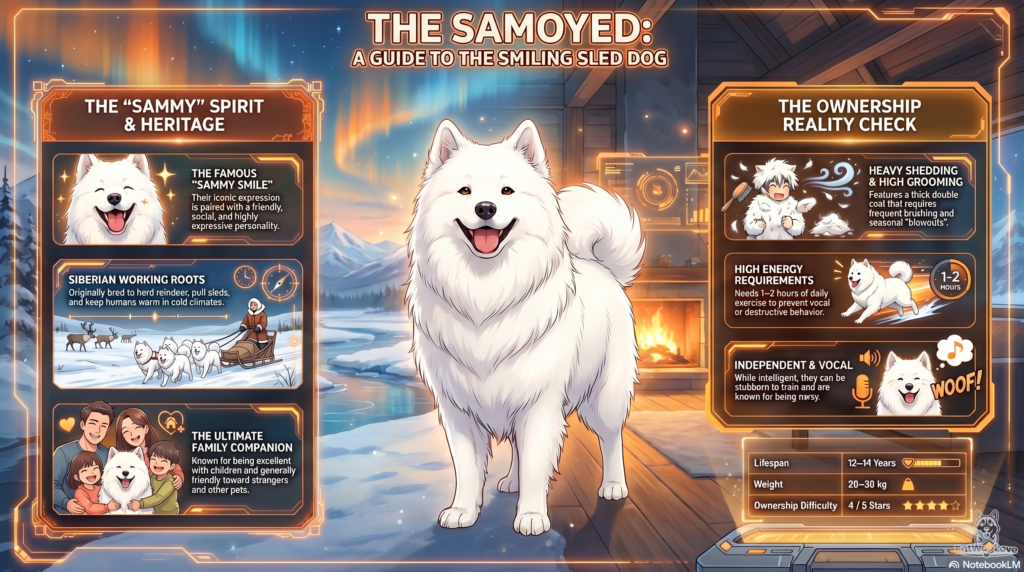
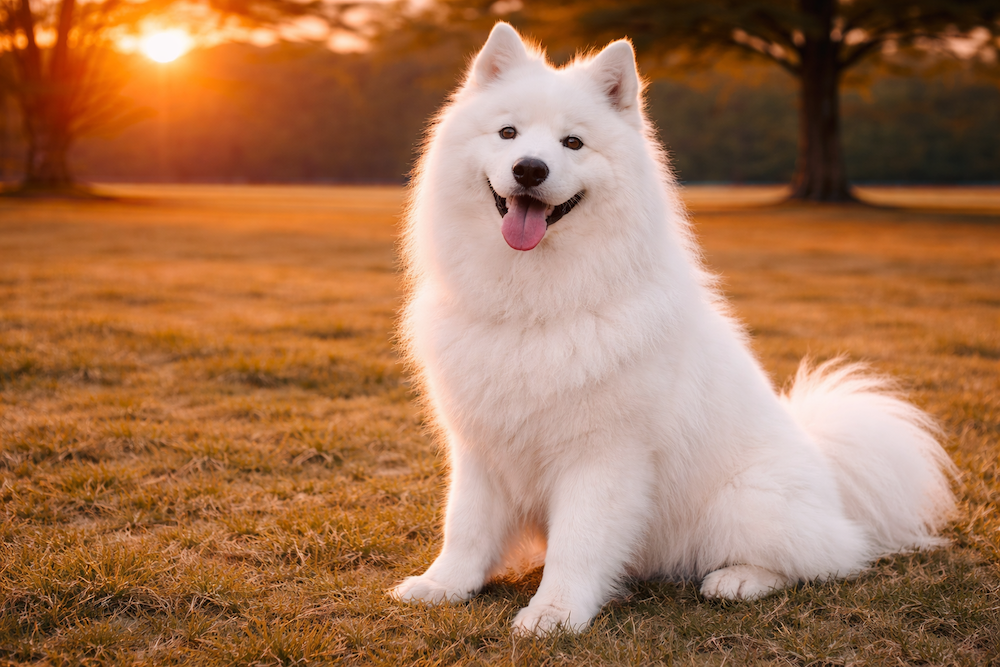







Fluffy, friendly, and always smiling — a beautiful companion with endless energy.
🧠 QUICK SNAPSHOT
- Temperament: Friendly, Gentle, Social
- Energy Level: High
- Size: Large
- Good with Families: Excellent
- Training Difficulty: Moderate
📚 OVERVIEW
Samoyeds are known for their iconic fluffy white coats and “smiling” expressions. Originally bred for herding and pulling sleds in cold climates, they are strong, energetic, and highly social dogs. They thrive on companionship and love being involved in family life.
✅ PROS & CONS
Pros
- Extremely friendly and social
- Beautiful, eye-catching appearance
- Great with families and children
Cons
- Heavy shedding and grooming needs
- Requires a lot of exercise
- Can be vocal and attention-seeking
Is a Samoyed a Good Family Dog?
Yes. Samoyeds are generally friendly, affectionate, playful and strongly people-oriented dogs.
They often thrive as part of an active family and usually want to be involved in whatever their humans are doing.
Their exercise, grooming and companionship requirements are substantial, so they’re best suited to families prepared for an energetic working breed with a lot of coat.
Are Samoyeds Good With Children?
Generally, yes. Samoyeds are often playful and affectionate with children.
Their friendly temperament can make them excellent family companions, although their enthusiasm and size can accidentally knock over small children.
As with any breed, interactions with young children should be supervised.
How Much Exercise Does a Samoyed Need?
Most adult Samoyeds need around 60–90 minutes of exercise each day, with some individuals wanting considerably more.
Walking, hiking, running, training and interactive games can all help.
Mental stimulation is equally important because Samoyeds are intelligent working dogs that can become destructive or excessively vocal when bored.
Are Samoyeds Easy to Train?
Samoyeds are intelligent and capable learners, but they can also be independent and strong-minded.
They were developed as working dogs rather than simply to follow commands, so training requires patience and consistency.
Positive reinforcement and interesting training sessions usually work better than repetitive drills.
Do Samoyeds Shed a Lot?
Yes. Samoyeds are extremely heavy shedders.
Their dense double coat consists of a soft insulating undercoat beneath a longer outer coat.
Seasonal “coat blows” can release extraordinary quantities of undercoat, particularly once or twice a year.
Are Samoyeds Hypoallergenic?
No. Despite occasional claims online, Samoyeds aren’t truly hypoallergenic.
They produce allergens through their skin, saliva and other secretions just like other dogs.
Their enormous amount of coat also makes them a poor choice for someone specifically seeking a low-shedding dog.
How Often Should You Groom a Samoyed?
Samoyeds need thorough brushing several times a week, and often daily attention during major shedding periods.
Their dense undercoat can mat if neglected.
Owners also need to ensure the coat dries thoroughly after bathing because moisture trapped close to the skin can contribute to skin problems.
Should You Shave a Samoyed?
Generally, no.
The Samoyed’s double coat provides insulation and protection, and routine shaving can interfere with the coat’s natural function and regrowth.
Medical clipping may occasionally be necessary under veterinary guidance, but shaving shouldn’t be used simply as a shortcut for grooming or as a way to keep the dog cool.
What Health Problems Are Common in Samoyeds?
Potential health concerns include hip dysplasia, eye disorders, heart conditions and certain inherited kidney diseases.
One particularly important inherited condition is Samoyed hereditary glomerulopathy, a kidney disorder associated with the breed.
Responsible breeders should use appropriate genetic testing and health screening.
How Long Do Samoyeds Live?
Samoyeds commonly live around 12–14 years, although individual lifespan varies.
Good breeding, maintaining a healthy weight, appropriate exercise, quality nutrition and regular veterinary care can all contribute to longevity.
How Big Does a Samoyed Get?
Samoyeds are medium-to-large dogs.
Adult males generally stand around 53–60 cm at the shoulder, while females are typically around 48–53 cm.
Adults commonly weigh approximately 16–30 kg, although their enormous fluffy coats can make them appear considerably larger.
Can a Samoyed Live in an Apartment?
Potentially, but it can be challenging.
Samoyeds can settle indoors when adequately exercised, but they’re energetic, vocal dogs that need substantial daily activity and interaction.
Their heavy shedding and tendency to vocalise can also make apartment living less practical.
Can Samoyeds Be Left Alone?
Samoyeds generally don’t enjoy being left alone for long periods.
They were developed to work and live closely alongside people and can be extremely social dogs.
Long periods of isolation may contribute to barking, howling, digging, chewing or other unwanted behaviours.
Do Samoyeds Bark a Lot?
They can.
Samoyeds are naturally communicative and may bark, howl, whine and make an impressive variety of other noises.
Training can help control excessive barking, but anyone wanting an exceptionally quiet breed may find a Samoyed challenging.
Are Samoyeds Aggressive?
Samoyeds aren’t generally known as an aggressive breed.
The typical Samoyed temperament is friendly, alert and sociable.
However, temperament varies between individuals, and good breeding, early socialisation and appropriate training remain essential.
Are Samoyeds Good Guard Dogs?
Samoyeds can make useful alert dogs, but they aren’t usually ideal traditional guard dogs.
They may enthusiastically announce that someone has arrived.
The problem is that many Samoyeds then decide the mysterious intruder is potentially their newest friend.
Are Samoyeds Good With Other Dogs?
Generally, yes.
Well-socialised Samoyeds are often sociable with other dogs and may enjoy having a compatible canine companion.
Individual temperament still matters, so introductions should be managed appropriately.
Are Samoyeds Good With Cats?
Some Samoyeds live very successfully with cats, particularly when raised with them.
However, they can retain a noticeable prey drive, so unfamiliar cats and smaller animals may trigger chasing.
Early socialisation and careful introductions are important.
Can Samoyeds Handle Hot Weather?
Samoyeds can live in warmer climates with careful management, but they’re far better adapted to cold conditions.
Exercise should be scheduled during cooler parts of the day, with constant access to shade, fresh water and cool indoor areas.
Owners need to watch carefully for signs of overheating.
Why Do Samoyeds Have Such Thick Fur?
The Samoyed’s extraordinary double coat developed as protection against the extreme cold of northern Siberia.
The dense undercoat traps insulating air close to the body, while the longer outer coat provides additional protection from the environment.
That coat was a functional survival feature long before it became one of the breed’s biggest attractions.
Why Do Samoyeds Smile?
The characteristic “Samoyed smile” comes from the slightly upturned corners of the mouth combined with the breed’s dark lips, eyes and expressive face.
This creates the appearance of a permanent grin.
The expression has become one of the breed’s most recognisable features, although it doesn’t literally mean the dog is smiling continuously from happiness.
Are Samoyeds Always White?
White is the colour most strongly associated with Samoyeds, but recognised coats can also include cream and biscuit colouring or white combined with biscuit, depending on the breed standard.
A pure black Samoyed isn’t a recognised standard colour.
What Is the Difference Between a Samoyed and a Siberian Husky?
Both are northern working breeds, but they’re distinct dogs with different histories and appearances.
Samoyeds have a much fuller white or cream coat and historically performed several roles, including herding and pulling.
Siberian Huskies are generally more streamlined, occur in a much wider range of colours and became particularly associated with endurance sled work.
What Were Samoyeds Originally Bred For?
The ancestors of modern Samoyeds were versatile northern working dogs associated with Indigenous peoples of Siberia.
They helped with activities including herding reindeer, pulling sleds and providing companionship in an extremely demanding environment.
Their close relationship with people helps explain the modern breed’s unusually social nature.
Where Does the Samoyed Come From?
The Samoyed’s ancestry comes from Siberia in northern Russia, where dogs of this type lived and worked alongside Indigenous Samoyedic peoples.
European explorers later encountered these northern dogs, and selected animals contributed to the development of the modern pedigree Samoyed.
The breed was subsequently standardised through organised breeding outside Siberia.
Is a Samoyed a Good First Dog?
A Samoyed can work for a committed first-time owner, but it isn’t one of the easiest beginner breeds.
The major challenges are heavy grooming, enormous shedding, exercise requirements, vocal behaviour and a strong need for companionship.
Someone prepared for those requirements can find the breed exceptionally affectionate and rewarding.
What Makes the Samoyed Unique?
The Samoyed looks almost impossibly well designed for social media: brilliant white coat, dark eyes and a permanent-looking smile.
But virtually everything about that appearance originally had a practical purpose.
These dogs trace their ancestry to the extreme conditions of Siberia, where northern dogs worked closely with people, helping with tasks such as herding reindeer and pulling sleds.
That magnificent coat wasn’t developed for photographs. It was survival equipment.
And the famous “Samoyed smile” isn’t evidence that the breed has spent thousands of years permanently delighted with life — it’s largely created by the shape of the mouth.
Yet the personality behind that smile is genuinely important.
Samoyeds developed alongside people rather than living as isolated working animals, which helps explain why modern Sammies can be so intensely social.
The result is a dog capable of handling extraordinary cold but often considerably less enthusiastic about another hardship:
being left at home while its favourite humans go somewhere without it.