






Bold, dignified, and full of character — a small dog with a big personality.
🧠 QUICK SNAPSHOT
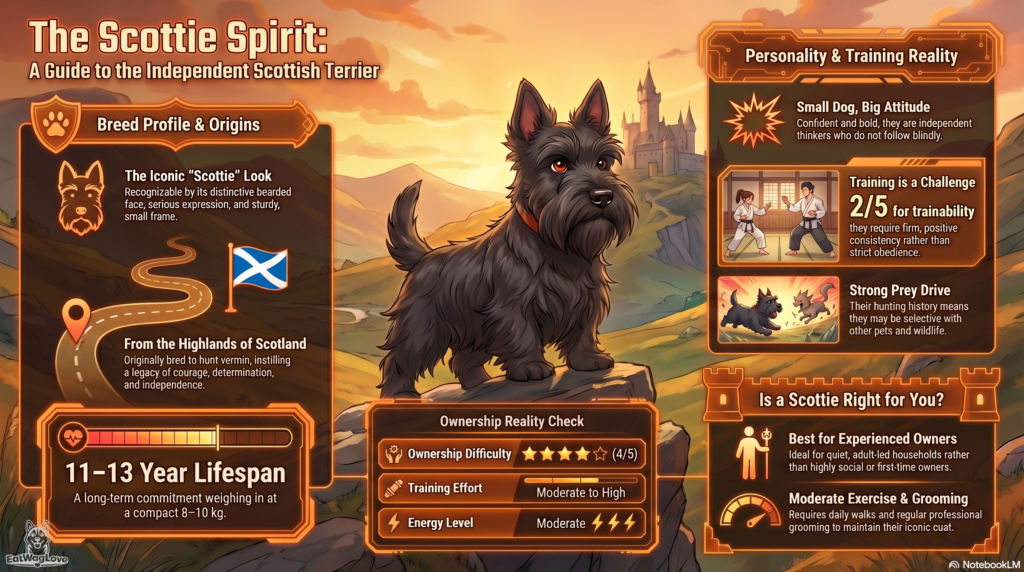
- Temperament: Independent, Loyal, Confident
- Energy Level: Moderate
- Size: Small
- Good with Families: Yes (with older children)
- Training Difficulty: Moderate
📚 OVERVIEW
Scottish Terriers, often called “Scotties,” are small but sturdy dogs known for their distinctive bearded faces and confident attitude. Originally bred for hunting vermin, they are brave, independent, and loyal companions. They are well-suited to owners who appreciate a dog with personality and character.
✅ PROS & CONS
Pros
- Loyal and devoted to their owner
- Low shedding coat
- Distinctive and charismatic appearance
Cons
- Can be stubborn and independent
- May be reserved with strangers
- Requires consistent training
Is a Scottish Terrier a Good Family Dog?
Yes. Scottish Terriers can be loyal, affectionate and devoted family dogs, although they’re typically more independent than many small companion breeds.
Scotties often form particularly strong bonds with their families while remaining reserved with strangers.
Their confident personality means they generally suit households that appreciate a dog with an independent streak.
Are Scottish Terriers Good With Children?
Scottish Terriers can be good with respectful children, particularly older children who understand how to interact appropriately with dogs.
They can be less tolerant of rough handling than some family breeds.
Early socialisation and supervision around young children are important.
How Much Exercise Does a Scottish Terrier Need?
Most Scottish Terriers need around 45–60 minutes of exercise each day.
Daily walks, sniffing opportunities, games and interactive activities usually suit them well.
They’re active terriers but don’t require the extreme exercise levels of many larger working breeds.
Are Scottish Terriers Easy to Train?
Scottish Terriers are intelligent but famously independent and strong-minded.
They can learn quickly when motivated but may not see the point in endlessly repeating commands.
Short, interesting training sessions using positive reinforcement generally work best.
Do Scottish Terriers Shed a Lot?
Scottish Terriers are relatively low-shedding dogs.
Their distinctive coat consists of a harsh, wiry outer layer with a softer undercoat.
Although they don’t usually leave enormous amounts of hair around the home, their coat requires regular maintenance.
Are Scottish Terriers Hypoallergenic?
Scottish Terriers are sometimes described as suitable for allergy sufferers because they shed relatively little, but no dog is truly hypoallergenic.
Dog allergens are also found in saliva and skin secretions.
Anyone with significant allergies should spend time around the breed before bringing one home.
How Often Should You Groom a Scottish Terrier?
Scotties should generally be brushed several times a week and require regular professional grooming or appropriate coat trimming.
Traditional show coats are maintained by hand-stripping, while many pet Scotties are clipped for convenience.
Their characteristic beard also needs regular cleaning and combing.
What Health Problems Are Common in Scottish Terriers?
Important health concerns include Scottie cramp, von Willebrand disease, patellar problems and certain cancers.
Scottish Terriers have also been associated with an increased risk of bladder cancer compared with many other breeds.
Responsible breeding, appropriate health testing and regular veterinary care are important.
What Is Scottie Cramp?
Scottie cramp is an inherited neurological movement disorder associated with Scottish Terriers.
Affected dogs may develop abnormal movements, stiffening or difficulty coordinating their legs, particularly during excitement or exercise.
Despite its dramatic appearance, affected dogs are usually conscious during an episode.
How Long Do Scottish Terriers Live?
Scottish Terriers commonly live around 11–13 years, although some live longer.
Maintaining a healthy weight, providing regular exercise and arranging appropriate preventive veterinary care can help support a long and healthy life.
How Big Does a Scottish Terrier Get?
Scottish Terriers are small but remarkably sturdy dogs.
Adults typically stand around 25–28 cm at the shoulder and weigh approximately 8–10 kg.
Their short legs, substantial body and distinctive furnishings make them appear surprisingly solid for their height.
Can a Scottish Terrier Live in an Apartment?
Yes.
Scottish Terriers can adapt well to apartment living when given adequate daily exercise and mental stimulation.
Their relatively compact size helps, although barking and their tendency to alert to activity outside the home may need management.
Can Scottish Terriers Be Left Alone?
Adult Scotties can often tolerate reasonable periods alone better than some highly dependent companion breeds.
They’re naturally independent, but that doesn’t mean they should routinely be isolated for very long periods.
Exercise and enrichment can help prevent boredom-related behaviour.
Do Scottish Terriers Bark a Lot?
Scottish Terriers can be alert and vocal, particularly when someone approaches their home.
They were bred to be determined working terriers and tend to take notice of what’s happening around them.
Early training can help keep unnecessary barking under control.
Are Scottish Terriers Good Watchdogs?
Yes. Scotties can be excellent little watchdogs.
They’re naturally alert, confident and often somewhat reserved around strangers.
Their size prevents them from functioning as conventional guard dogs, but they’re usually quite willing to announce unusual activity.
Are Scottish Terriers Affectionate?
Yes, although Scottie affection can be understated.
They’re often extremely loyal to their families but may not constantly demand cuddles or attention.
Some develop an especially close attachment to one person while remaining affectionate with the rest of the household.
Are Scottish Terriers Good With Other Dogs?
They can be, particularly with early socialisation.
Scotties are confident terriers and some can be assertive around unfamiliar dogs.
Careful introductions and positive social experiences from puppyhood are important.
Are Scottish Terriers Good With Cats?
Some Scottish Terriers can live successfully with cats, particularly when raised together.
However, their terrier ancestry means they can have a strong prey drive.
A Scottie that accepts a household cat may still chase unfamiliar cats or smaller animals outdoors.
Do Scottish Terriers Have a High Prey Drive?
Yes. Scottish Terriers were developed to pursue animals that lived underground, so the instinct to chase and investigate small animals remains strong in many Scotties.
Rodents and other fast-moving animals can be particularly tempting.
Secure fencing is important.
Do Scottish Terriers Dig a Lot?
They certainly can.
Digging is deeply connected to the breed’s working heritage as an earthdog used to pursue quarry underground.
A Scottie investigating an interesting scent in the garden may regard your carefully designed landscaping as merely an inconvenient obstacle.
Can Scottish Terriers Be Trusted Off Leash?
Caution is advisable.
Scotties can be independent and have a strong instinct to pursue interesting scents or small animals.
Even a well-trained dog may suddenly decide that chasing something is more important than responding to recall, so secure areas are safest for off-leash exercise.
What Colours Do Scottish Terriers Come In?
Although black is the colour most strongly associated with the breed, Scottish Terriers can also be wheaten or brindle.
Brindle coats can range considerably in appearance.
The familiar black Scottie is therefore only one of the breed’s recognised looks.
Why Do Scottish Terriers Have Beards?
The Scottie’s beard, eyebrows and longer furnishings form part of its distinctive traditional appearance.
Its harsh outer coat also had a practical purpose, helping protect a working terrier from rough vegetation, weather and difficult terrain.
Today, careful grooming maintains the classic Scottie silhouette.
What Were Scottish Terriers Originally Bred For?
Scottish Terriers were developed to hunt and control vermin and burrowing animals.
Their short legs allowed them to work close to the ground, while their powerful bodies, determination and strong jaws suited the demanding work of pursuing quarry.
That working heritage explains much of the modern Scottie’s bold and persistent personality.
What Is the Difference Between a Scottish Terrier and a West Highland White Terrier?
Both originated in Scotland and share terrier ancestry, but they’re distinct breeds.
The West Highland White Terrier is always white and often has a more openly outgoing personality, while the Scottish Terrier is typically more reserved and comes in black, brindle or wheaten.
Scotties also have a particularly long head and distinctive beard.
Is a Scottish Terrier the Same as a Scottie Dog?
Yes.
“Scottie” or “Scottie Dog” is simply the familiar nickname for the Scottish Terrier.
The nickname became so widely recognised that the silhouette of a little bearded Scottie is one of the most identifiable images in the dog world.
Where Does the Scottish Terrier Come From?
The Scottish Terrier originated in Scotland, where small, tough terriers had been used for centuries to control vermin and pursue quarry underground.
During the 19th century, different Scottish terrier types became more clearly separated and standardised.
This eventually produced the distinctive Scottish Terrier recognised today.
Is a Scottish Terrier a Good First Dog?
A Scottish Terrier can suit a first-time owner prepared for its independent personality.
They’re relatively compact and don’t require enormous amounts of exercise, but training can require patience, and grooming is an ongoing commitment.
Their prey drive and terrier determination shouldn’t be underestimated simply because they’re small.
What Makes the Scottish Terrier Unique?
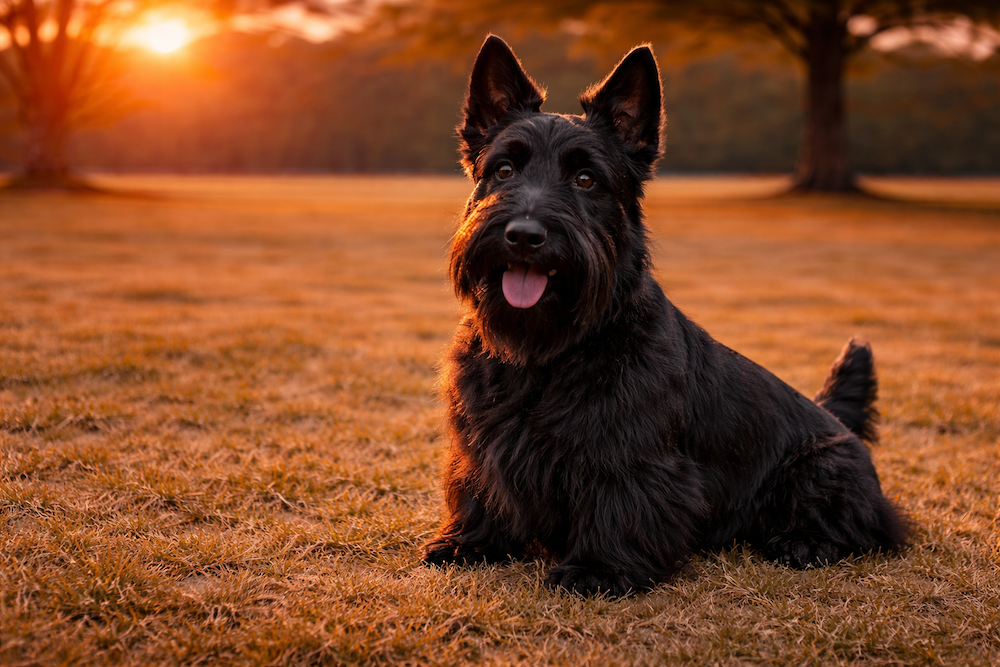
The Scottish Terrier has one of the most recognisable silhouettes in the dog world: short legs, long head, upright ears, enormous eyebrows and that magnificent beard.
It looks remarkably dignified.
The personality underneath can be considerably less concerned with maintaining that dignity.
Scotties were developed as tough working terriers capable of pursuing quarry underground, so generations of breeding rewarded courage, persistence and independent decision-making.
Those characteristics haven’t disappeared just because the modern Scottie now lives in a comfortable house.
That’s why a Scottie can look like a distinguished little gentleman while simultaneously deciding that a suspicious smell underneath your garden bed requires immediate excavation.
Small dog.
Serious beard.
Absolutely no requirement for your permission.