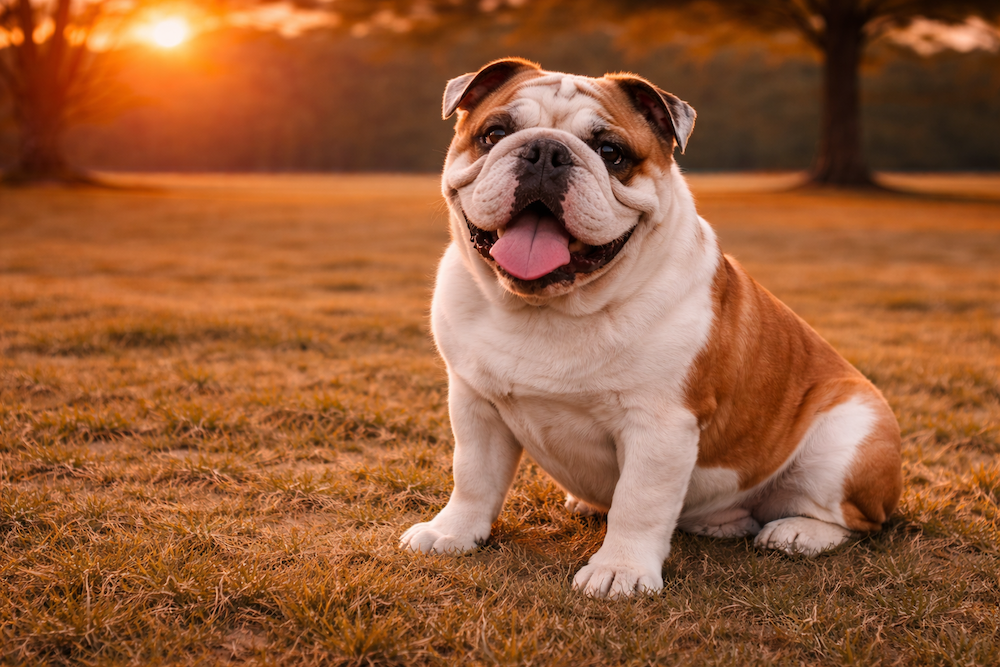







Calm, loyal, and full of character — a laid-back companion with a lovable personality.
🧠 QUICK SNAPSHOT
- Temperament: Gentle, Loyal, Easygoing
- Energy Level: Low
- Size: Medium
- Good with Families: Excellent
- Training Difficulty: Easy to Moderate
📚 OVERVIEW
Bulldogs are instantly recognisable by their wrinkled faces, sturdy build, and relaxed nature. Originally bred for bull-baiting, they are now gentle, affectionate companions. They enjoy a calm lifestyle and form strong bonds with their families.
✅ PROS & CONS
Pros
- Calm and low-energy
- Very affectionate and people-focused
- Great for apartments and smaller homes
Cons
- Prone to breathing and heat-related issues
- Can be stubborn
- Requires attention to skin folds and overall health
Is a Bulldog a Good Family Dog?
Yes, the Bulldog — commonly called the English Bulldog — can be an affectionate and devoted family companion.
Modern Bulldogs are generally calm, people-oriented dogs that enjoy being part of family life. Many are patient with respectful children and far less energetic than their formidable appearance suggests.
However, prospective owners need to understand the breed’s substantial health requirements.
A Bulldog can be a wonderful companion, but choosing one should involve careful attention to breathing ability, mobility, skin health and responsible breeding.
How Much Exercise Does a Bulldog Need?
Most Bulldogs need around 30–60 minutes of gentle daily activity, often divided into several shorter walks and play sessions.
They’re not endurance athletes.
Exercise is important for controlling weight and maintaining cardiovascular and muscular health, but strenuous activity can be dangerous in dogs with significant breathing difficulties.
Hot and humid conditions require particular caution.
The ideal Bulldog should be capable of enjoying normal exercise without struggling to breathe.
Is a Bulldog Easy to Train?
Bulldogs are intelligent but can be independent and stubborn.
Positive reinforcement, particularly food rewards, usually works far better than confrontation.
Short, enjoyable training sessions are often most effective.
Early training is worthwhile because an adult Bulldog is surprisingly strong.
They may not respond with the instant enthusiasm of a Border Collie, but Bulldogs can learn perfectly well when properly motivated.
Sometimes the real challenge is convincing them that your idea deserves immediate attention.
Does a Bulldog Shed?
Yes. Bulldogs shed moderately throughout the year.
Their short, smooth coat is relatively easy to maintain, and weekly brushing usually removes much of the loose hair.
Seasonal shedding can be heavier.
The coat itself may be low maintenance, but Bulldogs can require considerable additional care around their facial wrinkles, tail area, ears and skin folds.
So short-haired doesn’t necessarily mean low-maintenance.
What Health Problems Are Common in Bulldogs?
Bulldogs have significant breed-related health concerns, many associated with their body shape.
Brachycephalic obstructive airway syndrome (BOAS) can cause breathing difficulties, exercise intolerance, sleep problems and poor heat tolerance.
Hip and elbow problems, patellar luxation, skin-fold dermatitis, allergies, eye disorders and spinal abnormalities can also occur.
Some Bulldogs have problematic screw tails or deep tail pockets that cause chronic skin issues.
Responsible breeding should prioritise functional breathing, sound movement and less exaggerated anatomy rather than extreme appearance.
How Long Do Bulldogs Live?
Bulldogs commonly live around 8–10 years, although some live considerably longer.
Individual longevity is strongly influenced by genetics, airway health, body condition and overall physical structure.
Obesity can further compromise breathing and mobility, making weight control especially important.
Choosing a puppy from health-tested parents selected for functional anatomy can make a meaningful difference.
How Big Does a Bulldog Get?
The Bulldog is a medium-sized but exceptionally heavy and muscular dog for its height.
Adults commonly weigh around 18–25 kg, with males generally heavier than females.
They’re relatively short but have broad chests, powerful shoulders and substantial heads.
A healthy Bulldog should look strong and compact without being so exaggerated that normal walking, breathing or reproduction becomes difficult.
Can a Bulldog Live in an Apartment?
Yes. Bulldogs are generally very well suited to apartment living.
They don’t require enormous amounts of exercise and are often relatively relaxed indoors.
Daily walks and play remain essential for preventing obesity and maintaining fitness.
Climate control is an important consideration.
In hot environments, reliable cooling can be extremely important because Bulldogs can overheat much more easily than longer-muzzled breeds.
Can a Bulldog Be Left Alone?
Bulldogs can usually learn to spend reasonable periods alone, but they’re companion-oriented dogs that enjoy being around people.
Long periods of daily isolation aren’t ideal.
Boredom can contribute to chewing, barking or other unwanted behaviour.
Gradual independence training during puppyhood can help.
Many Bulldogs are perfectly happy spending much of the day sleeping — preferably somewhere that allows them to immediately notice when their human returns.
Are Bulldogs Good With Other Dogs?
Many Bulldogs are good with other dogs when properly socialised.
However, individual temperament varies, and some adults can be selective, particularly with dogs of the same sex.
Their physical play style can also be quite robust.
Early socialisation and carefully managed introductions are important.
Breathing limitations should also be considered during vigorous play because an excited Bulldog may continue longer than is physically safe.
Are Bulldogs Good With Cats?
Yes, many Bulldogs can live successfully with cats, especially when raised alongside them.
Modern Bulldogs generally don’t have the intense prey drive found in some hunting breeds.
Individual personalities still vary.
Slow introductions and providing cats with safe elevated areas are sensible.
Once accepted, some Bulldogs become remarkably relaxed around feline housemates.
Do Bulldogs Bark a Lot?
Bulldogs generally aren’t considered excessive barkers.
They may bark when someone approaches the home or when they want attention, but many are relatively quiet.
However, “quiet” doesn’t necessarily mean silent.
Bulldogs are famous for producing an impressive collection of snorts, grunts, snores and other respiratory noises.
Importantly, loud breathing shouldn’t automatically be dismissed as normal if it indicates airway obstruction.
Why Do Bulldogs Snore So Much?
Bulldogs often snore because their shortened skull and upper airway anatomy can restrict airflow during sleep.
Some mild noise can occur in brachycephalic dogs, but loud snoring, choking, gasping or disrupted sleep can indicate clinically significant airway obstruction.
Owners shouldn’t assume severe respiratory noise is simply a charming breed characteristic.
A sleeping dog should still be able to breathe comfortably.
Persistent breathing problems deserve veterinary assessment.
Can Bulldogs Handle Hot Weather?
Bulldogs are poorly suited to hot and humid weather.
Dogs rely heavily on panting to cool themselves, and the Bulldog’s shortened airway can make this process much less efficient.
Heatstroke can develop rapidly and become life-threatening.
Exercise should occur during cooler periods, with constant access to fresh water, shade and a cool indoor environment.
Bulldogs should never be pushed to exercise when they’re showing signs of respiratory distress or overheating.
Can Bulldogs Swim?
Bulldogs are generally poor swimmers and can be at serious risk around water.
Their heavy front end, broad chest, short legs and large head can make it difficult to keep the nose safely above the surface.
Some individual Bulldogs can paddle, but that shouldn’t be mistaken for reliable swimming ability.
Pools should be securely managed, and Bulldogs should always be supervised around water.
A properly fitted canine life jacket is highly advisable around boats or deeper water.
Why Does a Bulldog Have Such a Flat Face?
The Bulldog’s flat face is the result of selective breeding for brachycephalic skull shape.
Its historical ancestors had shorter muzzles than many dogs, but Victorian and modern selective breeding progressively exaggerated several physical characteristics.
Extreme shortening can reduce airway space and contribute to BOAS, dental crowding, eye problems and poor heat tolerance.
Increasing attention is now being placed on breeding Bulldogs with more moderate, functional anatomy while retaining recognisable breed type.
Why Does a Bulldog Have So Many Wrinkles?
The Bulldog’s facial wrinkles developed as part of the breed’s characteristic appearance through selective breeding.
Historical explanations sometimes claim wrinkles channelled blood away from a bull-baiting dog’s eyes, but such stories are difficult to substantiate and shouldn’t be treated as established anatomical fact.
In modern Bulldogs, deep wrinkles can trap moisture and debris.
Regular inspection and appropriate cleaning are important because neglected folds can develop irritation, yeast overgrowth or bacterial infection.
What Is a Bulldog Tail Pocket?
A tail pocket is a deep fold or indentation beneath or around the tail that occurs in some Bulldogs, particularly those with tightly curled or screw-shaped tails.
Moisture, hair and debris can become trapped inside.
This can lead to irritation, infection and discomfort if the area isn’t monitored.
Severe screw-tail deformity can also be associated with underlying vertebral abnormalities.
Not every Bulldog has a problematic tail pocket, but owners should learn their individual dog’s anatomy and care requirements.
Do Bulldogs Really Have Trouble Giving Birth Naturally?
Yes. Difficult birth is unusually common in Bulldogs, and Caesarean sections are frequently required.
The combination of relatively large puppy heads and the female Bulldog’s pelvic structure can make natural delivery difficult.
However, claims that absolutely every Bulldog must be born by Caesarean are incorrect.
The frequency of reproductive difficulty is nevertheless an important welfare issue and one reason responsible breeding should favour more functional anatomy.
Can Bulldogs Reproduce Naturally?
Some Bulldogs can mate and reproduce naturally, but reproductive difficulties are more common than in many less structurally exaggerated breeds.
Artificial insemination and Caesarean delivery are widely used within some Bulldog breeding programmes.
This has contributed to welfare debate about how far humans should maintain physical characteristics that interfere with normal reproduction.
Responsible breeding programmes increasingly focus on health, mobility, breathing and reproductive function rather than simply exaggerating traditional appearance.
Why Are Bulldogs So Stubborn?
Bulldogs have a reputation for being stubborn because they’re relatively independent and aren’t always motivated by repetitive commands.
That doesn’t mean they’re unintelligent.
Historically, their ancestors were selected for determination and persistence — characteristics that don’t necessarily produce unquestioning obedience.
Modern Bulldogs often respond extremely well when training is rewarding and worthwhile.
Food can be persuasive, although treats need to be controlled because obesity is a serious health concern.
What Colours Can Bulldogs Be?
Bulldogs occur in several traditional colours and patterns, including red, fawn, fallow, white, brindle and combinations of these colours.
Piebald patterns are also familiar.
Some breeders market unusual colours such as merle, lilac or other “rare” shades, but these may not be accepted by traditional breed standards and can sometimes involve breeding priorities unrelated to health.
Colour should never take precedence over breathing, structure, temperament and genetic health.
What Is the Difference Between an English Bulldog and a British Bulldog?
In everyday use, English Bulldog and British Bulldog generally refer to the same breed officially called the Bulldog.
“English Bulldog” is commonly used to distinguish it from breeds such as the American Bulldog and French Bulldog.
“British Bulldog” is another familiar informal name.
Major kennel organisations typically register the breed simply as Bulldog.
So these aren’t three separate breeds — they’re different names commonly applied to the same dog.
What Is the Difference Between a Bulldog and an American Bulldog?
The Bulldog and American Bulldog are distinct breeds with very different physical characteristics and working histories.
The English Bulldog is shorter, heavier relative to its height and much more brachycephalic.
The American Bulldog is generally taller, more athletic and closer to the functional farm and catch-dog type preserved in parts of the United States.
American Bulldogs typically require substantially more exercise.
Despite sharing historical Bulldog ancestry, modern examples can look and behave very differently.
What Is the Difference Between a Bulldog and a French Bulldog?
The Bulldog and French Bulldog are related but distinct breeds.
French Bulldogs are substantially smaller and are famous for their upright “bat ears.”
English Bulldogs are heavier, broader and typically have folded rose-shaped ears.
Both are brachycephalic and can suffer from airway, spinal and heat-related health problems.
The French Bulldog developed partly from smaller Bulldog-type dogs taken from England to France during the 19th century.
What Were Bulldogs Originally Bred to Do?
The ancestors of modern Bulldogs were historically associated with bull-baiting, a blood sport in which dogs were set upon tethered bulls.
Dogs required enormous determination, strength and courage to perform this brutal activity.
Britain’s Cruelty to Animals Act 1835 effectively ended legal bull-baiting.
Rather than disappearing, Bulldogs were gradually transformed through selective breeding into companion and show dogs.
The friendly modern Bulldog is therefore dramatically different in purpose from its working ancestors.
Why Is It Called a Bulldog?
The name Bulldog comes from the dog’s historical association with bulls.
Bulldog-type dogs were used for bull-baiting in Britain for centuries.
“Bull dog” therefore originally described a dog’s function rather than simply its appearance.
After bull-baiting disappeared, the name remained even as breeders completely transformed the dog’s role.
Today, the typical Bulldog is far more likely to battle for space on the sofa than encounter a bull.
Did Bulldogs Always Look Like They Do Today?
No. Historical Bulldogs generally looked more athletic, longer-legged and less extremely flat-faced than many modern Bulldogs.
After bull-baiting ended, breeders increasingly selected dogs for exhibition and companionship.
Over generations, features such as the broad head, shortened muzzle, wide chest, wrinkles and compact body became more pronounced.
Historical paintings and photographs make the change particularly obvious.
The Bulldog is one of the clearest examples of how strongly selective breeding can alter canine anatomy within a relatively short historical period.
Why Is the Bulldog a Symbol of Britain?
The Bulldog became strongly associated with British determination, courage and tenacity.
Its historical reputation for refusing to give up helped transform the breed into a national symbol.
The image became particularly powerful during periods of war and political propaganda.
The phrase “British Bulldog spirit” came to represent stubborn courage and resilience rather than the literal behaviour of the dog.
As a result, few dog breeds have become so closely linked with the national identity of one country.
Was Winston Churchill Called the British Bulldog?
Yes, Winston Churchill became strongly associated with the Bulldog image, particularly during the Second World War.
His determined public persona, facial expression and wartime rhetoric fitted the already established symbolism of “British Bulldog spirit.”
However, Churchill wasn’t responsible for creating the association between Bulldogs and Britain — it existed long before him.
Interestingly, Churchill himself was better known for owning other breeds, including Poodles, rather than being famous as a Bulldog owner.
Where Does the Bulldog Come From?
The Bulldog was developed in England from earlier mastiff-type and bull-baiting dogs.
Its ancestors were powerful working animals associated with blood sports, most famously bull-baiting.
After bull-baiting was prohibited in 1835, enthusiasts preserved the Bulldog and gradually transformed it into a companion and exhibition breed.
Victorian and later selective breeding substantially changed its anatomy and temperament.
The result is one of the world’s most recognisable dogs — an ancient symbol of toughness that ultimately became famous for preferring people, food and a comfortable place to sleep.