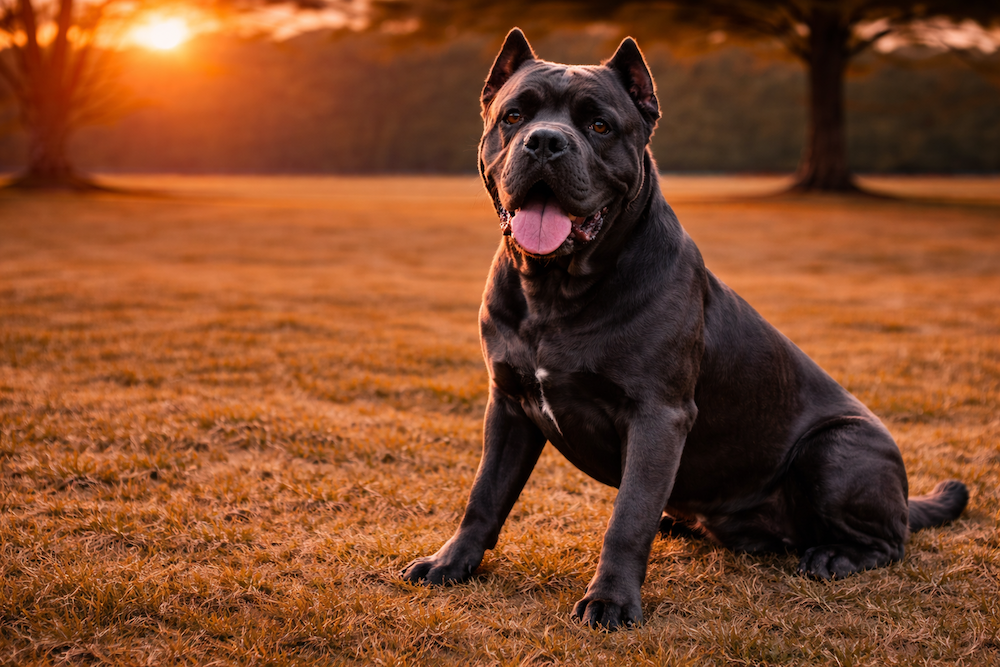







Powerful, protective, and fiercely loyal — a guardian breed for experienced owners.lity.
🧠 QUICK SNAPSHOT
- Temperament: Protective, Loyal, Confident
- Energy Level: Moderate to High
- Size: Large
- Good with Families: Yes (experienced homes)
- Training Difficulty: Moderate to Hard
📚 OVERVIEW
The Cane Corso is a powerful Italian mastiff breed known for its strength, intelligence, and protective nature. Originally bred as a working and guard dog, it is confident, alert, and highly devoted to its family. With the right training and leadership, it becomes a loyal and dependable companion.
✅ PROS & CONS
Pros
- Extremely loyal and protective
- Intelligent and trainable
- Strong deterrent presence
Cons
- Requires experienced ownership
- Needs consistent training and socialisation
- Can be territorial without proper guidance
Is a Cane Corso a Good Family Dog?
Yes, a well-bred and properly trained Cane Corso can be an exceptionally devoted family dog, but it’s best suited to experienced owners.
Corsos typically form powerful bonds with their families and can be calm and affectionate at home. Many are good with respectful children they know.
However, this is a very large guardian breed with considerable strength and protective instinct.
Early socialisation, reliable obedience and responsible management are essential. The Cane Corso isn’t generally an ideal choice for a first-time dog owner.
How Much Exercise Does a Cane Corso Need?
Most adult Cane Corsos need around 60–90 minutes of substantial daily exercise, combined with mental stimulation.
Long walks, controlled hiking, obedience training, tracking and structured play are excellent options.
They aren’t usually hyperactive, but they’re athletic working Mastiffs rather than sedentary giants.
Growing puppies should avoid excessive high-impact exercise while their joints develop.
A Corso that receives appropriate physical and mental work is generally much easier to live with.
Is a Cane Corso Easy to Train?
Cane Corsos are highly intelligent and trainable, but they can also be independent and strong-willed.
They were developed to work with humans while making decisions for themselves.
Training should begin immediately and focus on calm behaviour, recall, loose-lead walking and impulse control.
Positive reinforcement combined with clear, consistent boundaries works well.
An untrained puppy may seem manageable; an untrained 45–50 kg adult guardian is an entirely different proposition.
Does a Cane Corso Shed?
Yes. Cane Corsos shed throughout the year, with heavier seasonal shedding possible.
Their short coat is relatively easy to maintain.
Weekly brushing usually removes loose hair and helps keep the coat healthy.
Despite their sleek appearance, they possess an undercoat that varies in density according to climate.
They aren’t a non-shedding or hypoallergenic breed.
What Health Problems Are Common in Cane Corsos?
Cane Corsos can be affected by several important health problems.
Hip and elbow dysplasia are major concerns in a large, powerful breed.
Eye conditions including entropion and ectropion can occur, as can certain cardiac problems. Epilepsy has also been reported within the breed.
Like other deep-chested large dogs, Cane Corsos can be at risk of gastric dilatation-volvulus (GDV or bloat).
Responsible breeders should undertake appropriate health screening before breeding.
How Long Do Cane Corsos Live?
Cane Corsos generally live around 9–12 years.
An interesting Italian study of hundreds of Cane Corsos found differences in median lifespan associated with coat colour, although this shouldn’t be interpreted to mean that choosing a particular colour guarantees a longer-lived dog.
Genetics, responsible breeding, body condition and veterinary care matter considerably more when selecting an individual puppy.
Keeping a Corso lean is particularly beneficial for joint and overall health.
How Big Does a Cane Corso Get?
The Cane Corso is a large, muscular Mastiff-type dog.
Males typically stand around 64–68 cm at the shoulder, while females are generally around 60–64 cm.
Weight should be proportional to height, but adults commonly fall somewhere around 40–50 kg or more, with males generally heavier.
A Corso should be powerful yet athletic rather than excessively bulky.
Its historical work required movement and agility as well as strength.
Can a Cane Corso Live in an Apartment?
A Cane Corso can live in a sufficiently spacious apartment, but it’s rarely the easiest environment for the breed.
Adult Corsos can be relatively calm indoors when properly exercised.
Their size, guarding instincts and need for regular structured activity create practical challenges.
Secure outdoor space is useful, although a backyard doesn’t replace walks, training and socialisation.
Apartment owners also need particularly good control of a dog that may encounter strangers and other dogs frequently in confined communal areas.
Can a Cane Corso Be Left Alone?
Cane Corsos can learn to spend reasonable periods alone, but they’re strongly bonded to their families.
They’re generally happiest when included in everyday household life.
Long periods of isolation can contribute to boredom, destructive behaviour or inappropriate guarding.
Gradual independence training should begin during puppyhood.
A Corso shouldn’t simply be left outside to “guard the property” with minimal human interaction.
Are Cane Corsos Good Guard Dogs?
Yes. The Cane Corso is a natural guardian breed.
Corsos tend to be observant, confident and suspicious of genuinely unusual activity without necessarily barking continuously.
Their physical appearance alone provides considerable deterrence.
They generally don’t need specialised protection training.
For most owners, extensive socialisation and excellent obedience are far more valuable than encouraging defensive behaviour that the breed may already possess naturally.
Are Cane Corsos Aggressive?
Cane Corsos shouldn’t be indiscriminately aggressive, but they’re naturally protective and can be reserved with unfamiliar people.
Temperament depends on genetics, early development, socialisation, training and management.
Poor breeding or inadequate socialisation can create serious problems because of the breed’s enormous physical power.
A stable Corso should be confident and controllable rather than fearful or unpredictably reactive.
Responsible ownership is particularly important with any large guardian breed.
Are Cane Corsos Good With Strangers?
Cane Corsos are commonly reserved with strangers.
Unlike breeds developed to enthusiastically greet unfamiliar people, Corsos have generations of guardian ancestry encouraging them to evaluate newcomers.
Early socialisation shouldn’t attempt to make every Corso love everyone.
The objective is a confident dog capable of remaining calm and accepting people its owner welcomes.
Neutrality around strangers is often a more realistic goal than universal friendliness.
Are Cane Corsos Good With Other Dogs?
Cane Corsos can live successfully with other dogs, but dog-to-dog compatibility varies considerably.
Some adults can be selective, particularly with dogs of the same sex.
Early socialisation is important but doesn’t guarantee universal sociability.
Their strength means conflicts can have serious consequences.
Owners should learn canine body language, supervise introductions carefully and avoid assuming every Corso needs to interact freely with unfamiliar dogs.
Are Cane Corsos Good With Cats?
Cane Corsos can live successfully with cats, particularly when raised alongside them.
However, individual prey drive varies.
Their ancestors performed several types of farm and hunting work, so chasing instincts shouldn’t be ignored.
A familiar household cat may be treated as family while an unfamiliar running animal triggers pursuit.
Early introductions, training and supervision are important.
Do Cane Corsos Bark a Lot?
Cane Corsos generally aren’t constant barkers.
A well-adjusted Corso often watches quietly and vocalises when it believes something deserves attention.
This reflects its guardian heritage.
Boredom, inadequate exercise or territorial behaviour can increase barking.
When a normally quiet Cane Corso suddenly produces its deep warning bark, however, it’s difficult to overlook.
Do Cane Corsos Drool?
Yes, Cane Corsos can drool, although usually not as heavily as some extremely loose-jowled Mastiff breeds.
Individual dogs vary substantially.
Drooling may increase after eating, drinking, exercising or when food is nearby.
Dogs with looser lips generally drool more than those with tighter mouths.
Anyone considering a Corso should expect at least some saliva as part of life with the breed.
Can Cane Corsos Handle Hot Weather?
Cane Corsos generally tolerate warmth better than extremely brachycephalic Mastiffs, but they’re still large, muscular dogs that can overheat.
Exercise should be reduced during extreme heat and moved to cooler parts of the day.
Shade and fresh water are essential.
Dark-coated dogs can also become hot quickly in direct sunlight.
Their relatively short muzzle means owners should pay attention to breathing during strenuous exercise.
Can Cane Corsos Swim?
Many Cane Corsos can swim, but ability and enthusiasm vary.
Their muscular bodies are heavy, and some individuals aren’t naturally confident in deep water.
Dogs should be introduced gradually rather than simply placed into water.
Supervision is important around pools and open water.
A canine life jacket is sensible during boating or extended water activities.
Why Does the Cane Corso Have Such a Large Head?
The Cane Corso’s broad, powerful head and strong jaws reflect its Mastiff ancestry and historical working roles.
However, the breed shouldn’t have the extremely massive, exaggerated head seen in some heavier Mastiffs.
A traditional Corso needed to remain athletic enough for guarding, farm work and historically hunting large animals.
Excessive bulk works against that functional heritage.
The ideal appearance combines unmistakable power with athletic capability.
What Colours Can Cane Corsos Be?
Traditional Cane Corso colours include black, various shades of grey, fawn and red, along with brindle versions of some colours.
Fawn and red dogs typically have a dark mask.
Small white markings may occur on the chest, throat, chin, backs of the pasterns and toes under some breed standards.
So-called rare colours should never be prioritised over health, temperament and correct structure.
Why Do Some Cane Corsos Have Cropped Ears?
Cane Corsos naturally have medium-sized drop ears.
Historically, ears were sometimes cropped on working dogs, with practical explanations usually involving reducing injuries during hunting, guarding or confrontations with animals.
Today, cropping is largely cosmetic for companion dogs.
The practice is prohibited or heavily restricted in many countries, including Australia.
A natural-eared Cane Corso is completely normal.
Why Do Some Cane Corsos Have Docked Tails?
Cane Corsos naturally have long tails.
Historically, working dogs were sometimes docked, with explanations involving reducing the chance of injury during demanding farm, hunting or guardian work.
Docking later became part of the breed’s traditional show appearance in some countries.
Today, cosmetic tail docking is prohibited or restricted in many places, including Australia.
Natural tails are increasingly familiar internationally.
What Does Cane Corso Mean?
The exact linguistic history is debated, but Cane Corso essentially refers to a guardian or protective dog.
Cane is simply Italian for dog.
Corso is commonly connected with the Latin cohors, which can carry meanings associated with a courtyard, enclosure or guardian.
It isn’t related to the island of Corsica, despite the similarity in English spelling.
The name fits the breed remarkably well: a dog associated with guarding homes, farms and property.
How Do You Pronounce Cane Corso?
The Italian pronunciation is approximately “KAH-neh KOR-so.”
Cane isn’t pronounced like the English word “cane.”
It contains two syllables and is the Italian word for dog.
The plural in Italian is Cani Corsi.
Is a Cane Corso a Mastiff?
Yes. The Cane Corso is an Italian Mastiff-type breed, belonging to the broader molosser family of powerful dogs.
However, it’s generally more athletic and less massive than breeds such as the English Mastiff or Neapolitan Mastiff.
Historically, the Corso needed enough agility to perform practical farm, guardian and hunting work.
Calling it simply a giant couch-dwelling Mastiff therefore misses an important part of its character.
What Is the Difference Between a Cane Corso and a Neapolitan Mastiff?
Both breeds come from Italy and share ancient Mastiff-type ancestry, but modern examples are very different.
The Cane Corso is generally lighter, more athletic and less heavily wrinkled.
The Neapolitan Mastiff is considerably more massive, with loose skin, extensive wrinkles and a heavier overall structure.
Historically, the Corso remained associated with practical rural work, while the Neapolitan Mastiff developed into a more specialised heavy guardian type.
What Were Cane Corsos Originally Bred to Do?
Cane Corsos were versatile working dogs rather than specialists with only one job.
Historically, their ancestors were used for guarding property and livestock, helping manage cattle and pigs, and hunting formidable game such as wild boar.
This versatility explains the modern Corso’s combination of athleticism, courage, intelligence and protective instinct.
It was essentially a powerful all-purpose farm and estate dog capable of handling whatever job rural life required.
Did Cane Corsos Really Hunt Wild Boar?
Yes. Cane Corso-type dogs were historically associated with hunting large and dangerous game, including wild boar.
Their job required considerable courage, speed and physical strength.
However, hunting wasn’t their only purpose.
Corsos also guarded farms, property and livestock and assisted with other rural work.
Reducing their history to simply “boar-hunting dogs” overlooks the versatility that made them valuable throughout southern Italy.
Is the Cane Corso Descended From Roman War Dogs?
The Cane Corso is frequently said to descend directly from the Roman Canis Pugnax, sometimes described as a Roman war dog.
There is a reasonable historical connection between Italian Mastiff-type dogs and much older Roman molosser-type dogs, but claims of an unbroken documented pedigree stretching directly from Roman battlefields to today’s Cane Corso go beyond the available evidence.
It’s more accurate to say that the breed belongs to an ancient Italian Mastiff tradition whose roots extend back many centuries.
Did Cane Corsos Nearly Become Extinct?
Yes. By the mid-20th century, traditional Cane Corso populations had declined dramatically.
Changes in Italian agriculture reduced demand for the rural jobs these dogs historically performed.
By the 1970s, enthusiasts searching southern Italy found surviving examples of the old type and began organised efforts to recover the breed.
Without that revival, the Cane Corso as we know it today might easily have disappeared.
Who Helped Save the Cane Corso?
Several Italian enthusiasts were involved in the Cane Corso’s modern recovery.
A key figure was Dr Paolo Breber, who became interested in surviving Italian working Mastiffs during the 1970s after learning about them from traditional rural areas.
Breeding programmes subsequently gathered suitable dogs and worked towards establishing a consistent modern population.
The Società Amatori Cane Corso was later established to support breed development and recognition.
This organised revival transformed a disappearing rural dog into an internationally recognised breed.
When Was the Cane Corso Officially Recognised?
The Cane Corso’s modern recognition came surprisingly recently.
The Italian Kennel Club recognised the breed in 1994, and the Fédération Cynologique Internationale followed with international recognition later in the decade, with definitive recognition subsequently established.
The American Kennel Club recognised the Cane Corso in 2010.
So although the breed’s working ancestry is old, its formal international pedigree history is comparatively modern.
Where Does the Cane Corso Come From?
The Cane Corso comes from Italy, with particularly strong historical roots in the country’s southern rural regions.
For generations, Corso-type dogs guarded farms, protected livestock, helped manage large animals and accompanied hunters.
Mechanisation and changing agricultural practices almost caused the old working dog to disappear during the 20th century.
Italian enthusiasts began recovering the remaining population during the 1970s, eventually establishing the modern breed.
That history explains the Cane Corso remarkably well: it wasn’t created merely to look intimidating — it was built to be a powerful, athletic dog capable of doing serious work beside people.