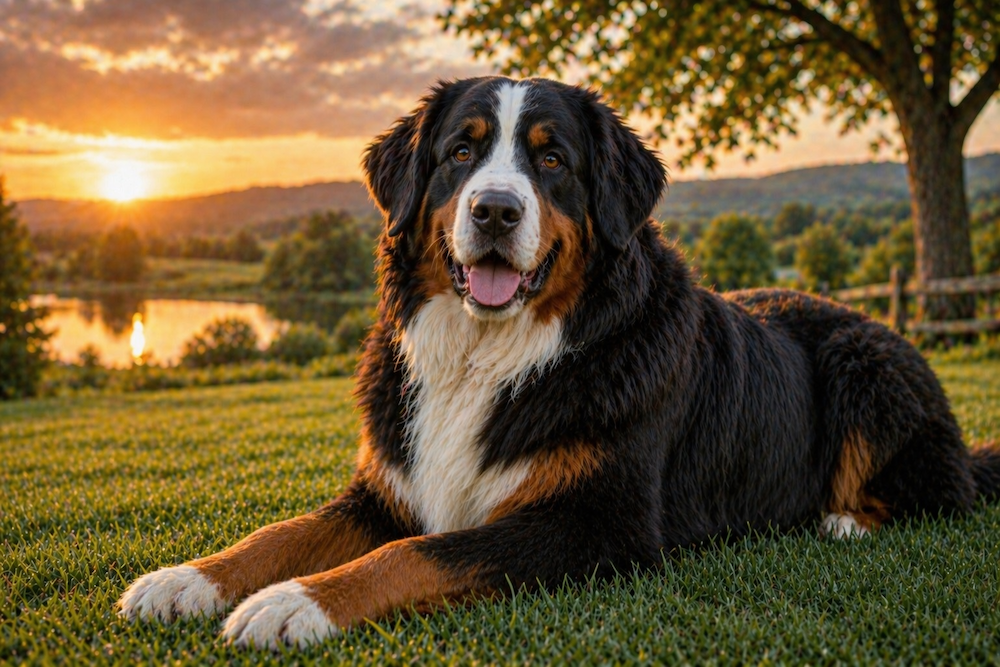







Gentle, loyal, and beautifully built — a big-hearted family companion.
🧠 QUICK SNAPSHOT
- Temperament: Gentle, Loyal, Friendly
- Energy Level: Moderate
- Size: Large
- Good with Families: Excellent
- Training Difficulty: Easy to Moderate
📚 OVERVIEW
Bernese Mountain Dogs are large, striking dogs known for their tri-colour coats and gentle nature. Originally bred as farm dogs in Switzerland, they are strong, hardworking, and deeply loyal. They thrive in family environments and love being part of daily life.
✅ PROS & CONS
Pros
- Extremely gentle and great with families
- Loyal and affectionate
- Beautiful, eye-catching appearance
Cons
- Heavy shedding and grooming needs
- Shorter lifespan compared to smaller breeds
- Requires space due to size
Is a Bernese Mountain Dog a Good Family Dog?
Yes, the Bernese Mountain Dog is generally considered an excellent family dog, particularly for families wanting a large, affectionate and gentle companion.
Berners are famous for their devotion to their people and often develop especially close relationships with family members. They’re typically patient and good-natured with children, although their substantial size means supervision around very young children is sensible.
They generally prefer being included in family activities rather than living separately outdoors.
Despite their imposing size, many Bernese Mountain Dogs seem convinced they’re perfectly suitable lap dogs — even when they weigh more than some of the people in the family.
How Much Exercise Does a Bernese Mountain Dog Need?
An adult Bernese Mountain Dog generally needs around 60–90 minutes of moderate exercise each day.
Daily walks, hiking, exploring and controlled play are usually excellent activities.
Berners were developed as working farm dogs, so they’re capable of considerable activity, but they aren’t usually as relentlessly energetic as breeds such as Border Collies or Belgian Malinois.
Exercise should be carefully managed while puppies are growing because of their large size and developing joints.
Berners often particularly enjoy activities they can do alongside their owners.
For many, the important part isn’t simply the walk — it’s doing the walk with their favourite humans.
Is a Bernese Mountain Dog Easy to Train?
Bernese Mountain Dogs are generally intelligent and trainable, particularly when training begins early.
They tend to respond well to positive reinforcement, food rewards and calm, consistent handling.
Some can be sensitive, so unnecessarily harsh training methods may reduce confidence rather than improve behaviour.
Berners can also mature relatively slowly and occasionally display a stubborn streak during adolescence.
Early loose-lead walking is particularly important.
A small puppy pulling towards something interesting may seem amusing. A fully grown Berner doing exactly the same thing is a considerably more persuasive argument.
Does a Bernese Mountain Dog Shed?
Yes. Bernese Mountain Dogs shed heavily, and seasonal coat changes can produce enormous amounts of loose hair.
They have a thick double coat developed to provide protection in cold Alpine conditions.
Brushing several times each week helps remove loose hair and prevent tangles, with more frequent grooming useful during major shedding periods.
The coat shouldn’t normally be shaved simply to reduce shedding.
Berners aren’t hypoallergenic.
Anyone considering the breed should probably become comfortable with the idea that black, white and rust may eventually become part of the household decorating scheme.
What Health Problems Are Common in Bernese Mountain Dogs?
Bernese Mountain Dogs unfortunately have several significant health concerns, making responsible breeding particularly important.
Hip and elbow dysplasia are important orthopaedic problems.
The breed also has an unusually high incidence of cancer, including histiocytic sarcoma and other malignancies.
Gastric dilatation-volvulus (GDV or bloat) is another serious concern because Berners are large, deep-chested dogs. GDV is a life-threatening emergency requiring immediate veterinary treatment.
Certain eye, cardiac and other inherited disorders can also occur.
Prospective owners should choose breeders who undertake appropriate health testing and openly discuss longevity and causes of death within their breeding lines.
How Long Do Bernese Mountain Dogs Live?
Bernese Mountain Dogs unfortunately have a relatively short lifespan, commonly around 7–10 years.
Some live considerably longer, but the breed’s high incidence of cancer contributes significantly to its reduced average longevity.
This is one of the most important realities prospective owners should understand before choosing a Berner.
Careful breeding, maintaining a healthy weight, appropriate exercise and regular veterinary care can all help, but they can’t eliminate every inherited risk.
The Berner’s relatively short lifespan is especially difficult because these dogs have a reputation for becoming extraordinarily important members of their families.
How Big Does a Bernese Mountain Dog Get?
The Bernese Mountain Dog is a large and powerful breed.
Adult males generally stand around 64–70 cm at the shoulder, while females are usually around 58–66 cm.
Adults commonly weigh approximately 32–52 kg, with males generally heavier than females.
Despite their substantial build, Berners should remain athletic enough to perform the farm work for which they were developed.
They’re powerful dogs rather than giant, cumbersome ones.
Their thick coat also makes them appear even more substantial than they actually are.
Can a Bernese Mountain Dog Live in an Apartment?
A Bernese Mountain Dog can technically live in an apartment, but its enormous size makes apartment living challenging.
A calm adult Berner may actually be relatively relaxed indoors after sufficient exercise.
Practical considerations are often the bigger issue: stairs, lifts, narrow hallways, hot apartments and simply finding enough room for a 40-plus-kilogram dog.
Access to suitable outdoor exercise is essential.
A house with some space is generally easier, but a backyard doesn’t replace walks and interaction.
Can a Bernese Mountain Dog Be Left Alone?
Bernese Mountain Dogs generally don’t enjoy routinely spending long periods alone.
They’re highly people-oriented dogs that were historically accustomed to working around farms and families.
Many develop extremely strong attachments to their owners.
Puppies should still learn gradually that spending reasonable periods alone is normal.
Without this training, some Berners may develop separation-related behaviours.
This is generally a better breed for people wanting a dog deeply involved in family life than for households where the dog will regularly spend entire days by itself.
Are Bernese Mountain Dogs Good With Other Dogs?
Bernese Mountain Dogs are generally good with other dogs, particularly when appropriately socialised.
Many have a tolerant, friendly temperament and live happily in multi-dog households.
Their large size can make enthusiastic play intimidating to smaller dogs, even when the Berner has completely friendly intentions.
Early socialisation helps puppies learn appropriate canine manners.
Individual temperament always matters, but serious dog aggression isn’t considered a defining characteristic of a well-bred Berner.
Are Bernese Mountain Dogs Good With Cats?
Yes, many Bernese Mountain Dogs can live very successfully with cats.
They generally aren’t known for the extreme prey drive found in some hunting breeds, although individuals vary.
Berners raised with cats often develop peaceful relationships with them.
Introductions should still be gradual and controlled, particularly because an enthusiastic young Berner can overwhelm a cat through size alone.
Providing the cat with elevated escape areas is always sensible.
Do Bernese Mountain Dogs Bark a Lot?
Bernese Mountain Dogs generally aren’t considered excessive barkers, although they can be effective watchdogs.
They may bark when someone approaches the property or when something unusual attracts their attention.
Boredom, anxiety or insufficient exercise can increase vocal behaviour.
Historically, Berners needed enough awareness to notice activity around Swiss farms without constantly sounding an alarm.
Many therefore combine a fairly relaxed household temperament with a useful ability to announce visitors.
Do Bernese Mountain Dogs Drool?
Bernese Mountain Dogs can drool, although they’re generally less notorious for it than breeds with very loose jowls such as Saint Bernards or some Mastiffs.
Individual variation can be considerable.
Drooling often increases around food, after drinking or during hot weather.
Prospective owners should expect some slobber simply because they’re dealing with a very large dog.
Fortunately, the Berner usually compensates by providing an impressive quantity of fur to accompany it.
Can Bernese Mountain Dogs Live in Hot Weather?
Bernese Mountain Dogs can live in warmer regions, but they tolerate cold weather much better than heat.
Their thick double coat developed for the cool climate of the Swiss Alps.
During hot weather, exercise should be scheduled for cooler parts of the day, with constant access to shade and fresh water.
Air-conditioned indoor environments may be important in very hot climates.
Signs of heat stress should always be taken seriously.
Their coat shouldn’t automatically be shaved in summer, as clipping doesn’t eliminate the underlying problems associated with heat.
Do Bernese Mountain Dogs Like Snow?
Most Bernese Mountain Dogs are extremely well suited to cold and snowy conditions.
Their thick double coat provides substantial insulation.
The breed developed in Switzerland, where working dogs needed to function through cold Alpine winters.
Many modern Berners become noticeably enthusiastic when they encounter snow.
Watching one suddenly come alive in freezing conditions provides a useful reminder that the enormous furry coat wasn’t designed primarily for appearance.
Why Does the Bernese Mountain Dog Have Three Colours?
The Bernese Mountain Dog is famous for its distinctive tricolour coat of jet black, rich rust and white.
Black forms the primary body colour, while rust markings typically appear above the eyes, on the cheeks, legs and chest.
White commonly appears on the face, chest, feet and tail tip.
The symmetrical facial markings contribute heavily to the breed’s instantly recognisable appearance.
This traditional colour pattern is part of the breed standard rather than simply a popular colour option.
What Were Bernese Mountain Dogs Originally Bred to Do?
Bernese Mountain Dogs were developed as versatile Swiss farm dogs.
They helped drive cattle, guarded farms and livestock and performed general farm duties.
One of their most fascinating jobs was pulling carts, transporting goods such as milk and other farm products.
Their powerful build made them particularly useful as draught dogs.
Modern Berners can still participate in carting and drafting activities.
The breed wasn’t developed for one specialised task. It was essentially a four-legged Swiss farm worker expected to help wherever needed.
Did Bernese Mountain Dogs Really Pull Milk Carts?
Yes. Bernese Mountain Dogs were historically used as draught dogs to pull carts, including carts carrying milk and dairy products.
Their strength and steady temperament made them well suited to transporting goods between farms, villages and markets.
This association became so strong that images of Berners pulling traditional carts remain closely connected with the breed today.
Dog-powered carts were particularly useful for farmers and tradespeople who couldn’t justify keeping horses solely for small loads.
The modern Berner’s broad chest and powerful body therefore weren’t developed simply to make it look impressive.
That strength once had a genuine working purpose.
What Is a Swiss Mountain Dog or Sennenhund?
The Bernese Mountain Dog is one of four traditional Swiss Sennenhund breeds.
They are:
Bernese Mountain Dog
Greater Swiss Mountain Dog
Appenzeller Sennenhund
Entlebucher Mountain Dog
The German term Sennenhund relates to the Alpine herdsmen or dairymen known as Sennen and their dogs.
All four breeds share the familiar black, rust and white colouring, but they differ significantly in size, coat and other characteristics.
The Bernese is particularly distinctive because it’s the only one of the four with a long coat.
What Is the Difference Between a Bernese Mountain Dog and a Greater Swiss Mountain Dog?
The Bernese Mountain Dog and Greater Swiss Mountain Dog are closely related Swiss working breeds, but they’re not the same dog.
Both have characteristic black, rust and white colouring.
The Greater Swiss Mountain Dog is generally larger, heavier and has a short coat.
The Bernese Mountain Dog has its famous long, flowing double coat and usually presents a somewhat softer overall appearance.
Both historically performed farm work including livestock management and cart pulling.
The easiest visual clue is usually the coat: long-haired points strongly toward the Berner.
Where Does the Bernese Mountain Dog Come From?
The Bernese Mountain Dog comes from Switzerland, particularly the region around Bern.
Its ancestors were traditional Swiss farm dogs used for livestock work, guarding and pulling carts.
The breed was historically known as the Dürrbächler, after the area around Dürrbach where dogs of this type were found.
During the late 19th and early 20th centuries, enthusiasts began preserving and standardising Switzerland’s native working dogs, and the name Bernese Mountain Dog became established internationally.
Today the Berner is primarily known as a much-loved family companion, but almost every feature of the breed — from its strength to its weather-resistant coat — reflects its original life as a hardworking dog of the Swiss countryside.