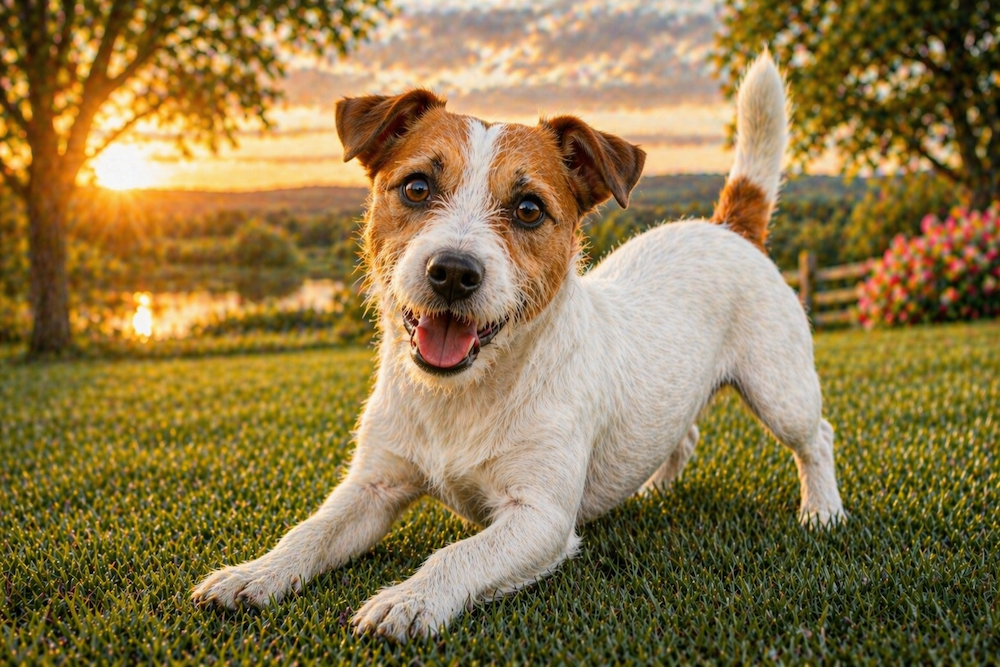







Small, fearless, and bursting with energy — a big personality in a compact body.
🧠 QUICK SNAPSHOT
- Temperament: Energetic, Intelligent, Bold
- Energy Level: Very High
- Size: Small
- Good with Families: Yes (active homes)
- Training Difficulty: Moderate
📚 OVERVIEW
Jack Russell Terriers are small but powerful dogs originally bred for fox hunting. They are fearless, energetic, and extremely intelligent. Known for their lively personalities, they thrive in environments where they can stay busy and engaged.
✅ PROS & CONS
Pros
- Highly intelligent and trainable
- Fun, energetic personality
- Small size but very capable
Cons
- Extremely high energy levels
- Can be destructive if bored
- Strong prey drive
Is a Jack Russell Terrier a Good Family Dog?
Yes, for an active family prepared for a high-energy, intelligent and determined terrier.
Jack Russells can be affectionate, funny and intensely loyal, but they’re rarely passive companion dogs. They need exercise, training and mental stimulation.
Their confidence can make them seem like a much larger dog compressed into a very small body.
How Much Exercise Does a Jack Russell Need?
Most adult Jack Russells need around 60–90 minutes of physical activity each day, plus mental stimulation.
Walking alone may not be enough. Running, scent games, retrieving, digging activities and training are useful outlets.
A bored Jack Russell can become remarkably creative.
Is a Jack Russell a High-Energy Dog?
Absolutely.
Jack Russells were developed to work alongside foxhounds and then pursue foxes underground.
That required stamina, speed, courage and extraordinary persistence.
Their small size shouldn’t be mistaken for low exercise requirements.
Is a Jack Russell Easy to Train?
Jack Russells are highly intelligent and learn quickly.
The challenge is convincing them that your idea is more interesting than theirs.
Positive reinforcement, variety and consistent boundaries generally work best.
Are Jack Russells Intelligent?
Extremely.
They’re excellent problem-solvers and quickly learn patterns, routines and weaknesses in household rules.
Terrier intelligence evolved around independent decision-making, so intelligence doesn’t necessarily translate into automatic obedience.
Are Jack Russells Stubborn?
They can be extraordinarily determined.
A terrier that gave up easily wouldn’t have been particularly useful underground confronting quarry.
What owners call stubbornness is often the modern expression of a trait deliberately selected for generations: persistence.
Does a Jack Russell Shed?
Yes.
Smooth-coated Jack Russells can shed surprisingly heavily for such small dogs.
Broken and rough coats may leave less obvious hair around the home but still shed.
Is a Jack Russell Hypoallergenic?
No.
Jack Russells produce normal canine allergens and aren’t considered hypoallergenic.
Coat type can influence how much loose hair is visible but doesn’t eliminate allergens.
What Coat Types Do Jack Russells Have?
There are three commonly recognised coat types: smooth, broken and rough.
Smooth coats are short all over.
Broken coats have a mixture of short and longer wiry hairs, while rough coats have more extensive coarse hair and facial furnishings.
What Is a Broken-Coat Jack Russell?
A broken coat sits between smooth and rough.
The dog has mostly short coat with areas of longer wiry hair, often around the face and body.
It retains the practical weather-resistant qualities of a working terrier coat.
Do Rough-Coated Jack Russells Need Hand Stripping?
Hand stripping can help preserve the harsh texture and colour of a rough or broken coat.
Clipping is possible for companion dogs but may gradually soften the coat.
Smooth-coated dogs require much less coat maintenance.
How Often Should You Groom a Jack Russell?
Smooth coats usually need brushing once or twice weekly.
Broken and rough coats may require additional maintenance and periodic stripping or tidying.
Nails, teeth and ears also require routine care.
What Health Problems Are Common in Jack Russells?
Potential concerns include patellar luxation, eye disorders, deafness, Legg-Calvé-Perthes disease and certain inherited neurological conditions.
Overall, responsibly bred Jack Russells can be robust and long-lived dogs.
Health testing remains important.
Are Jack Russells Prone to Deafness?
Congenital deafness occurs within the breed and is associated with pigmentation genetics found in predominantly white dogs.
A BAER hearing test can objectively assess hearing.
Responsible breeders should pay attention to hearing health.
Are Jack Russells Prone to Eye Problems?
They can inherit several eye disorders, including lens luxation and cataracts.
Primary lens luxation has been particularly important in terrier populations.
Genetic testing and ophthalmic screening can reduce inherited risk.
What Is Lens Luxation in Jack Russells?
Lens luxation occurs when the structures holding the eye’s lens in place fail, allowing the lens to move.
It can cause pain, inflammation, glaucoma and loss of vision.
Sudden eye pain, redness or visual difficulty requires urgent veterinary attention.
Are Jack Russells Prone to Patellar Luxation?
They can be.
Patellar luxation occurs when the kneecap moves out of its normal groove.
Affected dogs may intermittently skip or hold up a hind leg.
How Long Does a Jack Russell Live?
Jack Russells commonly live around 13–16 years, with some reaching their late teens.
Their moderate structure and active lifestyle can contribute to excellent longevity.
They’re a breed owners should expect to keep busy for many years.
How Big Does a Jack Russell Get?
Jack Russells are small but athletic dogs, typically around 25–30 cm tall.
Weight often falls around 5–8 kg, depending on height, build and breeding line.
A working Jack Russell should remain compact enough to follow quarry underground.
Is There a Mini Jack Russell?
There is no recognised Miniature Jack Russell variety.
Jack Russells are already small working terriers.
Dogs marketed as “Mini” or “Teacup Jack Russells” may simply be unusually small individuals or crosses.
Is There a Teacup Jack Russell?
No officially recognised Teacup Jack Russell exists.
Breeding specifically for extreme smallness can compromise the sound, athletic structure that defines the terrier.
Health should take priority over producing the smallest possible puppy.
Can a Jack Russell Live in an Apartment?
Yes, but only if its exercise and mental needs are met.
Their small size fits apartments easily; their energy, barking and desire for activity may not.
A well-exercised Jack Russell can settle indoors remarkably well.
Can a Jack Russell Be Left Alone?
A properly trained adult can tolerate reasonable periods alone.
However, long periods of boredom can produce barking, chewing, digging or escape attempts.
Mental stimulation matters enormously with this breed.
Are Jack Russells Velcro Dogs?
Some are extremely attached to their owners, while others retain more terrier independence.
Many want to be involved in everything happening around the household.
They often combine strong affection with an equally strong personal agenda.
Are Jack Russells Cuddly?
Many are.
After sufficient exercise, a Jack Russell may happily curl up beside or on its owner.
The key phrase is often “after sufficient exercise.”
Are Jack Russells Good With Children?
They can be excellent with respectful older children who enjoy active play.
However, Jack Russells generally dislike rough handling and may be less tolerant than some larger family breeds.
Supervision is important around young children.
Are Jack Russells Good With Other Dogs?
It varies.
Many live successfully with other dogs, but Jack Russells can be bold, assertive and surprisingly willing to challenge larger dogs.
Early socialisation and sensible management are important.
Do Jack Russells Know They Are Small?
Their behaviour frequently suggests otherwise.
The breed was selected for courage rather than self-preservation based on body size.
A Jack Russell may confidently confront dogs many times its own weight, which is why owners need to provide the judgement their terrier occasionally lacks.
Are Jack Russells Good With Cats?
Some live successfully with cats, particularly when raised together.
However, their strong prey drive means unfamiliar cats may trigger pursuit.
Individual temperament matters greatly.
Are Jack Russells Good With Rabbits?
Extreme caution is required.
Jack Russells were bred specifically to pursue small animals.
Pet rabbits, guinea pigs, hamsters and similar animals should never be assumed safe simply because the dog behaves calmly around them while supervised.
Do Jack Russells Have a Strong Prey Drive?
Yes — often extremely strong.
Their original purpose was hunting, and many retain intense interest in rabbits, rodents and other small moving animals.
This instinct is one of the most important characteristics prospective owners need to understand.
Are Jack Russells Good Off Leash?
Some can develop excellent recall, but prey drive makes reliability challenging.
A rabbit disappearing into the distance can instantly become the most important event in a Jack Russell’s life.
Secure off-leash areas are safest.
Are Jack Russells Escape Artists?
They can be exceptional escape artists.
They may dig beneath fences, squeeze through gaps or climb surprisingly well.
Secure fencing needs to account for what a determined terrier can do rather than what seems physically reasonable.
Can Jack Russells Climb Fences?
Some absolutely can.
Their athleticism, determination and problem-solving ability can make ordinary fencing unexpectedly negotiable.
Chain-link fencing can be particularly climbable for certain individuals.
Why Do Jack Russells Dig So Much?
Digging is deeply connected with their original work.
Jack Russells were bred to pursue foxes into underground dens or earths.
Providing an approved digging area can be a useful way of redirecting this natural behaviour.
Why Does My Jack Russell Dig Under Blankets?
Burrowing can be comfortable, warm and instinctively satisfying.
Their historical work involved entering underground spaces, although blanket burrowing shouldn’t be interpreted as literally practising fox hunting.
Mostly, your duvet is simply an exceptionally luxurious artificial burrow.
Do Jack Russells Bark a Lot?
They can be very vocal.
Terriers used barking to communicate during hunting and to alert people to activity.
Training, exercise and preventing boredom can help control excessive barking.
Are Jack Russells Good Watchdogs?
Yes.
They’re extremely alert and tend to notice changes in their environment quickly.
Their bark often creates the impression that something substantially larger is guarding the house.
Are Jack Russells Good Guard Dogs?
Not in the conventional sense because of their size.
However, their courage means some Jack Russells appear completely unaware of this limitation.
They’re much better suited to alerting than physically protecting property.
Are Jack Russells Aggressive?
A well-bred, properly socialised Jack Russell shouldn’t be indiscriminately aggressive toward people.
However, terrier assertiveness, prey drive and dog-to-dog confidence can create challenges.
Training and socialisation are important from puppyhood.
Why Does My Jack Russell Chase Everything?
Movement activates the instincts of a dog selectively bred for generations to locate and pursue quarry.
Rabbits, squirrels, birds, rodents and sometimes bicycles can become exciting.
Impulse-control training is particularly valuable.
Are Jack Russells Good Running Dogs?
Healthy adults can be excellent running companions.
Despite their short stature, they have impressive stamina.
Distances should be appropriate to the individual dog’s fitness and physical structure.
Are Jack Russells Good Hiking Dogs?
Excellent.
They’re lightweight, athletic, curious and capable of considerable endurance.
Their prey drive means reliable leash or recall management is important around wildlife.
Can Jack Russells Swim?
Yes, many are capable swimmers.
Some love water while others aren’t interested.
They’re not specialised water dogs, so individual preference varies considerably.
How High Can a Jack Russell Jump?
Remarkably high for its size.
Jack Russells have powerful hindquarters and can jump several times their own height under the right circumstances.
Exact heights vary, but their jumping ability is another reason secure fencing matters.
Are Jack Russells Fast?
Yes.
They’re exceptionally quick and agile for small dogs.
Historically they needed enough speed to accompany a hunt and reach fox earths after quarry had gone underground.
Are Jack Russells Good at Dog Sports?
Excellent.
They can excel in agility, flyball, scent work, rally, obedience, earthdog activities and terrier racing.
Dog sports provide useful outlets for their intelligence and enormous enthusiasm.
What Is Earthdog?
Earthdog activities simulate traditional terrier work in a controlled environment.
Dogs navigate artificial underground tunnels and locate safely caged quarry such as rats.
The quarry isn’t harmed.
These events allow terriers to demonstrate natural instincts without actual hunting.
Are Jack Russells Good Ratting Dogs?
Historically, yes.
Although developed particularly around fox hunting, Jack Russells became excellent all-purpose vermin controllers.
Their speed, prey drive and persistence make them naturally effective ratters.
Can Jack Russells Catch Snakes?
Some will attempt to attack snakes because of their strong prey drive and fast reactions.
This is extremely dangerous, particularly in countries such as Australia where venomous snakes are common.
A Jack Russell’s courage doesn’t provide protection from venom.
What Does a Jack Russell Look Like?
The classic Jack Russell is a small, athletic, predominantly white terrier with tan, black or tricolour markings.
Its body should remain functional and flexible enough for traditional earth work.
Smooth, broken and rough coats all occur.
Why Are Jack Russells Mostly White?
White colouring was deliberately favoured because hunters needed to distinguish their terriers from the fox during a hunt.
A mostly white dog was easier to identify in vegetation and around an earth.
This practical feature became one of the breed’s defining characteristics.
Can Jack Russells Be Black and White?
Yes.
Predominantly white dogs can have black markings, tan markings or both.
Tricolour Jack Russells commonly combine white, black and tan.
Can Jack Russells Be All White?
Nearly all-white individuals can occur.
However, extensive white pigmentation is relevant to the breed’s risk of congenital deafness.
Colour alone doesn’t determine whether a particular dog can hear normally.
Can Jack Russells Be Brindle?
Brindle isn’t considered a typical desired Jack Russell marking under traditional standards.
Dogs with substantial brindling may indicate ancestry outside the expected population.
Breed standards emphasise white with tan and/or black markings.
Can Jack Russells Be Merle?
Merle isn’t a traditional Jack Russell Terrier colour.
A merle dog marketed as a pure Jack Russell should prompt questions about ancestry.
Merle-to-merle breeding can also cause serious hearing and eye abnormalities.
Why Do Some Jack Russells Have Long Legs?
This leads to one of the most confusing parts of Jack Russell terminology.
Traditional working terriers varied somewhat in height and proportions, while modern kennel organisations developed separate standards.
Longer-legged dogs are particularly associated with the Parson Russell Terrier.
Is a Jack Russell the Same as a Parson Russell Terrier?
Not exactly under modern breed standards.
They share the same historical foundation in Reverend John Russell’s fox-working terriers, but organised breeding eventually separated them.
The Parson Russell is generally taller and more squarely proportioned, while the Jack Russell is lower and slightly longer-bodied.
What Is the Difference Between a Jack Russell and a Parson Russell?
The Parson Russell Terrier generally stands around 33–36 cm, with a relatively square outline.
The Jack Russell is usually around 25–30 cm and proportionally longer than tall.
Both descend from the same broad working-terrier tradition.
Is a Russell Terrier the Same as a Jack Russell?
This depends on the kennel organisation and country, which explains much of the confusion.
The Australian-developed standard for the shorter-legged Jack Russell Terrier played an important role internationally, while the American Kennel Club uses the name Russell Terrier for a closely related type.
Terminology isn’t identical worldwide.
Why Is There So Much Confusion About Jack Russell Names?
Because Jack Russells existed as working terriers long before kennel clubs attempted to standardise them.
Working enthusiasts often valued ability more than exact height or appearance.
Different organisations eventually formalised different types under the names Jack Russell, Parson Russell and Russell Terrier.
Is the Jack Russell a Recognised Breed in Australia?
Yes.
Australia played an important role in developing and formalising the modern Jack Russell Terrier as a distinct breed type.
The Australian National Kennel Council recognised the Jack Russell Terrier before international recognition followed.
Did Australia Help Create the Modern Jack Russell Terrier?
Yes — an especially interesting part of the breed’s modern history.
The original working terriers came from Britain, but Australian breeders played a major role in establishing the modern shorter Jack Russell type and its formal breed standard.
Australia therefore has an unusually important place in the breed’s modern development.
Where Does the Jack Russell Come From?
The breed’s foundation lies in 19th-century England, particularly the fox-hunting terriers bred by Reverend John “Jack” Russell.
Russell wanted athletic terriers capable of accompanying hunts and going underground after foxes.
His working philosophy became the foundation of the Jack Russell tradition.
Who Was Jack Russell?
Reverend John Russell, born in 1795, was an English clergyman and passionate fox hunter.
His nickname was Jack.
He became famous for breeding working terriers that combined speed, stamina, courage and a body capable of entering fox earths.
Was Jack Russell Really a Reverend?
Yes.
John Russell was an ordained clergyman, which is why he’s frequently called Reverend John Russell or “The Sporting Parson.”
His enthusiasm for fox hunting and terriers became almost as famous as his church career.
Why Was Jack Russell Called the Sporting Parson?
Russell was an enthusiastic sportsman and fox hunter as well as a clergyman.
Hunting occupied a major part of his life.
His dedication to working terriers eventually ensured that his nickname became attached to one of the world’s most recognisable dogs.
Who Was Trump the Jack Russell?
Trump was a small white-and-tan terrier acquired by John Russell while he was a student at Oxford in the early 19th century.
She became the famous foundation dog associated with his terrier breeding programme.
Her appearance reportedly represented the kind of working fox terrier Russell wanted.
Was Trump the First Jack Russell Terrier?
Trump is traditionally regarded as the foundation bitch behind John Russell’s terrier ideal, but she shouldn’t be interpreted as the first dog ever to resemble a Jack Russell.
Working fox terriers already existed.
Her importance comes from her influence on Russell’s breeding programme and the breed’s origin story.
What Did Trump Look Like?
Historical descriptions portray Trump as mostly white with tan markings around the head and tail area.
She reportedly had the size and proportions Russell considered ideal for fox work.
Unfortunately, no completely reliable photograph exists because she lived before photography became widely practical.
Is There a Painting of Trump?
A famous painting traditionally associated with Trump exists, but its accuracy has been questioned because it was produced after the dog’s lifetime.
It provides a cultural representation rather than photographic evidence of her exact appearance.
What Was the Jack Russell Originally Bred For?
The breed was developed primarily for fox hunting.
The terrier needed to keep up with the hunt and then enter underground fox dens after the hounds had driven the fox to ground.
This explains almost everything about Jack Russell temperament.
Did Jack Russells Kill Foxes?
Reverend Russell’s ideal terrier was expected primarily to bolt the fox from its earth rather than kill it underground.
The dog needed courage without becoming so aggressive that the hunt ended beneath the ground.
This distinction was important to traditional sporting terrier work.
What Does “Bolting a Fox” Mean?
Bolting means entering an underground earth and pressuring the fox sufficiently that it leaves the den and returns above ground.
The hunt could then continue.
The terrier’s job required courage, controlled aggression and persistence.
Why Did Jack Russells Need a Flexible Chest?
A working terrier had to fit through relatively narrow underground passages.
Traditional enthusiasts valued a chest that could be spanned by human hands, indicating a sufficiently narrow and compressible body.
This functional requirement influenced the breed’s shape.
What Does “Spanning” a Jack Russell Mean?
Spanning is the traditional practice of placing the hands around the dog’s chest behind the shoulders to assess its size and compressibility.
A fox-working terrier needed enough chest capacity for stamina while remaining small enough to negotiate an earth.
It’s a fascinating example of a physical feature being judged directly according to working function.
Why Does a Jack Russell Have Such a Deep Chest?
The chest needs enough capacity to support an athletic dog working hard for extended periods.
At the same time, it can’t be excessively wide if the terrier is expected to enter underground spaces.
The result is a functional balance between stamina and compactness.
Did Jack Russells Run With Foxhounds?
Yes.
A good working terrier needed enough speed and endurance to travel with the hunt or be transported to where the fox had gone underground.
This explains why Jack Russells are far more athletic than their small size suggests.
Did Jack Russells Ride on Horses During Hunts?
Terriers were sometimes carried by mounted hunters or transported in terrier bags or boxes so they could arrive fresh when needed at an earth.
Practices varied between hunts.
Their compact size made transport relatively easy.
Are Jack Russells Fox Terriers?
Historically, they came directly from the working fox-terrier tradition.
Before modern breed standards separated Fox Terriers, Jack Russells and Parson Russells, “fox terrier” could describe dogs according to function rather than a single modern pedigree breed.
Did John Russell Help Develop the Fox Terrier?
Yes. John Russell was respected within the 19th-century fox-terrier community and was involved with early dog showing and breed development.
However, he reportedly valued working ability over exaggerated show appearance.
His terriers retained a distinct working identity.
Did John Russell Judge Dog Shows?
Yes.
Russell became involved in the emerging world of dog shows and judged Fox Terriers.
This is interesting because his own breeding philosophy remained strongly centred on practical hunting ability.
Did John Russell Help Found The Kennel Club?
John Russell was associated with Britain’s early organised dog world and was among the founding members of The Kennel Club in 1873.
Yet the terriers carrying his name remained primarily working dogs for many years rather than becoming immediately standardised show dogs.
Why Was the Jack Russell Not Recognised as a Breed for So Long?
Many Jack Russell enthusiasts actively resisted formal kennel-club recognition.
They feared selecting dogs for a fixed show appearance would damage the working ability and functional diversity of the terrier.
For them, performance mattered more than conformity.
When Did the Jack Russell Become a Recognised Breed?
Recognition varies by organisation.
Australia played a central role in formalising the shorter Jack Russell Terrier, with international recognition following during the late 20th and early 21st centuries.
The related Parson Russell Terrier followed a different recognition pathway.
Why Are Australian Jack Russells Important?
Australian enthusiasts established detailed pedigrees and developed a relatively consistent shorter-legged Jack Russell type.
Their work strongly influenced the breed eventually recognised internationally as the Jack Russell Terrier.
It’s a rare case where a British working dog owes a significant part of its modern formalisation to Australia.
When Did Jack Russells Arrive in Australia?
Terriers resembling Jack Russells accompanied British settlers to Australia, while organised development accelerated considerably during the 20th century.
Australian breeders imported dogs and built breeding programmes that eventually helped establish the modern recognised type.
Were Jack Russells Used for Vermin Control in Australia?
Yes.
Their ratting ability, small size and toughness made terrier-type dogs useful around Australian farms and properties.
However, their strong prey drive also means responsible management around native wildlife is essential today.
Is the Jack Russell an English or Australian Breed?
Its historical origin is English, tracing back to Reverend John Russell’s working fox terriers.
Australia played a major role in developing and formalising the modern Jack Russell Terrier recognised by several kennel organisations.
So both countries have important but different roles in the story.
Why Did Jack Russells Become So Popular?
They pack enormous personality into a small, practical body.
They’re intelligent, funny, athletic, relatively long-lived and highly expressive.
Television and film later made their distinctive white-and-tan appearance internationally recognisable.
Was Eddie From Frasier a Jack Russell?
Yes. Eddie from the television series Frasier was portrayed primarily by a Jack Russell Terrier named Moose, and later by Moose’s son Enzo.
Eddie became one of the most famous television dogs of the 1990s.
Why Was Eddie From Frasier So Good at Staring at Frasier?
Moose was professionally trained to stare at actor Kelsey Grammer on cue.
The running joke became one of Eddie’s defining behaviours.
His intelligence and expressive face helped turn a relatively simple trained behaviour into a memorable television character.
Was Wishbone a Jack Russell?
Yes. Wishbone, star of the 1990s children’s television series, was portrayed primarily by a Jack Russell Terrier named Soccer.
The character imagined himself inside famous works of literature, appearing in elaborate costumes and roles.
Who Was Soccer the Jack Russell?
Soccer was the talented Jack Russell who played Wishbone.
His ability to perform complex behaviours while wearing costumes helped make the series enormously successful.
He became one of the breed’s most recognisable canine actors.
Was Milo From The Mask a Jack Russell?
Yes. Milo, Jim Carrey’s dog in the 1994 film The Mask, was a Jack Russell Terrier.
The character’s energetic, fearless personality was an excellent match for the breed.
Milo even gets involved with the magical mask himself.
Was the Dog From My Dog Skip a Jack Russell?
The film version of My Dog Skip prominently featured Jack Russell Terriers portraying Skip.
The breed’s intelligence, trainability and expressive personality have made it exceptionally successful in film work.
Why Are So Many Jack Russells Used in Movies and Television?
They’re highly trainable, compact, expressive and energetic.
A small dog can work comfortably on sets and interact easily with actors while performing complicated behaviours.
Their distinctive facial expressions also translate extremely well on camera.
Was Nipper the HMV Dog a Jack Russell?
Nipper, the famous dog listening to a gramophone in the “His Master’s Voice” image, is often described as a terrier or Fox Terrier-type dog.
His exact breed identity is uncertain.
Claims that he was definitively a purebred Jack Russell should therefore be treated cautiously.
Did Jack Russells Become Famous Through Horse Culture?
Yes. The breed has long been popular around horses, stables and equestrian communities.
Their historical connection with fox hunting, compact size and vermin-control ability made them natural stable dogs.
Even today, Jack Russells are frequently associated with horse owners.
Why Do Jack Russells Live So Long?
Their relatively small size and functional body structure contribute to good longevity.
They weren’t historically selected for extreme facial or body features.
Responsible breeding and maintaining healthy weight further support their potential for a long life.
Can a Jack Russell Still Be Active at 15?
Absolutely.
Many elderly Jack Russells remain remarkably energetic and mentally sharp.
Owners sometimes discover that the dog’s definition of “senior” differs significantly from the veterinarian’s.
Is a Jack Russell a Good First Dog?
It can be, provided the owner wants an active, clever and strongly opinionated terrier.
Their small size and robust health are advantages.
Prey drive, barking, digging, escape behaviour and enormous energy can surprise owners expecting an easy small companion dog.
What Makes the Jack Russell So Fearless?
Fearlessness was deliberately selected.
A terrier entering a dark underground tunnel after a fox couldn’t be timid.
Generations of breeding for courage, persistence and independence produced the extraordinary confidence still visible today.
Why Does a Jack Russell Act Like a Big Dog?
Because its original job required behaviour completely disproportionate to its physical size.
It needed to travel with a hunt, enter underground dens and confront animals capable of fighting back.
Nobody told the Jack Russell it was small — and after two centuries, apparently nobody has managed to convince it.
Where Does the Jack Russell Come From?
The Jack Russell story begins in 19th-century England with Reverend John “Jack” Russell, an enthusiastic fox hunter nicknamed the Sporting Parson. While studying at Oxford, Russell acquired a mostly white-and-tan terrier named Trump, who became the famous foundation dog associated with his ideal working terrier.
Russell wanted dogs athletic enough to accompany a fox hunt but small and flexible enough to enter an underground earth and bolt a fox back above ground. This produced the characteristics still immediately recognisable today: extraordinary energy, intelligence, prey drive, persistence and almost comical confidence.
For decades, enthusiasts resisted turning these working terriers into a rigid show breed. Eventually different populations developed into today’s Jack Russell Terrier, Parson Russell Terrier and related Russell Terrier standards.
Australia then played a particularly important role in formalising the shorter modern Jack Russell Terrier and establishing the type that achieved international recognition.
So the little dog now sleeping on someone’s sofa descends from a terrier designed to run with a hunt, disappear underground after a fox and refuse to give up until the job was finished.
Which explains quite a lot about living with one today.