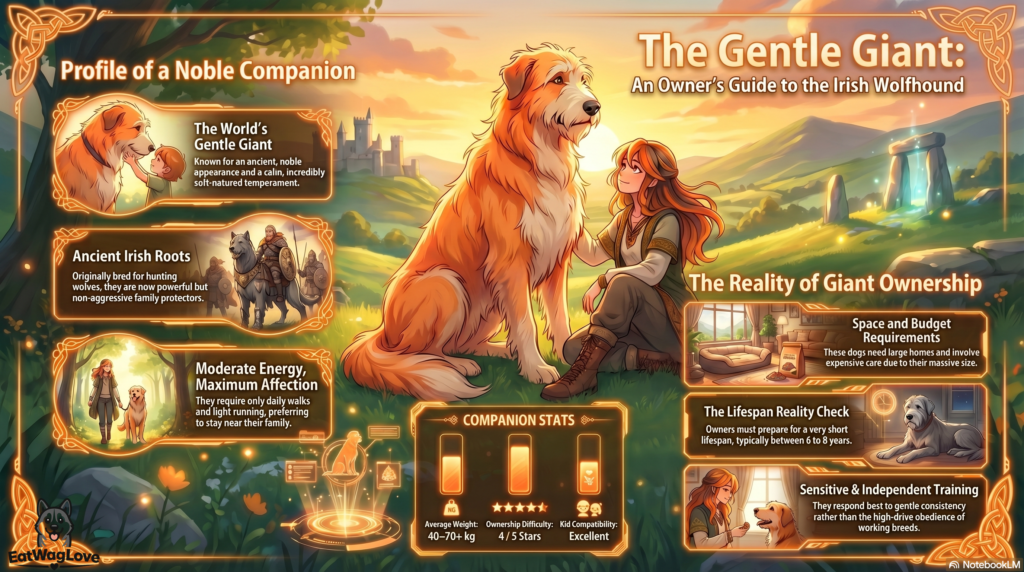






Towering, gentle, and deeply loyal — one of the largest and most noble dog breeds.
🧠 QUICK SNAPSHOT
- Temperament: Gentle, Calm, Loyal
- Energy Level: Moderate
- Size: Giant
- Good with Families: Excellent
- Training Difficulty: Easy to Moderate
📚 OVERVIEW
Irish Wolfhounds are one of the tallest dog breeds in the world, originally bred for hunting large game such as wolves. Despite their imposing size, they are known for their calm, gentle temperament and affectionate nature. They form strong bonds with their families and are often described as “gentle giants.”
✅ PROS & CONS
Pros
- Extremely gentle and calm
- Loyal and affectionate
- Impressive and noble appearance
Cons
- Very large size requires space
- Shorter lifespan compared to smaller breeds
- Higher food and care costs
Is an Irish Wolfhound a Good Family Dog?
Yes. Irish Wolfhounds are generally gentle, affectionate, patient and deeply devoted family dogs.
Despite their enormous size and intimidating history as hunters of wolves and other large game, modern Irish Wolfhounds are famous for their calm temperament.
Their size does require practical consideration, particularly around small children who can easily be knocked over accidentally.
How Much Exercise Does an Irish Wolfhound Need?
Most adult Irish Wolfhounds need around 60 minutes of moderate exercise each day, although individual requirements vary.
They enjoy walking and opportunities to stretch out and run safely, but they’re not dogs that need hours of intense exercise.
Growing puppies require particular care because excessive repetitive exercise can place unnecessary stress on rapidly developing bones and joints.
Is an Irish Wolfhound Easy to Train?
Generally, yes.
Irish Wolfhounds are intelligent and usually eager to maintain a good relationship with their owners, but they can also be independent and sensitive.
Calm, positive training works much better than harsh correction.
Early leash training is particularly important because an untrained adult may weigh as much as the person holding the lead.
Are Irish Wolfhounds Intelligent?
Yes.
As sighthounds, they were bred to spot, pursue and make decisions while hunting at speed, which required a different kind of intelligence from highly handler-focused herding breeds.
They’re often thoughtful and observant rather than constantly waiting for instructions.
Are Irish Wolfhounds Stubborn?
They can occasionally be independent, but they’re not generally considered extremely stubborn.
Repetitive training can quickly lose their interest.
Short, positive sessions usually suit their sensitive sighthound temperament best.
Does an Irish Wolfhound Shed?
Yes.
Irish Wolfhounds shed a moderate amount throughout the year.
Their rough coat doesn’t usually produce the dramatic seasonal coat blow associated with breeds such as Huskies, but owners should still expect hair around the home.
Is an Irish Wolfhound Hypoallergenic?
No.
Irish Wolfhounds shed and produce normal canine allergens through their skin and saliva.
Their rough coat shouldn’t be confused with the low-shedding coats of breeds such as Poodles.
What Type of Coat Does an Irish Wolfhound Have?
Irish Wolfhounds have a rough, hard coat, with particularly wiry hair around the eyebrows and jaw.
The coat provides useful protection against difficult weather and vegetation.
It’s considerably less demanding than many long-coated giant breeds.
How Often Should You Groom an Irish Wolfhound?
Brushing once or twice each week is usually sufficient for routine maintenance.
The coat may occasionally need tidying or removal of dead hair.
Nails require particular attention because such a large dog’s weight places substantial pressure on its feet.
What Health Problems Are Common in Irish Wolfhounds?
Important health concerns include dilated cardiomyopathy, bone cancer, gastric dilatation-volvulus, hip and elbow problems, and certain liver disorders.
Puppies can also be affected by developmental orthopaedic problems because of their extremely rapid growth.
Responsible breeding and appropriate health screening are particularly important.
Are Irish Wolfhounds Prone to Heart Problems?
Yes. Dilated cardiomyopathy (DCM) is a significant concern in Irish Wolfhounds.
DCM causes the heart muscle to become enlarged and less effective at pumping blood.
Regular veterinary assessment and cardiac screening of breeding dogs are important.
Are Irish Wolfhounds Prone to Bone Cancer?
Unfortunately, yes.
Osteosarcoma, an aggressive bone cancer, occurs at increased rates in many giant breeds, including Irish Wolfhounds.
Persistent lameness, swelling or unexplained limb pain should always be investigated promptly.
Are Irish Wolfhounds Prone to Bloat?
Yes. Irish Wolfhounds have a substantial risk of gastric dilatation-volvulus (GDV) because of their large, deep-chested build.
A swollen abdomen, restlessness, repeated unsuccessful attempts to vomit, weakness or collapse constitute an emergency.
Owners should discuss GDV prevention, including preventive gastropexy, with their veterinarian.
What Is Liver Shunt in Irish Wolfhounds?
Congenital portosystemic shunts can occur in Irish Wolfhound puppies.
Abnormal blood vessels allow blood to bypass normal processing through the liver.
Responsible breeders may use appropriate puppy screening protocols because early identification is important.
How Long Does an Irish Wolfhound Live?
Irish Wolfhounds unfortunately have a relatively short lifespan, commonly around 6–8 years.
Some live considerably longer, but giant body size is associated with accelerated ageing and increased risk of serious conditions such as heart disease and cancer.
Their short lifespan is one of the most difficult realities of owning the breed.
Why Do Irish Wolfhounds Have Such Short Lifespans?
Extreme body size appears to impose substantial biological costs.
Giant breeds grow extraordinarily quickly and have increased rates of conditions including cardiac disease and certain cancers.
Across dogs generally, larger breeds tend to have shorter lifespans than smaller breeds.
How Big Does an Irish Wolfhound Get?
Irish Wolfhounds are enormous.
Adult males should stand at least around 81 cm at the shoulder, with females at least around 76 cm, and many individuals are taller.
Males commonly weigh around 54 kg or more, while females are generally at least around 48 kg.
Is the Irish Wolfhound the Tallest Dog Breed?
The Irish Wolfhound is generally regarded as one of the tallest dog breeds in the world and is traditionally described as the tallest breed on average.
Individual Great Danes have frequently held records for the tallest individual dog.
So the distinction is useful: Irish Wolfhounds are exceptionally tall as a breed, while record-breaking individual height has often belonged to Great Danes.
Is an Irish Wolfhound Bigger Than a Great Dane?
It depends on how “bigger” is defined.
Irish Wolfhounds are exceptionally tall and long-legged, while Great Danes can be similarly tall and may have a heavier-looking build.
Individual dogs vary enormously.
Is an Irish Wolfhound Bigger Than an English Mastiff?
Irish Wolfhounds are generally taller and more lightly built.
English Mastiffs are substantially heavier and can exceed 90 kg.
The Wolfhound is built like an enormous athletic sighthound rather than a massive powerfully boned Mastiff.
How Fast Does an Irish Wolfhound Grow?
Extremely quickly.
A tiny Irish Wolfhound puppy develops into a giant adult within a remarkably short period.
Careful nutrition is essential because excessively rapid or unbalanced growth can contribute to developmental orthopaedic problems.
When Is an Irish Wolfhound Fully Grown?
Much of their height develops during the first 18 months, but physical filling-out can continue until around two to three years of age.
Mental maturity may also take time.
An enormous adolescent Wolfhound can therefore still be very much a puppy.
What Should an Irish Wolfhound Puppy Eat?
Puppies should receive a complete, appropriately formulated diet for large or giant-breed growth.
The goal isn’t to make puppies grow as quickly as possible.
Balanced calcium, phosphorus, energy and overall nutrition are particularly important during rapid skeletal development.
Should Irish Wolfhound Puppies Take Calcium Supplements?
Not routinely if they’re eating a complete, appropriately formulated giant-breed puppy diet.
Excess calcium during growth can be harmful.
Supplements should only be used when specifically recommended by a veterinarian.
Can an Irish Wolfhound Live in an Apartment?
Surprisingly, it can be possible.
Adult Irish Wolfhounds are often calm and quiet indoors, but their physical size creates obvious practical problems.
They need room to lie down, turn around and move comfortably, and repeated stair climbing may be undesirable, particularly for puppies and older dogs.
Do Irish Wolfhounds Need a Huge Backyard?
Not necessarily.
A large garden doesn’t replace daily walks and interaction.
Secure outdoor space is useful, but many Wolfhounds are perfectly content to spend substantial time relaxing indoors after appropriate exercise.
Can an Irish Wolfhound Be Left Alone?
Adult dogs can learn to tolerate reasonable periods alone, but Irish Wolfhounds generally form strong bonds with their families.
They’re companionable dogs and aren’t ideally suited to spending most of every day isolated.
Gradual independence training is useful from puppyhood.
Are Irish Wolfhounds Velcro Dogs?
Many are strongly attached to their people.
They may follow family members around the home or simply position themselves nearby.
Their enormous size can make ordinary affectionate behaviour considerably more noticeable.
Are Irish Wolfhounds Cuddly?
Many are extremely affectionate and enjoy physical contact.
Unfortunately, some appear unaware that they weigh around 50–70 kg.
A Wolfhound attempting to behave like a lapdog can therefore become a full-body experience.
Are Irish Wolfhounds Gentle Giants?
Yes. The phrase “gentle giant” is particularly appropriate for the modern Irish Wolfhound.
The ideal temperament is calm, dignified, affectionate and courageous without unnecessary aggression.
Their peaceful household personality contrasts dramatically with their historical role hunting dangerous game.
Are Irish Wolfhounds Good With Children?
Generally, yes.
Their patient, affectionate temperament can make them excellent family companions.
However, their enormous size means even a friendly dog can accidentally knock over a small child, so supervision remains important.
Are Irish Wolfhounds Good With Other Dogs?
Usually.
Many live happily with other dogs, particularly when properly socialised.
Care should be taken during rough play with very small dogs simply because of the enormous difference in body size.
Are Irish Wolfhounds Good With Cats?
Some live very successfully with cats, particularly when raised alongside them.
However, Irish Wolfhounds are sighthounds originally bred to pursue moving animals, so prey drive varies.
A dog that’s trustworthy with the household cat may still chase an unfamiliar cat outdoors.
Do Irish Wolfhounds Have a Strong Prey Drive?
They can.
Irish Wolfhounds descend from powerful hunting sighthounds that pursued large game by sight.
Movement can trigger pursuit, particularly in open spaces.
Individual prey drive varies considerably.
Are Irish Wolfhounds Sighthounds?
Yes.
They’re members of the sighthound family, alongside breeds such as Greyhounds, Deerhounds, Salukis and Borzois.
Sighthounds specialise in detecting and pursuing moving prey visually rather than following scent trails for long periods.
Are Irish Wolfhounds Good Off Leash?
Some can develop good recall, but sighthound instincts require caution.
A distant animal suddenly running can trigger an extremely fast pursuit.
Securely fenced areas are generally the safest places for unrestricted running.
How High Should a Fence Be for an Irish Wolfhound?
Fencing should be secure and sufficiently high for a giant athletic sighthound.
The exact requirement depends on the individual dog and property.
A flimsy low fence designed for a small companion dog isn’t appropriate.
Do Irish Wolfhounds Bark a Lot?
Generally, no.
They’re usually relatively quiet dogs.
They may bark to alert their owners, but excessive vocalisation isn’t normally a defining breed characteristic.
Are Irish Wolfhounds Good Guard Dogs?
Their sheer size can be an extraordinary deterrent, but they’re not specialist guard dogs.
Modern Irish Wolfhounds are generally too gentle and socially stable to be relied upon for aggressive property protection.
Few intruders, however, are likely to ignore a dog standing nearly a metre tall at the shoulder.
Are Irish Wolfhounds Protective?
They can be loyal and courageous, but deliberate protection behaviour isn’t the breed’s primary modern characteristic.
Historically, their courage was directed toward hunting formidable quarry.
The ideal modern Wolfhound should be confident without unnecessary aggression.
Are Irish Wolfhounds Aggressive?
They shouldn’t be.
A well-bred Irish Wolfhound should have a calm, stable and dignified temperament.
Fearfulness or indiscriminate aggression is particularly undesirable in a dog of this enormous size.
Are Irish Wolfhounds Friendly With Strangers?
Many are calm and accepting of strangers, although some initially appear dignified or reserved.
They’re generally less exuberant with visitors than Labradors.
Proper socialisation remains essential.
Are Irish Wolfhounds High-Energy Dogs?
Not usually in the way Huskies or Border Collies are.
They’re athletic dogs that need daily exercise and opportunities to move freely, but mature Wolfhounds are often remarkably relaxed indoors.
They tend to combine explosive sighthound athleticism with serious enthusiasm for sleeping.
Are Irish Wolfhounds Couch Potatoes?
Many adults can be.
After appropriate exercise, they often spend substantial periods resting.
The principal difficulty is that an Irish Wolfhound can occupy approximately the same amount of sofa as several ordinary dogs.
Are Irish Wolfhounds Good Running Dogs?
They’re capable of impressive speed, but aren’t ideal dogs for repetitive long-distance road running.
Their giant frame places substantial stress on joints.
Free running and moderate activity are generally more natural than forced endurance exercise.
Are Irish Wolfhounds Good Hiking Dogs?
Healthy adults can enjoy moderate hiking.
Distances should suit the dog’s fitness, age and health.
Long strenuous hikes are inappropriate for growing puppies, dogs with joint problems or older Wolfhounds.
Can Irish Wolfhounds Swim?
Some can swim, but they’re not specialised water dogs.
Their enormous size can make entering and leaving water difficult.
Supervision and easy access to shore are important.
How Fast Can an Irish Wolfhound Run?
Irish Wolfhounds are remarkably fast for their size and can reach impressive sprinting speeds.
Exact maximum speeds vary and are difficult to generalise reliably.
Their structure was developed to pursue fast-moving game across open country.
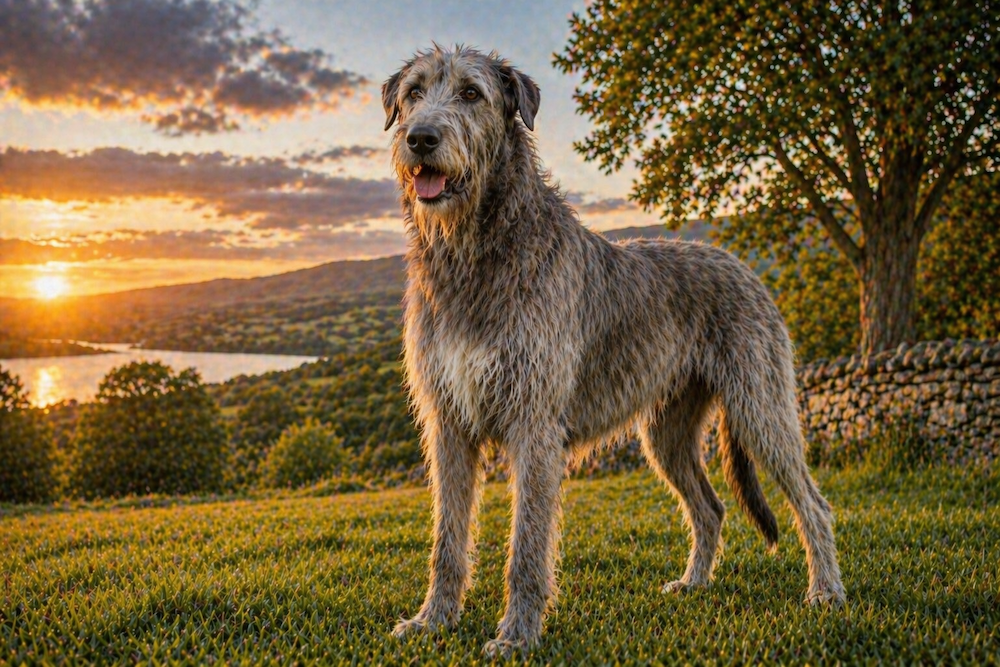
What Does an Irish Wolfhound Look Like?
The Irish Wolfhound resembles an enormous rough-coated Greyhound-like sighthound.
It has long legs, a deep chest, muscular body, long head, small folded ears and a rough coat.
Despite its size, the breed should appear athletic rather than heavy or cumbersome.
What Colours Can Irish Wolfhounds Be?
Recognised colours include grey, brindle, red, black, pure white and fawn, along with colours historically associated with the Scottish Deerhound.
Grey is probably the colour most strongly associated with the breed today.
Why Does an Irish Wolfhound Have a Rough Coat?
The harsh coat offered useful protection while hunting through rough vegetation and difficult weather.
Ireland’s climate made a more protective coat advantageous.
The wiry eyebrows and beard also contribute to the breed’s unmistakable expression.
Is the Irish Wolfhound Related to the Greyhound?
Yes, broadly.
Irish Wolfhounds belong to the same ancient functional family of large sighthounds.
Historical rebuilding of the modern Wolfhound also involved Greyhound ancestry, although the breed’s story is considerably more complex than simply being a rough-coated Greyhound.
Is the Irish Wolfhound Related to the Scottish Deerhound?
Very closely in historical and physical terms.
Both are giant rough-coated sighthounds from the British Isles.
The Scottish Deerhound played an important role in the 19th-century restoration of the modern Irish Wolfhound.
What Is the Difference Between an Irish Wolfhound and a Scottish Deerhound?
Irish Wolfhounds are generally larger, heavier and more powerfully built.
Scottish Deerhounds tend to be lighter and more refined.
Historically, the Wolfhound became associated with wolves and large Irish game, while the Deerhound specialised in pursuing red deer.
Is the Irish Wolfhound Related to the Great Dane?
The modern Irish Wolfhound’s restoration involved some Great Dane ancestry.
Great Danes contributed size and substance during the 19th-century breeding programme.
The breeds remain structurally and historically distinct.
Is the Irish Wolfhound Related to the Borzoi?
Both are giant sighthounds, but they’re separate breeds with different regional histories.
Borzoi developed in Russia, while Irish Wolfhound ancestry is centred on Ireland.
They share the fundamental sighthound strategy of pursuing quarry visually at speed.
What Were Irish Wolfhounds Originally Bred For?
Their ancestors were used to hunt wolves, deer, wild boar and other large game.
They were also prestigious animals associated with warriors and nobility.
A dog capable of pursuing dangerous quarry needed extraordinary size, speed and courage.
Did Irish Wolfhounds Really Hunt Wolves?
Yes. Large Irish hunting hounds were historically used against wolves.
Their association with wolf hunting eventually became so strong that the modern breed name explicitly preserves it.
However, ancient and medieval dogs weren’t necessarily identical in appearance to today’s standardised Wolfhound.
How Did Irish Wolfhounds Hunt Wolves?
They were coursing hounds, using sight and speed to pursue quarry.
Large hunting dogs could chase and engage wolves rather than tracking them slowly by scent.
This was dangerous work requiring athleticism and courage.
Did Irish Wolfhounds Hunt Deer?
Yes.
Large Irish hounds were used for hunting deer as well as wolves.
Their speed and size made them capable of pursuing substantial game across open terrain.
Did Irish Wolfhounds Hunt Wild Boar?
Large Irish hunting hounds have historically been associated with hunting formidable quarry including boar.
Exact practices varied across centuries.
The important point is that these were serious hunting dogs rather than purely ceremonial animals.
Did Irish Wolfhounds Fight in Wars?
Large Irish hounds are frequently associated in historical and legendary accounts with warriors and warfare.
Some stories describe dogs pulling mounted warriors from horses or chariots, although dramatic ancient claims can be difficult to verify.
Their connection with Ireland’s warrior culture is nevertheless extremely old.
Is the Irish Wolfhound an Ancient Breed?
Its ancestral Irish hunting-hound tradition is ancient, but the modern pedigree Irish Wolfhound is much more recent.
Large hounds were documented in Ireland many centuries before modern dog breeds existed.
Today’s standardised Wolfhound was substantially reconstructed during the 19th century.
Did Ancient Romans Know About Irish Wolfhounds?
Roman-era writings provide evidence that unusually large Irish dogs were known outside Ireland.
In AD 391, Roman consul Quintus Aurelius Symmachus famously thanked his brother for seven Irish dogs that reportedly caused considerable excitement in Rome.
Whether those dogs looked exactly like modern Irish Wolfhounds can’t be established.
What Happened to the Seven Irish Hounds Sent to Rome?
The dogs mentioned by Symmachus in AD 391 became famous because their size and abilities apparently impressed Roman spectators.
The surviving correspondence is important evidence that exceptional Irish hunting dogs had an international reputation more than 1,600 years ago.
Were Irish Wolfhounds Given as Royal Gifts?
Yes. Large Irish hounds became prestigious gifts exchanged among European nobility and royalty.
Their rarity, hunting ability and imposing appearance made them exceptionally valuable.
Exporting them became significant enough that attempts were eventually made to restrict their departure from Ireland.
Were Irish Wolfhounds Only Owned by Nobility?
Historically, the great hunting hounds were strongly associated with elite households and powerful landowners because maintaining specialised large hunting dogs required resources.
They also became symbols of status and prestige.
The modern breed is, of course, not restricted by social class.
Were Irish Wolfhounds Ever Banned From Being Exported?
Restrictions were imposed at various points because valuable Irish hunting hounds were being sent abroad.
A particularly famous episode occurred under Oliver Cromwell in 1652, when measures were taken to prevent the export of Wolfhounds because they were needed to control wolves in Ireland.
Why Did Oliver Cromwell Want Irish Wolfhounds Kept in Ireland?
Wolves remained a serious problem in 17th-century Ireland.
Large hunting hounds were valuable for controlling them.
Preventing the best dogs from continually leaving as prestigious foreign gifts helped preserve enough hunting animals for domestic wolf control.
When Did Wolves Become Extinct in Ireland?
Ireland’s wolves disappeared during the late 17th and early 18th centuries, although the exact date of the final wolf is uncertain and different historical accounts give different years.
Habitat loss and organised hunting contributed heavily.
The Wolfhound consequently lost one of its most important traditional jobs.
Did the Extinction of Wolves Nearly Cause the Irish Wolfhound to Disappear?
Yes.
Once wolves disappeared and traditional large-game hunting declined, there was far less practical need for enormous wolf-hunting hounds.
At the same time, many valuable dogs had historically been exported.
By the 19th century, the traditional Irish Wolfhound population had declined dramatically.
Did the Irish Wolfhound Become Extinct?
This is debated.
By the 19th century, dogs representing the old Wolfhound tradition had become extremely scarce, and some historians considered the original breed effectively extinct.
Others believed remnants survived.
The modern Irish Wolfhound was reconstructed from surviving dogs and related breeds rather than simply continuing unchanged in large numbers.
Who Saved the Irish Wolfhound?
The person most closely associated with restoring the breed is Captain George Augustus Graham.
Beginning in the 1860s, Graham spent decades locating dogs believed to carry surviving Wolfhound ancestry and breeding them with related giant and sighthound breeds.
His work created the foundation of the modern Irish Wolfhound.
Who Was Captain George Augustus Graham?
Captain George Augustus Graham was a British Army officer and dog breeder who became fascinated with Ireland’s disappearing Wolfhound.
He devoted much of his life to reconstructing the breed during the late 19th century.
Without his breeding programme, the modern Irish Wolfhound might not exist.
What Breeds Were Used to Rebuild the Irish Wolfhound?
Graham used surviving dogs believed to represent old Wolfhound lines together with related breeds.
The reconstruction is generally associated with Scottish Deerhounds, Great Danes and other large hounds, with additional historical contributions debated.
His objective was to recreate the size, structure and character described for Ireland’s old hunting hounds.
Were Scottish Deerhounds Used to Recreate Irish Wolfhounds?
Yes.
Scottish Deerhounds were especially important because they closely resembled the kind of rough-coated coursing hound Graham believed represented the historical Wolfhound type.
They provided an important foundation for the restored breed.
Were Great Danes Used to Recreate Irish Wolfhounds?
Yes.
Great Dane ancestry helped provide additional size and substance.
The resulting breeding programme wasn’t simply a cross between two breeds, however; Graham worked over generations toward a consistent Wolfhound type.
Was the Borzoi Used in Irish Wolfhound Development?
Borzoi ancestry is sometimes mentioned in discussions of later Wolfhound breeding and reconstruction.
The exact contribution of every breed and individual line can be complicated.
Scottish Deerhound and Great Dane influence is much more central to the standard historical account.
When Was the Irish Wolfhound Club Founded?
The Irish Wolfhound Club was founded in Britain in 1885, during the period when Graham and other enthusiasts were establishing the restored breed.
The club helped create greater consistency in breeding and conformation.
When Was the Modern Irish Wolfhound Standardised?
The breed took recognisable modern form during the late 19th century, particularly through Graham’s programme and the work of the Irish Wolfhound Club.
This distinction is important: Ireland had giant hunting hounds for centuries, but today’s pedigree Wolfhound was formally shaped much later.
Was the Ancient Irish Wolfhound the Same as Today’s Dog?
Probably not exactly.
Ancient and medieval Irish hounds existed long before modern breed standards, closed studbooks or systematic conformation breeding.
Today’s Wolfhound was deliberately developed to represent the historical giant Irish coursing-hound tradition, but shouldn’t be described as genetically unchanged since antiquity.
What Were Irish Wolfhounds Called Before “Irish Wolfhound”?
Historical terminology varied enormously.
References include Irish hounds, Irish greyhounds, wolf dogs and large hunting hounds, with Gaelic terminology appearing in older Irish traditions.
Modern breed naming became more consistent during formal standardisation.
What Does “Cú” Mean in Irish History?
The Irish word cú refers to a hound or dog and appears repeatedly in Irish mythology and personal names.
Hounds carried strong associations with hunting, courage and warrior status.
This helps explain their extraordinary cultural importance in early Ireland.
What Does Cú Chulainn Have to Do With Irish Wolfhounds?
The legendary Irish hero Cú Chulainn is intimately connected with hound mythology.
According to the famous story, the young hero killed the fierce guard hound of the smith Culann and offered to take its place until a replacement could be raised.
His name is commonly interpreted as “Hound of Culann.”
Was Cú Chulainn’s Dog an Irish Wolfhound?
We can’t identify a mythological dog as a modern pedigree breed.
The story reflects the enormous cultural importance of powerful hounds in ancient Ireland, but it predates the modern Irish Wolfhound breed by many centuries.
It’s better understood as part of the breed’s broader cultural heritage.
Are Irish Wolfhounds Mentioned in Irish Mythology?
Large and heroic hounds appear repeatedly throughout early Irish literature and mythology.
They could symbolise courage, loyalty, hunting skill and social prestige.
These stories contributed enormously to the romantic reputation surrounding the modern Wolfhound.
What Is the Story of Gelert?
The famous legend of Gelert, the faithful hound mistakenly killed after protecting a child from a wolf, is Welsh rather than specifically an Irish Wolfhound story.
Modern retellings sometimes attach various giant hound breeds to Gelert.
There’s no reliable basis for identifying the legendary dog as a modern Irish Wolfhound.
What Does “Gentle When Stroked, Fierce When Provoked” Mean?
A famous phrase associated with the Irish Wolfhound is:
“Gentle when stroked, fierce when provoked.”
It captures the traditional ideal of a dog that’s calm and affectionate with its family yet possesses enormous courage when genuinely challenged.
The sentiment has become closely linked with Wolfhound identity.
Is “Gentle When Stroked, Fierce When Provoked” the Official Irish Wolfhound Motto?
The phrase is widely associated with the breed and appears frequently in Wolfhound literature and imagery.
Its precise historical status as an “official” motto is less important than its enduring cultural association.
It neatly summarises the contrast between the breed’s temperament and hunting history.
Why Is the Irish Wolfhound a Symbol of Ireland?
Few breeds have such deep associations with Irish history, mythology and national identity.
Large Irish hounds appear in early literature, royal gift-giving, hunting history and folklore.
The modern Irish Wolfhound therefore became a powerful symbol of Ireland’s ancient cultural heritage.
Is the Irish Wolfhound Used by the Irish Guards?
Yes. The Irish Guards have a long tradition of having an Irish Wolfhound as their regimental mascot.
The mascot participates in ceremonial events and is one of the most visible modern associations between the breed and Irish identity.
Why Does the Irish Guards Regiment Have an Irish Wolfhound?
The breed’s Irish identity, imposing stature and historical association with courage made it an obvious regimental symbol.
The tradition dates to the early 20th century.
The Wolfhound remains an instantly recognisable presence at ceremonial occasions.
What Is the Irish Wolfhound’s Connection With St Patrick’s Day?
Irish Wolfhounds often appear in St Patrick’s Day ceremonies and parades, particularly through their connection with Irish organisations and the Irish Guards.
Their unmistakable size and Irish heritage make them natural cultural ambassadors.
Did Irish Wolfhounds Ever Appear on Coins or Stamps?
Yes. The breed has appeared on Irish stamps, coins and other cultural imagery, reflecting its status as a national symbol.
Its distinctive silhouette makes it particularly effective in heraldic and commemorative design.
Why Are Irish Wolfhounds So Expensive to Own?
Everything scales up with a giant dog.
Food, medication, beds, crates, veterinary procedures, anaesthesia and transport can all cost substantially more.
Potential serious health problems add further financial considerations.
Do Irish Wolfhounds Need Giant Beds?
Yes — genuinely giant ones.
Adequate cushioning is particularly useful because large dogs place substantial pressure on joints and bony areas when resting.
Many owners eventually discover that the Wolfhound considers the human sofa an appropriately sized alternative.
Can an Irish Wolfhound Fit in a Normal Car?
It depends heavily on the vehicle.
A mature Irish Wolfhound requires substantial headroom and floor space.
Owners should consider transport logistics before bringing home a puppy that will soon be one of the tallest dogs in the world.
Is an Irish Wolfhound a Good First Dog?
It can be, but prospective owners need to understand what giant-breed ownership involves.
Their gentle temperament can make them easier emotionally than many demanding working breeds, but size, expense, health risks, short lifespan and rapid puppy growth create significant challenges.
For the right household, they’re exceptionally devoted companions.
Why Are Irish Wolfhounds So Gentle If They Were Bred to Kill Wolves?
Hunting aggression and aggression toward humans are not the same behaviour.
Historical Wolfhounds needed the courage and prey drive to pursue dangerous quarry while remaining manageable by their handlers.
Modern breeding has strongly favoured stable, affectionate companion temperament, while preserving the breed’s dignity and confidence.
What Makes the Irish Wolfhound So Special?
Few breeds contain such an extraordinary contrast.
The Irish Wolfhound is one of the world’s tallest dogs, descended from Ireland’s legendary giant hunting hounds and historically associated with wolves, warriors, kings and ancient mythology.
Yet the modern dog is renowned primarily for gentleness.
A creature once bred to confront wolves is now far more likely to be found attempting to occupy the entire family sofa.