
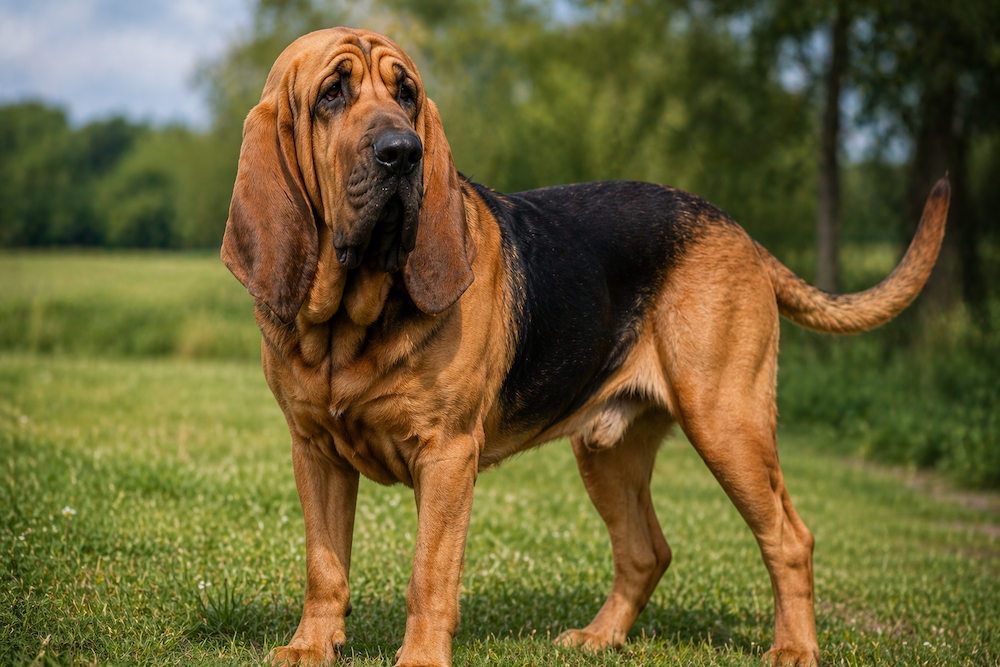







Loyal, scent-driven, and incredibly determined — a gentle giant with one of the best noses in the world.
🧠 QUICK SNAPSHOT
- Temperament: Gentle, calm, affectionate
- Energy Level: Moderate to high
- Size: Large
- Good With Families: Yes
- Trainability: Moderate (can be stubborn)
- Grooming: Low to moderate
- Best For: Active owners with space
📚 OVERVIEW
The Bloodhound is famous for its unmatched scent-tracking ability and calm, affectionate personality. Originally bred for tracking over long distances, they have an incredibly strong instinct to follow their nose.
They are friendly and loyal but can be independent, making them better suited to owners who understand their unique behaviour.
✅ PROS & CONS
Pros
- Gentle and affectionate
- Great with families
- Exceptional scent-tracking ability
- Unique and recognisable appearance
Cons
- Will follow scents without hesitation
- Can be stubborn to train
- Needs space and regular activity
- Drooling and ear care required
Is a Bloodhound a Good Family Dog?
Yes, a Bloodhound can be an excellent family dog for households prepared for its enormous size, scent-driven personality and considerable drool.
Bloodhounds are typically affectionate, gentle and patient with their families. Many are particularly tolerant with children, although their size means they can accidentally knock over smaller youngsters.
They’re generally friendly rather than naturally protective.
The biggest challenge is managing a powerful dog whose nose can suddenly become much more important than anything its owner is saying.
A Bloodhound may love its family enormously — but when an interesting scent appears, the nose occasionally takes temporary control of the dog.
How Much Exercise Does a Bloodhound Need?
Adult Bloodhounds generally need around 60–90 minutes of exercise each day, although young dogs can be surprisingly energetic.
Long walks and scent-based activities are particularly suitable.
Bloodhounds shouldn’t simply be allowed to follow scents wherever they please because they can travel considerable distances once focused on a trail.
Tracking and scent games provide excellent mental stimulation.
Exercise should be carefully controlled while puppies are growing because Bloodhounds become very large, heavy dogs.
Is a Bloodhound Easy to Train?
Bloodhounds are intelligent but independent, making them considerably more challenging to train than highly handler-focused breeds.
They were developed to follow scent trails and make decisions independently.
Positive reinforcement, patience and particularly valuable food rewards usually produce the best results.
Recall can be extremely difficult once a Bloodhound becomes absorbed in a scent.
Training sessions should be interesting and relatively short.
The Bloodhound isn’t unintelligent or stubborn simply because it ignores you.
Sometimes its nose has found something it considers considerably more important.
Does a Bloodhound Shed?
Yes, Bloodhounds shed moderately throughout the year, with heavier shedding possible seasonally.
Their short coat is relatively easy to brush.
Weekly brushing usually helps remove loose hair and keep the coat in good condition.
More maintenance is required around their skin folds and long ears.
Those areas should be checked and kept clean and dry because trapped moisture can contribute to irritation and infection.
Bloodhounds aren’t considered hypoallergenic.
What Health Problems Are Common in Bloodhounds?
Bloodhounds can be affected by several significant health conditions.
One of the most important is gastric dilatation-volvulus (GDV or bloat), a life-threatening emergency in which the stomach becomes distended and may twist.
Hip and elbow dysplasia can occur, along with certain eye problems such as entropion and ectropion.
Their enormous hanging ears can predispose them to ear infections, while deep skin folds may develop irritation.
Responsible breeders should undertake appropriate health screening, and owners should learn the warning signs of GDV because rapid veterinary treatment can be lifesaving.
How Long Do Bloodhounds Live?
Bloodhounds typically live around 10–12 years, although individual longevity varies.
Their large body size and susceptibility to conditions such as GDV influence overall lifespan.
Maintaining a lean body condition helps reduce unnecessary stress on joints.
Regular veterinary care, ear maintenance and appropriate exercise are also important throughout life.
Despite their famously solemn expression, many Bloodhounds remain wonderfully goofy and playful well into adulthood.
How Big Does a Bloodhound Get?
The Bloodhound is a large and powerful scent hound.
Adult males commonly stand around 64–69 cm at the shoulder, while females are generally around 58–64 cm.
Weight commonly falls somewhere around 36–50 kg, although some individuals are heavier.
Much of their strength can become very obvious when an interesting scent suddenly crosses the walking route.
Loose-lead training should therefore begin while the dog is still young enough that the owner has some negotiating power.
Can a Bloodhound Live in an Apartment?
A Bloodhound can technically live in an apartment, but it’s rarely the easiest environment for the breed.
These are large dogs requiring daily exercise and opportunities to explore scents.
Their deep voice can also carry remarkably well through shared buildings.
Practical problems include stairs, lifts, limited space and managing a very large dog with substantial ears, loose skin and drool.
A securely fenced home with more space is generally easier, although a backyard doesn’t replace proper exercise.
Do Bloodhounds Bark or Howl a Lot?
Bloodhounds can be very vocal, using deep barks, bays and howls.
Their voice was historically useful because hunters could follow the progress of scent hounds from a distance.
Some individuals vocalise more than others.
Boredom, excitement, unfamiliar sounds and separation can increase howling or barking.
The Bloodhound’s voice is impressive enough that neighbours may discover your dog is home before you’ve had the opportunity to tell them.
Do Bloodhounds Drool a Lot?
Yes. Bloodhounds can drool considerably.
Their loose lips and facial skin allow saliva to escape easily, particularly after eating, drinking or exercising.
Shaking the head can distribute that saliva considerably further than owners might expect.
Keeping towels around strategic areas of the home is common among experienced owners.
Anyone wanting an immaculate house with perfectly clean walls may find the Bloodhound challenging.
Drool isn’t an occasional malfunction — it’s practically part of the equipment package.
Are Bloodhounds Good With Other Dogs?
Bloodhounds are generally sociable with other dogs, particularly when appropriately socialised.
Their historical work often involved operating around other hounds, and many enjoy canine companionship.
Their size and enthusiastic play can overwhelm smaller dogs.
As with any breed, individual temperament varies, and careful introductions remain important.
Early socialisation should help the dog develop calm, appropriate interactions rather than simply encouraging excitement around every dog it sees.
Are Bloodhounds Good With Cats?
Bloodhounds can live successfully with cats, especially when raised alongside them.
However, they remain hunting hounds with strong instincts to investigate and follow scents.
Some individuals may chase cats or other animals outdoors.
Careful introductions and supervision are important.
Small animals should be managed particularly carefully because individual prey drive can vary.
Can a Bloodhound Be Left Alone?
Bloodhounds can learn to spend reasonable periods alone, but they generally enjoy companionship.
Dogs left isolated for long periods without sufficient exercise or enrichment may become destructive or extremely vocal.
Their powerful noses can also turn boredom into an investigation of cupboards, bins and anything else containing interesting smells.
Gradual independence training should begin during puppyhood.
Scent puzzles and appropriate chew items can help keep them occupied.
How Good Is a Bloodhound’s Sense of Smell?
The Bloodhound has one of the most extraordinary scent-tracking abilities in the canine world.
Bloodhounds have been selectively bred for centuries to follow human scent trails over long distances and difficult terrain.
Their ability isn’t simply about having a sensitive nose. They’re also extraordinarily persistent at following a particular scent once they’ve identified it.
This combination has made Bloodhounds valuable in search operations and trailing work.
To a human, a path may look empty.
To a Bloodhound, it can contain an entire invisible history written in scent.
Why Do Bloodhounds Have Such Long Ears?
A Bloodhound’s enormous ears are believed to help its scent-tracking work.
As the dog moves with its nose close to the ground, the ears sweep alongside its face and may help disturb scent particles around the trail.
The loose skin around the head and neck may also help retain scent near the nose.
However, those remarkable ears require regular care.
Their enclosed structure limits airflow and can trap moisture, increasing the risk of ear infections.
Why Does a Bloodhound Have So Much Loose Skin?
The Bloodhound’s distinctive loose skin and facial wrinkles are closely associated with its scent-hound anatomy.
When the dog’s head is lowered towards the ground, folds of skin fall forward around the face.
Traditionally, this has been thought to help trap scent particles near the nose.
The loose facial skin also contributes to the Bloodhound’s famously serious and somewhat mournful expression.
Unfortunately, deep folds can trap moisture and debris, so regular inspection is important.
Can Bloodhounds Follow a Scent That Is Days Old?
Yes, trained Bloodhounds can sometimes follow human scent trails that are many hours or even days old, depending on environmental conditions and the individual dog.
Temperature, wind, rain, surface type, contamination and human activity can all affect how long a trail remains workable.
Claims about exact maximum ages or distances should be treated cautiously because real tracking conditions vary enormously.
What makes the Bloodhound remarkable is its ability to discriminate and persist with a particular human scent despite competing smells.
Are Bloodhounds Still Used to Find Missing People?
Yes. Bloodhounds are still used in search, trailing and missing-person work.
A trained Bloodhound can be given a scent article associated with a particular person and attempt to follow that individual’s scent trail.
They have historically been used by law enforcement and search teams to locate missing children, lost people, fugitives and others.
Modern search operations also use many other breeds and technologies, but the Bloodhound remains one of the world’s most famous specialist trailing dogs.
Can Bloodhound Tracking Evidence Be Used in Court?
Bloodhound tracking has an unusual connection with legal history, particularly in the United States.
Courts have sometimes admitted evidence concerning a trained Bloodhound’s trail, provided requirements concerning the dog’s training, reliability, handling and circumstances of the track were satisfied.
The exact admissibility and evidentiary weight depend on jurisdiction and case circumstances.
Bloodhound evidence isn’t magical proof of identity and should be considered alongside other evidence.
Nevertheless, very few dog breeds can claim such a fascinating historical connection between their noses and the courtroom.
What Does the Name Bloodhound Mean?
Despite the dramatic name, “Bloodhound” doesn’t mean a dog that follows the smell of blood.
The traditional explanation connects “blooded hound” or “blood hound” with dogs of carefully maintained or noble breeding.
These hounds were prized and selectively bred for their extraordinary scenting abilities.
Over time, the name became associated with the breed itself.
Bloodhounds certainly can follow injured animals, but blood isn’t what gave the breed its name.
What Is the Difference Between a Bloodhound and a Basset Hound?
Bloodhounds and Basset Hounds are both powerful scent hounds, but they’re dramatically different in size and build.
The Bloodhound is tall, large and powerful, while the Basset Hound has extremely short legs and a long, low body.
Both possess long ears, loose facial skin and outstanding noses.
The Basset was traditionally suited to slower hunting of animals such as hare and rabbit, while Bloodhounds became particularly famous for following human scent.
Think of them as distant specialists built around the same fundamental principle:
put the nose in charge.
Where Does the Bloodhound Come From?
The modern Bloodhound was developed primarily in medieval and later Western Europe, particularly Britain, from ancient traditions of large scent-trailing hounds.
Its history is often linked with dogs kept by monasteries and aristocratic hunting establishments, including the famous St Hubert hounds associated with the Abbey of Saint-Hubert in the Ardennes.
Exactly how directly modern Bloodhounds descend from those medieval dogs is difficult to establish, so the historical connection shouldn’t be treated as a perfectly documented pedigree stretching uninterrupted through a thousand years.
What is clear is that generations of selective breeding created a dog extraordinarily specialised for one task:
following a scent and refusing to give up.