



Gentle, affectionate, and irresistibly cute — a small companion that thrives on love and attention.
🧠 QUICK SNAPSHOT
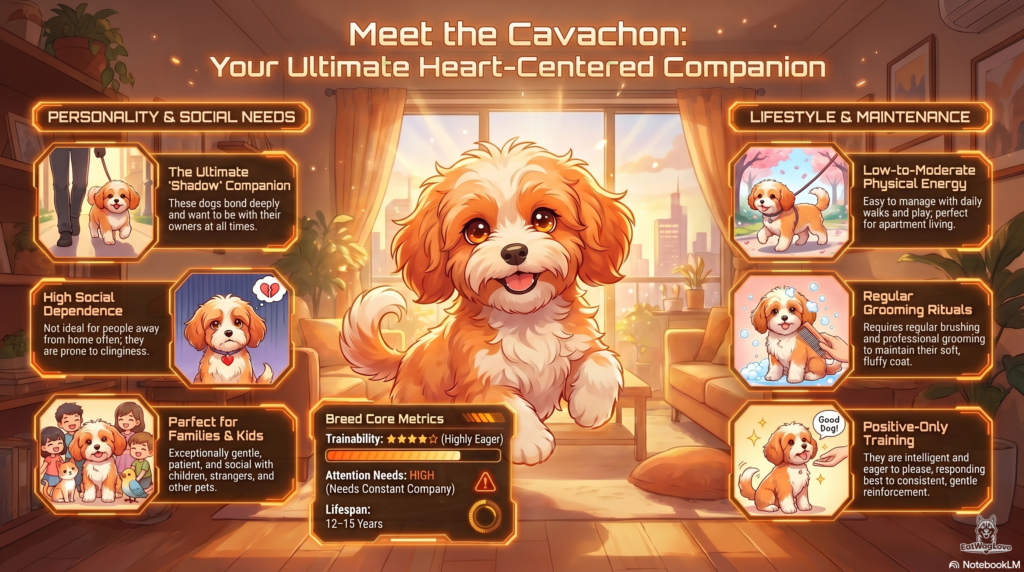
- Temperament: Friendly, gentle, affectionate
- Energy Level: Low to moderate
- Size: Small
- Good With Families: Yes
- Trainability: Moderate to high
- Grooming: Moderate
- Best For: Families, first-time owners, companionship
📚 OVERVIEW
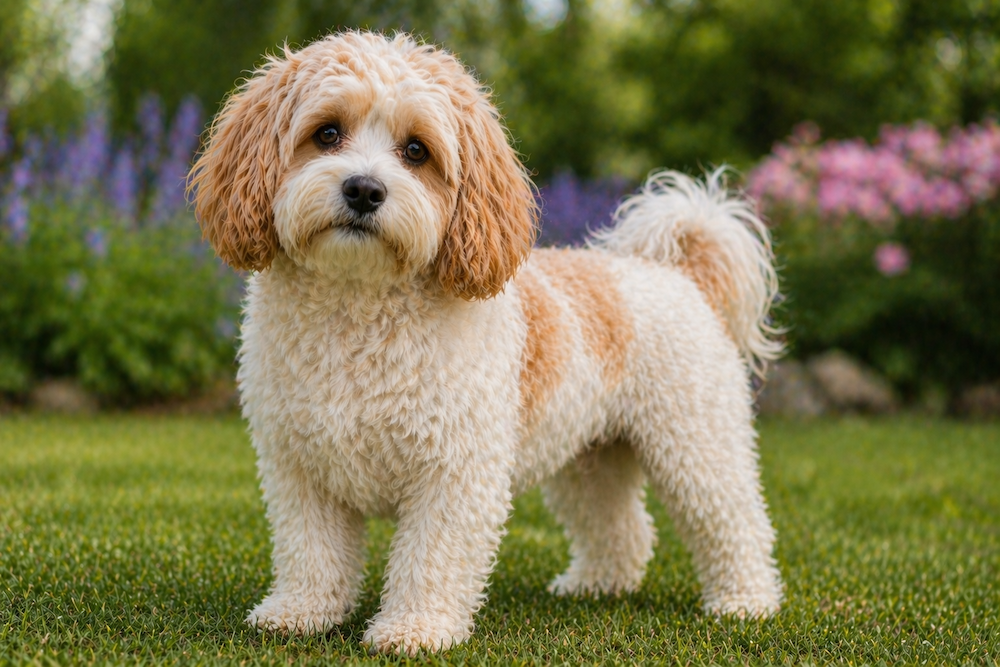
The Cavachon is a cross between the Cavalier King Charles Spaniel and the Bichon Frise, known for its soft coat and loving personality. They are highly social dogs that enjoy being around people and are well suited to family life.
Their small size and gentle nature make them a popular choice for both houses and apartments.
✅ PROS & CONS
Pros
- Very affectionate and friendly
- Great with children and families
- Adaptable to different living environments
- Low aggression and easy-going nature
Cons
- Can develop separation anxiety
- Needs regular grooming
- Requires companionship and attention
- Not suited to being left alone for long periods
Is a Cavachon a Good Family Dog?
Yes, the Cavachon can be an excellent family companion, particularly for households wanting a small, affectionate and sociable dog.
A Cavachon is usually a cross between a Cavalier King Charles Spaniel and Bichon Frise. Both parent breeds were developed primarily for companionship, so Cavachons often inherit a strong desire to be around people.
Many are gentle and playful with respectful children.
Their small size means interactions with very young children should still be supervised to prevent accidental injury.
How Much Exercise Does a Cavachon Need?
Most Cavachons need around 30–60 minutes of exercise each day, together with play and mental stimulation.
Daily walks, games and opportunities to explore are usually sufficient.
They’re generally more energetic than their cuddly appearance suggests but don’t require the exercise commitment of a working breed.
Some inherit the Cavalier’s enthusiasm for longer walks, while others are happier with more moderate activity.
Is a Cavachon Easy to Train?
Cavachons are generally intelligent and eager to interact with their owners, making them relatively easy to train.
Both parent breeds respond well to positive reinforcement.
Food rewards, praise and play can all be effective.
Some individuals may require patience with toilet training, particularly during puppyhood.
Early socialisation and basic obedience help prevent a cute little puppy from developing habits that become considerably less cute in adulthood.
Does a Cavachon Shed?
Cavachons can be low-to-moderate shedders, but shedding varies considerably between individuals.
A dog inheriting more of the Bichon Frise’s curly coat may release relatively little loose hair.
A more Cavalier-like coat can shed noticeably more.
Even puppies from the same litter can develop different adult coats.
Crossing two breeds doesn’t produce a guaranteed coat type.
Is a Cavachon Hypoallergenic?
No Cavachon can be guaranteed hypoallergenic.
Bichon Frises are low-shedding dogs often chosen by people concerned about allergies, while Cavalier King Charles Spaniels shed considerably more.
A Cavachon can inherit characteristics from either parent.
Dog allergies are also caused by proteins in saliva, skin secretions and dander rather than simply hair.
Anyone with significant allergies should spend time around the individual adult dog if possible.
How Often Does a Cavachon Need Grooming?
Most Cavachons require brushing several times each week, and curlier coats may need daily attention.
Professional grooming is commonly required around every 6–8 weeks, depending on coat length and texture.
Hair around the ears, eyes, legs and underarms can mat surprisingly quickly.
Dogs with drop ears also need regular ear checks.
The Cavachon may shed less than many breeds, but that doesn’t necessarily make it low maintenance.
What Health Problems Are Common in Cavachons?
Cavachons can potentially inherit health conditions found in both parent breeds.
One of the most important concerns is mitral valve disease, which is particularly common in Cavalier King Charles Spaniels.
Cavalier ancestry can also bring risks involving syringomyelia, eye disease and patellar luxation. Bichon Frises can be affected by patellar luxation, allergies, eye problems, bladder stones and dental disease.
Responsible breeders should health-test both parents rather than assuming crossbreeding automatically prevents inherited disease.
How Long Do Cavachons Live?
Cavachons commonly live around 12–15 years, although individual dogs may live longer.
Their relatively small size can contribute to good longevity.
Genetics remain extremely important, particularly because Cavalier King Charles Spaniels have significant inherited health concerns.
Maintaining a healthy weight, good dental care and regular veterinary examinations can help support a long life.
How Big Does a Cavachon Get?
Most Cavachons are small dogs, commonly weighing around 5–10 kg and standing approximately 25–35 cm tall.
However, there is no universal breed standard.
Size depends partly on the individual Cavalier and Bichon parents and can vary even within a litter.
Anyone purchasing a puppy should examine the actual parents rather than relying solely on advertised size labels.
Can a Cavachon Live in an Apartment?
Yes. Cavachons are generally excellent apartment dogs.
They’re small, adaptable and don’t require enormous amounts of exercise.
However, their strong attachment to people can create problems if they’re left alone for long periods.
Barking can also become an issue in apartments if the dog learns to react to every noise in hallways or neighbouring properties.
Exercise, enrichment and early training remain important regardless of home size.
Can a Cavachon Be Left Alone?
Cavachons generally don’t enjoy being left alone for long periods.
Both Cavaliers and Bichons are highly people-oriented companion breeds.
Some Cavachons can therefore be susceptible to separation-related distress.
Owners should teach independence gradually from puppyhood rather than allowing the dog to remain constantly attached to someone.
A second pet can provide companionship for some dogs, but it doesn’t automatically prevent separation anxiety.
Do Cavachons Bark a Lot?
Cavachons aren’t usually considered extreme barkers, but some can become quite vocal.
They may bark at visitors, noises outside, excitement or when seeking attention.
Bichon influence can contribute alert barking, while individual temperament and training have a major effect.
Early training is particularly useful for dogs living in apartments or other environments with close neighbours.
Are Cavachons Good With Other Dogs?
Yes, Cavachons are generally very sociable with other dogs when appropriately socialised.
Both parent breeds have strong histories as companion dogs.
Many Cavachons enjoy having another friendly dog in the household.
As with all dogs, individual temperament and introductions matter.
Their relatively small size also means interactions with extremely large or rough-playing dogs should be supervised.
Are Cavachons Good With Cats?
Cavachons can usually live successfully with cats, especially when introduced carefully.
Neither parent breed is typically associated with an extreme prey drive.
Some individuals may chase a running cat through excitement rather than serious hunting behaviour.
Early introductions and teaching calm behaviour around cats can create very successful multi-pet households.
Are Cavachons Good With Children?
Cavachons are generally good with respectful children.
They’re playful, affectionate and often enjoy attention.
However, they’re relatively small dogs and can be injured by rough handling.
Young children should be taught not to pick dogs up incorrectly, pull their ears or disturb them while eating or sleeping.
Supervision protects both the child and the dog.
Do Cavachons Like to Cuddle?
Many Cavachons love cuddling and physical contact.
Both parent breeds were developed largely to provide companionship.
Cavaliers are particularly famous lap dogs, while Bichons have spent centuries living closely with people.
A Cavachon may happily follow its owner from room to room before settling beside or directly on them.
For someone wanting an independent dog, that level of devotion may occasionally feel excessive.
Do Cavachons Like Water?
Some Cavachons enjoy water, but there’s no guarantee that an individual dog will enjoy swimming.
Cavalier King Charles Spaniels can sometimes be enthusiastic around water, while individual Bichons vary.
Dogs should be introduced gradually and never forced to swim.
Because Cavachons are small, supervision around pools and open water is important.
Why Does My Cavachon Have Tear Stains?
Tear staining can be noticeable in Cavachons, particularly dogs with white or very pale facial hair.
Tears contain compounds that can produce reddish-brown staining when they remain on the coat.
Facial anatomy, excessive tearing, blocked tear drainage, irritation and allergies can all contribute.
Persistent or suddenly increased tearing should be investigated by a veterinarian rather than treated purely as a cosmetic issue.
What Does a Cavachon Coat Feel Like?
Cavachon coats can range from soft and wavy to considerably curlier and fluffier.
Some strongly resemble a Cavalier with a slightly fuller coat, while others develop the soft, curly appearance associated with Bichons.
Coat texture can change substantially as a puppy matures.
This variation is one reason photographs of adult Cavachons can look surprisingly different from one another.
What Colours Can Cavachons Be?
Cavachons can occur in numerous colours and patterns.
Common combinations include white with chestnut or apricot markings, cream, sable, black and white, and tricolour patterns.
Cavalier ancestry contributes colours such as Blenheim, tricolour, ruby and black-and-tan, while Bichon ancestry strongly contributes white and cream.
Some puppy colouring may also lighten as the adult coat develops.
Does a Cavachon’s Coat Change Colour as It Gets Older?
Yes. Some Cavachons become noticeably lighter as they mature.
Bichon ancestry and other colour genetics can cause richer puppy colours to fade or soften over time.
Apricot, tan or darker markings may become much paler in adulthood.
The puppy’s exact colouring therefore isn’t necessarily a reliable prediction of its final appearance.
What Is an F1 Cavachon?
An F1 Cavachon is usually a first-generation cross between a purebred Cavalier King Charles Spaniel and a purebred Bichon Frise.
Because the parents are two different breeds, F1 puppies can inherit widely different combinations of traits.
One puppy might have a straighter Cavalier-like coat while another is much curlier.
The F1 label describes ancestry — it doesn’t guarantee appearance, shedding level, temperament or health.
What Is an F1B Cavachon?
An F1B Cavachon is generally produced by breeding an F1 Cavachon back to one of its parent breeds, often the Bichon Frise.
This is sometimes done in an attempt to increase the likelihood of a curlier, lower-shedding coat.
However, genetics don’t work as precisely as simple percentage marketing can suggest.
Individual puppies can still vary in coat, appearance and temperament.
What Is an F2 Cavachon?
An F2 Cavachon is generally produced by breeding two first-generation F1 Cavachons together.
Later-generation Cavachons may also be bred through different combinations.
Because the Cavachon isn’t governed by one universally accepted breed standard, terminology can sometimes vary between breeders.
Prospective owners should therefore ask for the actual pedigree and health information rather than relying entirely on labels such as F1, F1B or F2.
Is a Cavachon a Recognised Dog Breed?
The Cavachon is generally considered a designer crossbreed rather than a formally recognised pedigree breed.
Major kennel clubs don’t recognise it in the same way they recognise the Cavalier King Charles Spaniel or Bichon Frise.
There is therefore no single universally accepted standard for Cavachon size, coat, colour or appearance.
Two perfectly genuine Cavachons can look remarkably different.
Is a Cavachon Healthier Than a Cavalier King Charles Spaniel?
A Cavachon may benefit from greater genetic diversity, but it isn’t automatically healthier than a Cavalier.
Crossbreeding can reduce the probability of some recessive disorders under particular circumstances, but puppies can still inherit disease-associated genes from either parent.
This is particularly important with Cavaliers because conditions such as mitral valve disease and syringomyelia are significant breed concerns.
Health-tested parents are far more meaningful than simply advertising puppies as healthier because they’re crosses.
What Is the Difference Between a Cavachon and a Cavapoo?
A Cavachon crosses a Cavalier King Charles Spaniel with a Bichon Frise, while a Cavapoo crosses a Cavalier with a Poodle, usually Toy or Miniature.
Both are small companion crosses and can look surprisingly similar.
Cavapoos may inherit more of the Poodle’s athleticism and tightly curled coat, while Cavachons often have softer, looser waves.
Neither cross guarantees a non-shedding coat.
What Is the Difference Between a Cavachon and a Cockapoo?
A Cavachon combines the Cavalier King Charles Spaniel and Bichon Frise, while a Cockapoo combines a Cocker Spaniel and Poodle.
Cockapoos are often more energetic and may possess stronger sporting instincts because of their Cocker Spaniel ancestry.
Cavachons are typically bred primarily as companion dogs.
Both crosses can vary considerably in size, coat and temperament.
Why Are Cavachons So Affectionate?
Both parent breeds have a long history of being companion dogs selected for close relationships with humans.
The Cavalier King Charles Spaniel was developed as an affectionate toy spaniel associated with homes and royal courts.
Bichon-type dogs also spent centuries as fashionable companions and entertainers.
Combining these backgrounds often produces a dog strongly motivated by human interaction.
The downside is that the same characteristic can make some Cavachons unusually dependent on their owners.
Where Does the Cavachon Come From?
The Cavachon is a relatively modern designer crossbreed, usually combining the Cavalier King Charles Spaniel and Bichon Frise.
Deliberate breeding became increasingly visible during the late 20th and early 21st centuries, particularly as small companion crosses grew in popularity.
Unlike many established pedigree breeds, there isn’t a universally documented founder, location or precise date for the Cavachon’s creation.
Its history is therefore better understood through its two parent breeds than through claims about a single inventor.
The result is a dog combining two remarkably companion-oriented bloodlines — which helps explain why many Cavachons seem convinced that being within touching distance of a human is a full-time occupation.