






Powerful, intelligent, and striking — a high-energy companion built for action and loyalty.
🧠 QUICK SNAPSHOT
- Temperament: Loyal, intelligent, energetic
- Energy Level: Very high
- Size: Medium to large
- Good With Families: Yes (with training)
- Trainability: High
- Grooming: Moderate to high
- Best For: Active owners, experienced handlers
📚 OVERVIEW
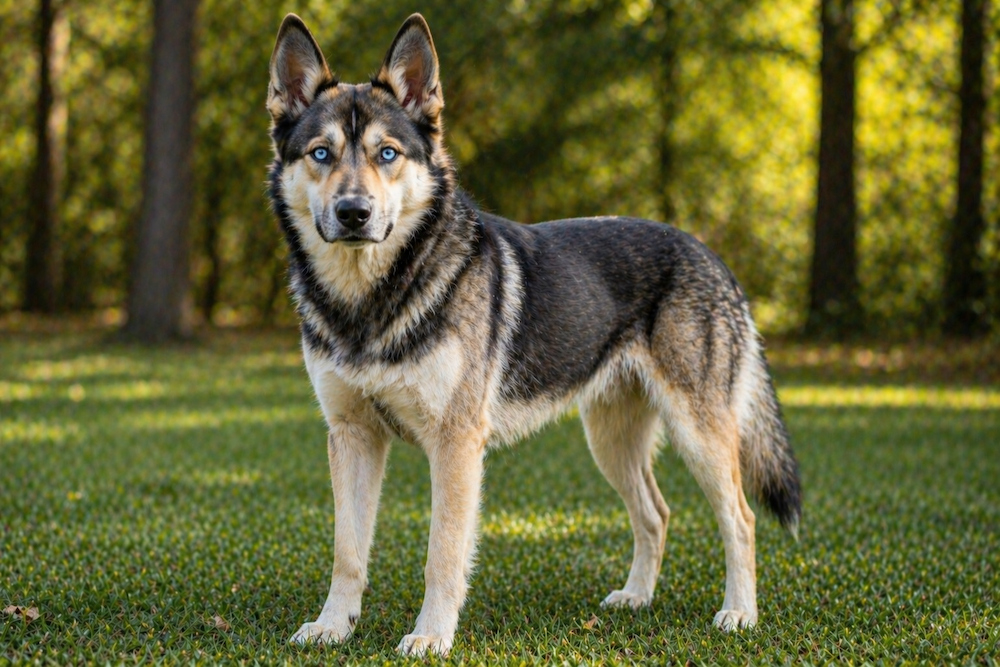
The Shepsky is a cross between a German Shepherd and a Siberian Husky, combining strength, intelligence, and endurance. Known for their striking appearance and high energy levels, they are best suited to active homes where they can stay engaged both physically and mentally.
They are loyal and protective but require consistent training and structure.
✅ PROS & CONS
Pros
- Extremely intelligent and capable
- Loyal and protective
- Great for active lifestyles
- Eye-catching appearance
Cons
- Very high energy requirements
- Needs strong, consistent training
- Can be stubborn or independent
- Requires plenty of attention and stimulation
Is a Shepsky a Good Family Dog?
Yes. A Shepsky can be a loyal, intelligent and energetic family dog in the right household.
The Shepsky is a German Shepherd–Siberian Husky cross, so temperament can vary considerably. Many are affectionate and strongly attached to their families, but they’re usually active dogs that require substantial exercise, training and mental stimulation.
Are Shepskies Good With Children?
Shepskies can be very good with children when properly trained and socialised.
They’re often playful and affectionate, but their size and enthusiasm can be overwhelming for small children.
Early training is particularly important because an excited adult Shepsky can be a powerful dog.
How Much Exercise Does a Shepsky Need?
Most adult Shepskies need around 90 minutes to two hours of exercise each day, although individual requirements vary.
Walking, running, hiking, interactive games and training can all help meet their needs.
Simply leaving a Shepsky in the backyard is unlikely to provide enough physical or mental stimulation.
Are Shepskies Easy to Train?
Shepskies are usually extremely intelligent, but that doesn’t necessarily make them easy to train.
A dog inheriting more German Shepherd characteristics may be highly responsive to training, while stronger Husky traits can bring considerably more independence and selective listening.
Positive reinforcement, consistency and interesting training sessions work best.
Do Shepskies Shed a Lot?
Yes. Most Shepskies are heavy shedders.
Both German Shepherds and Siberian Huskies have dense double coats, so there’s little reason to expect their offspring to leave less hair around the house.
Seasonal coat changes can produce particularly large quantities of loose undercoat.
Are Shepskies Hypoallergenic?
No.
Shepskies aren’t considered hypoallergenic and generally shed substantially.
They also produce allergens through saliva and skin secretions, making them unsuitable for someone specifically looking for a hypoallergenic dog.
How Often Should You Groom a Shepsky?
Most Shepskies should be brushed several times a week, potentially daily during periods of heavy seasonal shedding.
Their double coat needs to be brushed thoroughly enough to remove loose undercoat.
Routine nail trimming, dental care and ear checks are also important.
What Health Problems Are Common in Shepskies?
Potential health concerns include conditions found in either parent breed, such as hip and elbow dysplasia, eye disorders, degenerative myelopathy and certain neurological or endocrine conditions.
Being crossbred doesn’t automatically protect a Shepsky from inherited disease.
Responsible breeders should health-test both parent dogs for conditions relevant to their respective breeds.
How Long Do Shepskies Live?
Shepskies commonly live around 10–14 years, although there isn’t a single established lifespan because they’re a cross rather than a standardised breed.
Genetics, adult size, diet, exercise, body condition and veterinary care all influence longevity.
How Big Does a Shepsky Get?
Adult Shepskies commonly weigh around 20–40 kg, although some fall outside this range.
Height and build depend heavily on the parents.
Some resemble lean Siberian Huskies, while others inherit more of the larger, substantial build of a German Shepherd.
What Does a Shepsky Look Like?
There is no single Shepsky appearance.
They commonly have upright ears, athletic bodies, thick double coats and bushy tails, but coat colours and markings vary widely.
Some look predominantly like German Shepherds, while others can look remarkably Husky-like.
Can a Shepsky Have Blue Eyes?
Yes.
Shepskies can inherit the Siberian Husky’s striking blue eyes, although brown eyes are also common.
Some may have one blue and one brown eye, a condition known as heterochromia.
Eye colour doesn’t indicate how much Husky ancestry a particular dog has.
Can a Shepsky Live in an Apartment?
It’s possible, but challenging.
Shepskies are generally large, energetic and potentially vocal dogs that need substantial daily exercise.
A committed owner can meet those needs without a large property, but this cross is usually easier to manage in a home with adequate space and access to safe exercise areas.
Can Shepskies Be Left Alone?
Adult Shepskies can learn to tolerate reasonable periods alone, but long periods without exercise or stimulation can cause problems.
Both parent breeds are intelligent working dogs.
A bored Shepsky may bark, howl, chew, dig or attempt to escape in search of something more interesting.
Do Shepskies Bark or Howl a Lot?
Potentially.
German Shepherds can be naturally vocal alert dogs, while Siberian Huskies are famous for howling, whining and “talking.”
A Shepsky can inherit either or both tendencies.
Exercise, training and sufficient stimulation can help reduce excessive vocalisation.
Are Shepskies Protective?
They can be.
A Shepsky may inherit the German Shepherd’s natural watchfulness and protective instincts, although this isn’t guaranteed.
Some individuals are reserved with strangers, while others inherit more of the Husky’s typically sociable approach to unfamiliar people.
Are Shepskies Aggressive?
Shepskies shouldn’t automatically be considered aggressive.
However, they’re powerful dogs that can inherit strong guarding instincts, prey drive and independence, making early socialisation and training particularly important.
Genetics, breeding and individual experiences have a major influence on adult temperament.
Are Shepskies Good With Other Dogs?
Many Shepskies are very sociable with other dogs when properly socialised.
Siberian Huskies historically worked in teams, while German Shepherds can also live successfully with other dogs.
Individual compatibility still matters, particularly with dogs of similar size and confidence.
Are Shepskies Good With Cats?
Some can live successfully with cats, particularly when raised alongside them.
However, Siberian Huskies can have a strong prey drive, and this trait can be inherited by a Shepsky.
A dog that accepts a household cat may still chase unfamiliar cats outdoors.
Do Shepskies Have a High Prey Drive?
Many do.
Huskies can have particularly strong chase instincts, while German Shepherds also have substantial working and predatory drive.
Small animals, wildlife and running cats can therefore be extremely tempting to some Shepskies.
Are Shepskies Good Off Leash?
This varies considerably, but caution is advisable.
A Shepsky that inherits the Husky’s independence, desire to explore and strong prey drive can have unreliable recall when something interesting appears.
Securely fenced areas are generally the safest places for unrestricted running.
Are Shepskies Escape Artists?
They can be.
Siberian Huskies have a well-earned reputation for digging, climbing and finding weaknesses in fences, and some Shepskies inherit this determination.
Secure fencing is particularly important for dogs displaying strong Husky-like roaming behaviour.
Can Shepskies Handle Hot Weather?
Care is required in hot weather.
Their dense double coat is designed to provide insulation, and strenuous exercise during high temperatures can increase the risk of overheating.
Exercise should be scheduled during cooler periods, with constant access to shade, water and cool indoor areas.
Should You Shave a Shepsky?
Generally, no.
The double coat provides insulation and protection and shouldn’t normally be shaved simply because the weather is warm or shedding is inconvenient.
Regular brushing to remove loose undercoat is usually a better approach.
Medical clipping may occasionally be required under veterinary guidance.
What Is the Difference Between a Shepsky and a German Shepherd?
A German Shepherd is an established pedigree breed with a defined breed standard.
A Shepsky is a German Shepherd–Siberian Husky cross, so its appearance and temperament are less predictable.
Shepskies may inherit Husky traits such as blue eyes, increased vocalisation, stronger roaming instincts or greater independence.
What Is the Difference Between a Shepsky and a Siberian Husky?
A Siberian Husky is an established northern sled breed, while a Shepsky combines Husky and German Shepherd ancestry.
A Shepsky may inherit more protective behaviour and handler focus from the German Shepherd, while retaining Husky characteristics such as endurance, heavy shedding and independent behaviour.
Every individual can inherit a different combination.
Is a Shepsky a Recognised Dog Breed?
No. The Shepsky isn’t generally recognised as a standardised pedigree breed by major kennel clubs.
It’s a cross between a German Shepherd and Siberian Husky.
There is consequently no single official standard governing its size, appearance, coat or temperament.
Where Did the Shepsky Come From?
German Shepherd–Siberian Husky crosses have likely occurred for many years, while intentional breeding became more visible with the growing popularity of deliberately produced crossbred dogs.
There isn’t a reliably documented single founder or precise creation date for the Shepsky.
Claims that one particular breeder definitively invented the cross should therefore be treated cautiously.
Is a Shepsky a Good First Dog?
Usually, a Shepsky is better suited to an experienced or exceptionally well-prepared owner.
The combination can produce a large, intelligent and extremely energetic dog with heavy shedding, strong prey drive, guarding tendencies and an independent streak.
They’re rewarding dogs for owners able to provide consistent training and substantial daily activity.
What Makes the Shepsky Unique?
The Shepsky combines two of the world’s most recognisable working dogs — and neither parent breed was developed to spend its life quietly decorating a sofa.
The German Shepherd brings intelligence, trainability, athleticism and potentially strong protective instincts.
The Siberian Husky contributes extraordinary endurance, independence and, potentially, a remarkable talent for escaping from places its owner believed were completely secure.
Put them together and the result can be spectacular: a powerful, wolfish-looking dog that may have German Shepherd markings, brilliant Husky-blue eyes and enough intelligence to learn exactly what you want it to do.
Whether it actually agrees to do it is another question.
That’s the fascinating part of the Shepsky.
With any crossbreed, inheritance isn’t a menu where you select your favourite characteristics from each parent.
You could get more Shepherd.
You could get more Husky.
Or you could get the ultimate combination:
the German Shepherd’s brain working full-time on the Siberian Husky’s escape plan.