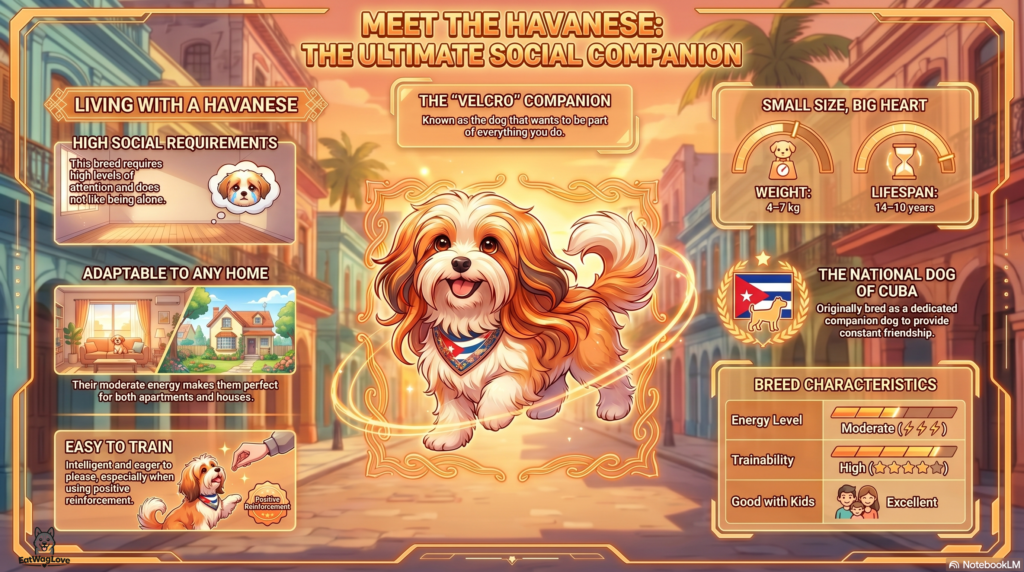







Cheerful, affectionate, and full of charm — a small companion that loves being the centre of attention.
🧠 QUICK SNAPSHOT
- Temperament: Friendly, affectionate, playful
- Energy Level: Low to moderate
- Size: Small
- Good With Families: Yes
- Trainability: High
- Grooming: Moderate to high
- Best For: Families, apartments, companionship
📚 OVERVIEW
The Havanese is a small, lively breed known for its silky coat and outgoing personality. Originally from Cuba, they are highly social dogs that thrive on companionship and love being part of everyday life.
They are playful, adaptable, and well suited to both apartments and houses.
✅ PROS & CONS
Pros
- Very friendly and affectionate
- Great with families and children
- Adaptable to different living environments
- Highly social and engaging
Cons
- Needs regular grooming
- Can develop separation anxiety
- Requires attention and companionship
- Coat maintenance can be time-consuming
Is a Havanese a Good Family Dog?
Yes. The Havanese is generally an affectionate, playful and highly people-oriented family dog.
They were developed primarily as companions and usually want to participate in family life rather than observe it from another room.
Their small size suits many households, although young children should be taught to handle them gently.
How Much Exercise Does a Havanese Need?
Most Havanese need around 30–60 minutes of daily activity, divided between walks, play and training.
They’re lively rather than intensely athletic.
Mental stimulation is important because Havanese are intelligent dogs that enjoy learning tricks and interacting with people.
Is a Havanese Easy to Train?
Usually, yes.
Havanese are intelligent, responsive and eager to interact with their owners.
Positive reinforcement works particularly well.
House training can sometimes take patience, as is common with several small companion breeds.
Is a Havanese Easy to Toilet Train?
Some Havanese take longer to house-train than owners expect.
Their small bladder, dislike of unpleasant weather and subtle early signals can make accidents more likely.
A consistent schedule, frequent opportunities outside and reward-based training usually produce the best results.
Does a Havanese Shed?
Havanese are generally low-shedding dogs, although they still lose some hair.
Loose hairs often become trapped within the long coat rather than falling freely around the house.
This reduces visible shedding but increases the need for brushing.
Is a Havanese Hypoallergenic?
Havanese are often described as hypoallergenic because they shed relatively little, but no dog is completely allergen-free.
Dog allergens are also present in saliva and skin secretions.
Some allergy sufferers tolerate Havanese well, while others still react.
How Often Should You Groom a Havanese?
A long-coated Havanese may require brushing several times a week or even daily.
The coat tangles easily, particularly behind the ears, around the legs and anywhere a harness creates friction.
Many companion owners keep the coat in a shorter puppy clip to simplify maintenance.
Can You Cut a Havanese’s Hair Short?
Yes.
Havanese kept as companions are frequently given a shorter puppy-style clip.
This doesn’t eliminate grooming, but it can make brushing and bathing considerably easier.
Dogs shown in conformation are generally maintained with their characteristic long natural coat.
Can You Shave a Havanese?
The coat can be clipped short when necessary, particularly if severe matting develops.
However, routine extremely close shaving isn’t usually necessary.
Regular brushing and scheduled grooming can maintain a manageable coat without allowing painful mats to develop.
Does a Havanese Have Hair or Fur?
People often describe Havanese as having hair rather than fur because their coat grows long and sheds relatively little.
Biologically, however, hair and fur are both made from keratin and aren’t fundamentally different substances.
The useful distinction is that the Havanese coat has a long growth pattern and relatively low visible shedding.
What Health Problems Are Common in Havanese?
Potential health concerns include patellar luxation, hip dysplasia, eye disorders, heart problems, deafness and Legg-Calvé-Perthes disease.
Responsible breeders should perform appropriate health screening rather than relying on the breed’s generally healthy reputation.
Dental care is also particularly important in small dogs.
Are Havanese Prone to Luxating Patellas?
Yes. Patellar luxation is a recognised problem.
The kneecap moves out of its normal position, potentially causing skipping, intermittent lameness or eventually arthritis.
Severity varies considerably.
Breeding dogs should be evaluated for patellar health.
Are Havanese Prone to Eye Problems?
They can be.
Several inherited or developmental eye conditions can occur within the breed.
Regular veterinary examinations and appropriate ophthalmic screening of breeding dogs help reduce inherited disease.
Are Havanese Prone to Dental Problems?
Like many small dogs, Havanese can develop periodontal disease and dental crowding.
Daily tooth brushing is one of the most useful preventive measures owners can provide.
Small dogs shouldn’t be assumed to need less dental care simply because their teeth are smaller.
How Long Does a Havanese Live?
Havanese commonly live around 14–16 years, with some reaching their late teens.
Their relatively long lifespan is one of the attractions of the breed.
Maintaining healthy weight, dental health and appropriate preventive veterinary care can help maximise longevity.
How Big Does a Havanese Get?
Havanese are small dogs, usually standing around 21–29 cm at the shoulder.
Adults commonly weigh approximately 4–7 kg, although individual dogs vary.
They’re sturdy little dogs rather than extremely delicate toy breeds.
Is There a Miniature Havanese?
No. There is no officially recognised Miniature Havanese variety.
The standard Havanese is already a small companion breed.
Dogs marketed specifically as “Mini Havanese” are usually unusually small individuals or dogs bred deliberately below the normal size range.
Is There a Teacup Havanese?
“Teacup Havanese” isn’t an officially recognised breed variety.
Extreme miniaturisation can increase the risk of fragility, dental crowding, hypoglycaemia and other health concerns.
A responsible breeding programme should prioritise health and sound structure rather than exceptionally tiny size.
Can a Havanese Live in an Apartment?
Yes. Havanese are excellent apartment dogs.
Their small size and moderate exercise requirements make them adaptable to compact homes.
Regular walks, play, mental stimulation and companionship remain important.
Potential barking should also be considered in shared buildings.
Can a Havanese Be Left Alone?
Havanese generally don’t enjoy being alone for extended periods.
They were developed specifically as human companions and can form very strong attachments.
Gradual independence training from puppyhood is important to reduce the risk of separation-related problems.
Are Havanese Prone to Separation Anxiety?
They can be.
Their strong attachment to people means some Havanese become distressed when left alone.
Owners should deliberately teach puppies that short periods of separation are normal and safe, rather than allowing constant companionship from the first day.
Are Havanese Velcro Dogs?
Very often.
The Havanese is famous for following its people from room to room.
This behaviour reflects centuries of breeding primarily for companionship.
For many Havanese, being excluded from household activity is considerably more troubling than missing a long walk.
Are Havanese Cuddly?
Usually.
Many Havanese enjoy sitting beside or on their owners and receiving substantial physical affection.
They’re classic companion dogs that often prefer close human contact over independence.
Are Havanese Good With Children?
Generally, yes.
Havanese are often playful, gentle and affectionate with respectful children.
Because they’re small dogs, young children should be supervised to prevent accidental falls, squeezing or rough handling.
Are Havanese Good With Other Dogs?
Usually.
The breed tends to be sociable and can live happily with other dogs when appropriately introduced.
Early socialisation helps prevent fearfulness around larger dogs.
Are Havanese Good With Cats?
Often, yes.
Havanese generally have relatively manageable prey drive compared with many hunting breeds.
Dogs raised around cats frequently coexist very successfully with them.
Individual personalities still matter.
Do Havanese Bark a Lot?
They can be moderately vocal.
Many Havanese bark to announce visitors, unfamiliar sounds or excitement.
They’re often good little watchdogs despite having very little ability to physically guard anything.
Early training can help prevent alert barking from becoming excessive.
Are Havanese Good Watchdogs?
Yes, as alarm dogs.
They’re often quick to notice visitors and unusual activity.
Once the visitor is welcomed inside, however, many Havanese rapidly transition from security department to social committee.
Are Havanese Good Guard Dogs?
No.
Their small size and sociable companion temperament make them unsuitable for serious guarding.
They may enthusiastically announce an intruder, but physically confronting one is another matter entirely.
Are Havanese High-Energy Dogs?
They’re lively but generally not hyperactive.
Havanese enjoy play, walks and training but usually don’t require the intense daily exercise of working or sporting breeds.
They’re particularly good at adapting their activity to family life.
Are Havanese Playful?
Very.
The breed is known for a cheerful, mischievous and entertaining personality.
Many retain puppy-like playfulness well into adulthood.
This entertaining character contributed to their historical popularity as performing dogs.
Are Havanese Good at Tricks?
Excellent.
Havanese are intelligent, food-motivated and naturally interested in interacting with people.
They can learn spins, bows, retrieves, jumping tricks and more complicated routines surprisingly quickly.
Trick training is an excellent form of mental stimulation for the breed.
Were Havanese Circus Dogs?
Yes. Havanese and related small companion dogs became popular performing and circus dogs in Europe because of their intelligence, trainability and entertaining personalities.
They could learn complex routines while remaining small enough to transport easily.
The modern Havanese still often seems convinced that an audience improves almost any activity.
Why Does My Havanese Stand on Its Hind Legs?
Many Havanese naturally stand or bounce on their hind legs when seeking attention or investigating something.
Their sturdy little bodies and playful nature can make this behaviour particularly noticeable.
It also contributed to their reputation as talented trick and performing dogs.
Why Does My Havanese Follow Me Everywhere?
Because human companionship is deeply embedded in the breed’s history.
Unlike dogs developed primarily for independent hunting or livestock guarding, Havanese spent generations being selected to live closely with people.
Following an owner from room to room is therefore extremely typical.
Why Does My Havanese Sit on My Feet?
Sitting on or beside someone’s feet provides physical contact and security while keeping the dog close to its person.
It’s common among strongly people-oriented companion breeds.
It also ensures the owner can’t quietly leave the room without being detected.
Are Havanese Good for Older People?
They can be excellent companions for older adults.
Their small size, moderate exercise requirements, trainability and affectionate temperament are useful qualities.
Potential owners should still consider grooming costs and the breed’s need for substantial companionship.
Are Havanese Good First Dogs?
Yes. Havanese are often excellent first dogs.
They’re generally friendly, intelligent, adaptable and manageable in size.
The biggest surprises for new owners are usually coat maintenance, toilet training and how strongly the dog may dislike being left alone.
Can Havanese Swim?
Many can swim, but swimming ability and enthusiasm vary.
Their long coat can become heavy when wet.
Dogs should always be supervised around pools and deep water, particularly if they haven’t demonstrated strong swimming ability.
Are Havanese Good Hiking Dogs?
Despite their size, healthy adult Havanese can enjoy moderate hikes and longer walks.
They’re sturdier than their glamorous coat suggests.
Distance should still be appropriate for the individual dog, weather and terrain.
Can Havanese Handle Hot Weather?
Reasonably well with sensible management, although any dog can suffer heat stress.
Their Cuban history doesn’t make them immune to high temperatures.
Shade, water and avoiding strenuous exercise during extreme heat remain important.
Can Havanese Handle Cold Weather?
They can tolerate cool conditions but aren’t specialised cold-weather dogs.
Their coat provides some protection, but their small body size means they can lose heat relatively quickly.
A coat may be useful during genuinely cold conditions, particularly for dogs kept in short clips.
What Does a Havanese Look Like?
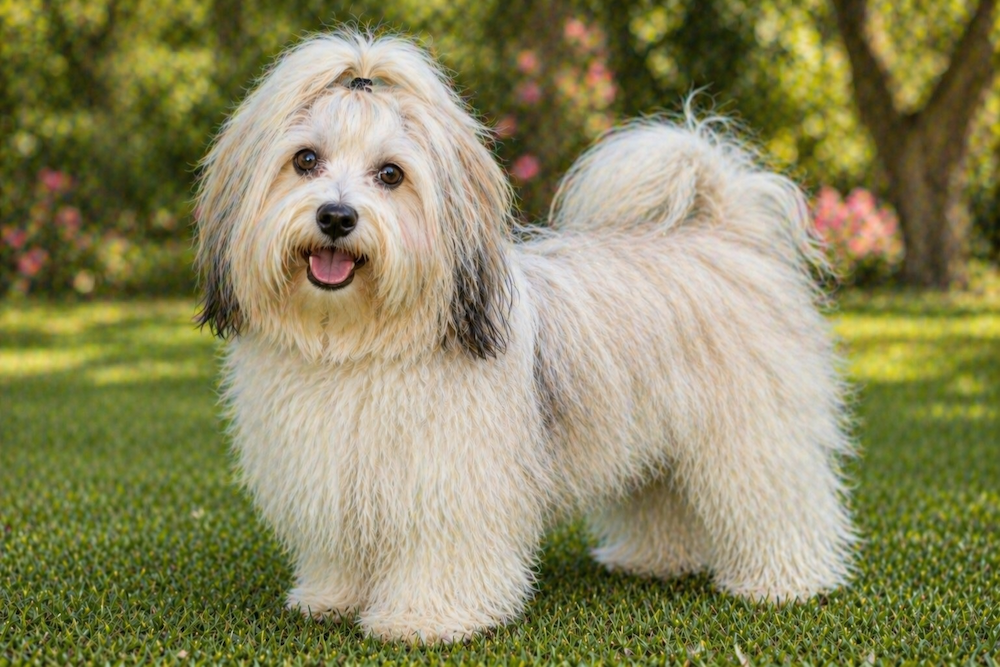
The Havanese is a small but sturdy dog with a long, soft coat, expressive dark eyes, drop ears and a plumed tail carried over the back.
Its movement should appear lively and springy.
The overall impression is cheerful and elegant rather than fragile.
Why Does a Havanese Have Such a Long Coat?
The long coat became a defining feature of the breed’s development as a companion dog in Cuba.
Its texture is typically soft and relatively lightweight rather than the dense heavy coat of a northern breed.
The coat can provide some protection from sun while allowing air circulation.
Does a Havanese Have a Double Coat?
Yes. The breed is generally described as having a soft double coat, although the undercoat may be relatively light compared with heavy northern breeds.
Both layers can become long.
This contributes to the need for regular brushing.
Can a Havanese Have a Corded Coat?
Yes.
A Havanese coat can naturally be encouraged to form cords, somewhat like narrow ropes or dreadlocks.
Corded coats require specialised maintenance and aren’t simply a way of avoiding grooming.
They’re permitted under some breed standards.
What Colours Can Havanese Be?
Havanese occur in an unusually broad range of colours, including white, cream, gold, fawn, red, chocolate, black, silver and various combinations and patterns.
Unlike some breeds, Havanese aren’t defined by one particular coat colour.
Are All Havanese White?
No.
Although white Havanese are common and historically prominent, the breed comes in many colours and patterns.
Black, chocolate, gold, cream, red and parti-coloured dogs are all seen.
Can Havanese Be Black?
Yes. Solid black Havanese occur naturally within the breed.
Black may also appear alongside white or other markings.
Coat colour doesn’t determine personality.
Can Havanese Be Chocolate?
Yes.
Chocolate Havanese have brown pigmentation, generally including brown rather than black nose pigment.
Chocolate is one of several naturally occurring colours within the breed.
Do Havanese Change Colour as They Grow?
They can.
Some Havanese coats lighten or change shade substantially with age.
A dark puppy may become much lighter as the adult coat develops.
This can make predicting final colour surprisingly difficult.
What Is a Sable Havanese?
Sable hairs have darker tips over a lighter base colour.
Puppies can initially appear strongly sable and then lighten dramatically as the coat grows and changes.
Adults may retain only traces of the darker puppy colouring.
Why Does a Havanese Have a Tail Over Its Back?
The plumed tail carried over the back is a characteristic part of the breed’s silhouette.
It’s primarily a breed characteristic created through generations of selection rather than a specialised working adaptation.
When relaxed, the tail position may vary.
What Is the Difference Between a Havanese and a Maltese?
Both are small, long-coated companion dogs, but the Maltese is generally smaller and traditionally pure white.
Havanese are somewhat sturdier and occur in many colours.
Their breed histories also developed in different regions.
What Is the Difference Between a Havanese and a Bichon Frise?
The Bichon Frise typically has a curly white coat, while the Havanese has a longer, softer coat that may be wavy and comes in numerous colours.
Both belong to the broader historical family of small Mediterranean companion dogs.
Is the Havanese Related to the Bichon Frise?
Yes. The Havanese belongs to the broader Bichon family of small companion dogs.
These dogs share historical connections around the Mediterranean and European trading routes.
Over time, regional populations developed into distinct breeds.
Is the Havanese Related to the Maltese?
They share broader ancestry among small Mediterranean companion dogs, although they’re separate established breeds.
Dogs of this general type travelled extensively with merchants, sailors and wealthy families, creating related populations in different regions.
Is a Havanese the Same as a Havana Silk Dog?
The terms have historical connections, but modern usage can be confusing.
“Havana Silk Dog” has been used in discussions of older Havanese-type dogs and also by modern breeding groups pursuing a particular interpretation of that type.
It shouldn’t automatically be assumed to mean any ordinary registered Havanese.
Is a Havanese a Cuban Dog?
Yes. The Havanese is strongly associated with Cuba and is recognised as the country’s national dog.
Its ancestors probably arrived through European and Mediterranean trade connections before developing into a distinct Cuban companion breed.
Is the Havanese the National Dog of Cuba?
Yes. The Havanese is widely recognised as Cuba’s national dog.
It’s the only dog breed generally identified as native to Cuba.
Its history is closely connected with Havana and Cuban society.
Where Does the Name Havanese Come From?
The name refers to Havana, the capital of Cuba.
The breed became strongly associated with the city and Cuban upper-class households.
“Havanese” essentially means the dog associated with Havana.
Did Havanese Originate in Havana?
The recognisable breed developed in Cuba, with Havana becoming particularly associated with it.
Its more distant ancestors probably arrived from Europe through maritime trade.
The modern Havanese therefore combines European companion-dog ancestry with distinctive Cuban development.
What Dogs Were the Ancestors of the Havanese?
The Havanese belongs to the Bichon family, whose historical relatives include small companion dogs around the Mediterranean and Europe.
Exact early pedigrees don’t exist.
Dogs related to Bichon-type populations were likely brought to Cuba by European settlers and traders, where they developed into a distinctive local type.
What Was the Blanquito de la Habana?
The Blanquito de la Habana, or “Little White Dog of Havana,” is commonly described as an important predecessor of the modern Havanese.
It was a small white companion dog associated with wealthy Cuban households.
Later crossing with other Bichon-type dogs is generally believed to have contributed to the modern Havanese.
Is the Blanquito de la Habana Extinct?
Yes, as a separate historical type.
Its ancestry survives through the modern Havanese.
Because systematic pedigree records from the earliest period are limited, precise reconstruction of the Blanquito’s development isn’t possible.
Were Poodles Used to Create the Havanese?
Poodle influence is sometimes suggested in historical accounts, particularly through European companion dogs entering Cuba.
However, early breed development isn’t documented well enough to produce a precise modern-style genetic recipe.
The strongest historical description places the Havanese within the broader Bichon family.
Were Havanese Dogs Owned by Cuban Aristocrats?
Yes. Havanese became fashionable companion dogs among wealthy Cuban families, particularly during the 18th and 19th centuries.
They were primarily household companions rather than working farm or hunting dogs.
Their small size and glamorous coats made them particularly suited to affluent urban households.
Were Havanese Given as Gifts Rather Than Sold?
Breed histories often describe Havanese as highly prized companion dogs that were sometimes given as special gifts to visitors and friends.
Such stories fit their status among wealthy households, although precise historical details are difficult to verify for every claim.
Their relative exclusivity contributed to the breed’s prestige.
Were Havanese Popular With European Visitors to Cuba?
Yes. Cuba attracted wealthy European travellers and residents, and its distinctive little companion dogs attracted attention.
Some Havanese-type dogs eventually travelled back to Europe, where their trainability helped them become popular performers.
Did Charles Dickens Own a Havanese?
Charles Dickens is frequently reported in breed histories as having owned a small dog named Tim, sometimes identified as Havanese or Havanese-type.
Historical breed identification can be difficult because modern breed standards weren’t always established at the time.
It’s an interesting association, but precise modern breed labels should be applied cautiously.
Did Queen Victoria Own Havanese Dogs?
Queen Victoria is frequently mentioned in popular Havanese histories as having owned dogs of the breed or closely related type.
Small companion dogs were certainly popular in European royal circles.
However, some historical breed claims predate modern registration and should be treated with appropriate caution.
Were Havanese Used in European Circuses?
Yes. Their intelligence, agility and eagerness to interact with people made Havanese-type dogs successful performers.
They could learn tricks rapidly and were small enough to travel easily.
This performing tradition helps explain why modern Havanese frequently excel at trick training.
Did the Cuban Revolution Affect the Havanese?
Yes, dramatically.
Following the 1959 Cuban Revolution, many wealthy Cuban families fled the country.
Some took their dogs with them, while the established companion-dog population in Cuba declined substantially.
This political upheaval played an important role in the modern breed’s history.
Did Havanese Nearly Become Extinct?
Yes. By the latter part of the 20th century, the breed had become extremely rare outside Cuba.
Its international revival depended on a very small number of dogs taken from Cuba by emigrating families.
This created a significant genetic bottleneck in the modern population.
How Many Dogs Helped Rebuild the Havanese in the United States?
Popular breed histories commonly describe the American revival as beginning from roughly a dozen dogs belonging to Cuban exile families.
The frequently quoted number is 11 foundation dogs, although later imports also contributed.
The tiny founding population shows how close the breed came to disappearing internationally.
Who Were the Goodales in Havanese History?
American breeder Dorothy Goodale and her husband Bert played an important role in rebuilding the Havanese population in the United States during the 1970s.
They sought surviving dogs from Cuban families and developed a breeding programme.
Their work was crucial to the breed’s modern international recovery.
How Did Dorothy Goodale Find Havanese Dogs?
After becoming interested in the nearly vanished breed, Goodale reportedly advertised in search of Havanese owned by Cuban immigrant families.
This led her to surviving dogs descended from animals brought out of Cuba.
From these limited foundations, an organised breeding population was developed.
Why Was the Havanese Gene Pool So Small?
Political upheaval in Cuba dramatically reduced access to the original population, while only a small number of dogs had been taken abroad.
Modern breeders therefore had to rebuild from a narrow foundation population.
This makes responsible genetic management particularly important.
When Was the Havanese Recognised by the American Kennel Club?
The Havanese received full American Kennel Club recognition in 1996.
Its rise after recognition was remarkable.
A breed that had been close to disappearing only decades earlier became a popular companion dog internationally.
Is the Havanese Still Found in Cuba?
Yes, although the modern breed’s international population was heavily rebuilt outside Cuba.
The Havanese remains symbolically important as Cuba’s national dog.
Its survival is a fascinating example of a breed being preserved across both its homeland and an emigrant community.
Why Did the Havanese Become So Popular?
The breed combines many qualities modern companion-dog owners want: small size, low shedding, intelligence, sociability and an affectionate temperament.
They’re also adaptable enough for apartment living while remaining playful and trainable.
Their cheerful appearance certainly hasn’t hurt.
Is the Havanese a Natural Breed?
Not in the sense of an untouched ancient landrace.
The Havanese developed over generations from small companion dogs brought to Cuba and selectively bred there.
Its identity became increasingly formalised through modern pedigree breeding.
Is the Havanese a Good Companion Dog?
Companionship is arguably what the Havanese does best.
Unlike many breeds whose modern pet role differs completely from their original occupation, the Havanese was historically bred primarily to live closely with people.
The modern dog’s desire to participate in everything its owner does is therefore entirely consistent with its original purpose.
Where Does the Havanese Come From?
The Havanese comes from Cuba, where small Bichon-type companion dogs brought through European trade and settlement developed into a distinctive local population. An important predecessor was the Blanquito de la Habana, the Little White Dog of Havana.
Havanese became fashionable among wealthy Cuban families and later gained a reputation as talented performing dogs. Their history changed dramatically after the 1959 Cuban Revolution, when families fleeing Cuba took a small number of dogs abroad. By the 1970s, the international population was dangerously small, and breeders including Dorothy and Bert Goodale helped rebuild it from dogs preserved by Cuban exile families.
Today the Havanese is recognised as Cuba’s national dog and has become popular around the world.
It’s also one of the rare breeds whose historical job description hasn’t changed very much. For centuries the Havanese was expected to stay close to people, entertain them and be an affectionate companion.
The only major technological improvement has been the invention of the sofa.