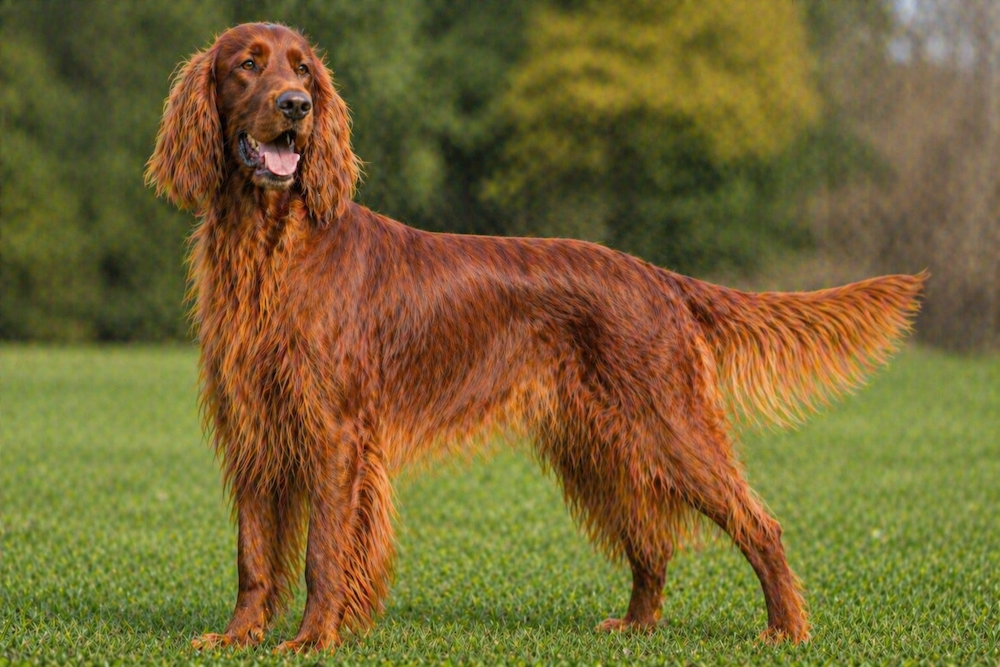







Elegant, energetic, and full of life — a striking companion that thrives on activity and attention.
🧠 QUICK SNAPSHOT
- Temperament: Friendly, energetic, affectionate
- Energy Level: Very high
- Size: Large
- Good With Families: Yes
- Trainability: Moderate
- Grooming: Moderate
- Best For: Active families and outdoor lifestyles
📚 OVERVIEW
The Irish Setter is known for its stunning red coat and lively personality. Originally bred for hunting, they are full of energy and love to run, explore, and be part of an active household.
They are friendly, social dogs that enjoy companionship and thrive when included in daily activities.
✅ PROS & CONS
Pros
- Beautiful, eye-catching coat
- Friendly and affectionate
- Great with families and children
- Loves outdoor activity
Cons
- Very high exercise requirements
- Can be easily distracted
- Needs regular grooming
- Requires time and attention
Is an Irish Setter a Good Family Dog?
Yes. Irish Setters are generally affectionate, outgoing and playful family dogs.
They’re famous for their friendly temperament and often form close relationships with everyone in the household.
However, they’re large, energetic dogs that can remain exuberant well into adulthood, so families need to provide substantial exercise and training.
How Much Exercise Does an Irish Setter Need?
Most adult Irish Setters need around 90 minutes to two hours of daily exercise, with working individuals potentially requiring more.
Long walks, running, hiking, scent work and retrieving games are excellent outlets.
They’re genuine sporting dogs rather than decorative red-coated companions.
Is an Irish Setter Easy to Train?
Irish Setters are intelligent and capable of advanced training, but they can be enthusiastic, independent and easily distracted.
Positive reinforcement works particularly well.
Harsh or repetitive training can be counterproductive with their sensitive temperament.
Are Irish Setters Intelligent?
Yes.
Irish Setters were developed to locate game birds and work cooperatively with hunters, requiring intelligence, scenting ability and stamina.
Their playful personality can sometimes make them appear less serious than highly focused working breeds, but that shouldn’t be mistaken for a lack of intelligence.
Are Irish Setters Stubborn?
They can be independent and distractible rather than simply stubborn.
A Setter may understand exactly what its owner wants but decide that an interesting scent or bird deserves immediate investigation.
Consistent, rewarding training helps channel this natural curiosity.
Does an Irish Setter Shed?
Yes.
Irish Setters are moderate shedders, with some seasonal increase.
Their long feathering also makes shed hair more noticeable around the home.
Regular brushing helps remove loose coat and prevent tangles.
Is an Irish Setter Hypoallergenic?
No.
Irish Setters shed and produce normal canine allergens through their skin and saliva.
They’re not considered a suitable choice specifically for someone seeking a hypoallergenic dog.
How Often Should You Groom an Irish Setter?
Most should be brushed several times each week.
Their feathering is particularly prone to tangles around the ears, chest, belly, legs and tail.
Regular nail trimming, dental care and ear checks should also form part of the grooming routine.
Do Irish Setters Need Professional Grooming?
Not necessarily, but many owners find professional grooming useful.
The breed’s feathering can be trimmed and tidied to maintain a neat outline.
Unlike a Poodle, an Irish Setter doesn’t require routine full-body clipping every few weeks.
Should You Shave an Irish Setter?
Generally, no.
Irish Setters have a protective coat that shouldn’t routinely be shaved simply to reduce shedding or cope with summer.
Regular brushing and sensible heat management are preferable unless clipping is medically necessary.
What Health Problems Are Common in Irish Setters?
Important concerns include hip dysplasia, progressive retinal atrophy, epilepsy, hypothyroidism, gastric dilatation-volvulus and certain inherited blood or immune disorders.
Responsible breeders should screen for relevant inherited conditions.
Their deep chest also makes awareness of GDV particularly important.
Are Irish Setters Prone to Bloat?
Yes. Their deep chest puts them at risk of gastric dilatation-volvulus (GDV).
The stomach expands and may twist, cutting off blood supply.
Repeated unsuccessful attempts to vomit, abdominal swelling, restlessness, weakness or collapse require immediate emergency veterinary treatment.
Are Irish Setters Prone to Hip Dysplasia?
They can be.
Hip dysplasia is an important inherited orthopaedic concern within the breed.
Responsible breeding programmes use formal hip assessment, while maintaining a lean body condition helps reduce unnecessary stress on the joints.
Are Irish Setters Prone to Eye Problems?
Yes. Progressive retinal atrophy (PRA) has historically been an important inherited concern in Irish Setters.
Modern DNA testing allows breeders to identify carriers of certain forms.
Regular eye examinations and appropriate genetic screening have greatly improved responsible breeding decisions.
Are Irish Setters Prone to Epilepsy?
Epilepsy occurs within the breed.
Seizures can have many causes, so any suspected seizure requires veterinary investigation.
Responsible breeders should consider family health history when making breeding decisions.
Are Irish Setters Prone to Hypothyroidism?
They can be.
Hypothyroidism occurs when insufficient thyroid hormone is produced.
Possible signs include weight gain, lethargy, coat changes and skin problems, although these symptoms can have many other causes.
Diagnosis requires veterinary testing.
How Long Does an Irish Setter Live?
Irish Setters commonly live around 12–15 years.
For a relatively large dog, they can have good longevity.
Genetics, healthy body weight, exercise and preventive veterinary care all influence lifespan.
How Big Does an Irish Setter Get?
Irish Setters are medium-to-large, athletic dogs.
Males commonly stand around 67 cm at the shoulder, with females around 62 cm, although breed standards vary somewhat internationally.
Adults often weigh approximately 25–32 kg.
Is an Irish Setter a Large Dog?
Yes, although they’re built more for athleticism and endurance than bulk.
Their long legs, deep chest and flowing coat can make them appear larger than their actual weight suggests.
They’re considerably more lightly built than Mastiffs or many large working breeds.
Can an Irish Setter Live in an Apartment?
It’s possible, but challenging.
Their size isn’t the main problem — their exercise requirements and youthful energy are.
An apartment Irish Setter would need an owner committed to substantial outdoor activity every day.
Can an Irish Setter Be Left Alone?
Adult Irish Setters can learn to tolerate reasonable periods alone, but they’re generally highly social dogs.
Long periods of daily isolation can lead to boredom and destructive behaviour.
Exercise and gradual independence training are important.
Are Irish Setters Prone to Separation Anxiety?
Some are.
They often develop strong attachments to their families and enjoy being involved in daily activities.
Teaching puppies to relax independently can help prevent excessive dependence.
Are Irish Setters Velcro Dogs?
Many are very people-oriented and like staying close to their owners.
Others are somewhat more independent outdoors when scents and birds capture their attention.
They’re affectionate dogs without necessarily being as constantly attached as some dedicated companion breeds.
Are Irish Setters Cuddly?
Many are extremely affectionate.
They’re often physically demonstrative and enjoy being close to family members.
Their considerable size doesn’t always prevent them from attempting activities more appropriate for a small lapdog.
Are Irish Setters Good With Children?
Generally, yes.
Their playful, affectionate and tolerant temperament can make them excellent family dogs.
Young Setters can be extremely exuberant, however, and may accidentally knock over toddlers.
Training calm greetings is particularly useful.
Are Irish Setters Good With Other Dogs?
Usually.
They’re generally sociable dogs and often enjoy canine companionship.
Early socialisation remains important, particularly during adolescence when their enthusiasm can overwhelm quieter dogs.
Are Irish Setters Good With Cats?
Many can live successfully with cats, especially when raised together.
However, Irish Setters have strong sporting-dog instincts and may chase animals that run.
Individual prey drive should always be considered.
Do Irish Setters Have a Strong Prey Drive?
They can have significant interest in birds and wildlife.
Irish Setters were specifically developed to search for game birds, so movement and scent can be extremely stimulating.
Their hunting behaviour is generally centred more on locating and indicating game than independently killing it.
Are Irish Setters Good Off Leash?
They can be, with excellent recall training.
Their natural tendency to range across terrain searching for scent and birds can make off-leash reliability challenging.
Training should begin in controlled environments and progress gradually.
Do Irish Setters Bark a Lot?
They’re generally moderate barkers.
Some bark to alert, from excitement or when bored.
Adequate exercise and mental stimulation can prevent excessive vocalisation caused by frustration.
Are Irish Setters Good Guard Dogs?
Generally, no.
Their size may be a deterrent, and many will alert to visitors, but Irish Setters are typically friendly sporting dogs rather than serious guardians.
A stranger may receive considerably more enthusiasm than intimidation.
Are Irish Setters Protective?
Some may naturally alert or position themselves around family members, but strong protection behaviour isn’t a defining breed characteristic.
They weren’t developed as personal-protection dogs.
Their traditional role was hunting and companionship.
Are Irish Setters Friendly With Strangers?
Usually, yes.
The breed is known for an outgoing, enthusiastic personality.
Appropriately socialised Irish Setters commonly greet unfamiliar people warmly.
Excessive shyness or unwarranted aggression isn’t typical of the ideal temperament.
Are Irish Setters High-Energy Dogs?
Yes.
Irish Setters were bred to cover substantial areas of countryside searching for birds.
Young dogs can have enormous stamina and enthusiasm.
They’re best suited to households that genuinely enjoy active outdoor lifestyles.
When Do Irish Setters Calm Down?
Irish Setters are famous for maturing slowly.
Many become noticeably calmer between two and three years of age, but some retain youthful exuberance considerably longer.
Their playful personality often continues throughout life.
Are Irish Setter Puppies Hyperactive?
They can certainly appear that way.
Puppies and adolescents combine sporting-dog energy with curiosity, enthusiasm and relatively slow emotional maturity.
Appropriate exercise, training, enrichment and adequate sleep are all important.
Are Irish Setters Good Running Dogs?
Yes. Healthy adult Irish Setters can make excellent running companions.
Their long legs and sporting heritage provide substantial endurance.
Structured distance running should wait until the dog’s skeleton has matured.
Are Irish Setters Good Hiking Dogs?
Excellent.
They were developed to travel across large areas of varied countryside, making hiking a natural activity.
Owners should maintain good recall or leash control around wildlife.
Do Irish Setters Like Water?
Many do.
They’re sporting dogs and can be enthusiastic swimmers, although individual preference varies.
Water activities can provide excellent exercise during suitable conditions.
Are Irish Setters Good Swimmers?
Many are capable swimmers.
Their athletic build and sporting background make swimming relatively natural.
They’re not as specifically specialised for water retrieving as Labradors, but plenty of Irish Setters enthusiastically enjoy it.
Do Irish Setters Like Playing Fetch?
Many do.
Retrieving can be enjoyable, although their historical specialty was finding and setting game rather than primarily retrieving it.
Some individuals have stronger natural retrieving instincts than others.
Are Irish Setters Good Hunting Dogs?
Yes. Hunting ability is the foundation of the breed.
Irish Setters were developed as bird dogs capable of searching substantial areas, locating game by scent and indicating its position to the hunter.
Working lines continue to participate in field sports today.
What Does an Irish Setter Hunt?
Irish Setters traditionally worked on upland game birds, including grouse, partridge and pheasant.
Their role was to locate birds rather than simply chase them.
The dog’s characteristic setting behaviour allowed hunters to approach the game.
Why Is It Called a Setter?
The name comes from the dog’s traditional behaviour after locating game.
Early setting dogs would crouch or “set” close to birds, allowing hunters to approach.
Before firearms became dominant, this behaviour helped hunters capture birds using nets.
What Does an Irish Setter Do When It Finds a Bird?
Modern Irish Setters generally point or freeze, indicating the location of game through body position.
Earlier setting dogs were more likely to crouch low.
Selective breeding gradually adapted their behaviour to changing hunting methods.
Did Irish Setters Work Before Guns Were Used for Bird Hunting?
Yes.
Setter-type dogs existed before modern sporting firearms became widespread.
They worked with hunters using nets, locating birds and crouching so the game and sometimes the dog could be covered.
The later development of gun hunting changed the preferred working style.
Do Irish Setters Have a Good Sense of Smell?
Yes.
Their original job depended on locating hidden game birds through scent carried through the air and vegetation.
They combine excellent olfactory ability with the stamina required to search large areas.
Do Irish Setters Work Close to the Hunter?
Working style varies, but Irish Setters can range widely while searching open country.
Their speed and athleticism allow them to cover substantial ground efficiently.
Training ensures that this ranging remains useful to the hunter rather than simply becoming an independent expedition.
Are Irish Setters Fast?
Yes. They’re fast, agile sporting dogs.
Their long legs, deep chest and lean body allow them to move quickly across open terrain.
They’re built for a combination of speed and endurance, rather than Greyhound-style maximum sprinting.
What Does an Irish Setter Look Like?
The Irish Setter is an elegant, athletic dog with a deep chest, long head, drop ears and flowing feathered coat.
Its most famous feature is the rich red colour.
The overall outline combines refinement with obvious sporting ability.
Why Are Irish Setters Red?
Today’s solid-red coat is the result of generations of selective breeding.
Earlier Irish setting dogs frequently had substantial white markings and were often red-and-white.
During the 19th century, solid rich-red dogs became increasingly fashionable and were selectively developed into the modern Irish Setter.
Were Irish Setters Originally Red and White?
Many early Irish setters were red and white rather than solid red.
Both colour types existed historically.
Selective breeding eventually separated them into the modern Irish Setter and Irish Red and White Setter.
Is the Irish Red and White Setter the Same Breed?
No. The Irish Red and White Setter is now recognised as a separate breed.
It preserves a colour pattern that predates the dominance of the solid-red Irish Setter.
The two breeds share substantial historical ancestry.
Which Came First: the Irish Setter or Irish Red and White Setter?
Red-and-white setting dogs existed in Ireland before the modern solid-red Irish Setter became standardised.
Solid-red dogs became increasingly fashionable during the 19th century.
So the red-and-white type represents an older visible form of the Irish setting-dog tradition.
Can an Irish Setter Have White Markings?
Small amounts of white may occur, particularly on the chest, throat, toes or head, depending on the breed standard.
Large areas of white are characteristic of the separate Irish Red and White Setter.
Can Irish Setters Be Black?
No. Black isn’t a normal recognised colour of a purebred Irish Setter.
A dog described as a “black Irish Setter” would generally require a different explanation, including possible crossbreeding or incorrect identification.
Can Irish Setters Be Golden?
The recognised coat is generally described as rich chestnut or mahogany red.
Individual shade varies.
Very pale golden colouring isn’t characteristic of the breed standard.
Why Does an Irish Setter Have Feathering?
Longer hair on the ears, chest, belly, legs and tail creates the breed’s characteristic feathering.
Selective breeding enhanced this elegant appearance.
The coat still retains a practical sporting-dog character rather than becoming as extreme as some purely ornamental long coats.
Do Irish Setters Have a Double Coat?
They have a relatively fine coat with protective characteristics, although it’s not comparable with the massive undercoat of a Husky.
Coat density can vary.
Their feathering requires more grooming than the body coat.
What Is the Difference Between an Irish Setter and a Golden Retriever?
Both are friendly sporting dogs, but their original jobs differ.
The Irish Setter primarily located and indicated game, while the Golden Retriever specialised in retrieving shot game.
Irish Setters are generally leaner, more independent and often more intensely ranging outdoors.
What Is the Difference Between an Irish Setter and an English Setter?
Irish Setters are famous for their solid red coats, while English Setters usually have white coats with distinctive Belton ticking.
Both developed from older setting-dog traditions.
English Setters are generally somewhat more moderate in build and appearance.
What Is the Difference Between an Irish Setter and a Gordon Setter?
Gordon Setters are generally heavier, black-and-tan and somewhat more reserved.
Irish Setters are red, lighter in build and often particularly outgoing.
Both share the fundamental job of locating game birds.
Are All Setter Breeds Related?
The major Setter breeds share historical ancestry among European and British setting dogs used for bird hunting.
Over time, regional breeding programmes produced the Irish Setter, English Setter, Gordon Setter and Irish Red and White Setter.
They’re now distinct breeds.
Where Does the Irish Setter Come From?
The Irish Setter developed in Ireland from older setting dogs used to locate game birds.
Its ancestry likely involved various spaniel, setter and pointer-type dogs rather than one simple documented cross.
The modern breed became increasingly standardised during the 18th and 19th centuries.
How Old Is the Irish Setter Breed?
Setting dogs have existed for centuries, but the recognisable Irish Setter developed primarily during the 18th and 19th centuries.
The modern pedigree breed was shaped through organised breeding and dog shows during the 19th century.
Claims that today’s Irish Setter has existed unchanged for thousands of years aren’t supported.
What Dogs Were Used to Create the Irish Setter?
The exact recipe isn’t perfectly documented.
Historical Irish setting dogs probably developed from older spaniel and setter populations with possible pointer-type influences.
Breeding occurred long before modern closed studbooks, making precise ancestry difficult to reconstruct.
Did Spaniels Help Create the Irish Setter?
Spaniel-type setting dogs are important in the deeper history of Setters.
Before modern breed categories became rigid, hunting dogs were often classified more by function and working style than today’s pedigree labels.
Setter development therefore overlaps historically with land spaniels.
Did Pointers Help Create the Irish Setter?
Pointer-type influence is often discussed in histories of Setter development.
However, early breeding records aren’t complete enough to provide an exact percentage or definitive recipe.
Modern Setters and Pointers ultimately developed into distinct sporting breeds.
When Did the Solid Red Irish Setter Appear?
Solid-red dogs became increasingly prominent during the 19th century.
Breeders deliberately favoured rich red coats, eventually creating the appearance now universally associated with the Irish Setter.
Earlier Irish setting dogs showed much more white.
Who Was Palmerston?
Palmerston, born in the 1860s, became one of the most influential dogs in Irish Setter history.
He was a striking, refined red dog who became highly successful in shows and breeding.
His descendants had an enormous influence on the developing modern breed.
Why Was Palmerston Important to Irish Setters?
Palmerston helped establish the elegant, refined appearance that became fashionable in Irish Setters.
He reportedly almost didn’t survive because his breeder considered him unsuitable as a working dog, but he was spared and eventually became enormously influential.
His descendants spread through Irish Setter pedigrees internationally.
Was Palmerston Almost Killed?
According to a famous breed-history account, Palmerston’s breeder considered him unsuitable for the intended working programme and planned to have him destroyed.
He was instead acquired by Cecil Moore, who recognised his potential.
Palmerston subsequently became one of the most influential Irish Setters in breed history.
When Was the Irish Setter Breed Standard Established?
Organised breed clubs and standards emerged during the late 19th century as dog showing and pedigree registration expanded.
The Irish Red Setter Club was established in Ireland in 1882, and an influential breed standard followed during that era.
This helped formalise the modern Irish Setter.
What Was the Irish Red Setter Club?
The Irish Red Setter Club was established in Ireland in 1882 to promote and standardise the breed.
Its work helped define the appearance and characteristics expected of the modern Irish Setter.
The name reflects the breed’s increasingly dominant solid-red identity.
When Did Irish Setters Come to America?
Irish Setters were exported to North America during the 19th century and became established relatively early in American pedigree-dog history.
They were valued both as sporting dogs and for their spectacular appearance.
Was the Irish Setter One of the Early AKC Breeds?
Yes.
The Irish Setter was among the breeds recognised during the early years of the American Kennel Club.
Its presence in America predates the modern explosion in companion-dog popularity.
Did Irish Setters Become More Show Dogs Than Hunting Dogs?
In some breeding populations, yes.
As dog shows became increasingly influential, breeders placed greater emphasis on coat, colour, movement and conformation.
Working breeders continued selecting for hunting ability, eventually producing noticeable differences between some field and show lines.
What Is the Difference Between Field and Show Irish Setters?
Field-bred Irish Setters are generally selected primarily for hunting performance, speed, stamina and bird-finding ability.
Show lines are selected more heavily for conformation, movement and the characteristic flowing coat.
Field dogs may be lighter, less heavily feathered and intensely energetic.
Are Working Irish Setters Still Used for Hunting?
Yes.
Irish Setters continue to participate in bird hunting, field trials and other gundog activities.
Working populations preserve the abilities that originally created the breed.
The glamorous show coat shouldn’t obscure the fact that this remains a genuine hunting dog.
Why Did Irish Setters Become So Popular in the 20th Century?
Their combination of spectacular appearance, friendly temperament and family suitability made them extremely fashionable.
Books, films, advertising and famous owners further increased their visibility.
At various times, popularity became high enough to create concerns about indiscriminate breeding.
Did Irish Setters Become Victims of Their Own Popularity?
To some extent.
Rapid demand can encourage breeding focused on quantity rather than health, temperament or working ability.
Irish Setter enthusiasts subsequently worked to preserve the breed’s sound temperament, structure and sporting qualities.
This pattern has affected many suddenly fashionable breeds.
Who Was Big Red?
Big Red is the Irish Setter protagonist of Jim Kjelgaard’s 1945 novel Big Red.
The story and later film adaptation helped popularise the image of the Irish Setter as an intelligent, beautiful and courageous sporting dog.
The character became one of the breed’s best-known cultural associations.
Was Big Red a Real Irish Setter?
Big Red is primarily a fictional literary character, although the story drew on the real qualities of sporting dogs.
The novel’s success introduced generations of readers to Irish Setters.
What Was Disney’s Big Red?
Disney released the film Big Red in 1962, adapting Jim Kjelgaard’s novel.
The film featured an Irish Setter and further increased public recognition of the breed.
Its beautiful red coat made it particularly suited to colour cinema.
Did a US President Own an Irish Setter?
Yes. US President Richard Nixon owned an Irish Setter named King Timahoe.
The dog was named after a village in Ireland associated with Nixon’s ancestry.
King Timahoe became one of several Irish Setters linked with prominent public figures.
Who Was King Timahoe?
King Timahoe was Richard Nixon’s Irish Setter.
The name referenced Timahoe in County Kildare, Ireland, reflecting Nixon’s Irish family connections.
The dog became part of the breed’s public profile in the United States during the Nixon era.
Why Were Irish Setters Popular in Advertising?
Few dogs are as visually distinctive.
The combination of flowing mahogany coat, elegant movement and athletic build photographs exceptionally well.
Irish Setters therefore became natural choices for advertising, calendars, books and films.
Are Irish Setters Rare Today?
They’re not an endangered breed, but they’re considerably less ubiquitous than during periods of peak popularity.
Their substantial exercise requirements and large size mean they don’t fit every modern household.
Dedicated breeders continue to maintain both companion/show and working populations.
Is an Irish Setter a Good First Dog?
It can be, but only for an owner prepared for a large, energetic and slow-maturing sporting dog.
Their friendly temperament and intelligence are major advantages.
Exercise requirements, recall training and adolescent exuberance are usually the biggest challenges.
Why Are Irish Setters So Playful?
Playfulness is deeply characteristic of the breed.
They were selected to be energetic, responsive working dogs while also living closely with people.
Many retain a puppy-like enthusiasm well into adulthood, which is part of their charm but can surprise owners expecting early maturity.
Why Do Irish Setters Seem to Stay Puppies for So Long?
Physical growth occurs much faster than emotional maturity.
An Irish Setter can therefore reach nearly full adult size while still behaving like an exuberant adolescent.
This slow maturation contributed to the breed’s reputation as a lovable but occasionally chaotic family companion.
Where Does the Irish Setter Come From?
The Irish Setter developed in Ireland from older setting dogs used to locate game birds. Early Irish setters weren’t uniformly red — many were red and white, reflecting the older setting-dog population from which both the modern Irish Setter and Irish Red and White Setter eventually emerged.
During the 19th century, breeders increasingly selected spectacular solid-red dogs, and organised dog showing helped shape the elegant modern type. One particularly influential dog was Palmerston, born in the 1860s, whose descendants became enormously important in later pedigrees. The establishment of the Irish Red Setter Club in 1882 helped formalise the breed.
Yet underneath the flowing mahogany coat remains a genuine working bird dog. For centuries, the Setter’s job was to search open countryside, locate birds by scent and indicate where they were hiding.
The modern Irish Setter may now be famous for its beauty, but its behaviour often makes much more sense when you remember its original job: run across a huge field, find something interesting and become extremely excited about it.