






Powerful, calm, and fiercely protective — a natural guardian built to defend and watch over.
🧠 QUICK SNAPSHOT
- Temperament: Protective, calm, loyal
- Energy Level: Moderate
- Size: Giant
- Good With Families: Yes (experienced homes)
- Trainability: Moderate
- Grooming: Low
- Best For: Experienced owners, large properties
📚 OVERVIEW
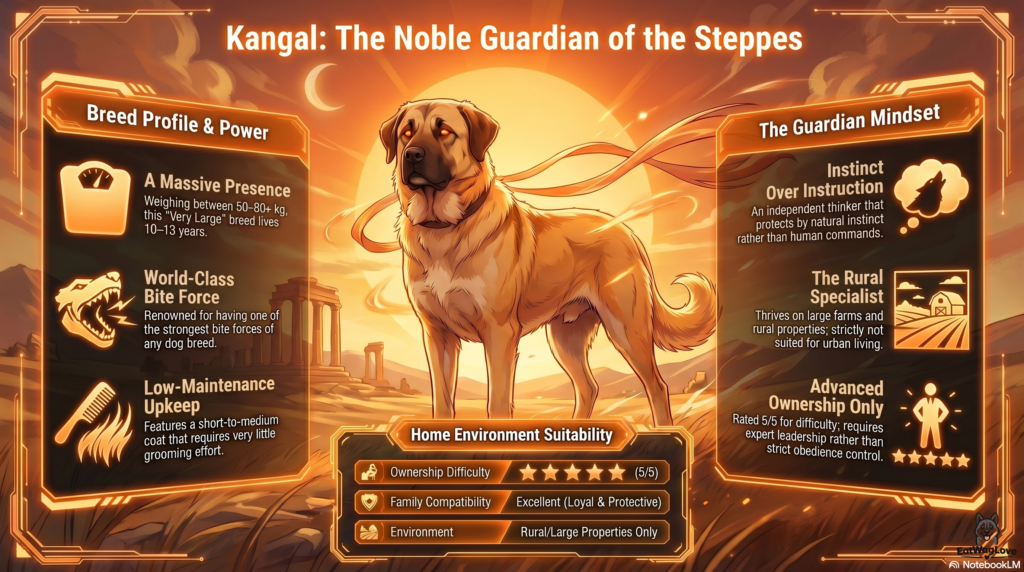
The Kangal is a large livestock guardian dog originating from Turkey, known for its strength, speed, and protective instincts. Bred to guard flocks against predators, it is naturally alert and highly territorial.
Despite its imposing presence, the Kangal is calm and composed with its family, forming strong bonds and showing deep loyalty.
✅ PROS & CONS
Pros
- Extremely protective and loyal
- Calm and steady temperament
- Low grooming needs
- Highly capable guardian
Cons
- Requires experienced handling
- Strong territorial instincts
- Needs space and secure boundaries
- Not suited to apartment living
Is a Kangal a Good Family Dog?
A well-bred Kangal can be deeply loyal, calm and affectionate with its family, but it is not an easy family dog for the average household.
Kangals were developed to make independent decisions while protecting livestock from predators. They need experienced handling, secure property, careful socialisation and owners who understand livestock guardian behaviour.
Is a Kangal Good With Children?
Kangals can be gentle and protective with children in their family.
However, they’re extremely large and powerful, so interactions with young children require supervision.
They may also interpret rough play between children as something requiring intervention, making good management particularly important.
How Much Exercise Does a Kangal Need?
Most adult Kangals need around 60–90 minutes of moderate daily activity, although working livestock guardians may naturally cover much greater distances.
They’re not usually frantic high-energy dogs.
Steady walking, patrolling and purposeful activity suit them better than repetitive high-intensity exercise.
Is a Kangal a High-Energy Dog?
Not in the same way as a Border Collie or Belgian Malinois.
Kangals are generally calm and economical with their energy, but they possess substantial stamina and endurance.
A livestock guardian may spend hours apparently doing very little and then react instantly when a potential threat appears.
Is a Kangal Easy to Train?
Kangals are intelligent but independently minded.
They were bred to assess situations without waiting for human instructions, which is valuable when guarding livestock but can make conventional obedience challenging.
Early training, consistency and calm positive reinforcement are essential.
Are Kangals Intelligent?
Yes.
Their intelligence is particularly evident in situational judgement and independent problem-solving.
A working Kangal must distinguish ordinary activity from a potential threat and decide when intervention is necessary, often without a person nearby.
Are Kangals Stubborn?
They can appear stubborn, but independence is a more accurate description.
For generations, livestock guardian dogs were valued precisely because they could operate without constant direction.
A Kangal that questions an instruction is displaying part of the same independent temperament that historically made the breed useful.
Does a Kangal Shed?
Yes.
Kangals have a dense double coat and can shed substantially, particularly during seasonal coat changes.
Regular brushing helps remove loose undercoat.
Is a Kangal Hypoallergenic?
No.
Kangals shed and produce normal canine allergens.
They’re not considered a hypoallergenic breed.
How Often Should You Groom a Kangal?
Weekly brushing is generally sufficient for much of the year.
During seasonal shedding, more frequent brushing may be needed to remove large amounts of loose undercoat.
Their functional coat otherwise requires relatively little specialised grooming.
Should You Shave a Kangal?
Generally, no.
The double coat protects the dog from weather, sunlight and environmental conditions.
Routine shaving isn’t necessary and can interfere with the coat’s natural protective function.
What Health Problems Are Common in Kangals?
Kangals are generally robust dogs, but potential concerns include hip dysplasia, elbow dysplasia, gastric dilatation-volvulus (bloat) and certain eye or orthopaedic problems.
Responsible breeding is particularly important because of their large size.
Maintaining a lean body condition helps reduce unnecessary stress on joints.
Are Kangals Prone to Hip Dysplasia?
They can be.
Like many large breeds, Kangals can develop hip dysplasia.
Breeding dogs should receive appropriate hip evaluation, and puppies should be kept lean while their skeleton develops.
Are Kangals at Risk of Bloat?
Yes.
Their large, deep-chested structure means gastric dilatation-volvulus (GDV) is a potential concern.
GDV is a life-threatening emergency requiring immediate veterinary treatment.
Owners should know its warning signs and discuss preventive strategies with their veterinarian.
How Long Does a Kangal Live?
Kangals commonly live around 10–13 years.
That’s a respectable lifespan for such a large dog.
Genetics, healthy weight, appropriate nutrition and preventive veterinary care all influence longevity.
How Big Does a Kangal Get?
Kangals are very large, powerful dogs.
Depending on the standard, males are commonly around 72–78 cm or more at the shoulder, with females somewhat smaller.
Adult weight frequently falls around 40–60 kg, although oversized individuals exist.
Is the Kangal the Largest Dog Breed?
No.
Kangals are large dogs, but breeds such as the English Mastiff can be substantially heavier, while Great Danes and Irish Wolfhounds can be taller.
The Kangal’s strength comes from its combination of size, athleticism, speed and functional structure, rather than simply being the biggest dog.
Is There a Giant Kangal?
“Giant Kangal” isn’t a recognised separate variety.
Breeding excessively oversized dogs can compromise movement, joint health and working ability.
Traditional Kangals are large but should remain athletic enough to patrol difficult terrain.
Can a Kangal Live in an Apartment?
Generally, a Kangal is poorly suited to apartment living.
The problem isn’t simply its enormous body size. Kangals have strong territorial and guardian instincts and benefit from substantial secure space.
A large rural property is far more compatible with their traditional behaviour.
Does a Kangal Need a Large Backyard?
Ideally, it needs considerably more than a small suburban garden.
Kangals were developed to patrol extensive territory with livestock.
A secure rural environment that provides space and meaningful activity is generally the best fit.
Can a Kangal Be Left Alone?
Kangals are capable of considerable independence.
Working dogs traditionally spend long periods with livestock rather than constantly beside humans.
However, a companion Kangal still needs appropriate social interaction, exercise and stimulation.
Are Kangals Velcro Dogs?
Usually not in the conventional sense.
They can form exceptionally strong bonds with their family while retaining substantial independence.
A Kangal may prefer to position itself where it can observe and protect everyone rather than constantly seeking physical attention.
Are Kangals Cuddly?
Some are very affectionate with their families.
However, their affection may be quieter and more dignified than that of highly demonstrative companion breeds.
A 50-kilogram Kangal deciding it is a lapdog can nevertheless be difficult to ignore.
Are Kangals Good With Other Dogs?
It depends.
Kangals raised with other dogs can live successfully with them, particularly when the dogs form part of the same household or working group.
However, mature guardian dogs can be territorial or assertive toward unfamiliar dogs.
Are Kangals Good With Cats?
They can be remarkably tolerant of cats and other animals they recognise as part of their household or livestock group.
Early introduction is important.
A livestock guardian’s relationship with familiar animals can be very different from its response to unfamiliar animals entering its territory.
Are Kangals Good With Livestock?
Yes. This is exactly what they were developed for.
Kangals traditionally protect sheep and goats against predators.
They live around livestock, observe their surroundings and respond when they perceive a threat.
Is a Kangal a Herding Dog?
No.
This is an important distinction.
A herding dog such as a Border Collie moves livestock, while a Kangal is a livestock guardian dog that protects them.
Its job is security rather than livestock movement.
How Does a Kangal Know What Animals to Protect?
Early bonding and socialisation with livestock are extremely important.
Young livestock guardian dogs learn that the animals around them belong to their social environment.
Good working behaviour also depends on genetics, maturity, experience and appropriate guidance.
Can Kangals Protect Chickens?
Some can successfully protect poultry after appropriate introduction and training.
However, young guardian dogs can be playful and physically rough.
They shouldn’t simply be placed unsupervised with vulnerable animals and expected to understand the job immediately.
What Animals Were Kangals Bred to Protect?
They have traditionally been associated particularly with protecting sheep and goats.
Their job was to defend livestock against predators while accompanying flocks across open country.
Do Kangals Have a Strong Prey Drive?
Their behavioural pattern differs from that of hunting breeds.
A well-developed livestock guardian should protect familiar animals rather than hunt them.
However, individual Kangals can still chase unfamiliar wildlife or animals, so secure management remains essential.
Are Kangals Territorial?
Yes.
Territorial awareness is fundamental to their traditional work.
A Kangal may regard unfamiliar people, dogs or animals entering its property very differently from individuals formally introduced by its owner.
Are Kangals Protective?
Extremely.
Protection of territory, livestock and social group is one of the breed’s defining characteristics.
A good Kangal should combine confidence and judgement, rather than displaying uncontrolled aggression toward everything unfamiliar.
Are Kangals Aggressive?
Kangals shouldn’t be indiscriminately aggressive.
Traditional livestock guardians need enough confidence to confront predators while remaining manageable around shepherds, livestock and accepted visitors.
Poor breeding, inadequate socialisation or irresponsible management can nevertheless create serious problems in such a powerful dog.
Are Kangals Dangerous Dogs?
Any very large, powerful guardian dog can cause serious injury if poorly bred, trained or managed.
The Kangal’s strength and territorial instincts mean ownership carries substantial responsibility.
Its traditional temperament should be calm, confident and discriminating rather than unpredictably aggressive.
Are Kangals Good Guard Dogs?
Yes, although their traditional speciality is livestock and property guardianship rather than conventional personal-protection work.
They’re naturally watchful and imposing.
Their presence alone can be a substantial deterrent.
Do Kangals Need Protection Training?
Generally, their natural guardian instincts don’t need to be artificially intensified.
The more important priorities are socialisation, reliable handling, boundaries and appropriate management.
Trying to encourage unnecessary aggression in an already powerful guardian breed can create serious problems.
Do Kangals Bark a Lot?
They can be very vocal, particularly at night.
Livestock guardians often bark to warn potential predators that a protected territory is occupied.
This makes barking functional rather than merely nuisance behaviour, although it can create problems in suburban environments.
Why Do Kangals Bark at Night?
Many predators are most active after dark.
Livestock guardian dogs therefore tend to become particularly alert during the evening and overnight.
Barking can deter potential threats before physical confrontation becomes necessary.
Do Kangals Patrol Their Property?
Yes.
Many naturally establish patrol routes around their territory.
They may repeatedly check boundaries, elevated viewpoints and areas where unfamiliar activity is likely to occur.
Why Does My Kangal Sit on a Hill or High Point?
A high position provides a better view of the surrounding territory.
For a guardian dog, being able to detect approaching animals or people early is extremely useful.
What looks like relaxing may actually be surveillance.
Do Kangals Dig?
They can.
Digging may help them create a cooler resting place in hot weather or simply arise from normal canine behaviour.
Secure fencing needs to account for the possibility of digging near boundaries.
Are Kangals Escape Artists?
They can roam if containment is inadequate.
Livestock guardian breeds historically worked across large territories, so property boundaries aren’t automatically meaningful to them.
Strong, secure fencing is essential.
Can a Kangal Be Trusted Off Leash?
Not casually.
Their independence, territorial instincts and enormous physical power mean off-leash freedom requires exceptional judgement and a suitable environment.
Secure private land is very different from an uncontrolled public area.
Are Kangals Friendly With Strangers?
They can be reserved and suspicious of unfamiliar people.
That’s consistent with livestock guardian work.
Owners need to manage introductions carefully rather than expecting Labrador-style enthusiasm toward every visitor.
Do Kangals Attack Intruders?
A Kangal may respond strongly to a perceived threat entering its territory, but individual responses vary.
Responsible ownership should focus on secure containment and controlled introductions, not encouraging confrontation.
Their size means preventing avoidable incidents is particularly important.
Are Kangals Good With Visitors?
They can accept visitors when properly introduced and managed.
However, a visitor entering independently may be interpreted very differently from someone clearly welcomed by the owner.
Good gates, fencing and household routines are essential.
When Does a Kangal Mature?
Kangals mature relatively slowly.
Physical and behavioural maturity may continue until around two to three years of age.
Guardian judgement also improves with experience, which is why young livestock guardian dogs shouldn’t be expected to behave like seasoned adults immediately.
When Does a Kangal’s Protective Instinct Develop?
Guardian behaviours can appear during puppyhood but usually become more pronounced as the dog matures.
Adolescence can bring increased territorial awareness and confidence.
Good socialisation should begin well before this stage.
Are Kangal Puppies Difficult?
They can be challenging.
A puppy may be playful and relatively easy to manage, but it will eventually become an enormous independent guardian.
Training leash manners, handling, recall, boundaries and social behaviour before the dog reaches adult size is extremely important.
How Quickly Does a Kangal Puppy Grow?
Very quickly during its first year.
As with other large breeds, excessive weight gain and inappropriate nutrition can place unnecessary stress on developing joints.
A balanced diet formulated for large-breed growth is important.
Should Kangal Puppies Have Extra Calcium?
Not unless specifically recommended by a veterinarian.
Large-breed puppies require carefully balanced mineral intake.
Adding calcium to an already complete puppy diet can disrupt normal skeletal development.
Are Kangals Good Running Dogs?
They’re athletic and capable of impressive bursts of speed, but they aren’t ideal repetitive road-running companions.
Their traditional activity involves walking, patrolling and responding rapidly when necessary.
Forced endurance exercise should also be avoided while puppies are growing.
Are Kangals Good Hiking Dogs?
Healthy adults can be excellent hiking companions in suitable conditions.
They’re strong, athletic and have considerable stamina.
Owners must maintain control around unfamiliar dogs, livestock and wildlife.
Can Kangals Swim?
Most are physically capable of swimming, although enthusiasm varies.
They’re not specialised water dogs.
Their large body size means safe entry and exit points are important around deep water.
Can Kangals Handle Cold Weather?
Generally, yes.
Their dense double coat provides good protection against cold conditions.
Anatolia can experience substantial seasonal temperature variation, so functional dogs needed to cope with more than just hot summers.
Can Kangals Handle Hot Weather?
They evolved in a region where summers can be hot and dry.
Their coat and behaviour help them manage environmental conditions, but modern owners must still provide shade, water and protection from extreme heat.
Strenuous activity should be avoided during the hottest part of the day.
What Does a Kangal Look Like?
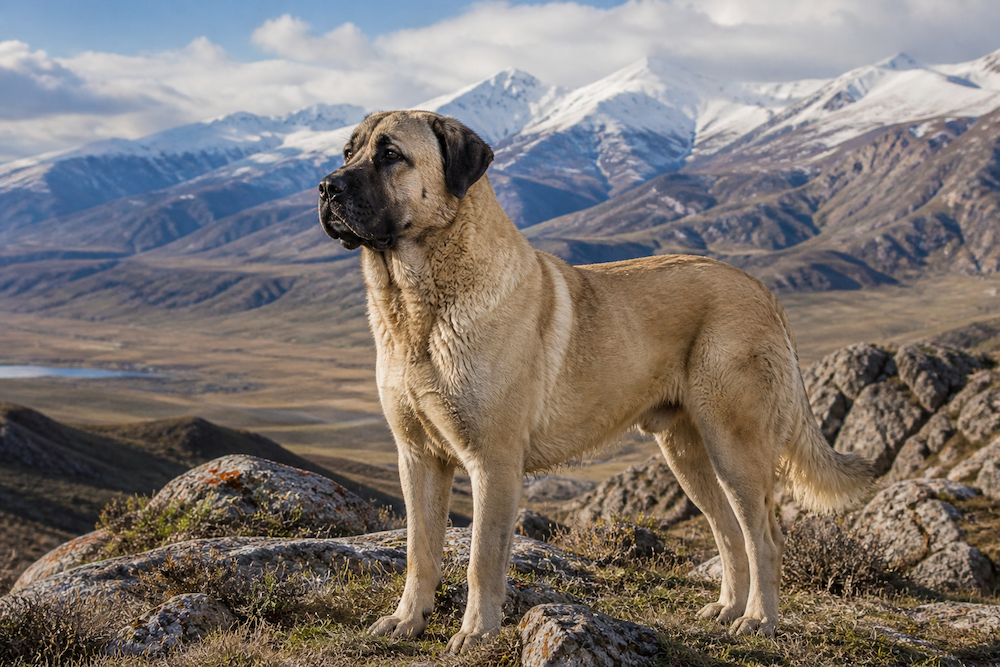
A Kangal is a large, athletic livestock guardian with a pale fawn or dun body, distinctive black mask, dark ears, powerful head and curled tail.
Its build should be strong without becoming cumbersome.
Functional movement and stamina are central to the traditional type.
What Colour Is a Kangal?
Traditional Kangals are generally fawn, dun or pale tan with a dark facial mask and dark ears.
Small amounts of white may occur.
Highly varied coat colours aren’t characteristic of the traditional breed.
Why Does a Kangal Have a Black Mask?
The dark facial mask is one of the breed’s most recognisable characteristics.
It contrasts strongly with the lighter body coat and forms part of the traditional Kangal appearance.
The Turkish term associated with the dark face also appears in historical naming of these dogs.
Can a Kangal Be Brindle?
Brindle isn’t characteristic of the traditional Kangal type.
Dogs labelled Kangals with strongly brindled coats may represent other Turkish livestock guardian populations or mixed ancestry.
Colour terminology can become complicated when different regional Turkish dogs are grouped together internationally.
Can a Kangal Be White?
An all-white dog isn’t typical of the traditional Kangal.
Turkey has other livestock guardian populations that can be predominantly white.
The classic Kangal appearance is a pale body with a distinct dark mask.
Can a Kangal Be Black?
Solid black isn’t a standard traditional Kangal colour.
Dogs of other ancestry are sometimes incorrectly marketed under the Kangal name because the breed has become internationally famous.
Why Does a Kangal Curl Its Tail?
The tail typically curls over the back, particularly when the dog is alert.
This is a characteristic feature of the breed and many related livestock guardian dogs.
Tail carriage can become more pronounced when the dog detects something unusual.
Is a Kangal the Same as an Anatolian Shepherd?
This is one of the most confusing questions surrounding the breed.
Historically, international kennel organisations often grouped various Turkish livestock guardian dogs under the broad Anatolian Shepherd Dog label.
Turkish breeders and Kangal enthusiasts generally regard the Kangal as a distinct regional breed with specific appearance, ancestry and cultural identity.
What Is the Difference Between a Kangal and an Anatolian Shepherd?
“Kangal” traditionally refers to a specific Turkish livestock guardian associated particularly with the Sivas region and Kangal district.
“Anatolian Shepherd” has often been used internationally as a broader category for Turkish livestock guardian dogs.
Breed recognition and terminology have changed over time, so the distinction depends partly on the registry and country.
Is a Kangal the Same as an Akbash?
No.
The Akbash is another Turkish livestock guardian type, traditionally characterised by its white coat.
The Kangal’s fawn body and dark mask make the visual difference particularly obvious.
Both were developed for livestock protection but represent different traditions.
Is a Kangal the Same as a Boz Shepherd?
No, although terminology surrounding Turkish guardian dogs can be contentious.
Dogs marketed as Boz Shepherds are generally presented as a different Turkish livestock guardian population.
Not every enormous Turkish guardian dog should automatically be labelled a Kangal.
Is a Kangal a Mastiff?
It’s sometimes loosely described as a mastiff-type dog because of its size and guardian role.
However, calling it simply a mastiff can be misleading.
Traditional Kangals are more athletic and comparatively lighter-built than many heavy European mastiff breeds.
Is a Kangal Related to the Great Pyrenees?
Both are livestock guardian dogs, but they developed in different regions and have distinct histories.
The Great Pyrenees developed around the Pyrenean Mountains, while the Kangal is associated with central Turkey.
Their behavioural similarities largely reflect similar jobs.
Is a Kangal Related to the Caucasian Shepherd?
Both belong to broad livestock guardian traditions across Eurasia, but they’re distinct populations.
The Caucasian Shepherd developed in the Caucasus and tends to have a heavier, differently coated appearance.
The Kangal is typically more streamlined and athletic.
Is a Kangal Related to the Central Asian Shepherd?
They share the broader history of large livestock guardian dogs spread across Eurasia.
However, the Kangal has its own Turkish regional identity and recognised characteristics.
Claims that one modern breed directly descended from another should be treated cautiously.
Is the Kangal an Ancient Breed?
The livestock guardian tradition of Anatolia is very old, potentially extending back thousands of years.
However, describing the modern standardised Kangal as unchanged for thousands of years goes beyond what historical evidence can demonstrate.
Ancient guardian dogs and the modern registered breed aren’t necessarily identical populations.
Where Does the Kangal Come From?
The Kangal comes from Turkey, particularly the Kangal district of Sivas Province in central Anatolia.
The region’s pastoral communities relied on powerful guardian dogs to protect sheep and goats.
The breed became closely associated with this landscape and livestock culture.
Why Is It Called a Kangal?
The name comes from Kangal, a district and town in Turkey’s Sivas Province.
Dogs associated with the region became known internationally by the geographic name.
This connection remains central to the breed’s Turkish identity.
What Does Karabaş Mean?
Karabaş roughly refers to “black head” or “black-headed,” reflecting the characteristic dark facial mask.
The term has historically been applied to dark-masked Turkish livestock guardian dogs.
Terminology varies across regions and historical sources, so it isn’t always synonymous with the modern registered Kangal.
What Was the Kangal Originally Bred For?
The Kangal was developed to protect livestock from predators.
Rather than herding sheep, the dog stayed with the flock and monitored its surroundings.
Its combination of size, speed, confidence and independence made it suited to confronting serious threats.
Did Kangals Protect Sheep From Wolves?
Yes.
Wolves were among the most important predators faced by pastoral communities in Anatolia.
The Kangal’s reputation was built largely around its ability to deter and, when necessary, confront predators threatening livestock.
Do Kangals Fight Wolves?
Historically, they could confront wolves when livestock was threatened.
However, successful livestock guardianship is not simply about fighting.
Deterrence, barking, territorial presence and coordinated behaviour can prevent encounters from escalating into physical combat.
Do Kangals Protect Livestock From Bears?
Large livestock guardian dogs can help deter various predators, potentially including bears in regions where they occur.
However, claims portraying an individual dog routinely defeating large bears should be treated sceptically.
The safest guardian strategy is usually preventing close confrontation.
Do Kangals Work in Packs?
They can.
Multiple livestock guardian dogs may cooperate when protecting large flocks or areas with substantial predator pressure.
Working together can dramatically increase deterrence against predators.
Did Kangals Wear Spiked Collars?
Livestock guardian dogs in Turkey and elsewhere have traditionally worn protective collars, sometimes fitted with outward-facing spikes.
These were intended to protect the vulnerable neck area during encounters with predators.
The practice isn’t unique to Kangals.
Why Do Kangal Dogs Have Cropped Ears in Some Old Photos?
Ear cropping has historically been practised on some livestock guardian dogs, often with claims that it reduced vulnerability during predator encounters.
It isn’t necessary for a modern companion dog’s health or working ability.
Natural Kangal ears are medium-sized, triangular and drop alongside the head.
Is Ear Cropping Traditional for Kangals?
It has historical associations with some working populations.
However, tradition doesn’t make cosmetic cropping medically necessary.
Legality and animal-welfare rules vary considerably between countries.
Are Kangals Used Outside Turkey to Protect Livestock?
Yes.
Livestock guardian dogs including Kangals have been exported to other countries for predator-management programmes and farm work.
Their traditional skill set can be useful wherever livestock and large predators share the landscape.
Have Kangals Been Used to Protect Livestock From Cheetahs?
Livestock guardian dogs have played an important role in non-lethal predator conservation programmes, particularly in southern Africa.
Dogs living with livestock can discourage cheetahs from approaching flocks, reducing losses and therefore reducing pressure on farmers to kill predators.
Anatolian-type livestock guardians have been especially prominent in these programmes, though not every dog involved should automatically be identified specifically as a pure Kangal.
Can Kangals Help Wildlife Conservation?
Potentially, yes.
Livestock guardian dogs can reduce conflict between farmers and predators by preventing livestock losses.
When successful, this can help protect animals such as cheetahs and wolves because farmers have less reason to use lethal predator control.
It’s an interesting example of an ancient working-dog role contributing to modern conservation.
Is the Kangal Turkey’s National Dog?
The Kangal is one of Turkey’s most culturally significant native dog breeds and is frequently described as a national dog or national treasure.
It’s particularly associated with Sivas and Turkish pastoral heritage.
Its cultural importance extends well beyond ordinary breed popularity.
Is the Kangal Protected in Turkey?
Turkey has historically placed restrictions and controls on exporting native Kangal breeding stock, reflecting concerns about preserving the breed.
Rules and enforcement can change, so current legal requirements should always be checked rather than relying on older claims.
Why Are Kangals So Important in Turkey?
The breed represents generations of pastoral life in Anatolia.
For shepherds, these dogs weren’t decorative possessions; they helped protect economically vital livestock from predators.
That practical importance developed into considerable regional and national pride.
Is the Kangal the Strongest Dog in the World?
There is no scientifically established “strongest dog breed” ranking.
Strength can mean pulling power, body mass, bite force, endurance or athletic ability, and these aren’t interchangeable.
The Kangal is unquestionably a very powerful livestock guardian, but simplistic “world’s strongest dog” claims aren’t meaningful measurements.
Does the Kangal Have the Strongest Bite Force of Any Dog?
Claims that Kangals have a bite force of 743 PSI are repeated constantly online, but they should be treated with considerable caution.
There is no robust, standardised scientific database testing every dog breed under identical conditions that establishes the Kangal as the definitive bite-force champion.
The Kangal obviously has powerful jaws, but viral PSI rankings create a false level of precision.
Where Did the 743 PSI Kangal Bite-Force Claim Come From?
The figure has circulated widely through breed websites, social media and list-style articles, often without a clear original scientific study demonstrating the measurement under controlled conditions.
Repeating the number doesn’t make it established scientific evidence.
It’s safer to describe the Kangal as physically powerful without presenting an internet bite-force ranking as proven fact.
Is a Kangal Stronger Than a Wolf?
There isn’t a useful universal answer.
Body size, age, sex, condition and circumstances all vary, and strength can’t be reduced to a single measurement.
Historically, Kangals were successful because they could deter predators, work with other guardian dogs and defend livestock, not because every individual dog was guaranteed to overpower every wolf.
Can a Kangal Beat a Wolf?
Videos and online discussions often frame this as a contest, but that misses the purpose of the breed.
A working Kangal succeeds when the wolf doesn’t reach the livestock.
Barking, territorial presence, teamwork and confrontation when necessary are all part of that job; killing the predator isn’t the measure of success.
How Fast Can a Kangal Run?
Kangals are surprisingly fast for such large dogs and can produce impressive short bursts of speed.
Exact maximum-speed claims online vary and are rarely based on standardised testing.
What’s more important historically is that the breed remained athletic enough to respond rapidly across open terrain.
Why Is the Kangal More Athletic Than Many Giant Dogs?
Its traditional work demanded it.
An excessively heavy dog would struggle to patrol large areas and respond quickly to predators.
Functional Kangal breeding therefore favoured a powerful but mobile and enduring body, rather than maximum bulk.
Is a Kangal Stronger Than a Cane Corso?
Both are powerful guardian breeds developed for different historical purposes.
The Kangal is a large livestock guardian built for endurance and independent territorial work, while the Cane Corso descends from Italian multipurpose guardian and working dogs.
Simple strength comparisons ignore these very different functional specialisations.
Is a Kangal Bigger Than a Cane Corso?
Kangals are generally taller and can be comparably heavy or heavier depending on the individuals.
More importantly, their proportions differ.
The Kangal tends to have a more rangy, endurance-oriented livestock guardian build, while the Cane Corso is more compact and mastiff-like.
Is a Kangal Bigger Than a German Shepherd?
Yes, substantially.
A mature Kangal is normally taller and considerably heavier than a German Shepherd.
The breeds also perform fundamentally different jobs: one traditionally guards livestock independently, while the other developed from European herding dogs into an exceptionally versatile working breed.
Is a Kangal Bigger Than a Great Pyrenees?
Their size ranges overlap.
Both are large livestock guardians, although Great Pyrenees generally have a much heavier-looking coat while Kangals have a shorter coat and more visibly athletic outline.
Individual dogs can vary considerably.
Is a Kangal a Good First Dog?
Generally, no.
Their size, independence, territorial instincts, physical power and guardian behaviour make them much better suited to experienced owners.
A first-time owner with an appropriate rural environment and expert support could succeed, but the Kangal isn’t a forgiving choice for casual ownership.
Can Anyone Own a Kangal?
Legal requirements vary by country, state and municipality.
Even where ownership is legal, practical suitability matters just as much.
Secure property, appropriate insurance where required, responsible socialisation and the ability to control a very powerful dog should all be considered before ownership.
What Makes the Kangal Unique?
The Kangal wasn’t developed to wait beside a shepherd for instructions.
Its traditional workplace was the open landscape of central Anatolia, where it might need to notice a predator, assess the danger and act while the shepherd was some distance away.
That created a dog combining enormous physical power with patience, independence and territorial judgement.
The impressive part isn’t that a Kangal can confront a predator.
It’s that a good livestock guardian understands that most of the time, the best fight is the one its presence prevents from happening at all.