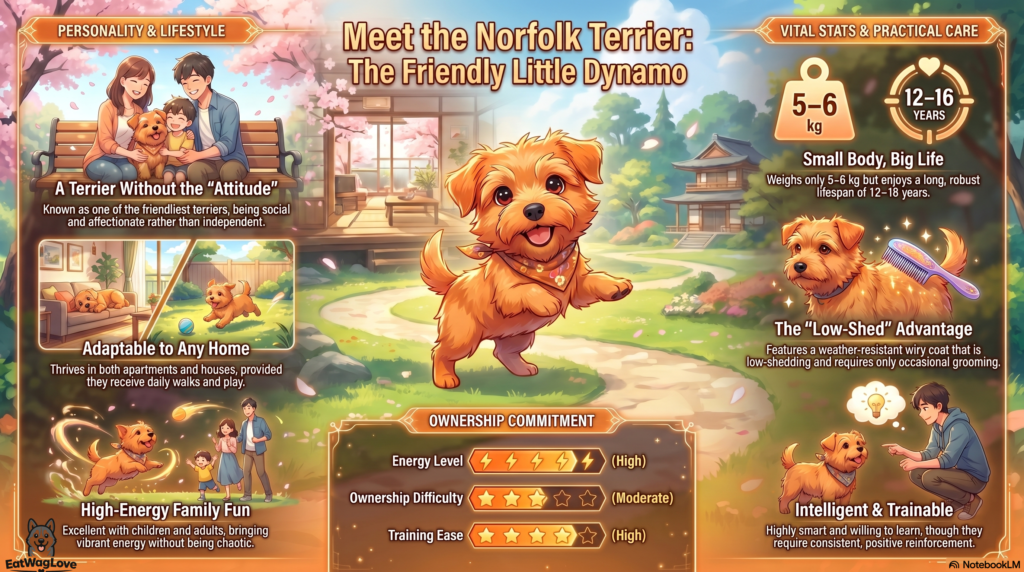





Small, fearless, and full of charm — a lively companion with a big terrier personality.
🧠 QUICK SNAPSHOT
- Temperament: Brave, affectionate, lively
- Energy Level: Moderate to high
- Size: Small
- Good With Families: Yes
- Trainability: Moderate
- Grooming: Low to moderate
- Best For: Families, active homes, companionship
📚 OVERVIEW
The Norfolk Terrier is one of the smallest working terriers, originally bred to hunt vermin in packs. Despite its size, it is tough, energetic, and always ready for action.
They are friendly and affectionate with their family and tend to be more social than many other terrier breeds.
✅ PROS & CONS
Pros
- Friendly and sociable
- Compact and adaptable
- Energetic and playful
- Good with families
Cons
- Can be stubborn
- Strong prey drive
- Needs regular activity
- May dig or chase
Is a Norfolk Terrier a Good Family Dog?
Yes. The Norfolk Terrier can be an affectionate, cheerful, confident and entertaining family dog.
Although tiny, it’s a genuine working terrier with plenty of energy and personality. Norfolk Terriers generally enjoy being involved in family life and are often less aloof than people expect from a traditional terrier.
They’re particularly well suited to active households that want a small but sturdy dog rather than a delicate lap dog.
Are Norfolk Terriers Good With Children?
Generally, yes.
They’re sturdy, playful little dogs and can be excellent companions for respectful children.
As with any small breed, interactions with young children should be supervised to prevent rough handling.
How Much Exercise Does a Norfolk Terrier Need?
Most Norfolk Terriers need around 45–60 minutes of exercise each day, together with play and mental stimulation.
They’re small enough that some activity can happen indoors, but they still need proper walks and opportunities to explore.
Their working-terrier heritage means they usually have considerably more stamina than their size suggests.
Is a Norfolk Terrier a High-Energy Dog?
It’s moderately to highly energetic.
Norfolks are lively, curious dogs that enjoy exploring, playing and investigating scents.
They can settle comfortably at home once their physical and mental needs have been met.
Is a Norfolk Terrier Easy to Train?
Norfolk Terriers are intelligent and capable learners, but they have an independent streak.
Their ancestors were expected to pursue vermin without waiting for detailed instructions from humans.
Positive reinforcement, variety and short training sessions generally produce the best results.
Are Norfolk Terriers Intelligent?
Yes.
They’re clever, observant and excellent problem-solvers.
Unfortunately, this intelligence can also be applied to discovering where food is stored, finding gaps beneath fences and identifying exactly which household rules aren’t being consistently enforced.
Are Norfolk Terriers Stubborn?
They can be.
Terrier determination was historically useful when pursuing rats and other quarry.
Modern Norfolk Terriers retain some of that persistence, so owners need consistency and patience rather than expecting automatic obedience.
Are Norfolk Terriers Difficult to Toilet Train?
Usually not excessively difficult, although consistency is important.
Small puppies need frequent opportunities to go outside.
Cold or wet weather can sometimes make outdoor toileting considerably less appealing.
Does a Norfolk Terrier Shed?
Yes, but generally not heavily.
The breed has a hard, wiry outer coat with a softer undercoat.
Regular grooming helps remove dead hair and maintain the characteristic weather-resistant texture.
Is a Norfolk Terrier Hypoallergenic?
No.
Norfolk Terriers may shed relatively little compared with some breeds, but they still produce normal canine allergens.
Low shedding and hypoallergenic aren’t the same thing.
How Often Should You Groom a Norfolk Terrier?
A thorough brushing once or twice each week is usually appropriate.
The coat also requires periodic stripping or specialist grooming to remove dead outer hairs.
Regular nail, ear and dental care should form part of the routine.
Does a Norfolk Terrier Need Haircuts?
The traditional coat is hand stripped rather than routinely clipped.
Hand stripping removes dead outer hairs while maintaining the hard texture and rich colour of the coat.
Pet dogs are sometimes clipped for convenience, although repeated clipping can make the coat softer and duller.
What Is Hand Stripping a Norfolk Terrier?
Hand stripping involves carefully pulling out mature dead hairs from the coat.
A correctly ready hair releases without damaging healthy skin.
It preserves the weather-resistant wiry texture that historically protected working terriers outdoors.
What Health Problems Are Common in Norfolk Terriers?
Norfolk Terriers are generally robust, but potential concerns include patellar luxation, hip problems, eye disorders and some heart conditions, including mitral valve disease in some lines.
Responsible breeders should use appropriate health screening and maintain good records across generations.
Regular dental care is also important in a small breed.
Are Norfolk Terriers Prone to Heart Problems?
Heart disease is an important consideration in the breed.
Mitral valve disease has received particular attention within Norfolk Terrier populations.
Responsible breeding programmes increasingly use cardiac assessment alongside other health screening.
Are Norfolk Terriers Prone to Patellar Luxation?
They can be.
Patellar luxation occurs when the kneecap moves out of its normal position.
Affected dogs may intermittently skip, hop or briefly carry a rear leg.
How Long Does a Norfolk Terrier Live?
Norfolk Terriers commonly live around 12–15 years, with some reaching their later teens.
They’re generally long-lived dogs.
Maintaining a healthy weight, good dental health and regular veterinary care can help support longevity.
How Big Does a Norfolk Terrier Get?
Norfolk Terriers typically stand around 25 cm at the shoulder and weigh approximately 5–6 kg.
They’re among the smallest working terriers.
Despite their compact dimensions, they should feel sturdy and substantial rather than fragile.
Is There a Miniature Norfolk Terrier?
No.
The Norfolk Terrier is already naturally very small.
There is no recognised Miniature Norfolk Terrier variety.
Is There a Teacup Norfolk Terrier?
No.
“Teacup Norfolk Terrier” isn’t a recognised breed or size.
Deliberately breeding an already small breed for extreme miniaturisation can introduce unnecessary health and structural problems.
Can a Norfolk Terrier Live in an Apartment?
Yes.
Their compact size makes apartment living entirely possible if their exercise and mental-stimulation needs are met.
Potential issues include barking and the need for regular outdoor activity.
Does a Norfolk Terrier Need a Backyard?
No.
A Norfolk can live successfully without a garden provided it receives daily walks and play.
If a yard is available, fencing needs to be secure because terriers can be talented diggers and escape artists.
Are Norfolk Terriers Good at Digging?
Very.
Digging is completely logical behaviour for a dog whose ancestors were expected to pursue quarry into underground spaces.
Providing a designated digging area can be more realistic than expecting some Norfolks never to dig.
Are Norfolk Terriers Escape Artists?
They can be.
A combination of prey drive, curiosity and digging ability means apparently secure gardens deserve careful inspection.
A small gap beneath a fence can become extremely interesting when something on the other side smells like a rodent.
Can a Norfolk Terrier Be Left Alone?
Adult Norfolk Terriers can learn to tolerate reasonable periods alone.
However, they’re unusually sociable for traditional working terriers and generally enjoy considerable interaction with their families.
Long periods of isolation can lead to boredom and unwanted behaviour.
Are Norfolk Terriers Prone to Separation Anxiety?
Some can be.
They’re often strongly attached to their owners and tend to enjoy companionship.
Gradual independence training from puppyhood can help prevent excessive dependence.
Are Norfolk Terriers Velcro Dogs?
Some are surprisingly close to their owners.
They often combine classic terrier independence outdoors with considerable affection at home.
A Norfolk may spend a walk pretending it has an entirely independent agenda, then insist on sitting beside you for the rest of the evening.
Are Norfolk Terriers Cuddly?
Many are.
Norfolks are often affectionate and enjoy physical contact with their families.
They’re generally considered one of the more sociable and companionable traditional terriers.
Are Norfolk Terriers Good With Other Dogs?
Generally, yes.
Historically, these terriers often needed to work alongside other dogs, and the breed has a reputation for being relatively sociable.
Individual personalities still vary, and early socialisation remains important.
Are Norfolk Terriers Good With Cats?
They can live successfully with cats, particularly when raised together.
However, the breed’s hunting instincts shouldn’t be underestimated.
An unfamiliar running cat may produce a very different reaction from the family cat sleeping on the sofa.
Can Norfolk Terriers Live With Rabbits or Guinea Pigs?
Extreme caution is required.
Norfolk Terriers were developed specifically from dogs used to hunt rats and other small quarry.
Rabbits, hamsters and guinea pigs can activate deeply ingrained predatory behaviour.
Do Norfolk Terriers Have a Strong Prey Drive?
Yes.
Their small size doesn’t indicate weak hunting instincts.
Rodents, rabbits and other small animals can trigger intense pursuit.
Are Norfolk Terriers Good Off Leash?
Recall can be challenging when prey is present.
A Norfolk that normally responds beautifully may suddenly become selectively deaf when a rabbit appears.
Secure fenced areas are generally safest for unrestricted running.
Do Norfolk Terriers Bark a Lot?
They can be vocal, although they’re not necessarily constant barkers.
Their alertness makes them quick to notice visitors and unusual sounds.
Training can help prevent alert barking from becoming excessive.
Are Norfolk Terriers Good Watchdogs?
Yes.
They’re alert, confident and quick to announce unusual activity.
Their small size doesn’t reduce their enthusiasm for reporting potential intruders.
Are Norfolk Terriers Good Guard Dogs?
No, not in the physical sense.
They’re excellent alarm dogs but simply too small to function as serious property-protection dogs.
Their opinion of their own capabilities may differ.
Are Norfolk Terriers Aggressive?
Aggression shouldn’t be a defining feature of a well-bred Norfolk Terrier.
They should be alert, fearless and confident without unnecessary quarrelsomeness.
Poor socialisation, fear or inappropriate breeding can still produce behavioural problems.
Are Norfolk Terriers Friendly With Strangers?
Many are.
The Norfolk is often more outgoing and sociable than some traditional terrier breeds.
They may initially announce a stranger’s arrival before quickly deciding the visitor could potentially be useful.
When Does a Norfolk Terrier Calm Down?
Many become noticeably more settled between two and three years old.
However, they’re often lively and playful throughout adulthood.
A senior Norfolk may still show considerable enthusiasm when something interesting moves across the garden.
Do Norfolk Terriers Get the Zoomies?
Yes.
A small, sturdy terrier travelling at maximum speed can produce surprisingly energetic zoomies.
Furniture may temporarily become part of the course.
Are Norfolk Terriers Fast?
Yes.
They’re quick and agile rather than long-distance sprinters.
Speed was useful when pursuing rats and other fast-moving quarry.
Are Norfolk Terriers Good Walking Dogs?
Yes.
They’re excellent walking companions and can cover much greater distances than their tiny stature suggests.
Walks also provide valuable opportunities for sniffing and exploration.
Are Norfolk Terriers Good Hiking Dogs?
Healthy adults can make excellent hiking companions.
Their stamina and compact size are useful, although owners need to consider rough terrain, wildlife and prey drive.
They’re very much small dogs with working-dog ambitions.
Are Norfolk Terriers Good Running Dogs?
They can accompany owners on shorter runs once mature and conditioned.
They’re better suited to walking, hiking and varied outdoor adventures than sustained long-distance road running.
Can Norfolk Terriers Swim?
Many can swim, although they’re not specialised water dogs.
Individual enthusiasm varies considerably.
Supervision and a canine life jacket are sensible around deep or moving water.
Do Norfolk Terriers Get Cold Easily?
Their harsh double coat provides reasonable protection from cool weather.
However, they’re still very small dogs and can become cold in severe conditions.
Older dogs and recently groomed dogs may require additional protection.
Can Norfolk Terriers Handle Hot Weather?
Generally, with sensible precautions.
Exercise should occur during cooler periods in extreme heat, particularly in Australian summers.
Shade, water and cool indoor areas should always be available.
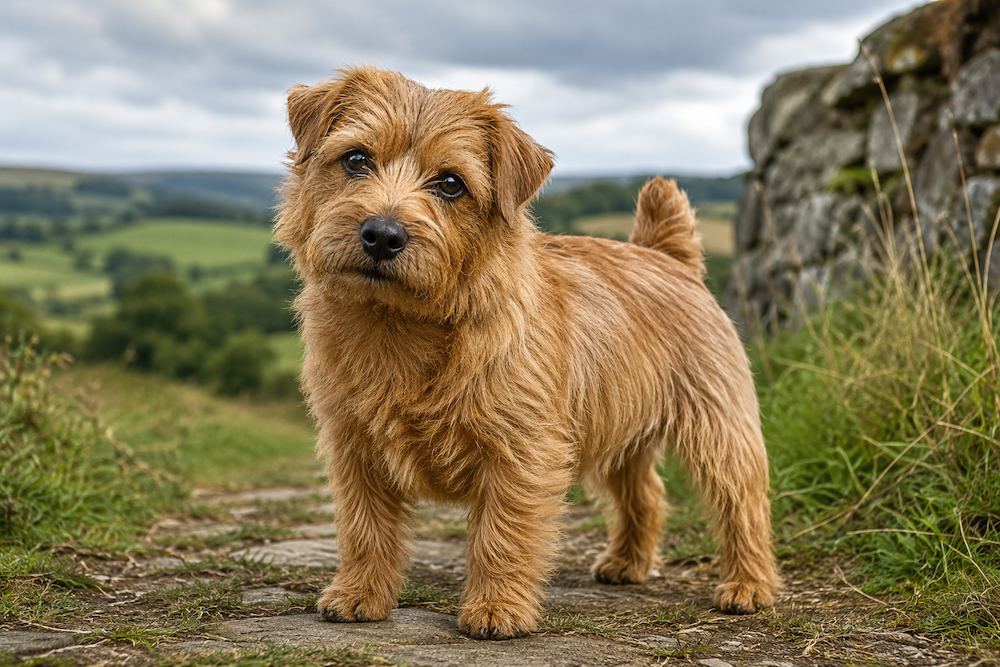
What Does a Norfolk Terrier Look Like?
The Norfolk Terrier is a small, sturdy, low-to-the-ground terrier with a wiry coat, broad slightly rounded head and distinctive folded ears.
Its expression is alert and friendly.
The body should look capable of genuine work rather than excessively refined or delicate.
What Colours Can Norfolk Terriers Be?
Traditional colours include red, wheaten, black and tan, and grizzle.
Red is particularly strongly associated with the breed.
Small amounts of white may occur but extensive white isn’t traditionally desirable.
What Is a Grizzle Norfolk Terrier?
Grizzle describes a coat containing an intermixture of differently coloured hairs, often producing a shaded greyish, reddish or darkened appearance.
It’s a traditional terrier colour rather than one single uniform shade.
Can a Norfolk Terrier Be Black and Tan?
Yes.
Black and tan is an established breed colour.
The distribution differs from the solid red appearance many people most strongly associate with Norfolk Terriers.
Can a Norfolk Terrier Be White?
Predominantly white isn’t a standard traditional Norfolk Terrier colour.
Small white markings may occasionally occur.
A largely white dog being sold as an unusually coloured purebred Norfolk deserves closer investigation.
Can a Norfolk Terrier Be Merle?
No traditional Norfolk Terrier population carries merle.
A merle dog marketed as a purebred Norfolk Terrier should raise questions about ancestry.
Merle isn’t simply a rare Norfolk colour.
What Is the Difference Between a Norfolk Terrier and a Norwich Terrier?
The easiest visible difference is the ears.
Norfolk Terriers have folded or drop ears, while Norwich Terriers have upright, pointed ears.
Historically, however, they were once treated as varieties of essentially the same terrier population.
Are Norfolk and Norwich Terriers Related?
Extremely closely.
Their histories are intertwined, and for decades drop-eared and prick-eared dogs were bred within the same general population.
They eventually became formally recognised as separate breeds.
Why Does the Norfolk Terrier Have Folded Ears?
The folded ear became the defining characteristic separating the Norfolk from the Norwich Terrier.
Earlier breeding populations contained both prick and drop ears.
Once the breeds were separated, ear carriage became one of their clearest visual distinctions.
Is the Norfolk Terrier Smaller Than the Norwich Terrier?
They’re extremely similar in size.
Both are among the smallest working terriers.
Differences between individual dogs can easily be greater than the average difference between the breeds.
Is a Norfolk Terrier the Same as a Cairn Terrier?
No.
Both are small, rough-coated British terriers, but they have different origins and breed histories.
The Cairn developed primarily from Scottish working terriers, while the Norfolk’s history is centred on eastern England.
Is a Norfolk Terrier the Same as a Border Terrier?
No.
The Border Terrier originated around the border country between England and Scotland and was developed for work associated with fox hunting.
The Norfolk is smaller and has a different historical development in East Anglia.
Is a Norfolk Terrier Related to the Yorkshire Terrier?
Both belong to Britain’s broad terrier tradition, but they’re distinct breeds with different development histories.
The Yorkshire Terrier became increasingly refined as a companion dog, while the Norfolk retained the appearance and character of a compact working terrier.
Where Does the Norfolk Terrier Come From?
The Norfolk Terrier developed in East Anglia in England, particularly around Norfolk and neighbouring areas.
Its ancestors were small working terriers used for ratting, fox control and general vermin work.
Its history is inseparable from that of the Norwich Terrier because the two were originally varieties within the same developing population.
What Was the Norfolk Terrier Originally Bred For?
Norfolks were developed as practical working terriers.
They hunted rats and other vermin around farms and stables and could also participate in fox hunting by pursuing or bolting quarry from underground.
Their tiny size was an advantage rather than a limitation.
Why Were Small Terriers Useful on Farms?
Rats could destroy stored grain, contaminate animal feed and spread disease.
A determined little dog capable of reaching confined spaces provided extremely effective pest control.
Small terriers required relatively little food while performing a genuinely valuable job.
Were Norfolk Terriers Used for Fox Hunting?
Yes.
Small terriers of the Norfolk/Norwich type could accompany hunts and work around fox earths.
Their job wasn’t to race with hounds for miles but to use their compact size and courage where larger dogs couldn’t operate effectively.
Can a Norfolk Terrier Go Underground?
Historically, small terriers were selected specifically because they could enter underground spaces after quarry.
Modern pet dogs shouldn’t be encouraged into dangerous uncontrolled burrows, but the instinct to investigate holes remains strong in many Norfolks.
Why Is the Norfolk Terrier So Small?
Its small size was functional.
A terrier pursuing rats or working around fox earths needed to fit into confined spaces.
The Norfolk wasn’t miniaturised simply to create a fashionable lap dog.
What Dogs Created the Norfolk Terrier?
The exact recipe isn’t perfectly documented.
Its ancestry involved various small working terriers in Britain, with Irish Terrier-type dogs and other local terrier populations often mentioned in historical accounts.
The developing Norfolk/Norwich population was bred primarily for working ability rather than maintaining a closed pedigree from the beginning.
What Were Cantab Terriers?
Small terriers kept by students at Cambridge University during the late 19th and early 20th centuries became known as Cantab Terriers.
These little ratting dogs became fashionable among students and form an important part of the early Norfolk/Norwich story.
They were practical vermin hunters as well as companions.
Why Were Norfolk Terriers Associated With Cambridge University?
Small red terriers became popular among Cambridge students.
They were compact, entertaining and useful for controlling rats around stables and lodgings.
This university connection helped spread the reputation of the developing terrier type.
What Was a Trumpington Terrier?
“Trumpington Terrier” was another early name associated with the dogs that eventually contributed to Norfolk and Norwich Terriers.
The name came from Trumpington Street in Cambridge, where an influential breeder and horse dealer was connected with the developing dogs.
These historical names show how informal the breed was before standardisation.
Who Was “Doggy” Lawrence?
Charles “Doggy” Lawrence was a Cambridge-area dog dealer and breeder strongly associated with the early development and distribution of small working terriers that contributed to the Norfolk/Norwich breeds.
He supplied dogs to Cambridge students and other enthusiasts.
His role is one of the colourful chapters in the breed’s early history.
Who Was Frank Jones in Norfolk Terrier History?
Frank “Roughrider” Jones became enormously influential in developing and promoting these small East Anglian terriers.
Dogs associated with him became known in some circles as Jones Terriers.
His breeding helped shape the dogs that eventually became modern Norwich and Norfolk Terriers.
What Was a Jones Terrier?
“Jones Terrier” was an informal name associated with dogs bred or promoted by Frank Jones.
These small red working terriers contributed importantly to the modern Norfolk/Norwich population.
The name eventually disappeared as formal breed names became established.
Why Were Norfolk Terriers Once Called Norwich Terriers?
For much of their early registered history, both prick-eared and drop-eared dogs were recognised together as Norwich Terriers.
Ear carriage was treated as a variety rather than sufficient reason for separate breed status.
That eventually changed.
When Was the Norwich Terrier Recognised?
Britain’s Kennel Club formally recognised the Norwich Terrier in 1932, initially including both prick-eared and drop-eared dogs.
This means dogs that would now be called Norfolk Terriers were originally registered under the Norwich name.
Why Were Norfolk and Norwich Terriers Separated?
Breeders increasingly regarded the drop-eared and prick-eared varieties as distinct.
Breeding the two ear types together could also produce inconsistent ear carriage.
Eventually, formal separation allowed each type to develop according to its own standard.
When Did the Norfolk Terrier Become a Separate Breed?
The Kennel Club in Britain recognised the drop-eared variety as the Norfolk Terrier in 1964.
Other kennel organisations subsequently followed.
So although the dog’s ancestry is much older, the Norfolk Terrier as a separately named registered breed is relatively recent.
When Did the AKC Recognise the Norfolk Terrier Separately?
The American Kennel Club separated the Norfolk and Norwich Terriers in 1979.
Before that, both ear varieties had been registered under the Norwich Terrier name in the United States.
Why Was It Called the Norfolk Terrier?
When the two varieties were separated, the drop-eared dogs became the Norfolk Terrier, taking their name from the English county closely associated with their development.
The prick-eared dogs retained the Norwich Terrier name.
Is the Norfolk Terrier an Ancient Breed?
Not in the strict modern pedigree sense.
Its ancestors came from Britain’s long tradition of working terriers, but the recognisable Norfolk/Norwich population developed mainly around the late 19th and early 20th centuries.
Formal recognition of the Norfolk as its own breed didn’t occur until 1964.
Did Norfolk Terriers Work in Packs?
They could work alongside other terriers and hunting dogs.
A cooperative temperament was useful when multiple dogs were involved in vermin control or hunting.
This may help explain why modern Norfolks often get along comparatively well with other dogs.
Why Is the Norfolk Terrier Less Quarrelsome Than Some Terriers?
Historically, dogs expected to work alongside others couldn’t spend all their time fighting their teammates.
Breeders valued courage toward quarry without unnecessary aggression toward other dogs.
The breed standard has traditionally emphasised being fearless without being quarrelsome.
Why Does My Norfolk Terrier Chase Squirrels?
Because a squirrel activates instincts shaped by generations of vermin hunting.
Movement, scent and rustling sounds can immediately attract a Norfolk’s attention.
The behaviour makes much more sense when you remember that this tiny companion was originally a professional pest controller.
Why Does My Norfolk Terrier Shake Its Toys?
Grabbing and shaking is related to the predatory behaviour used by terriers when dealing with small quarry.
Modern toys provide a safe outlet.
The fact that the toy is a stuffed dinosaur rather than a rat appears irrelevant to the Norfolk.
Why Does My Norfolk Terrier Dig at Blankets?
Digging can be an extension of normal terrier behaviour.
Some dogs scratch bedding to create a comfortable resting place, while others appear to approach a blanket as though there’s a particularly suspicious rodent beneath it.
Why Does My Norfolk Terrier Stare Into Holes?
Because holes historically mattered.
For a working terrier, an opening in the ground could contain exactly the animal it was expected to find.
Modern Norfolks may therefore investigate burrows, drains and gaps with extraordinary enthusiasm.
Why Does My Norfolk Terrier Follow Me Everywhere?
Norfolks tend to be unusually sociable little terriers.
They enjoy family involvement and often form strong attachments to their owners.
They may be independent enough to chase a scent but companionable enough to expect inclusion in everything else.
Are Norfolk Terriers Good at Agility?
Yes.
They’re quick, intelligent and athletic, making agility an excellent outlet.
They can also enjoy rally, obedience, scent work, Earthdog-style activities and trick training.
What Is Earthdog Training for Norfolk Terriers?
Earthdog activities allow small terriers and Dachshunds to use their natural instincts in a controlled, non-lethal sporting environment.
Dogs navigate artificial tunnels and demonstrate interest in safely protected quarry.
For a Norfolk Terrier, the concept is very close to the work its ancestors were bred to perform.
Are Norfolk Terriers Still Used for Ratting?
Some retain considerable practical ratting ability, although most modern Norfolks are companions.
Their instinct to pursue rodents remains deeply embedded in many individuals.
Controlled dog sports and games can provide safer outlets for those instincts.
Are Norfolk Terriers Rare?
Yes, they’re considerably less common than many popular small companion breeds.
Their relatively limited population means responsible breeding and genetic diversity are important considerations.
Their rarity is somewhat surprising given how adaptable they can be as companions.
Are Norfolk Terriers Good Therapy Dogs?
Individual Norfolks with calm, sociable temperaments can make excellent therapy dogs.
Their small size is convenient while their cheerful personality can make them engaging companions.
Not every highly energetic terrier will enjoy therapy environments, so temperament matters.
Is a Norfolk Terrier a Good Dog for Older People?
It can be an excellent choice for active older owners.
The breed is small and portable without being especially fragile.
However, owners still need to meet its exercise requirements and manage its terrier prey drive.
Is a Norfolk Terrier a Good First Dog?
Potentially, yes.
Norfolks are affectionate, manageable in size and often more sociable than many traditional terriers.
First-time owners should nevertheless be prepared for prey drive, digging, grooming, independent thinking and occasional selective hearing.
What Makes the Norfolk Terrier Unique?
The Norfolk Terrier is an excellent example of why you should never judge a working dog by its size.
At roughly 5–6 kilograms, it’s one of the smallest true working terriers. But it wasn’t created as a miniature lap dog.
Its ancestors were practical little ratters around farms and stables. They became fashionable among students at Cambridge University, acquired colourful names such as Cantab Terriers, Trumpington Terriers and Jones Terriers, and eventually developed into the closely related Norfolk and Norwich Terriers.
For decades, the two weren’t even separate breeds.
They were essentially distinguished by one particularly obvious feature: the ears.
The prick-eared dogs eventually remained Norwich Terriers, while the drop-eared dogs became Norfolk Terriers.
Yet beneath those folded ears remains the same basic piece of machinery: a compact dog designed to investigate holes, chase vermin, dig enthusiastically and refuse to be intimidated by animals considerably larger than itself.
Today, it can live happily in an apartment, cuddle on the sofa and look remarkably cute with its scruffy little face.
Then a mouse runs across the garden.
And suddenly you remember:
the Norfolk Terrier wasn’t bred to be small so people could carry it around. It was bred to be small so it could follow the mouse.