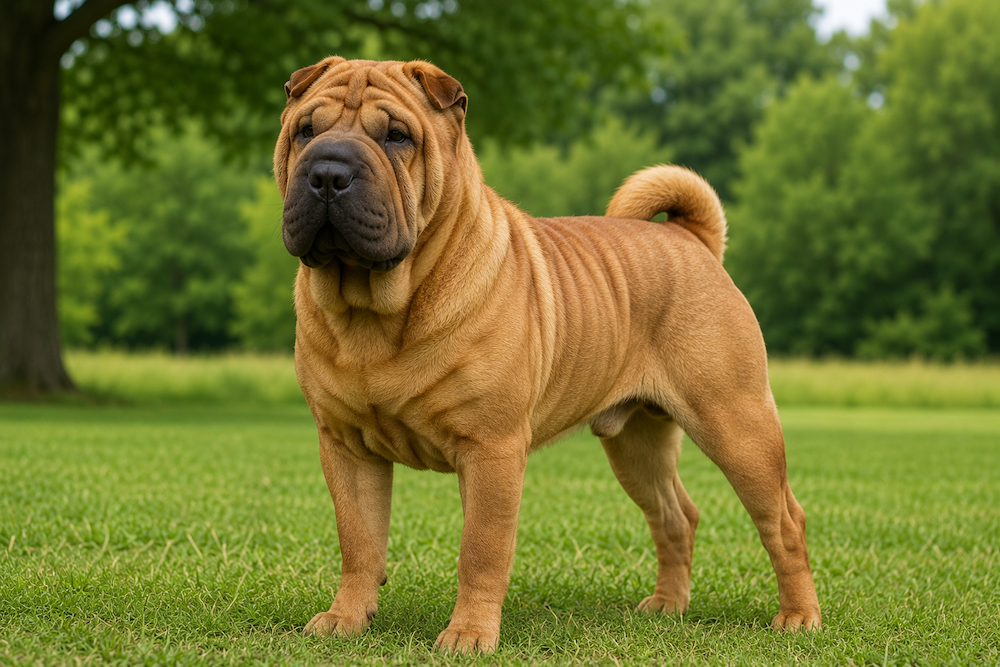







Wrinkled, loyal, and quietly confident — a distinctive companion with a strong independent streak.
🧠 QUICK SNAPSHOT
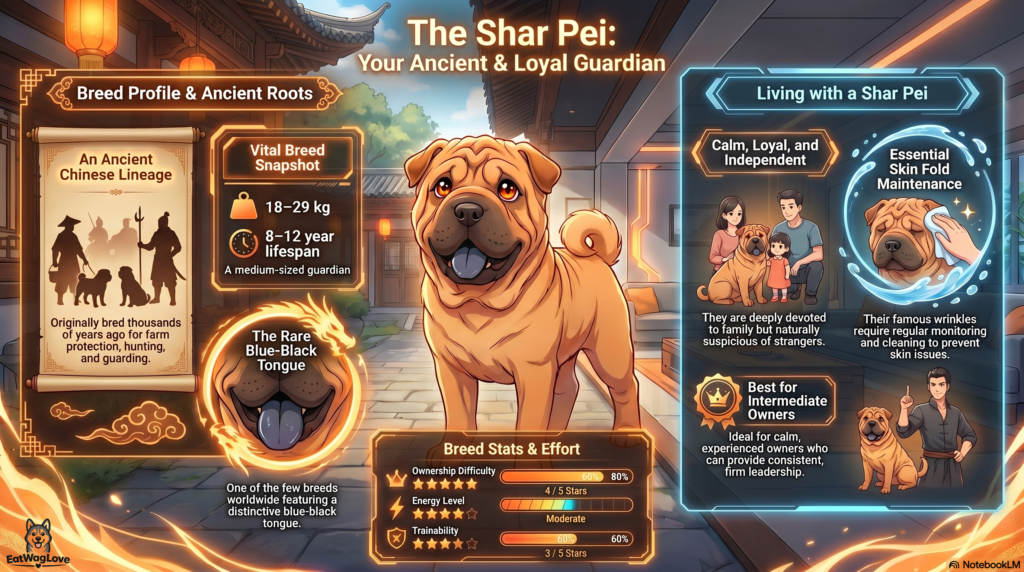
- Temperament: Loyal, independent, calm
- Energy Level: Low to moderate
- Size: Medium
- Good With Families: Yes (with training)
- Trainability: Moderate to low
- Grooming: Low (but skin care needed)
- Best For: Experienced owners, calm households
📚 OVERVIEW
The Shar Pei is a unique breed known for its deep wrinkles and distinctive appearance. Originally developed in China for guarding and hunting, they are naturally protective and reserved.
They are loyal to their family but tend to be independent and cautious around strangers.
✅ PROS & CONS
Pros
- Loyal and protective
- Calm and low-energy indoors
- Low grooming needs
- Unique appearance
Cons
- Can be stubborn
- Needs early socialisation
- Skin care is essential
- Can be wary of strangers
Is a Shar Pei a Good Family Dog?
Yes. Shar Peis can be loyal, calm and deeply devoted family dogs, particularly when properly socialised from puppyhood.
They often form very strong bonds with their household but can be naturally reserved around strangers.
Their independence, guarding instincts and potential health problems mean they’re generally better suited to owners who understand confident, strong-willed breeds.
Are Shar Peis Good With Children?
Shar Peis can be good with respectful children, particularly when raised alongside them.
They’re often protective and affectionate toward their own family, but may not appreciate rough or intrusive handling.
Supervision is important around young children, as it is with any dog.
How Much Exercise Does a Shar Pei Need?
Most adult Shar Peis need around 45–60 minutes of moderate exercise each day.
Daily walks and opportunities to explore are generally sufficient.
They’re not usually extreme endurance dogs, and particular care is needed during hot weather because their short muzzle and skin characteristics can make overheating a concern.
Are Shar Peis Easy to Train?
Shar Peis are intelligent but can be independent, strong-minded and somewhat stubborn.
They were developed to think and act independently rather than constantly seek human direction.
Early, consistent training using positive reinforcement is particularly important, along with extensive socialisation.
Do Shar Peis Shed?
Yes. Shar Peis shed throughout the year, although the amount varies between individuals.
Their very short coat may make the loose hair less visually dramatic than that of a long-haired breed, but it can still accumulate around the home.
Regular brushing helps remove loose hair.
Are Shar Peis Hypoallergenic?
No.
Shar Peis aren’t considered hypoallergenic and can produce allergens through their skin, saliva and dander.
Their short coat doesn’t mean they’re automatically suitable for people with dog allergies.
How Often Should You Groom a Shar Pei?
Shar Peis are relatively straightforward to brush, with weekly grooming usually sufficient for the coat itself.
However, their skin, ears and wrinkles need careful monitoring.
Wrinkles should be kept clean and dry where necessary, and persistent redness, odour, itching or irritation should be investigated by a veterinarian.
Do You Need to Clean a Shar Pei’s Wrinkles?
The skin folds should be regularly checked rather than aggressively or excessively cleaned.
Moisture, dirt and poor ventilation within deeper folds can contribute to irritation or infection.
If cleaning is required, the area should be dried thoroughly afterwards and veterinary advice sought for recurring problems.
What Health Problems Are Common in Shar Peis?
Shar Peis can experience several significant health problems, including skin disease, allergies, ear problems, eye disorders such as entropion and Shar Pei autoinflammatory disease.
Hip and elbow problems can also occur.
Choosing a responsible breeder who prioritises health rather than extreme physical features is particularly important.
What Is Shar Pei Fever?
Shar Pei fever is associated with Shar Pei autoinflammatory disease, an inherited inflammatory disorder found in the breed.
Affected dogs can experience recurring episodes of fever, often accompanied by swelling around the hocks.
Some affected dogs can develop amyloidosis, which may cause serious kidney or other organ damage.
Repeated unexplained fevers in a Shar Pei require veterinary attention.
Why Do Shar Peis Have So Many Skin Problems?
Shar Peis have unusual skin biology as well as their characteristic folds.
The breed’s excessive production of hyaluronan, a substance found within connective tissue, contributes to its thick, wrinkled skin.
Allergies, infections and irritation can also occur, particularly when skin folds trap moisture.
What Is Entropion in Shar Peis?
Entropion occurs when an eyelid rolls inward, causing eyelashes or hair to rub against the surface of the eye.
Shar Peis are particularly susceptible because of their facial structure and heavy skin folds.
It can cause pain and corneal damage and may require surgical treatment.
How Long Do Shar Peis Live?
Shar Peis commonly live around 8–12 years, although individual lifespan varies.
Genetics and inherited health problems can significantly influence longevity.
Responsible breeding, maintaining a healthy weight and regular veterinary monitoring are particularly important.
How Big Does a Shar Pei Get?
Shar Peis are medium-sized dogs.
Adults generally stand approximately 44–51 cm at the shoulder and commonly weigh around 18–30 kg.
Their broad head, compact body and loose skin can make them appear heavier than their height suggests.
Can a Shar Pei Live in an Apartment?
Yes.
Shar Peis can adapt surprisingly well to apartment living because mature dogs are often relatively calm indoors.
They still need daily exercise and mental stimulation, while early training is useful for managing alert or territorial behaviour around neighbours and visitors.
Can Shar Peis Be Left Alone?
Adult Shar Peis can often tolerate reasonable periods alone when gradually accustomed to it.
They’re generally more independent than extremely clingy companion breeds.
However, regular exercise, interaction and enrichment are still essential.
Do Shar Peis Bark a Lot?
Usually not excessively.
Shar Peis tend to be watchful rather than constantly vocal.
They may bark when someone approaches their home or when they detect something unusual, reflecting their historical guarding instincts.
Are Shar Peis Good Guard Dogs?
Shar Peis can be naturally effective watchdogs and protective companions.
They’re often reserved with strangers, confident and highly devoted to their families.
Early socialisation is extremely important so natural watchfulness doesn’t develop into inappropriate suspicion or aggression.
Are Shar Peis Aggressive?
Shar Peis shouldn’t automatically be described as aggressive, but they can be territorial, independent and wary of unfamiliar people or animals.
Genetics, early experiences, socialisation and training have a major influence on adult behaviour.
Responsible breeding for stable temperament is especially important.
Are Shar Peis Good With Other Dogs?
Some are, but dog-to-dog compatibility can be more challenging than with highly sociable breeds.
Shar Peis can be confident and territorial, and some individuals may be selective about other dogs.
Extensive early socialisation and careful introductions are important.
Are Shar Peis Good With Cats?
Shar Peis can live successfully with cats, particularly when raised alongside them.
However, individual prey drive and temperament vary.
Careful introductions and supervision are advisable, especially with unfamiliar cats.
Can Shar Peis Handle Hot Weather?
Care is required in hot weather.
Although their coat is short, Shar Peis have a relatively broad, shortened muzzle and can be susceptible to overheating.
Exercise should be restricted during hot conditions, with constant access to shade, cool surroundings and fresh water.
Why Does a Shar Pei Have a Blue-Black Tongue?
A blue-black or lavender tongue is one of the Shar Pei’s most distinctive characteristics.
The colour results from heavy pigmentation.
The Chow Chow is also famous for having a similarly dark tongue, although the two are separate breeds.
Do Shar Pei Puppies Lose Their Wrinkles?
Shar Pei puppies are often dramatically more wrinkled than adults.
As they grow, the body stretches into much of the loose skin, so many wrinkles become less pronounced.
Adult Shar Peis generally retain obvious wrinkles around areas such as the head, neck and shoulders, although the amount varies.
What Does Shar Pei Mean?
“Shar Pei” is commonly translated from Cantonese as “sand skin”, referring to the breed’s distinctive short, harsh coat.
Running your hand against the direction of the coat can feel surprisingly rough compared with the smooth coat of many short-haired dogs.
What Were Shar Peis Originally Bred For?
Shar Peis developed in China as versatile working dogs used for activities including guarding property, hunting and farm work.
Historical sources also associate the breed with dog fighting, although this doesn’t define the appropriate temperament of today’s companion Shar Pei.
Their working background helps explain their independence and natural watchfulness.
What Is the Difference Between a Shar Pei and a Chow Chow?
Both are ancient-looking Chinese breeds and famously share strongly pigmented tongues, but they’re easily distinguished.
The Chow Chow has a much heavier, fluffier coat, while the Shar Pei has a short, harsh coat and characteristic loose skin and wrinkles.
Both can be independent and reserved with strangers.
Where Does the Shar Pei Come From?
The Shar Pei originated in China, particularly southern China, where dogs of this general type have a long history.
The modern breed came dangerously close to disappearing during the 20th century.
International interest and breeding programmes later helped increase its numbers dramatically.
Did the Shar Pei Nearly Become Extinct?
Yes. By the mid-20th century, Shar Pei numbers had fallen dramatically.
Breeders in Hong Kong and elsewhere worked to preserve the remaining dogs, and an international campaign during the 1970s generated enormous interest in the breed.
The once extremely rare Shar Pei subsequently became known around the world.
Is a Shar Pei a Good First Dog?
Usually, a Shar Pei is better suited to an experienced or thoroughly prepared owner.
Its independence, guarding instincts, socialisation requirements and potential health problems can make ownership more complicated than its relatively calm appearance suggests.
Early training and choosing a responsibly bred puppy are particularly important.
What Makes the Shar Pei Unique?
Few puppies look quite as though they’re wearing a dog several sizes too large, but the Shar Pei manages it beautifully.
Those extraordinary wrinkles made the breed famous around the world.
Yet the Shar Pei has much more unusual biology than simply loose skin. The same breed gives us a harsh coat whose name is associated with “sand skin,” a blue-black tongue, unusually high levels of hyaluronan in its skin and an inherited inflammatory disorder so characteristic that it carries the breed’s name — Shar Pei fever.
Its history is equally remarkable.
The Shar Pei came dangerously close to disappearing before preservation efforts and international attention helped transform it into one of China’s most recognisable dogs.
And although the puppy wrinkles may reduce as the dog grows, the personality rarely disappears with them.
Independent, watchful and fiercely devoted — the Shar Pei has never needed to look like every other dog, and it certainly doesn’t behave like one either.