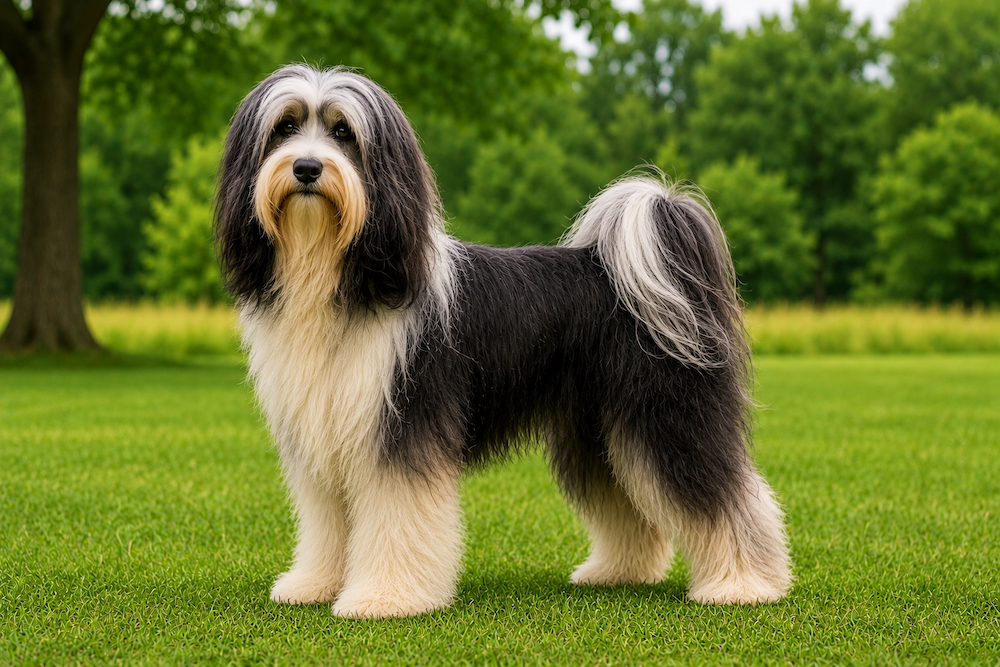







Loyal, adaptable, and full of personality — a shaggy companion with a gentle and affectionate nature.
🧠 QUICK SNAPSHOT
- Temperament: Affectionate, loyal, adaptable
- Energy Level: Moderate
- Size: Medium
- Good With Families: Yes
- Trainability: Moderate
- Grooming: High
- Best For: Families, companionship, indoor living
📚 OVERVIEW
The Tibetan Terrier is a sturdy, medium-sized breed originally bred as a companion and watchdog in Tibetan monasteries. Despite its name, it is not a true terrier but shares a lively and alert personality.
They are affectionate and form strong bonds with their family, thriving in environments where they are included in daily life.
✅ PROS & CONS
Pros
- Loyal and affectionate
- Adaptable to different living environments
- Good with families
- Alert and watchful
Cons
- Requires regular grooming
- Can be sensitive
- Needs companionship
- May be cautious with strangers
Is a Tibetan Terrier a Good Family Dog?
Yes. Tibetan Terriers can make affectionate, loyal and adaptable family dogs.
They tend to form very strong relationships with their families and enjoy being involved in everyday life. Despite their name, they aren’t true terriers and generally have a very different temperament from traditional vermin-hunting terrier breeds.
Are Tibetan Terriers Good With Children?
Generally, yes. Tibetan Terriers are often playful and affectionate with respectful children.
Their medium size makes them sturdier than many small companion breeds, although interactions with young children should still be supervised.
Early socialisation helps them become confident around different people and situations.
How Much Exercise Does a Tibetan Terrier Need?
Most Tibetan Terriers need around 60 minutes of exercise each day, although active individuals may enjoy considerably more.
Daily walks, play, hiking and training can all help satisfy their needs.
They’re energetic without generally requiring the intensive exercise of many high-drive working breeds.
Are Tibetan Terriers Easy to Train?
Tibetan Terriers are intelligent and capable learners, but they can also be independent and sensitive.
Positive reinforcement and patient, consistent training generally work best.
They often respond poorly to harsh or repetitive training methods.
Do Tibetan Terriers Shed a Lot?
Tibetan Terriers are generally considered low-shedding dogs.
Their loose hair tends to become caught within the coat rather than being deposited extensively around the home.
This doesn’t make their coat low maintenance — regular grooming is essential.
Are Tibetan Terriers Hypoallergenic?
Tibetan Terriers are often described as hypoallergenic because they shed relatively little, but no dog is completely hypoallergenic.
Dog allergens are also present in saliva and skin secretions.
People with allergies should spend time around adult Tibetan Terriers before deciding whether the breed is suitable.
How Often Should You Groom a Tibetan Terrier?
A Tibetan Terrier’s long double coat requires thorough brushing several times a week, potentially daily depending on coat length and lifestyle.
Without regular grooming, tangles and mats can develop quickly.
Many pet owners choose a shorter trim to make everyday coat maintenance easier.
What Health Problems Are Common in Tibetan Terriers?
Potential health concerns include hip dysplasia, patellar luxation and inherited eye disorders such as progressive retinal atrophy and lens luxation.
Certain neurological conditions can also occur within the breed.
Responsible breeders should perform appropriate health and genetic screening.
How Long Do Tibetan Terriers Live?
Tibetan Terriers commonly live around 12–15 years, with some reaching their later teens.
Maintaining a healthy weight, providing regular exercise and arranging appropriate preventive veterinary care can help support a long life.
How Big Does a Tibetan Terrier Get?
Tibetan Terriers are medium-sized dogs, generally standing around 35–41 cm at the shoulder and weighing approximately 8–14 kg.
Despite their abundant coats, they’re relatively compact and agile underneath all that hair.
Can a Tibetan Terrier Live in an Apartment?
Yes. Tibetan Terriers can adapt well to apartment living if given sufficient daily exercise.
They’re moderately sized and generally capable of settling indoors.
Their tendency to alert-bark can be a consideration when living close to neighbours.
Can Tibetan Terriers Be Left Alone?
Adult Tibetan Terriers can learn to tolerate reasonable periods alone, but they’re strongly attached to their families.
They generally prefer being included in household activities.
Long periods of isolation may contribute to boredom, barking or separation-related behaviour in some individuals.
Do Tibetan Terriers Bark a Lot?
They can be quite alert and vocal.
Tibetan Terriers historically helped alert people to approaching strangers, and many modern dogs retain strong watchdog instincts.
Early training can help prevent alert barking from becoming excessive.
Are Tibetan Terriers Good Watchdogs?
Yes. Tibetan Terriers can make excellent watchdogs.
They’re naturally observant and often reserved with unfamiliar people, making them quick to notice unusual activity.
Their role is much more suited to raising an alarm than physically guarding property.
Are Tibetan Terriers Affectionate?
Yes. Tibetan Terriers are generally affectionate and deeply devoted to their families.
Many enjoy cuddling and staying close to their owners without necessarily demanding constant attention.
Their strong attachment to people is one of the breed’s most appealing characteristics.
Are Tibetan Terriers Good With Strangers?
Tibetan Terriers can be reserved around unfamiliar people.
They’re generally not expected to greet every stranger as an immediate best friend.
Good early socialisation helps ensure their natural caution develops into calm confidence rather than excessive nervousness.
Are Tibetan Terriers Good With Other Dogs?
Generally, yes.
Well-socialised Tibetan Terriers can live very successfully with other dogs and often enjoy canine companionship.
As always, individual temperament and appropriate introductions matter.
Are Tibetan Terriers Good With Cats?
Many Tibetan Terriers can live successfully with cats, particularly when raised alongside them.
Because they aren’t true hunting terriers, they don’t necessarily have the intense vermin-hunting drive associated with some breeds carrying the terrier name.
Individual prey drive can still vary.
Are Tibetan Terriers High-Energy Dogs?
They’re generally moderately energetic.
Tibetan Terriers enjoy walks, games and outdoor adventures but are usually capable of relaxing at home after their exercise needs have been met.
They’re often particularly well suited to owners looking for an active companion without extreme exercise demands.
Are Tibetan Terriers Smart?
Yes. Tibetan Terriers are intelligent and excellent problem solvers.
Their intelligence is combined with an independent streak, so they may occasionally decide there are more interesting things to do than repeat an exercise they’ve already mastered.
Mental stimulation helps keep them engaged.
Why Do Tibetan Terriers Have Such Large, Flat Feet?
One of the Tibetan Terrier’s most fascinating features is its large, broad, relatively flat feet.
These helped dogs move across the rugged and snowy terrain of Tibet.
They’re sometimes compared with natural snowshoes because their broad surface helps distribute the dog’s weight.
Why Does a Tibetan Terrier Have Hair Over Its Eyes?
The Tibetan Terrier’s long coat naturally falls forward over the face and eyes.
Traditionally, this hair provided some protection from harsh weather, wind and bright conditions.
Despite appearances, many Tibetan Terriers can see surprisingly well through the falling hair, although owners must keep the area clean and ensure vision isn’t impaired.
What Colours Do Tibetan Terriers Come In?
Tibetan Terriers occur in a very wide variety of colours and patterns.
These include white, black, gold, cream, grey, brindle and various combinations.
The breed’s identity isn’t defined by one particular coat colour.
Is a Tibetan Terrier Actually a Terrier?
No. Despite its name, the Tibetan Terrier isn’t a true terrier.
European visitors applied the term because the dogs reminded them of terriers in size and general appearance.
Historically, Tibetan Terriers were companions, watchdogs and versatile working dogs, not specialised vermin-hunting terriers.
What Is the Difference Between a Tibetan Terrier and a Tibetan Spaniel?
The Tibetan Terrier is substantially larger and has a long, shaggy double coat.
The Tibetan Spaniel is a much smaller companion and alert dog, usually weighing only around 4–7 kg.
Interestingly, neither breed fits neatly into the traditional Western definition suggested by its name — the Tibetan Terrier isn’t really a terrier, and the Tibetan Spaniel isn’t a sporting spaniel.
What Were Tibetan Terriers Originally Bred For?
Tibetan Terriers were versatile dogs that served as companions, watchdogs and general-purpose working dogs in Tibet.
They became particularly associated with monasteries and Tibetan communities.
Their agility and broad feet were useful when travelling through difficult mountainous terrain.
Where Does the Tibetan Terrier Come From?
The Tibetan Terrier originated in Tibet, where dogs of this type existed for centuries.
They were valued as companions and working dogs and became associated with Buddhist monasteries.
The modern breed outside Tibet developed after examples were brought to Europe during the 20th century.
Were Tibetan Terriers Considered Lucky?
Tibetan Terriers have often been described as “Holy Dogs of Tibet” or associated with good fortune.
Historical accounts describe these dogs as highly valued companions that could be given as gifts rather than simply treated as ordinary commodities.
Some of the more romantic stories surrounding the breed are difficult to verify precisely, but the association with Tibetan monasteries and valued companionship is an important part of its history.
Is a Tibetan Terrier a Good First Dog?
Yes. A Tibetan Terrier can be a good first dog for an owner prepared for its grooming requirements.
They’re intelligent, affectionate, adaptable and have manageable exercise needs.
The main challenges are their substantial coat maintenance, independent streak and potential alert barking.
What Makes the Tibetan Terrier Unique?
The Tibetan Terrier has one of the most misleading names in the dog world.
It’s from Tibet.
But it isn’t actually a terrier.
These shaggy dogs developed as versatile companions and watchdogs in a landscape containing mountains, snow and extremely challenging terrain.
And evolution and selective breeding left them with a particularly interesting piece of equipment:
their feet.
Tibetan Terriers have unusually broad, flat feet that helped them negotiate difficult terrain and are often compared with natural snowshoes.
Add a thick protective double coat, hair falling over the eyes and remarkable agility, and you get a dog beautifully suited to its historical environment.
Today, most Tibetan Terriers aren’t negotiating Himalayan mountain trails.
But underneath that enormous shaggy coat is still a surprisingly agile little dog equipped with its own set of four furry snowshoes.