






Compact, mischievous, and full of personality — a bold little dog with endless energy and charm.
🧠 QUICK SNAPSHOT
- Temperament: Playful, bold, affectionate
- Energy Level: High
- Size: Small to medium
- Good With Families: Yes
- Trainability: Moderate
- Grooming: Low
- Best For: Active owners, experienced families
📚 OVERVIEW
The Miniature Bull Terrier is a smaller version of the Bull Terrier, sharing the same distinctive egg-shaped head and lively personality. They are energetic, entertaining dogs that love attention and interaction.
They are affectionate with their family and thrive in homes where they receive plenty of engagement and structure.
✅ PROS & CONS
Pros
- Fun and playful personality
- Loyal and affectionate
- Low grooming requirements
- Unique appearance
Cons
- Can be stubborn and strong-willed
- High energy levels
- Needs consistent training
- Requires mental stimulation
Is a Miniature Bull Terrier a Good Family Dog?
Yes. The Miniature Bull Terrier can be an affectionate, playful, loyal and highly entertaining family dog in the right household.
They’re often extremely devoted to their people and have a famously clownish personality. However, they’re also strong, energetic and determined terriers, so early training and socialisation are important.
They generally suit families that enjoy an active, confident dog rather than a quiet lap dog.
How Much Exercise Does a Miniature Bull Terrier Need?
Most adults need around 60–90 minutes of exercise each day, combined with play and mental stimulation.
Walks alone may not completely satisfy them. Games, scent work, training and controlled opportunities to explore can help channel their considerable energy.
Young dogs should avoid excessive repetitive impact while their joints are developing.
Is a Miniature Bull Terrier a High-Energy Dog?
Yes.
They’re energetic, muscular dogs that often retain a playful, puppy-like attitude well into adulthood.
They can settle around the house after sufficient activity, but an under-exercised Miniature Bull Terrier may invent its own entertainment — and its ideas may involve furniture.
Is a Miniature Bull Terrier Easy to Train?
They’re intelligent but not always easy.
Miniature Bull Terriers can learn quickly, yet they also possess the independence and persistence of a genuine terrier.
Short, varied training sessions using food, toys and positive reinforcement generally work better than repetitive obedience drills.
Are Miniature Bull Terriers Intelligent?
Yes.
Their intelligence tends to combine problem-solving ability with independent decision-making.
They can learn obedience, tricks and dog sports very successfully, although understanding a command doesn’t necessarily guarantee immediate agreement with it.
Are Miniature Bull Terriers Stubborn?
They certainly can be.
Persistence was useful in the breed’s terrier ancestors, so giving up easily was never an especially desirable characteristic.
Owners need consistency, patience and a sense of humour.
Are Miniature Bull Terriers Difficult to Toilet Train?
Usually not exceptionally difficult, although individual puppies vary.
A consistent routine, frequent outdoor opportunities and immediate rewards generally produce good results.
Their strong personalities make consistency particularly important.
Does a Miniature Bull Terrier Shed?
Yes, but generally not excessively.
The breed has a short, flat, harsh-textured coat that sheds moderately.
A weekly brushing or grooming mitt is usually sufficient.
Is a Miniature Bull Terrier Hypoallergenic?
No.
The short coat still sheds and the dog produces normal canine allergens through skin and saliva.
A short-haired breed isn’t automatically an allergy-friendly breed.
How Often Should You Groom a Miniature Bull Terrier?
Usually once a week.
The coat requires very little specialist maintenance.
Nail trimming, dental care and checking the ears are generally more time-consuming than coat grooming.
Does a Miniature Bull Terrier Need Haircuts?
No.
The coat naturally remains short.
Clipping or shaving isn’t required.
What Health Problems Are Common in Miniature Bull Terriers?
Important concerns can include primary lens luxation, deafness, kidney disease, heart disease, patellar luxation and skin problems.
Some lines can also be affected by neurological or behavioural conditions.
Responsible breeders should use appropriate DNA testing and health screening rather than relying on appearance alone.
What Is Primary Lens Luxation in Miniature Bull Terriers?
Primary lens luxation, or PLL, is an inherited eye disorder in which the fibres holding the lens in position deteriorate.
The lens can move from its normal location, potentially causing severe pain, glaucoma and blindness.
A DNA test is available, making responsible genetic management particularly important.
Are Miniature Bull Terriers Prone to Deafness?
Yes.
Congenital deafness occurs in Bull Terriers and Miniature Bull Terriers, particularly in white dogs, although coloured dogs can also be affected.
A BAER hearing test can objectively determine whether a dog hears normally in both ears.
Are Miniature Bull Terriers Prone to Kidney Problems?
Inherited kidney disease is an important concern within Bull Terrier-type populations.
Responsible breeding programmes may include kidney testing alongside cardiac, hearing and eye screening.
Increased thirst, urination or unexplained weight loss should always receive veterinary attention.
Are Miniature Bull Terriers Prone to Heart Problems?
Some are.
Inherited heart abnormalities can occur, including conditions affecting the valves and structure of the heart.
Cardiac screening of breeding dogs can help reduce risk.
Are Miniature Bull Terriers Prone to Skin Problems?
They can be.
Allergies and other skin conditions can cause itching, redness, recurrent infections and paw licking.
White dogs can also be more susceptible to sun-related skin damage on exposed areas.
How Long Does a Miniature Bull Terrier Live?
Miniature Bull Terriers commonly live around 11–14 years.
Genetics, healthy weight, appropriate exercise and preventive veterinary care all influence longevity.
Responsible health screening is particularly valuable because several inherited conditions are known within the breed.
How Big Does a Miniature Bull Terrier Get?
The Miniature Bull Terrier is generally no more than about 35.5 cm at the shoulder under major breed standards.
Weight can vary considerably because the standard emphasises a powerful, balanced dog rather than a specific weight.
Many adults weigh approximately 9–16 kg, although individuals can fall outside that range.
Is There a Maximum Weight for a Miniature Bull Terrier?
Not necessarily under every breed standard.
Size is generally controlled primarily through height rather than a strict weight limit.
The dog should look muscular and substantial without becoming overweight.
Is There a Teacup Miniature Bull Terrier?
No.
There is no recognised Teacup Miniature Bull Terrier.
The Miniature Bull Terrier is already the established smaller version of the Bull Terrier, and breeding for extreme tiny size could compromise health and structure.
Is There a Toy Bull Terrier?
Historically, extremely small Bull Terriers existed and were sometimes called Toy Bull Terriers.
They eventually disappeared as a recognised variety.
The modern Miniature Bull Terrier shouldn’t be confused with attempts to recreate exceptionally tiny dogs for marketing purposes.
Can a Miniature Bull Terrier Live in an Apartment?
Yes, provided its exercise and behavioural needs are properly met.
Its compact size can work well in smaller homes.
However, boredom, energetic play and potential dog reactivity can make apartment life challenging without committed management.
Does a Miniature Bull Terrier Need a Backyard?
No, although a securely fenced garden is useful.
Daily exercise, training and mental stimulation matter more than simply having outdoor space.
A bored dog left alone in a backyard won’t necessarily exercise itself.
Can a Miniature Bull Terrier Be Left Alone?
Adult dogs can learn to tolerate reasonable periods alone.
However, Miniature Bull Terriers often form strong bonds with their owners and can become bored or destructive when routinely left for long periods.
Gradual independence training should begin early.
Are Miniature Bull Terriers Prone to Separation Anxiety?
Some can be.
Their strong attachment to people can make sudden isolation difficult.
Exercise, enrichment and teaching calm independence can help reduce the risk.
Are Miniature Bull Terriers Velcro Dogs?
Many are surprisingly people-oriented.
They may follow their owners around the house, demand involvement in family activities and position themselves inconveniently close whenever possible.
Their tough appearance can conceal an extremely affectionate personality.
Are Miniature Bull Terriers Cuddly?
Many are very cuddly.
They often enjoy leaning against people, sitting far closer than necessary and sleeping beside their owners.
A Miniature Bull Terrier may be compact, but that doesn’t mean it has accepted the concept of personal space.
Are Miniature Bull Terriers Good With Children?
They can be excellent with respectful children.
They’re playful, affectionate and sturdy, but their muscular bodies and enthusiastic behaviour can accidentally knock over smaller children.
Supervision and good manners on both sides are important.
Are Miniature Bull Terriers Good With Other Dogs?
It varies considerably.
Some live happily with other dogs, while others can become dog-selective or confrontational as they mature.
Early socialisation helps, but owners shouldn’t assume that puppy friendliness guarantees universal adult dog sociability.
Are Miniature Bull Terriers Good With Cats?
Some can live successfully with cats, particularly when raised together.
However, terrier ancestry means prey drive can be significant.
Introductions should be carefully managed.
Can Miniature Bull Terriers Live With Rabbits or Guinea Pigs?
They’re generally not an ideal combination.
Terriers were historically selected to pursue small animals, and individual prey drive can be strong.
Physical separation is safest around small pets.
Do Miniature Bull Terriers Have a Strong Prey Drive?
Many do.
Their ancestry includes terriers developed for vermin control.
Moving animals, squirrels, rabbits and other small creatures can trigger chasing.
Are Miniature Bull Terriers Good Off Leash?
Some develop reliable recall, but secure areas are preferable.
Terrier prey drive, independence and enthusiasm can override recall in highly exciting situations.
Training should begin early and be heavily reinforced.
Are Miniature Bull Terriers Aggressive?
Aggression toward people isn’t a defining characteristic of a well-bred Miniature Bull Terrier.
However, they’re powerful, confident terriers and some individuals can show dog-directed aggression or strong prey behaviour.
Responsible breeding, socialisation, training and management matter enormously.
Are Miniature Bull Terriers Friendly With Strangers?
Many are friendly and curious.
Others may initially be more reserved.
They’re generally more people-oriented than their formidable appearance might suggest.
Are Miniature Bull Terriers Good Guard Dogs?
They’re not primarily specialist guard dogs.
Their appearance can certainly provide a deterrent, and many will alert to unusual activity.
The breed was developed around terrier and Bull Terrier functions rather than formal property protection.
Do Miniature Bull Terriers Bark a Lot?
Usually not excessively compared with some smaller terriers.
They can certainly bark when excited, bored or alerting to something unusual.
Individual behaviour varies considerably.
When Does a Miniature Bull Terrier Calm Down?
Many begin becoming noticeably more settled around two to three years old.
Some retain a remarkably juvenile personality for much longer.
The breed is famous for continuing to behave like a muscular puppy well into adulthood.
Do Miniature Bull Terriers Get the Zoomies?
Absolutely.
They’re particularly famous for explosive bursts of running, spinning and general chaos.
Bull Terrier owners sometimes refer to these episodes as “hucklebutting.”
What Is Hucklebutting in a Bull Terrier?
Hucklebutting is an informal Bull Terrier term for frantic bursts of playful activity.
The dog may sprint, spin, tuck its rear end and race around furniture with apparently questionable regard for conventional traffic rules.
Miniature Bull Terriers can be enthusiastic practitioners.
Why Does My Miniature Bull Terrier Spin Around?
Excited spinning can simply be playful behaviour.
However, persistent repetitive tail chasing or spinning can sometimes become compulsive in Bull Terrier-type dogs.
If it becomes frequent, difficult to interrupt or causes injury, veterinary behavioural assessment is appropriate.
Are Miniature Bull Terriers Prone to Compulsive Tail Chasing?
Some Bull Terriers and Miniature Bull Terriers can develop repetitive tail-chasing behaviour.
In severe cases, this isn’t simply funny play but a potentially serious compulsive disorder.
Early veterinary assessment is worthwhile if the behaviour becomes excessive.
Are Miniature Bull Terriers Good Running Dogs?
Healthy adults can enjoy running, although they’re not specialist long-distance endurance dogs.
Their muscular build suits energetic shorter runs and varied exercise.
Structured running should wait until the dog has physically matured.
Are Miniature Bull Terriers Good Hiking Dogs?
Yes.
Their compact size, strength and adventurous temperament can make them enjoyable hiking companions.
Weather, fitness and interactions with wildlife or unfamiliar dogs need sensible management.
Can Miniature Bull Terriers Swim?
Some can swim, but they aren’t specialised water dogs.
Their muscular, relatively heavy build means individual swimming ability varies.
A canine life jacket is sensible around deep water until the dog’s ability is known.
Can Miniature Bull Terriers Handle Cold Weather?
They can tolerate moderate cold but have little insulation compared with double-coated breeds.
Their short coat means some appreciate additional protection during cold or wet weather.
They shouldn’t be expected to live outdoors in harsh conditions.
Can Miniature Bull Terriers Handle Hot Weather?
Reasonably, but strenuous exercise should be avoided during extreme heat.
Their short coat doesn’t eliminate the risk of overheating.
White dogs also need protection from excessive sun exposure on sparsely haired skin.
What Does a Miniature Bull Terrier Look Like?
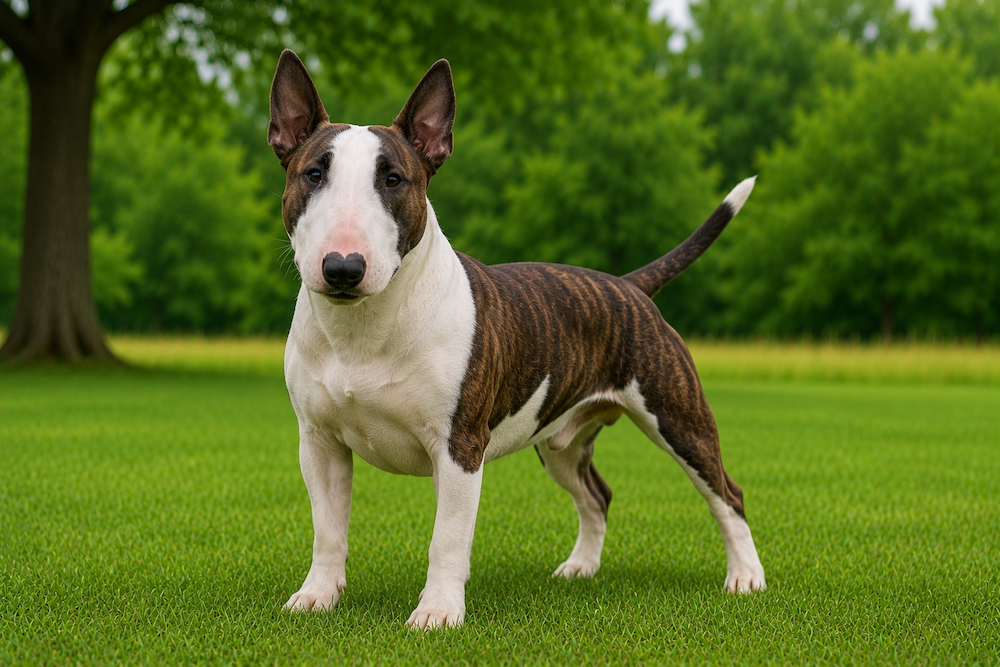
The Miniature Bull Terrier is a compact, muscular dog with an unmistakable egg-shaped head, tiny triangular eyes, erect ears and powerful body.
Its head curves downward from the top of the skull to the nose with very little obvious stop.
Few breeds have such an instantly recognisable profile.
Why Does a Miniature Bull Terrier Have an Egg-Shaped Head?
The modern head shape resulted from generations of selective breeding.
Early Bull Terriers had more conventional heads.
Breeders gradually selected the distinctive curved profile now known as the downface, producing the modern egg-shaped appearance.
What Is “Downface” in a Bull Terrier?
Downface describes the smooth convex curve running from the top of the Bull Terrier’s skull toward the nose.
Ideally, the profile shouldn’t have the pronounced stop seen in many other breeds.
This feature became one of the defining characteristics of both Bull Terrier varieties.
Why Are a Miniature Bull Terrier’s Eyes So Small?
Small triangular eyes are part of the breed’s established standard and contribute enormously to its distinctive expression.
They’re one of the few breeds where a triangular eye shape is specifically characteristic.
The combination of egg-shaped head, erect ears and triangular eyes is unmistakable.
What Colours Can Miniature Bull Terriers Be?
Miniature Bull Terriers can be white or coloured.
Coloured dogs may include brindle, black brindle, red, fawn and tricolour patterns, often with white markings.
Accepted details vary somewhat between kennel organisations.
Can a Miniature Bull Terrier Be Brindle?
Yes.
Brindle is a traditional and important colour within Bull Terrier populations.
Dark striping over a lighter base can range from obvious tiger-like markings to extremely dark brindling.
Can a Miniature Bull Terrier Be Black?
Dogs can appear predominantly black, although recognised colour patterns commonly involve black brindle or tricolour rather than an entirely featureless solid-black coat.
Breed-standard terminology varies.
Can a Miniature Bull Terrier Be Blue?
Blue isn’t a traditional recognised Miniature Bull Terrier colour.
Dogs marketed primarily as “rare blue Mini Bulls” should prompt questions about breeding priorities and pedigree.
Rare colour should never take precedence over health testing.
Can a Miniature Bull Terrier Be Merle?
Merle isn’t a traditional colour in the Bull Terrier or Miniature Bull Terrier.
A merle dog marketed as purebred indicates ancestry outside the recognised breed population.
It isn’t simply a rare colour mutation routinely found within the breed.
Why Are Some Miniature Bull Terriers Completely White?
The famous white Bull Terrier was deliberately developed during the Victorian period.
For many years, white became strongly associated with the breed’s identity.
Coloured Bull Terriers later became an important part of the recognised population.
Why Can White Miniature Bull Terriers Be Deaf?
Genes responsible for extensive white pigmentation can interfere with development of pigment-producing cells needed for normal function of the inner ear.
This relationship occurs in several predominantly white dog populations.
It doesn’t mean every white Miniature Bull Terrier is deaf, which is why BAER testing is useful.
Is a Miniature Bull Terrier Just a Small Bull Terrier?
Essentially, they’re extremely closely related and share the same fundamental breed type, but the Miniature Bull Terrier is now treated as a distinct recognised breed or variety depending on the kennel organisation.
Its history developed alongside the larger Bull Terrier rather than simply being a recent downsized copy.
What Is the Difference Between a Bull Terrier and a Miniature Bull Terrier?
The most obvious difference is size.
The Miniature Bull Terrier retains the muscular body, egg-shaped head, triangular eyes and clownish personality of the larger Bull Terrier in a considerably smaller package.
Historically, both descend from the same broad bull-and-terrier population.
Is a Miniature Bull Terrier the Same as a Staffordshire Bull Terrier?
No.
They’re distinct breeds.
Both ultimately have ancestry in Britain’s historical bull-and-terrier dogs, but they developed along different paths and now have very different breed standards.
Is a Miniature Bull Terrier the Same as an American Pit Bull Terrier?
No.
Although both ultimately connect to old bull-and-terrier ancestry, they’re separate populations with different histories and physical characteristics.
The Miniature Bull Terrier’s egg-shaped head alone makes the distinction obvious.
Is a Miniature Bull Terrier a Pit Bull?
“Pit bull” is used inconsistently, sometimes describing a specific breed and sometimes a broader group of bull-type dogs.
The Miniature Bull Terrier is its own recognised breed and shouldn’t simply be relabelled as an American Pit Bull Terrier.
Local legislation may nevertheless use broad legal definitions, so owners should check applicable rules.
Is the Miniature Bull Terrier a True Terrier?
Yes, although its ancestry combines terrier and bulldog-type dogs.
The terrier contribution brought speed, determination and vermin-hunting ability.
The bulldog side contributed strength and tenacity.
Where Does the Miniature Bull Terrier Come From?
The Miniature Bull Terrier developed in England from the same 19th-century bull-and-terrier populations that produced the larger Bull Terrier.
Breeders maintained smaller examples for ratting, companionship and sport.
Over time, these smaller dogs developed into the modern Miniature Bull Terrier.
What Were Bull-and-Terrier Dogs?
Bull-and-terriers were crosses and working populations combining old bulldog-type dogs with terriers.
Breeders sought to combine strength and determination with speed, agility and terrier persistence.
They existed before modern pedigree breed standards separated their descendants into recognisable breeds.
Were Miniature Bull Terriers Originally Fighting Dogs?
Their distant bull-and-terrier ancestors were associated with blood sports, including dog fighting, during a period when such activities occurred in Britain.
However, the modern Miniature Bull Terrier was shaped through later selective breeding and kennel-club development.
It shouldn’t be described simply as a miniature fighting dog.
Were Miniature Bull Terriers Used for Ratting?
Yes.
Small bull-and-terrier dogs were particularly useful for vermin control and ratting.
Their compact size, speed and determination made this practical work well suited to them.
This helps explain why strong prey drive can remain in modern dogs.
Why Were Small Bull Terriers Developed?
Small dogs were practical for ratting and vermin control, while some people simply preferred a more compact companion.
Victorian breeders experimented with Bull Terriers across a surprisingly broad size range.
At one point, some examples became dramatically smaller than today’s Miniature Bull Terrier.
Did Toy Bull Terriers Really Exist?
Yes.
Extremely small Bull Terriers were exhibited historically as Toy Bull Terriers.
Some reportedly weighed only a few kilograms.
However, excessive miniaturisation created problems with maintaining the characteristic Bull Terrier appearance and sound structure, and the Toy variety eventually disappeared.
Why Did the Toy Bull Terrier Disappear?
Breeders struggled to combine extremely tiny size with the substantial, muscular structure expected of a Bull Terrier.
Very small dogs could become fine-boned or lose characteristic breed type.
Eventually the extreme Toy form fell out of favour, while the more substantial Miniature Bull Terrier survived.
Who Was James Hinks?
James Hinks of Birmingham was one of the most important figures in the development of the modern Bull Terrier during the 19th century.
He refined earlier bull-and-terrier dogs into a more uniform and distinctive type.
His dogs helped establish the foundation from which both modern Bull Terriers and Miniature Bull Terriers ultimately developed.
Did James Hinks Create the Miniature Bull Terrier?
Not specifically in the modern sense.
Hinks was central to developing the refined Bull Terrier type from earlier bull-and-terrier stock.
Dogs existed in multiple sizes, and the smaller population was subsequently developed into the Miniature Bull Terrier.
Why Were James Hinks’ Bull Terriers White?
Hinks became particularly associated with elegant white Bull Terriers.
The white dogs became fashionable and were sometimes known as “White Cavaliers.”
Later breeding reintroduced or incorporated coloured lines into the broader Bull Terrier population.
What Was the White Cavalier?
“White Cavalier” became a famous nickname for the white Bull Terrier.
It reflected the breed’s reputation for combining courage with a more gentlemanly show-ring image than its rough bull-and-terrier ancestors.
The phrase remains part of Bull Terrier history.
Did Bull Terriers Always Have Egg-Shaped Heads?
No.
Early photographs and illustrations show Bull Terriers with much more conventional head shapes.
The dramatic modern downface became increasingly pronounced through selective breeding during the late 19th and 20th centuries.
The breed’s appearance therefore changed substantially after its initial development.
Was the Dalmatian Used to Develop the Bull Terrier?
Dalmatian ancestry is traditionally associated with the development of the refined Bull Terrier.
It may have contributed elegance, leg length and movement.
Exact historical breed recipes aren’t perfectly documented, so overly precise percentages or claims should be avoided.
Was the English White Terrier Used to Develop the Bull Terrier?
The extinct English White Terrier is traditionally considered an important contributor to the Bull Terrier developed by James Hinks.
Old bulldog-type dogs provided another major component.
Other breeds may also have contributed during later refinement.
What Was the English White Terrier?
The English White Terrier was a Victorian-era British terrier breed characterised by its white coat and relatively refined appearance.
It eventually disappeared as a distinct breed.
Its ancestry survives indirectly through several breeds to which it contributed, including the Bull Terrier.
Why Did the English White Terrier Become Extinct?
The breed experienced health and breeding problems, including congenital deafness associated with extensive white colouring.
Changing fashions and competition from other terriers also contributed.
By the early 20th century it had effectively disappeared as a distinct breed.
When Did the Miniature Bull Terrier Become a Separate Breed?
Small Bull Terriers existed during the 19th century, but establishing a consistent modern Miniature Bull Terrier took considerably longer.
Breed enthusiasts worked to preserve the smaller type after its numbers declined, eventually achieving formal recognition under modern kennel systems.
Did the Miniature Bull Terrier Nearly Become Extinct?
Yes.
By the early-to-mid 20th century, the Miniature Bull Terrier population had declined dramatically.
Maintaining consistent size and type proved difficult, and formal recognition was lost in Britain for a period.
Dedicated enthusiasts subsequently rebuilt the breed.
Why Did Miniature Bull Terriers Lose Kennel Club Recognition?
Early breeders had difficulty producing a consistent population within the desired size range.
The variety became sufficiently uncommon and inconsistent that its separate status declined.
Later breeders organised more systematic efforts to restore the Miniature Bull Terrier.
Who Helped Save the Miniature Bull Terrier?
British breed enthusiasts established the Miniature Bull Terrier Club in the 1930s, helping organise and preserve the remaining population.
Their breeding efforts were critical to the survival and eventual restoration of formal recognition.
The modern breed owes much of its existence to this recovery work.
When Was the Miniature Bull Terrier Recognised Again in Britain?
The breed regained recognition by The Kennel Club in 1939 after enthusiasts successfully re-established the smaller Bull Terrier population.
This was an important milestone in its recovery.
When Did the AKC Recognise the Miniature Bull Terrier?
The American Kennel Club recognised the Miniature Bull Terrier as a separate breed in 1991.
Before that, Bull Terrier history in America was centred primarily on the standard-sized breed.
Why Did Breeders Cross Miniature Bull Terriers With Standard Bull Terriers?
At various stages, carefully managed crossing with Standard Bull Terriers helped maintain or restore breed type and genetic diversity while breeders worked to stabilise the miniature population.
The challenge was preserving the characteristic Bull Terrier appearance while keeping dogs within the required height.
Why Isn’t the Miniature Bull Terrier Simply Bred Smaller and Smaller?
Because extreme miniaturisation can compromise structure, health and breed type.
The goal is a powerful, substantial Bull Terrier in a smaller body, not the tiniest possible dog.
That’s why height limits are more meaningful than marketing labels such as “micro” or “teacup.”
Why Does a Miniature Bull Terrier Look So Muscular?
The breed was deliberately selected to retain the substance and power of the Bull Terrier despite reduced height.
A correct Miniature Bull Terrier should therefore look compact and muscular rather than delicate.
It’s essentially a surprisingly large amount of dog packed into a relatively small frame.
Why Do Miniature Bull Terriers Act Like Clowns?
The breed is famous for exaggerated play, unusual sleeping positions, sudden zoomies and persistent attempts to participate in whatever its family is doing.
Generations of owners have described Bull Terriers as clownish, mischievous and entertaining.
It’s one of the breed’s most endearing characteristics — assuming you’re prepared to be part of the performance.
Why Does My Miniature Bull Terrier Lean on Me?
Leaning can simply be a way of seeking physical contact and attention.
Many Bull Terriers are remarkably affectionate with their families.
A compact muscular dog pressing its entire body against your leg may apparently consider this a subtle gesture.
Why Does My Miniature Bull Terrier Sleep in Strange Positions?
Bull Terriers seem unusually talented at sleeping upside down, twisted around cushions or with their heads hanging somewhere that appears profoundly uncomfortable.
There’s no special medical explanation required for ordinary examples.
They’re simply a breed with considerable enthusiasm for doing normal things strangely.
Are Miniature Bull Terriers Good at Dog Sports?
Yes.
They can enjoy agility, obedience, rally, scent work, trick training and other activities suited to their build and temperament.
Variety is important because repetitive exercises can quickly lose their appeal.
Is a Miniature Bull Terrier a Good Dog for Older People?
Potentially, for active owners comfortable managing a strong terrier.
Their smaller size is easier to handle than a Standard Bull Terrier, but they remain muscular, energetic and determined.
They’re not necessarily an easy low-energy small dog.
Is a Miniature Bull Terrier a Good First Dog?
It can be, but it’s not among the easiest beginner breeds.
A committed first-time owner can succeed with good training and support, but needs to be prepared for terrier independence, prey drive, high-energy play, possible dog selectivity and considerable determination.
What Makes the Miniature Bull Terrier Unique?
The Miniature Bull Terrier isn’t simply a Bull Terrier that somebody recently shrank.
Its history stretches back into Victorian Britain’s bull-and-terrier world, when breeders combined bulldog strength with terrier speed and determination. Smaller versions proved useful as ratters, while larger dogs gradually developed into the refined Bull Terrier associated with James Hinks and his famous white dogs.
At one stage breeders went even smaller, creating tiny Toy Bull Terriers. Those eventually disappeared, and the Miniature Bull Terrier itself came dangerously close to following them.
Enthusiasts rescued the smaller type, rebuilt its population and preserved what mattered most: not simply reduced size, but the unmistakable Bull Terrier character.
That’s why today’s Miniature Bull Terrier still has the extraordinary egg-shaped head, triangular eyes, muscular body and oversized personality of its larger relative.
It’s compact — but almost nothing else about it is miniature.
Especially its opinion of itself.