






Elegant, intelligent, and highly loyal — a striking working dog with endless energy and devotion.
🧠 QUICK SNAPSHOT
- Temperament: Intelligent, loyal, alert
- Energy Level: Very high
- Size: Large
- Good With Families: Yes
- Trainability: Very high
- Grooming: Moderate to high
- Best For: Active owners, experienced homes
📚 OVERVIEW
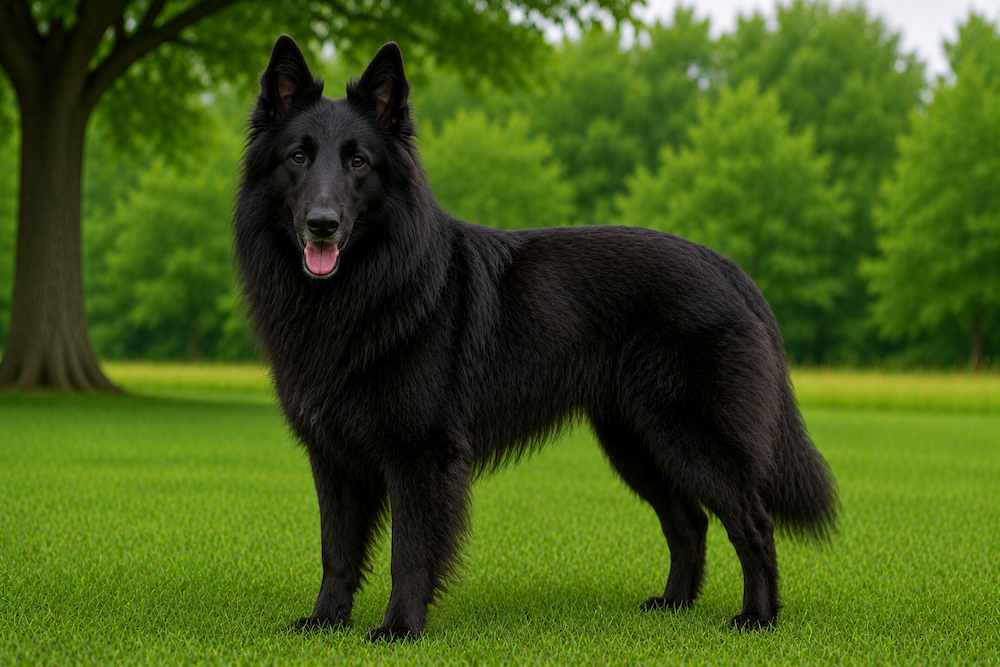
The Belgian Sheepdog is a highly intelligent herding breed known for its elegant black coat and strong work ethic. Originally developed for herding and guarding, they are energetic dogs that thrive on activity and purpose.
They are deeply loyal to their family and form strong bonds with their owners.
✅ PROS & CONS
Pros
- Extremely intelligent and trainable
- Loyal and protective
- Athletic and energetic
- Beautiful, striking appearance
Cons
- Very high exercise needs
- Requires mental stimulation
- Can become bored easily
- Needs experienced handling
Is a Belgian Sheepdog a Good Family Dog?
Yes, a Belgian Sheepdog can be an excellent family dog for an active and experienced household.
Belgian Sheepdogs tend to form exceptionally strong bonds with their families. They’re intelligent, affectionate, watchful and often want to be involved in almost everything their owners do.
They can be good with respectful children, although their energy and herding instincts may lead to chasing or attempting to control running youngsters.
Early socialisation is important because the breed can be naturally reserved around unfamiliar people.
This is not usually a dog content to simply exist in the background. A Belgian Sheepdog tends to become a highly involved member of the family management team.
How Much Exercise Does a Belgian Sheepdog Need?
An adult Belgian Sheepdog generally needs around 90 minutes to two hours of exercise each day, together with significant mental stimulation.
These are genuine working dogs with considerable stamina.
Long walks, hiking, running, agility, obedience, tracking, herding and scent work can all provide useful outlets.
Mental exercise is equally important. Belgian Sheepdogs learn quickly and can become frustrated when their intelligence isn’t being used.
Simply providing a large backyard isn’t enough.
A Belgian Sheepdog generally needs activities, interaction and something worthwhile to think about.
Is a Belgian Sheepdog Easy to Train?
Belgian Sheepdogs are exceptionally intelligent and highly trainable, although their sensitivity and intensity mean training should be handled thoughtfully.
They learn new behaviours very quickly and have excelled in obedience, herding, tracking, protection work and numerous dog sports.
Positive reinforcement combined with clear, consistent boundaries generally works best.
Harsh handling can be counterproductive with such a responsive breed.
Owners should also teach calmness and the ability to settle rather than constantly increasing excitement and drive.
The Belgian Sheepdog’s greatest training advantage can also become a challenge:
it learns the things you didn’t mean to teach remarkably quickly too.
Does a Belgian Sheepdog Shed?
Yes, Belgian Sheepdogs shed considerably.
Their beautiful black coat consists of a long outer coat and dense insulating undercoat.
Regular brushing several times each week helps prevent tangles and removes loose hair.
During seasonal coat changes, shedding can become particularly heavy and daily brushing may be useful.
The coat generally doesn’t require routine clipping and shouldn’t simply be shaved for convenience.
Belgian Sheepdogs aren’t considered hypoallergenic.
That magnificent black coat is one of the breed’s defining features — and occasionally a surprisingly large proportion of it will appear to be decorating your house.
What Health Problems Are Common in Belgian Sheepdogs?
Belgian Sheepdogs are generally athletic dogs, but several inherited health conditions can occur.
Hip and elbow dysplasia are important concerns.
Inherited eye disorders and epilepsy have also been reported within Belgian Shepherd populations.
Responsible breeders should perform appropriate orthopaedic and eye screening and consider the health history of their breeding lines.
Temperament is also extremely important in such an intelligent and sensitive working breed.
Choosing dogs from carefully health-tested, stable parents can significantly improve the chances of a healthy companion.
How Long Do Belgian Sheepdogs Live?
Belgian Sheepdogs typically live around 12–14 years, although some individuals live longer.
Genetics, nutrition, exercise, body condition and preventive veterinary care all influence lifespan.
Keeping the dog lean and physically fit can help protect joints and maintain mobility.
Mental activity remains important as the dog ages too.
Many Belgian Sheepdogs retain considerable enthusiasm for training throughout their senior years.
Their bodies may eventually request shorter sessions, while their brains continue asking when the next job starts.
Can a Belgian Sheepdog Live in an Apartment?
A Belgian Sheepdog can live in an apartment with an exceptionally active owner, but it isn’t usually the easiest environment for the breed.
These dogs require substantial daily exercise, training and mental stimulation.
They can also be naturally alert and may react to people, dogs or noises around communal areas unless taught appropriate behaviour.
A house with a garden can be convenient, but even a large property doesn’t replace structured activity.
The Belgian Sheepdog needs considerably more than somewhere to run.
It needs engagement.
Are Belgian Sheepdogs Aggressive?
A well-bred Belgian Sheepdog should not be indiscriminately aggressive.
However, the breed is naturally watchful, confident and protective, and some individuals can be reserved around strangers.
These traits made Belgian Shepherds valuable livestock guardians and later working dogs.
Early socialisation is important so puppies learn to distinguish normal everyday experiences from genuine threats.
Poor breeding, insufficient socialisation or inappropriate protection training can create serious behavioural problems.
The ideal Belgian Sheepdog is alert without being unstable and protective without treating ordinary life as a threat.
Are Belgian Sheepdogs Good Guard Dogs?
Yes, Belgian Sheepdogs can be excellent natural watchdogs and guardians.
They’re highly alert, strongly bonded to their families and usually very aware of activity around their home.
Their appearance and confident behaviour alone can provide a substantial deterrent.
However, most family Belgian Sheepdogs don’t need specialised protection training.
Developing excellent obedience, confidence and reliable control is generally far more useful.
A stable dog that can recognise when nothing is wrong is considerably more valuable than one trained to suspect everyone.
Are Belgian Sheepdogs Good With Other Dogs?
Belgian Sheepdogs can live successfully with other dogs, particularly when properly socialised.
Many enjoy canine companionship and can thrive in multi-dog households.
However, their energetic and intense play style may overwhelm quieter dogs.
Some individuals can also be selective or assertive around unfamiliar dogs.
Early socialisation should focus on developing calm, appropriate behaviour rather than teaching the puppy that every dog it encounters must become a playmate.
Are Belgian Sheepdogs Good With Cats?
Belgian Sheepdogs can live successfully with cats, particularly when raised alongside them.
However, their herding instincts and sensitivity to movement can encourage chasing.
A running cat can be especially tempting.
Early training should discourage persistent pursuit, and cats should have safe places where they can avoid unwanted attention.
Individual prey drive varies, so careful introductions remain important.
Can a Belgian Sheepdog Be Left Alone?
Belgian Sheepdogs generally prefer substantial interaction with their families and aren’t ideal for households where they’ll routinely spend very long periods alone.
They were developed to work closely with people and tend to become deeply attached to their owners.
Boredom can result in barking, destructive behaviour or other unwanted habits.
Puppies should still learn to spend reasonable periods independently.
Teaching a Belgian Sheepdog how to relax is just as important as providing activities.
The goal isn’t a dog that requires entertainment every waking minute, but one capable of working hard and switching off afterwards.
Do Belgian Sheepdogs Bark a Lot?
Belgian Sheepdogs can be fairly vocal, particularly when alerting their owners to activity around the property.
Barking was useful in their historical roles as herding and guardian dogs.
Modern dogs may bark at visitors, unfamiliar noises, passing animals or anything they consider unusual.
Boredom and insufficient exercise can increase vocal behaviour.
Early training can help establish when alert barking is appropriate and when it’s time to stop.
A Belgian Sheepdog often considers itself responsible for security — sometimes including incidents the rest of the household didn’t realise required investigation.
What Is the Difference Between a Belgian Sheepdog and a Belgian Malinois?
The Belgian Sheepdog and Belgian Malinois belong to the same Belgian Shepherd family, but the most obvious difference is their coats.
The Belgian Sheepdog — commonly associated with the Groenendael variety — has a long black coat.
The Malinois has a short coat, typically fawn to mahogany with black overlay and a black mask.
Both are intelligent, athletic working dogs with herding ancestry.
Modern working-line Malinois are particularly famous for police and military service, while Belgian Sheepdogs are also highly capable working, sporting and performance dogs.
The Malinois may currently receive more attention, but its long-haired relative is no decorative version of the working dog.
Is a Belgian Sheepdog the Same as a Groenendael?
The answer depends partly on which kennel-club terminology is being used.
In some countries, particularly the United States, the name Belgian Sheepdog generally refers specifically to the long-haired black variety.
Internationally, this variety is widely known as the Groenendael.
Under systems that treat the Belgian Shepherd as one breed, there are four varieties:
Groenendael — long-haired black
Tervuren — long-haired, usually fawn/grey with black overlay
Malinois — short-haired
Laekenois — rough-haired
Other kennel organisations recognise these varieties as separate breeds.
So a Groenendael is the dog most Americans mean when they say Belgian Sheepdog.
Why Is the Belgian Sheepdog Usually Black?
The classic Belgian Sheepdog/Groenendael is famous for its solid black long coat.
This appearance became strongly associated with the variety during the development and standardisation of Belgian Shepherd dogs in the late 19th century.
Selective breeding helped establish the characteristic long black coat.
Small amounts of white may be permitted in limited locations under some breed standards, but the overall appearance should remain distinctly black.
The coat gives the Groenendael one of the most dramatic silhouettes among European shepherd breeds.
Where Does the Name Groenendael Come From?
The name Groenendael comes from a village and historic estate area in Belgium, closely associated with the development of the long-haired black Belgian Shepherd.
One important early breeder was Nicolas Rose, proprietor of the Château de Groenendael restaurant.
Dogs associated with Rose’s breeding programme, particularly Picard d’Uccle and Petite, played an important role in establishing the long-haired black variety.
The Groenendael name consequently became attached to these dogs.
It’s another example of Belgian Shepherd varieties carrying names connected with the regions or places associated with their development.
What Were Belgian Sheepdogs Originally Bred to Do?
Belgian Sheepdogs were originally developed primarily as herding and livestock-working dogs.
They needed enough stamina to work for long periods while controlling sheep and protecting farms.
Their intelligence, responsiveness and guarding instincts later made them suitable for many additional roles.
Belgian Shepherds have been used for police work, military service, messenger duties, tracking, search work and competitive dog sports.
The breed’s elegant appearance can sometimes disguise its history.
Underneath the flowing black coat is a serious European working shepherd.
Were Belgian Sheepdogs Used During the World Wars?
Yes, Belgian Shepherd dogs served in military roles during the World Wars, including messenger and support work.
Their intelligence, athleticism and trainability made them useful for tasks requiring dogs to work in difficult environments.
Belgian Shepherds subsequently became increasingly recognised internationally as versatile service and working dogs.
Their modern participation in search work, protection sports, obedience and other demanding activities continues that tradition.
Where Does the Belgian Sheepdog Come From?
The Belgian Sheepdog comes from Belgium, where several types of working shepherd dogs existed during the 19th century.
An important step toward standardisation occurred in the 1890s, when Belgian enthusiasts began systematically classifying the country’s shepherd dogs.
Veterinary professor Adolphe Reul played a major role in studying these dogs and helping establish the foundation of the Belgian Shepherd breed.
Different coat varieties eventually became associated with names including Groenendael, Malinois, Tervuren and Laekenois.
The long-haired black Groenendael became what some kennel organisations now specifically call the Belgian Sheepdog.
Its flowing coat may be spectacular, but its origins were thoroughly practical: this was a working shepherd first and a show-ring beauty later.