





Fearless, energetic, and bursting with confidence — a tiny dog with a huge personality and endless attitude.
🧠 QUICK SNAPSHOT
- Temperament: Bold, energetic, alert
- Energy Level: High
- Size: Small
- Good With Families: Yes
- Trainability: Moderate
- Grooming: Low
- Best For: Active owners, apartment living, companionship
📚 OVERVIEW
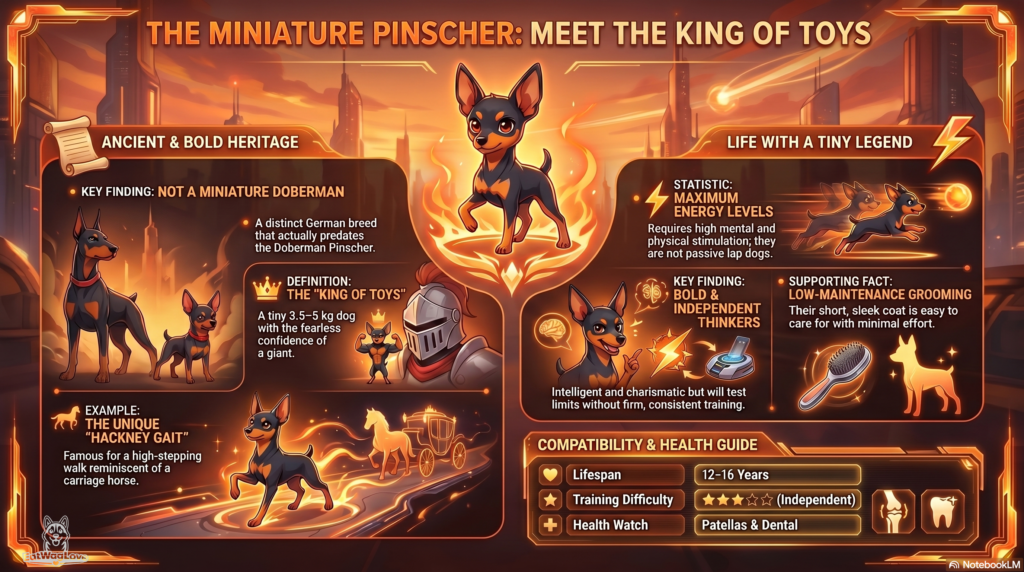
The Miniature Pinscher, often called the “Min Pin,” is a small but fearless breed known for its confident personality and energetic nature. Despite its size, it carries itself with pride and independence, often acting much larger than it really is.
They are lively companions that enjoy attention, activity, and being involved in family life.
✅ PROS & CONS
Pros
- Confident and entertaining personality
- Low grooming requirements
- Compact and adaptable size
- Alert and watchful
Cons
- Can be stubborn and independent
- High energy levels
- May be vocal
- Needs regular stimulation and activity
Is a Miniature Pinscher a Good Family Dog?
Yes. The Miniature Pinscher can be an affectionate, energetic, confident and entertaining family dog for households prepared for its enormous personality.
Min Pins are small but rarely behave as though they’re small. They’re alert, adventurous and often intensely attached to their families.
They generally do best with children who understand how to handle a small dog respectfully.
How Much Exercise Does a Miniature Pinscher Need?
Most Miniature Pinschers need around 45–60 minutes of exercise each day, together with play and mental stimulation.
They’re considerably more energetic than their tiny size suggests.
Walks, training, scent games, fetch and opportunities to explore can help keep them physically and mentally satisfied.
Is a Miniature Pinscher a High-Energy Dog?
Yes.
The Min Pin is an energetic, athletic little dog with a strong desire to investigate its surroundings.
They often alternate between high-speed activity and enthusiastically occupying the warmest available blanket.
Is a Miniature Pinscher Easy to Train?
They’re intelligent and capable learners, but not necessarily easy.
Miniature Pinschers are independent, confident and often highly motivated by whatever currently interests them.
Short, rewarding training sessions generally work better than repetitive exercises.
Are Miniature Pinschers Intelligent?
Very.
They’re observant, quick to learn and excellent problem-solvers.
Unfortunately, their problem-solving skills can also be applied to opening doors, reaching forbidden objects and discovering previously unnoticed weaknesses in fences.
Are Miniature Pinschers Stubborn?
They can certainly appear stubborn.
Min Pins were developed from working dogs expected to pursue vermin independently, so unquestioning obedience wasn’t historically their most important quality.
Consistency and positive reinforcement are essential.
Are Miniature Pinschers Difficult to Toilet Train?
Some can require patience.
Their small bladder means puppies need frequent toilet opportunities, while dislike of cold or wet weather can make outdoor toileting less appealing.
A consistent schedule and immediate rewards help considerably.
Does a Miniature Pinscher Shed?
Yes, although usually not heavily.
The Min Pin has a short, smooth, close-fitting coat that’s relatively easy to maintain.
Regular brushing with a grooming mitt helps remove loose hair.
Is a Miniature Pinscher Hypoallergenic?
No.
Miniature Pinschers shed and produce normal canine allergens.
Their short coat may be easy to clean, but that doesn’t make them hypoallergenic.
How Often Should You Groom a Miniature Pinscher?
Usually once a week is sufficient.
The coat needs very little specialist maintenance.
Nail trimming, dental care and ear checks are generally more important than elaborate coat grooming.
Does a Miniature Pinscher Need Haircuts?
No.
Its short coat naturally remains at the appropriate length.
Routine clipping or shaving isn’t required.
What Health Problems Are Common in Miniature Pinschers?
Potential concerns include patellar luxation, Legg-Calvé-Perthes disease, eye disorders, thyroid disease, epilepsy and dental problems.
Responsible breeders should screen breeding dogs for relevant inherited conditions.
Maintaining a healthy weight also reduces unnecessary stress on the joints.
Are Miniature Pinschers Prone to Patellar Luxation?
Yes.
Patellar luxation occurs when the kneecap moves out of its normal position.
Affected dogs may intermittently skip or carry a rear leg before suddenly walking normally again.
Severe cases can require surgery.
What Is Legg-Calvé-Perthes Disease in Miniature Pinschers?
Legg-Calvé-Perthes disease affects the hip joint when blood supply to the head of the femur becomes disrupted.
The bone deteriorates, causing pain and lameness.
It’s seen particularly in small breeds and usually appears in young dogs.
Are Miniature Pinschers Prone to Dental Problems?
They can be.
Small jaws can contribute to crowded teeth and periodontal disease.
Daily tooth brushing and regular veterinary dental assessment are particularly valuable.
How Long Does a Miniature Pinscher Live?
Miniature Pinschers commonly live around 12–16 years.
Some remain remarkably active well into their senior years.
Healthy weight, dental care, exercise and preventive veterinary care all contribute to longevity.
How Big Does a Miniature Pinscher Get?
Adult Miniature Pinschers generally stand around 25–32 cm at the shoulder and weigh approximately 4–5 kg.
They’re genuinely small dogs despite their athletic, substantial appearance.
Is There a Teacup Miniature Pinscher?
No.
There’s no recognised Teacup Miniature Pinscher.
The breed is already naturally small, and deliberately breeding for extreme miniaturisation can increase fragility and health problems.
Is There a Toy Miniature Pinscher?
The Miniature Pinscher is already classified within the Toy Group by several major kennel organisations.
“Toy Min Pin” therefore doesn’t describe a separate recognised smaller variety.
Can a Miniature Pinscher Live in an Apartment?
Yes.
Their compact size makes them physically well suited to apartment living.
However, their energy, alertness and tendency to bark mean they still need exercise, training and mental stimulation.
Does a Miniature Pinscher Need a Backyard?
No.
A Min Pin can thrive without a garden if its exercise needs are met.
If a yard is available, it should be extremely secure because the breed has a reputation for exploiting surprisingly small escape opportunities.
Are Miniature Pinschers Escape Artists?
Yes.
Their combination of curiosity, intelligence, agility and determination can make them impressive escape artists.
Small gaps that appear completely irrelevant to a larger dog may look like perfectly adequate doorways to a Min Pin.
Can Miniature Pinschers Climb Fences?
Some can climb or scramble surprisingly well.
They may also squeeze through gaps or dig beneath barriers.
Secure fencing should be designed for the dog’s actual size rather than assuming a small dog can’t escape.
Can a Miniature Pinscher Be Left Alone?
Adult Min Pins can learn to tolerate reasonable periods alone.
They’re nevertheless social dogs that often become strongly attached to their households.
Gradual independence training and appropriate enrichment help prevent boredom-related behaviour.
Are Miniature Pinschers Prone to Separation Anxiety?
Some can be.
Their close attachment to owners can develop into separation problems if they never learn to relax independently.
Teaching short periods of calm separation during puppyhood can be valuable.
Are Miniature Pinschers Velcro Dogs?
Many are.
They may follow their favourite person around the house while simultaneously behaving as though they require no assistance from anyone.
The Min Pin manages to combine considerable independence with a strong desire to know exactly what its owner is doing.
Are Miniature Pinschers Cuddly?
Many are extremely affectionate with their families.
Their short coat also provides very little insulation, making laps, blankets and warm beds particularly attractive.
Some become enthusiastic burrowers beneath blankets.
Are Miniature Pinschers Good With Children?
They can be good with respectful children.
Because Min Pins are small and relatively fine-boned, rough handling can cause injury.
Older children who understand dogs are often a better match than very young children.
Are Miniature Pinschers Good With Other Dogs?
Many are, especially when properly socialised.
However, Min Pins can be extremely confident and may challenge dogs considerably larger than themselves.
Their self-image doesn’t always correspond particularly closely with their actual dimensions.
Are Miniature Pinschers Good With Cats?
They can live successfully with cats, particularly when raised together.
However, their vermin-hunting ancestry can produce significant prey drive.
Careful introductions remain important.
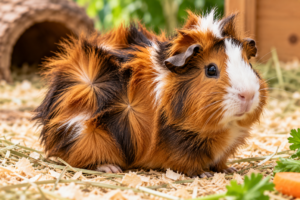
Can Miniature Pinschers Live With Rabbits or Guinea Pigs?
Extreme caution is required.
The breed’s ancestors were used for controlling rodents and other vermin.
Small, rapidly moving animals can trigger instinctive pursuit.
Do Miniature Pinschers Have a Strong Prey Drive?
Yes, many do.
Rats, mice, squirrels, rabbits and other small animals can attract intense interest.
Their small size shouldn’t be confused with the temperament of a purely ornamental lap dog.
Are Miniature Pinschers Good Off Leash?
Reliable recall can be challenging.
A Min Pin that spots a small animal may suddenly become much more interested in pursuing it than returning to its owner.
Secure fenced areas are usually the safest option.
Do Miniature Pinschers Bark a Lot?
They can.
Min Pins are extremely alert and often quick to announce visitors, noises and activity outside the home.
Early training can help prevent normal watchdog behaviour from becoming excessive barking.
Are Miniature Pinschers Good Watchdogs?
Excellent.
Their hearing, alertness and confidence make them highly effective alarm dogs.
Very little appears to happen around a Min Pin without being noticed.
Are Miniature Pinschers Good Guard Dogs?
They’re watchdogs rather than serious physical guard dogs.
Their confidence may suggest otherwise, but a 4–5 kg dog has obvious limitations as a protection animal.
Nobody appears to have explained those limitations to the Min Pin.
Are Miniature Pinschers Aggressive?
Aggression isn’t an essential characteristic of a well-bred Miniature Pinscher.
They can, however, be bold, territorial and assertive.
Poor socialisation or allowing inappropriate behaviour because the dog is small can create problems.
Are Miniature Pinschers Friendly With Strangers?
Many are initially alert or reserved.
Once they understand that a visitor is welcome, they may become considerably friendlier.
Good early socialisation helps develop confident rather than fearful behaviour.
When Does a Miniature Pinscher Calm Down?
Many become noticeably more settled between two and three years old.
However, Min Pins frequently retain their curiosity, playfulness and enthusiasm well into adulthood.
Senior dogs can still behave remarkably young.
Do Miniature Pinschers Get the Zoomies?
Absolutely.
Their compact size and rapid acceleration make indoor zoomies particularly impressive.
A Min Pin can apparently complete several laps of a room before a human has finished asking what it’s doing.
Are Miniature Pinschers Fast?
Yes.
They’re quick, agile dogs capable of impressive bursts of speed.
Their historical vermin-control work required rapid reactions and the ability to pursue small animals.
Are Miniature Pinschers Good Running Dogs?
They can enjoy shorter runs once physically mature and properly conditioned.
Their small size makes them less suitable for long-distance running than larger athletic breeds.
Walking, hiking and varied activity generally suit them extremely well.
Are Miniature Pinschers Good Hiking Dogs?
Yes, healthy adults can be surprisingly capable hikers.
Their size makes them easy to transport while their energy allows them to cover substantial distances.
Cold conditions may require additional protection.
Can Miniature Pinschers Swim?
They can usually swim physically, but they’re not specialised water dogs.
Their small size means they can tire quickly or become chilled.
A canine life jacket is sensible around deep water.
Do Miniature Pinschers Get Cold Easily?
Yes.
Their short coat, small body and limited insulation make them sensitive to cold weather.
Many appreciate a jumper or coat during genuinely cold conditions.
Why Do Miniature Pinschers Love Blankets?
Warmth is a major reason.
Their coat provides little protection against cold surfaces or draughts.
Many Min Pins become expert blanket burrowers and can disappear almost completely beneath bedding.
Can Miniature Pinschers Handle Hot Weather?
Generally reasonably well, but they’re still susceptible to overheating.
Exercise should be reduced during extreme heat and scheduled during cooler periods.
Fresh water and shade should always be available.
What Does a Miniature Pinscher Look Like?
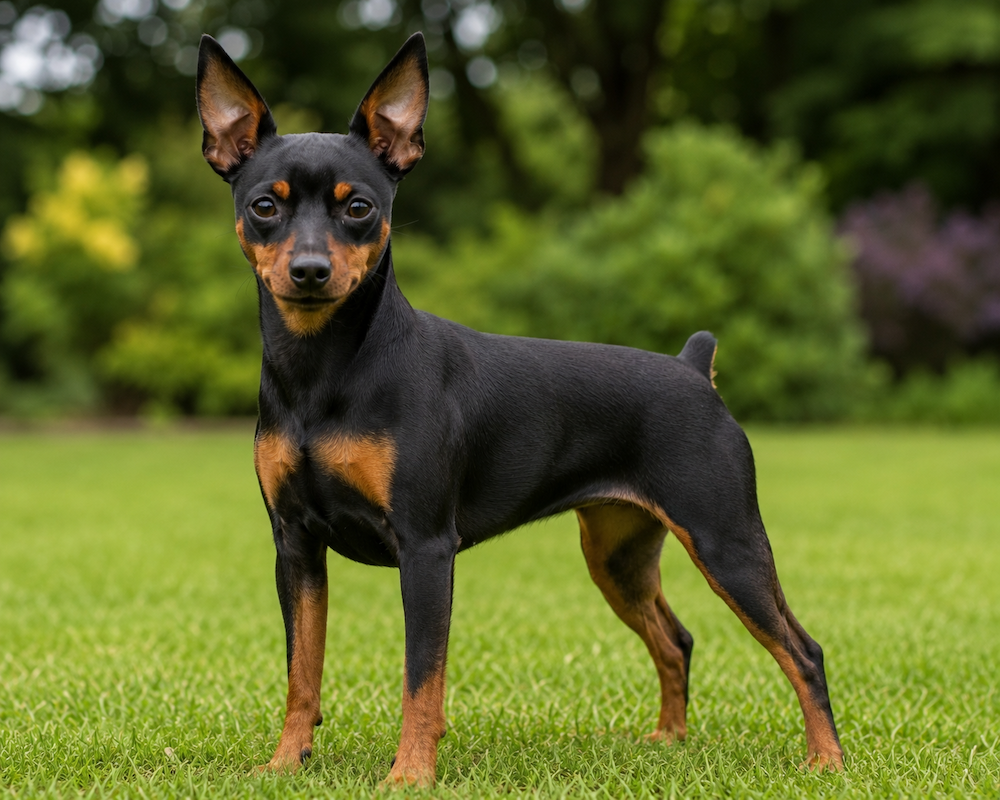
The Miniature Pinscher is a small, compact, muscular and elegant dog with a wedge-shaped head, alert expression, high-set ears and short glossy coat.
Its clean outline and black-and-tan colouring can make it resemble a tiny Doberman.
That resemblance has caused one of the most persistent myths about the breed.
Is a Miniature Pinscher a Miniature Doberman?
No.
Despite the remarkable resemblance, the Miniature Pinscher wasn’t created by shrinking the Doberman.
The Min Pin developed separately and its history predates the creation of the Doberman breed.
Did the Miniature Pinscher Exist Before the Doberman?
Yes.
Small German pinscher-type dogs resembling the Miniature Pinscher existed before Karl Friedrich Louis Dobermann developed the Doberman during the late 19th century.
The Miniature Pinscher therefore can’t simply be a miniature version of a breed that came later.
Is the Miniature Pinscher Related to the Doberman?
They’re part of the broader German pinscher tradition, so there are historical similarities, but the Min Pin isn’t simply descended from the Doberman.
The exact early ancestry of both breeds isn’t documented perfectly.
Their shared black-and-tan colouring and sleek outlines exaggerate the visual resemblance.
What Colours Can Miniature Pinschers Be?
Recognised colours vary somewhat between kennel organisations but commonly include red, stag red, black with rust or tan markings, and chocolate with rust markings in some standards.
Colour terminology differs internationally.
What Is a Stag Red Miniature Pinscher?
Stag red describes a red coat containing an intermingling of darker hairs.
This can create a shaded or lightly sable appearance rather than a completely uniform red coat.
It’s a traditional Min Pin colour.
Can a Miniature Pinscher Be Completely Red?
Yes.
Solid clear red is a well-established colour in the breed.
Red Min Pins can look dramatically different from the familiar black-and-rust variety.
Can a Miniature Pinscher Be Chocolate?
Chocolate-and-rust colouring is recognised by some kennel organisations.
Terminology and accepted colours vary internationally, so local breed standards should be consulted for showing.
Can a Miniature Pinscher Be Blue?
Dilute blue-and-tan Min Pins can occur genetically, but blue isn’t accepted under all modern breed standards and dilute colouring can be associated with coat problems in some dogs.
Colour should never be prioritised over health and temperament.
Can a Miniature Pinscher Be Merle?
Merle isn’t a traditional Miniature Pinscher colour.
A merle dog marketed as a purebred Min Pin should raise questions about ancestry.
The gene isn’t simply a rare version of the breed’s normal colour range.
Why Does a Miniature Pinscher Walk Like a Tiny Horse?
The breed is famous for its distinctive high-stepping gait, particularly in American descriptions of the breed.
The front legs lift high with pronounced flexion at the wrist, creating an action often compared with a Hackney horse.
It’s one of the Min Pin’s most recognisable characteristics.
What Is the Hackney Gait in a Miniature Pinscher?
Hackney-like action describes the breed’s distinctive high-stepping front movement.
The name references the dramatic action associated with Hackney horses.
It’s unusual among dog breeds and contributes significantly to the Min Pin’s show-ring presence.
Is the Miniature Pinscher the Only Dog With a Hackney-Like Gait?
It’s certainly the breed most famously associated with it.
The high-stepping action is explicitly characteristic of the Miniature Pinscher in some breed standards.
It’s one reason the breed looks remarkably confident while moving.
Why Does a Miniature Pinscher Hold Its Head So High?
Their alert posture reflects both physical structure and temperament.
Min Pins tend to carry themselves confidently, scanning their surroundings while moving.
This contributes to the breed’s characteristic proud appearance.
Why Is the Miniature Pinscher Called the “King of Toys”?
The breed is famously nicknamed the “King of Toys.”
The phrase reflects its bold personality, proud carriage, athleticism and extraordinary self-confidence despite its small size.
Few toy breeds appear quite so convinced that they’re in charge.
Is the Miniature Pinscher Actually a Terrier?
No, not in the strict modern breed-group sense.
The word Pinscher refers to a German type of dog historically associated with vermin control and farm work.
Although Min Pins performed terrier-like jobs, they’re part of the German pinscher tradition rather than Britain’s classic terrier family.
What Does “Pinscher” Mean?
“Pinscher” is a German dog-type term historically associated with dogs used for ratting, guarding and general farm work.
It’s sometimes loosely translated as something like “terrier,” although the historical and linguistic relationship is more complicated than a simple direct translation.
Where Does the Miniature Pinscher Come From?
The Miniature Pinscher originated in Germany, where small pinscher-type dogs were used around farms and stables to control rats and other vermin.
The breed’s German name is Zwergpinscher.
Its history developed independently from the later Doberman.
What Does Zwergpinscher Mean?
“Zwerg” means dwarf in German.
Zwergpinscher therefore essentially means “dwarf pinscher” or “miniature pinscher.”
It’s the breed’s traditional German name.
How Old Is the Miniature Pinscher?
Dogs resembling small pinschers existed in Germany for centuries, although the modern pedigree breed was standardised much later.
Visual evidence of small red and black-and-tan dogs resembling Min Pins appears in older European art.
However, identifying every historical small pinscher-looking dog as a modern purebred Min Pin would be an overstatement.
Was the Miniature Pinscher Originally a Ratting Dog?
Yes.
Controlling rats and mice around farms, homes and stables was an important historical function.
This helps explain the breed’s speed, alertness, confidence and persistent interest in small moving animals.
Why Were Small Ratting Dogs Useful in Stables?
Stables provided food, grain, bedding and shelter — excellent conditions for rodents.
Small agile dogs could pursue rats into places larger dogs couldn’t easily reach.
An effective ratter protected stored feed and reduced vermin around livestock.
What Breeds Created the Miniature Pinscher?
Its exact historical recipe isn’t perfectly documented.
The breed is traditionally associated with German Pinscher-type dogs, with Dachshund and Italian Greyhound often cited as influences in its development.
These contributions would help explain its combination of ratting ability, compact size and elegant movement.
Is the Miniature Pinscher Related to the German Pinscher?
Yes.
The German Pinscher is central to the broader pinscher family from which the Miniature Pinscher developed.
The Min Pin wasn’t simply produced by continually breeding today’s German Pinscher smaller, but the breeds share important historical ancestry.
Is the Miniature Pinscher Related to the Dachshund?
Dachshund ancestry is traditionally cited as part of the Miniature Pinscher’s development.
Historical breeding records aren’t complete enough to assign precise percentages.
The possible contribution fits the breed’s German background and vermin-hunting heritage.
Is the Miniature Pinscher Related to the Italian Greyhound?
Italian Greyhound influence is also traditionally associated with the development of the Min Pin.
It may have contributed refinement and elegance.
Again, the breed’s early development isn’t documented well enough to provide a precise genetic recipe.
Is the Miniature Pinscher Related to the Manchester Terrier?
They’re separate breeds developed in different countries.
The Manchester Terrier developed from Britain’s black-and-tan terrier tradition, while the Miniature Pinscher emerged from German pinscher stock.
Their sleek bodies and black-and-tan markings make them easy to confuse.
What Is the Difference Between a Miniature Pinscher and a Manchester Terrier?
The Miniature Pinscher is a German pinscher breed, while the Manchester Terrier developed from British ratting terriers.
The Min Pin is particularly famous for its high-stepping gait, while the Manchester Terrier generally has a more traditionally terrier-like movement and outline.
Both share a serious historical interest in rodents.
Is a Miniature Pinscher the Same as a German Pinscher?
No.
The German Pinscher is considerably larger.
The two share historical connections, but they’re established as separate breeds.
Is a Miniature Pinscher the Same as a Miniature Schnauzer?
No.
Both developed in Germany and have historical vermin-control backgrounds, but they’re very different breeds.
The Miniature Schnauzer has a harsh wiry coat and characteristic beard, while the Min Pin has a smooth short coat.
When Was the Miniature Pinscher Standardised as a Breed?
Organised breeding developed in Germany during the late 19th and early 20th centuries, as pinscher and schnauzer enthusiasts began recording pedigrees and defining breed standards.
This transformed local working dogs into the recognisable pedigree Min Pin.
What Was the Pinscher-Schnauzer Club?
German breeders organised clubs to standardise the country’s pinscher and schnauzer breeds.
The Pinscher-Schnauzer-Klub, founded around the turn of the 20th century from earlier club organisations, became central to preserving and documenting these breeds.
This helped establish the modern Zwergpinscher.
When Did Miniature Pinschers Become Popular Outside Germany?
The breed began spreading internationally during the early 20th century.
Dogs reached other parts of Europe and North America, where organised breeding populations developed.
Its distinctive appearance and bold personality helped it become a recognised toy companion while retaining its working-dog character.
When Did the AKC Recognise the Miniature Pinscher?
The American Kennel Club recognised the Miniature Pinscher in 1925.
The breed was initially classified differently before eventually becoming established within the Toy Group.
American breeding also helped popularise the famous “King of Toys” image.
Did World War I and World War II Affect the Miniature Pinscher?
Yes.
Like many European breeds, Min Pin populations were disrupted by war, economic hardship and food shortages.
International breeding populations became increasingly important to maintaining the breed.
The Miniature Pinscher ultimately recovered and spread widely around the world.
Why Do Miniature Pinschers Look So Different From Many Toy Dogs?
Many toy breeds were primarily developed as companions.
The Min Pin’s background was much more practical: catch vermin, investigate the property and remain alert.
That working heritage helps explain why it often behaves like a much larger dog compressed into a toy-sized body.
Why Does My Miniature Pinscher Chase Everything?
Movement activates the instincts of a dog whose ancestors were selected to notice and pursue vermin.
Leaves, insects, rodents and birds can all become targets.
The behaviour is historically logical even when the target is a plastic bag moving across the garden.
Why Does My Miniature Pinscher Shake Its Toys?
Grabbing and shaking objects resembles part of the predatory behaviour used by vermin-catching dogs.
Modern toys provide a safe outlet for that instinct.
Durable toys are advisable because Min Pins can be remarkably enthusiastic despite their size.
Why Does My Miniature Pinscher Patrol the House?
Alertness is deeply embedded in the breed.
Historically, a small farm or stable dog needed to notice rodents, unfamiliar animals and unusual activity.
The modern Min Pin may therefore conduct regular household security inspections without having been formally appointed.
Why Does My Miniature Pinscher Stand on the Back of the Sofa?
Height provides a better view of the environment.
For an alert little watchdog, the back of a sofa can become an excellent observation platform.
From there, the Min Pin can supervise windows, doors, neighbours and any suspicious delivery vehicles.
Why Does My Miniature Pinscher Burrow Under the Covers?
The breed’s thin coat makes warmth attractive, and burrowing provides both heat and security.
Many Min Pins enthusiastically disappear beneath blankets.
Owners should check bedding before sitting down.
Are Miniature Pinschers Good at Agility?
Yes.
Their speed, intelligence and athleticism can make them excellent at agility.
They can also enjoy rally, scent work, trick training and other activities that keep both mind and body occupied.
Are Miniature Pinschers Good at Ratting Today?
The instinct remains in many dogs, although most modern Min Pins are companions rather than working ratters.
Where legal and appropriately managed, their historical vermin instincts can still be obvious.
For most pets, toys and scent games provide safer outlets.
Are Miniature Pinschers Good Therapy Dogs?
Individual Min Pins with calm, sociable temperaments can succeed in therapy work.
However, the breed’s high alertness and energetic nature mean not every individual is suited to it.
Temperament matters more than breed alone.
Is a Miniature Pinscher a Good Dog for Older People?
It can be.
Their small size and easy coat are convenient, but prospective owners need to be comfortable with a surprisingly energetic and assertive dog.
They’re very different from a quiet, low-energy lap breed.
Is a Miniature Pinscher a Good First Dog?
It can be for an owner prepared to train consistently.
They’re physically manageable, intelligent and relatively easy to groom.
The biggest challenges are prey drive, barking, escape behaviour, independence and a level of confidence dramatically disproportionate to their size.
What Makes the Miniature Pinscher Unique?
The Miniature Pinscher has spent decades being introduced as “that little Doberman”, which is unfortunate because its real history is much more interesting.
The Min Pin wasn’t created by shrinking a Doberman. Small pinscher dogs were already working around German farms and stables before the Doberman breed existed, hunting rats and acting as alert little farm dogs.
Over time, breeders refined them into the elegant Zwergpinscher: compact, muscular, sleek and famous for its extraordinary high-stepping gait.
Then came perhaps the most appropriate nickname ever given to a dog:
the King of Toys.
It’s only around 4–5 kilograms, yet the typical Min Pin patrols its home as though it owns the property, challenges toys as though they’re dangerous prey, investigates every unexplained noise and frequently considers fences to be engineering puzzles rather than boundaries.
The Doberman resemblance is largely what made the breed famous.
But the Min Pin doesn’t need to pretend to be a tiny Doberman.
It was already hunting rats in Germany before the Doberman had even been invented.