






Gentle, affectionate, and incredibly relaxed — a beautiful indoor companion that loves being close to its family.
🧠 QUICK SNAPSHOT
- Temperament: Gentle, affectionate, calm
- Energy Level: Low to moderate
- Size: Large
- Good With Families: Yes
- Trainability: Moderate
- Grooming: Moderate
- Best For: Families, indoor living, companionship
📚 OVERVIEW
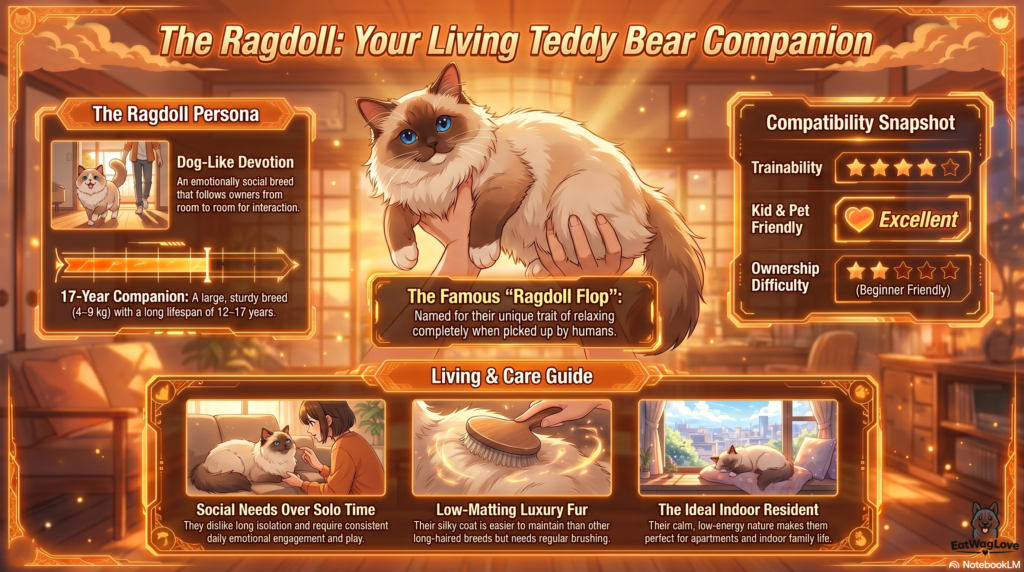
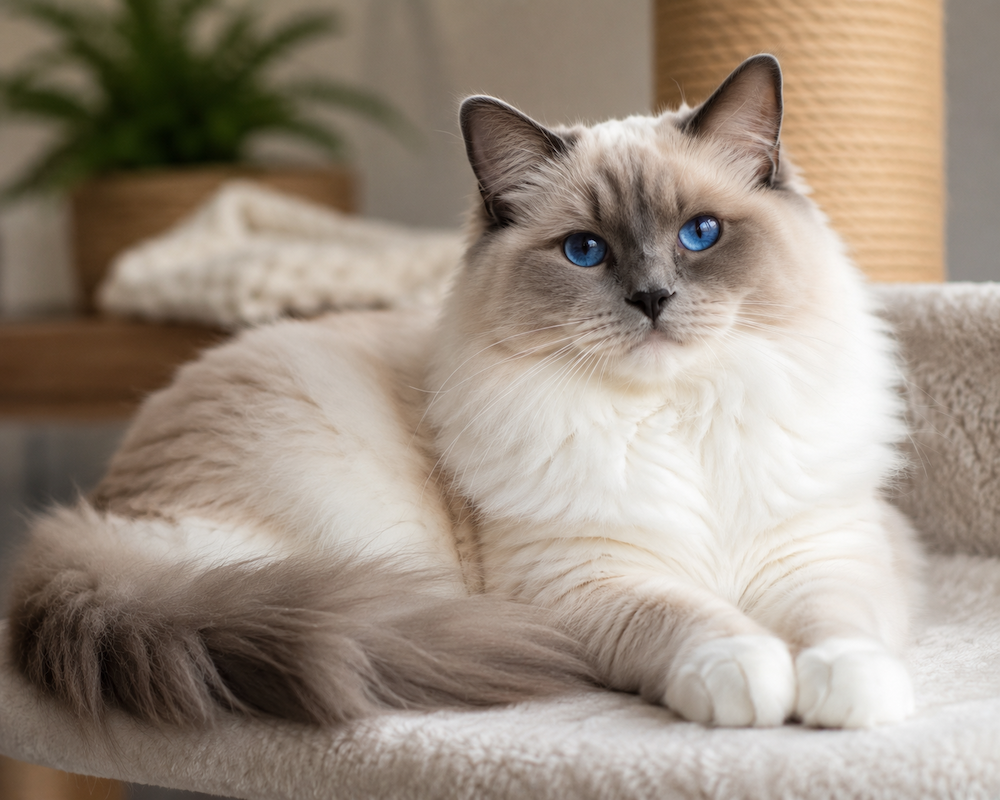
The Ragdoll is a large, affectionate cat breed known for its striking blue eyes and relaxed personality. Famous for going limp when picked up, they are gentle cats that thrive on companionship and enjoy spending time with their family.
They are calm, friendly, and well suited to indoor living.
✅ PROS & CONS
Pros
- Extremely affectionate and gentle
- Great with families and children
- Calm indoor temperament
- Beautiful long coat and blue eyes
Cons
- Needs regular grooming
- Prefers companionship and attention
- Can be prone to weight gain
- Best suited to indoor living
Is a Ragdoll a Good Family Cat?
Yes. Ragdolls are generally gentle, affectionate, calm and people-oriented cats, making them excellent family companions.
They often enjoy being involved in household life without being as intensely active as some breeds. Their relaxed temperament can suit families, couples and older people.
They are large cats, however, and still need regular play, grooming and companionship.
Are Ragdoll Cats Good With Children?
Generally, yes.
Ragdolls are known for their patient and easy-going temperament, and many live very happily with respectful children.
Their relatively large size also makes them more robust than some small breeds, although children should still be taught to handle cats gently.
Are Ragdoll Cats Affectionate?
Yes. Affectionate behaviour is one of the characteristics most strongly associated with Ragdolls.
Many follow their owners around the home, sit beside them and seek regular physical contact.
Individual personalities vary, but Ragdolls are generally much more people-focused than aloof.
Do Ragdoll Cats Like to Be Held?
Many Ragdolls enjoy being held, but not every Ragdoll automatically goes limp when picked up.
The famous “Ragdoll” reputation has led to the misconception that every cat will completely relax in anyone’s arms.
Some do become remarkably relaxed when handled, while others prefer affection with their feet firmly on the ground.
Are Ragdoll Cats Lap Cats?
Many are excellent lap cats.
Ragdolls tend to enjoy close contact with their owners and may spend long periods sitting beside or on them.
The main complication is that an adult male Ragdoll can be a very substantial cat, so your “lap cat” may eventually occupy considerably more lap than anticipated.
How Much Exercise Does a Ragdoll Cat Need?
Ragdolls have moderate exercise requirements.
Several short interactive play sessions each day with wand toys, balls, tunnels and puzzle feeders can help keep them physically and mentally stimulated.
Exercise is particularly important because their relaxed lifestyle can make weight gain easy.
Are Ragdoll Cats Easy to Train?
Yes. Ragdolls are intelligent cats and can learn household routines, their names and simple behaviours relatively easily.
Many can be taught tricks, recall and even retrieving games using positive reinforcement.
Food rewards can be effective, but portions should be controlled to prevent excess weight.
Do Ragdoll Cats Shed a Lot?
Yes. Ragdolls shed despite sometimes being described as easier-care long-haired cats.
Their semi-long coat can leave noticeable hair around the home, particularly during seasonal coat changes.
Regular combing helps remove loose hair before it reaches furniture and clothing.
Are Ragdoll Cats Hypoallergenic?
No.
Ragdolls aren’t considered hypoallergenic.
The major cat allergens are associated with proteins in saliva and skin secretions, so having a particular coat type doesn’t make a Ragdoll allergy-free.
How Often Should You Groom a Ragdoll?
Most Ragdolls benefit from combing around two or three times a week, with more frequent grooming during heavier shedding periods.
Pay particular attention to areas where friction encourages tangles, including under the legs and around the hindquarters.
Regular nail, dental and ear care should also form part of their routine.
What Health Problems Are Common in Ragdoll Cats?
One of the most important inherited health concerns in Ragdolls is hypertrophic cardiomyopathy (HCM), a disease that causes abnormal thickening of the heart muscle.
A known Ragdoll-associated genetic variant can be tested for, although genetic testing doesn’t identify every possible cause of HCM.
Other potential concerns include urinary problems and obesity. Responsible breeders should prioritise appropriate genetic and health screening.
How Long Do Ragdoll Cats Live?
Ragdolls commonly live around 12–17 years, although individual lifespan varies.
Indoor living, maintaining a healthy weight, good nutrition, dental care and regular veterinary examinations can all contribute to longevity.
Some Ragdolls live well into their late teens.
How Big Do Ragdoll Cats Get?
Ragdolls are one of the larger domestic cat breeds.
Adult males commonly weigh around 5.5–9 kg, while females are generally smaller at approximately 4–7 kg.
Individual cats can fall outside these ranges, and a naturally large frame shouldn’t be confused with obesity.
When Is a Ragdoll Cat Fully Grown?
Ragdolls mature slowly and can take around three to four years to reach their full adult size and physical development.
Their coat and colouring also continue developing as they mature.
A one-year-old Ragdoll may therefore still have considerable growing and filling out ahead.
Can Ragdoll Cats Live Indoors?
Yes. Ragdolls are particularly well suited to indoor living.
Their relatively trusting temperament can make unrestricted outdoor roaming risky, while indoor living also protects them from traffic, fights, disease and other hazards.
Cat trees, scratching posts, window views, toys and interactive play can provide plenty of enrichment.
Can Ragdoll Cats Be Left Alone?
Adult Ragdolls can tolerate reasonable periods alone, but they’re generally social cats that enjoy human companionship.
They may become lonely or bored when routinely left without interaction for very long periods.
Owners who spend much of the day away should provide plenty of enrichment and consider whether a compatible animal companion would be appropriate.
Are Ragdoll Cats Vocal?
Ragdolls are generally moderately quiet cats.
Many communicate using relatively soft meows, chirps and other gentle sounds rather than constant loud vocalisation.
Individual personalities differ, but they’re typically less talkative than breeds such as the Siamese.
Are Ragdoll Cats Good With Other Cats?
Generally, yes.
Their calm, sociable temperament often makes Ragdolls good companions for other friendly cats.
Introductions should still be gradual because compatibility depends on the personalities and previous experiences of both animals.
Are Ragdoll Cats Good With Dogs?
Many Ragdolls live successfully with cat-friendly dogs.
Their relaxed and confident personality can make them relatively adaptable to multi-pet households.
Dogs should still be introduced carefully and prevented from chasing or intimidating the cat.
What Colours Do Ragdoll Cats Come In?
Traditional Ragdoll colours include seal, blue, chocolate, lilac, red and cream, although accepted colours vary somewhat between cat registries.
These colours combine with characteristic patterns such as colourpoint, mitted and bicolour.
Ragdoll kittens are born very pale, with their points developing as they grow.
Why Do Ragdoll Cats Have Blue Eyes?
Traditional pedigree Ragdolls are known for their striking blue eyes, which are associated with the colourpoint genetics responsible for their characteristic coat pattern.
Eye colour can range from relatively pale blue to intense deep blue.
Blue eyes are one of the breed’s most recognisable features.
Why Are Ragdoll Kittens Born White?
Ragdoll kittens are born white or very pale because the gene responsible for their pointed colouring is temperature sensitive.
Pigment develops more strongly in cooler parts of the body, such as the ears, face, legs and tail.
As kittens grow and these areas cool relative to the core of the body, their characteristic points gradually become visible.
What Is the Difference Between a Ragdoll and a Ragamuffin?
Ragdolls and Ragamuffins share historical connections but are now distinct breeds.
Traditional Ragdolls have blue eyes and pointed colouring, including colourpoint, mitted and bicolour patterns.
Ragamuffins are accepted in a much wider range of colours, patterns and eye colours. Both are typically large, affectionate companion cats.
What Is the Difference Between a Ragdoll and a Birman?
Both can have blue eyes, pointed colouring and affectionate personalities, but they’re distinct breeds.
Ragdolls are generally larger and heavier, while Birmans are known for their characteristic white “gloves” on the feet.
Their histories and breed standards are also different.
What Is the Difference Between a Ragdoll and a Maine Coon?
Both are large, popular long-haired cats, but their appearances and origins differ considerably.
Ragdolls typically have blue eyes, pointed colouring and a softer, more rounded appearance, while Maine Coons have a rugged shaggy coat, prominent ears and a broader range of colours and patterns.
Both can be affectionate, although individual temperament always varies.
Where Do Ragdoll Cats Come From?
The Ragdoll was developed in California, United States, during the 1960s by breeder Ann Baker.
The foundation of the breed centred around a white long-haired cat named Josephine and selected descendants noted for their appearance and temperament.
From this relatively recent breeding programme came one of today’s most recognisable pedigree cat breeds.
Why Are They Called Ragdoll Cats?
The name comes from the breed’s reputation for becoming unusually relaxed or limp when picked up.
Ann Baker used this characteristic as part of the identity of the developing breed.
However, it shouldn’t be interpreted literally for every cat. Ragdolls have individual personalities, and some enjoy being carried far more than others.
Is a Ragdoll a Good First Cat?
Yes. Ragdolls can be excellent first cats.
Their gentle temperament, affectionate nature and moderate activity level make them relatively easy companions for many households.
New owners should nevertheless be prepared for regular grooming, a very large adult cat and the costs associated with responsible lifelong veterinary care.
What Makes the Ragdoll Cat Unique?
The Ragdoll is unusual because its history isn’t buried hundreds or thousands of years in the past.
We can trace the modern breed to 1960s California, breeder Ann Baker and a white long-haired cat named Josephine.
From those beginnings came a cat now famous worldwide for its large size, striking blue eyes, pointed colouring and exceptionally affectionate reputation.
Even its colour has an interesting biological trick behind it.
Ragdoll kittens arrive almost completely white because the gene controlling their pointed colouring responds to temperature. As the cooler extremities develop pigment, the ears, face, legs and tail gradually darken.
Then there’s the famous name.
Some Ragdolls really do become extraordinarily relaxed when handled — but buying one doesn’t guarantee a cat that instantly transforms into a furry beanbag whenever you pick it up.
What you are much more likely to get is a large, gentle cat that wants to know where you are, what you’re doing and whether there’s enough room beside you for approximately nine kilograms of fluff.