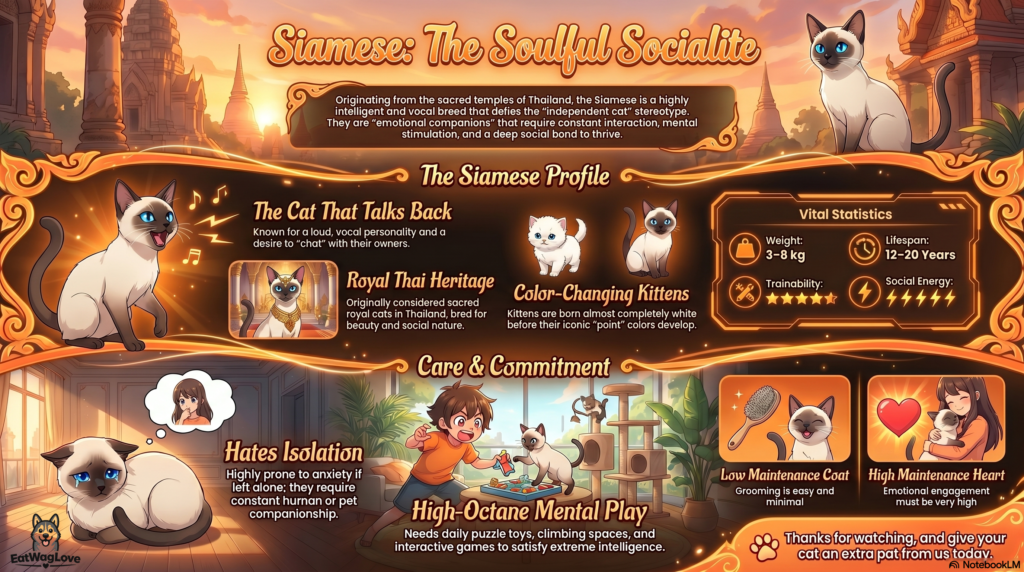







Vocal, intelligent, and deeply affectionate — a sleek companion that loves attention and interaction.
🧠 QUICK SNAPSHOT
- Temperament: Vocal, affectionate, intelligent
- Energy Level: High
- Size: Medium
- Good With Families: Yes
- Trainability: High
- Grooming: Low
- Best For: Interactive households, companionship, indoor living
📚 OVERVIEW
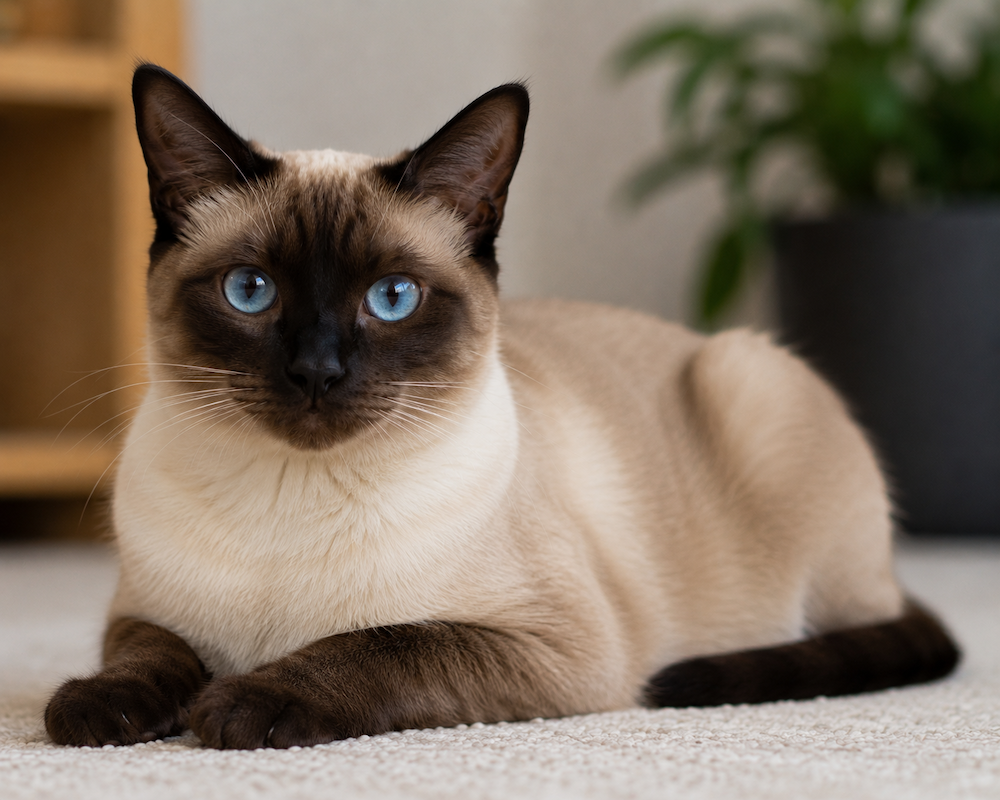
The Siamese is one of the world’s most recognisable cat breeds, known for its striking blue eyes, elegant body, and talkative personality. They are highly social cats that form strong bonds with their owners and often demand attention and interaction.
They are playful, intelligent, and thrive in homes where they are actively included in daily life.
✅ PROS & CONS
Pros
- Extremely affectionate and social
- Highly intelligent and playful
- Low grooming requirements
- Strong bond with owners
Cons
- Can be very vocal
- Dislikes being left alone
- Needs mental stimulation
- Demands attention and interaction
Is a Siamese Cat a Good Family Pet?
Yes. Siamese cats are generally affectionate, intelligent, playful and highly social, making them excellent family pets for households that can give them plenty of attention.
They tend to become strongly involved in family life and often follow their favourite people around the home.
Are Siamese Cats Good With Children?
Generally, yes. Siamese cats are often playful and sociable with respectful children.
Their energetic, interactive personality can make them excellent companions for children who enjoy playing with pets.
As with any cat, children should be taught to handle them gently and respect their boundaries.
Are Siamese Cats Affectionate?
Very. Siamese cats are famous for forming strong emotional bonds with their owners.
Many actively seek physical affection, follow their people from room to room and want to participate in whatever the household is doing.
They’re generally much more people-focused than independent.
Do Siamese Cats Like to Cuddle?
Many do.
Siamese cats often enjoy sitting on laps, sleeping beside their owners and seeking warmth and physical contact.
Individual personalities vary, but this is generally a highly affectionate breed.
Are Siamese Cats Vocal?
Yes — extremely.
Siamese cats are one of the most famously vocal cat breeds and may communicate using meows, chirps and distinctive loud calls.
Many appear to conduct lengthy “conversations” with their owners and aren’t shy about expressing their opinions.
Why Do Siamese Cats Meow So Much?
Siamese cats are naturally communicative and strongly people-oriented.
They may vocalise to request attention, food, play or companionship, or simply because they want to interact.
Sudden or excessive changes in vocalisation should still be investigated because increased meowing can sometimes indicate stress or illness.
Are Siamese Cats Intelligent?
Yes. Siamese cats are exceptionally intelligent and curious.
They can learn routines, solve puzzle feeders, play interactive games and sometimes learn tricks such as retrieving toys.
Their intelligence means they generally need considerably more mental stimulation than simply having food and somewhere comfortable to sleep.
Are Siamese Cats Easy to Train?
Yes. Siamese cats are among the more trainable cat breeds.
Positive reinforcement can be used to teach behaviours such as coming when called, retrieving toys, entering a carrier and walking in a harness.
Their intelligence and strong interest in human interaction can make training particularly rewarding.
How Much Exercise Does a Siamese Cat Need?
Siamese cats are active and need daily interactive exercise and play.
Climbing trees, teaser toys, puzzle feeders, chasing games and training sessions can all help keep them stimulated.
Without sufficient activity, an intelligent Siamese may invent its own entertainment.
Do Siamese Cats Shed a Lot?
No. Siamese cats generally have a short, fine coat with relatively modest shedding.
Regular gentle brushing can help remove loose hair and maintain coat condition.
Their grooming requirements are considerably lower than those of most long-haired breeds.
Are Siamese Cats Hypoallergenic?
No.
Despite their short coat and relatively low shedding, Siamese cats aren’t hypoallergenic.
Cat allergies are primarily triggered by proteins produced in saliva and skin secretions, so coat length doesn’t eliminate the risk of an allergic reaction.
How Often Should You Groom a Siamese Cat?
Siamese cats are relatively low-maintenance when it comes to grooming.
Weekly brushing is usually sufficient to remove loose hair and maintain their sleek coat.
Regular nail trimming, dental care and ear checks should also form part of their routine.
What Health Problems Are Common in Siamese Cats?
Health concerns associated with Siamese cats can include progressive retinal atrophy, certain heart conditions, dental disease, respiratory problems and amyloidosis.
Some inherited conditions are more common in particular bloodlines.
Responsible breeding and regular veterinary care are important.
How Long Do Siamese Cats Live?
Siamese cats commonly live around 12–15 years, although many reach their late teens and some live considerably longer.
Indoor living, appropriate nutrition, maintaining a healthy weight and regular veterinary care can help maximise lifespan.
How Big Does a Siamese Cat Get?
Siamese cats are generally medium-sized but have a long, slender and athletic build.
Adults commonly weigh around 3–6 kg, with males typically larger than females.
Their long legs and elegant body can make them appear larger than their actual weight suggests.
Can Siamese Cats Live Indoors?
Yes. Siamese cats can live very successfully indoors.
However, they need plenty of climbing opportunities, interactive toys, scratching surfaces, play and human interaction.
A secure cat enclosure can provide additional outdoor stimulation without the risks associated with unrestricted roaming.
Can Siamese Cats Be Left Alone?
Siamese cats generally don’t enjoy being left alone for long periods.
They’re highly social and can become bored or distressed without sufficient companionship.
For households where people are regularly away for extended periods, a compatible feline companion can sometimes be beneficial.
Are Siamese Cats Good With Other Cats?
Usually, yes.
Their social and playful nature means many Siamese cats enjoy living with another compatible cat.
They can be particularly energetic playmates, so matching personalities and activity levels can help.
Are Siamese Cats Good With Dogs?
Many Siamese cats can live successfully with cat-friendly dogs.
Their confident, outgoing personalities can make them more comfortable around dogs than some timid cat breeds.
Introductions should still be gradual and carefully supervised.
Do Siamese Cats Need Another Cat?
Not necessarily, but many Siamese cats benefit from regular companionship.
A second compatible cat can provide play and social interaction, particularly when owners spend significant time away from home.
Human interaction remains important even when another cat is present.
What Colours Do Siamese Cats Come In?
The four classic Siamese point colours are seal point, chocolate point, blue point and lilac point.
Depending on the registry and breed classification, additional point colours and patterns may be recognised or classified under closely related breeds.
All share the characteristic contrast between a lighter body and darker extremities.
Why Do Siamese Cats Have Dark Faces, Ears, Paws and Tails?
Siamese colouring is caused by a fascinating temperature-sensitive form of pigment production.
Pigment develops more strongly in cooler parts of the body, which is why the ears, face, paws and tail become darker than the warmer torso.
This unusual genetics creates the breed’s famous “pointed” appearance.
Are Siamese Kittens Born White?
Yes. Siamese kittens are typically born very pale or almost completely white.
Inside the mother’s womb, their bodies are kept at a relatively uniform warm temperature, limiting the development of darker pigment.
Their characteristic points gradually appear after birth as cooler areas of the body begin producing more pigment.
Do Siamese Cats Get Darker as They Age?
Yes. Many Siamese cats become noticeably darker as they mature.
Because their coat pigmentation is temperature-sensitive, age, genetics and environmental temperature can influence their colouring.
Older Siamese cats can therefore look considerably darker than they did as young adults.
Why Do Siamese Cats Have Blue Eyes?
Siamese cats are famous for their striking blue eyes.
The genetics responsible for their temperature-sensitive colour-point pattern also affect pigment development in the eyes.
The resulting structure causes light to scatter in a way that produces the characteristic blue appearance.
Do All Siamese Cats Have Blue Eyes?
Pedigree Siamese cats should have blue eyes as a defining breed characteristic.
The intensity can range from lighter blue to a particularly vivid deep blue.
A pointed cat with another eye colour may resemble a Siamese but isn’t necessarily a pedigree Siamese.
What Is the Difference Between a Traditional and Modern Siamese Cat?
Modern show-type Siamese cats typically have a long, slender body, wedge-shaped head and very large ears.
Cats described as Traditional, Old-Style or “Applehead” Siamese generally have rounder heads and more substantial bodies.
Terminology and recognition vary between cat registries and breeding organisations.
What Is the Difference Between a Siamese and a Thai Cat?
The Thai cat preserves a body and head type closer to the more moderate, traditional Siamese appearance.
Modern Siamese cats have generally been selectively bred toward a more elongated body, wedge-shaped head and larger ears.
They’re closely historically related but treated as separate breeds by some major registries.
Where Do Siamese Cats Come From?
Siamese cats originated in Thailand, historically known as Siam.
Cats resembling the Siamese appear in historic Thai manuscripts, demonstrating that pointed cats have existed in the region for centuries.
They were introduced to Western countries during the 19th century and subsequently became one of the world’s best-known cat breeds.
Were Siamese Cats Royal Cats?
Siamese cats have long been associated with Thai royalty, temples and elite households, although some of the more elaborate stories surrounding their royal history have become difficult to separate from later legend.
Their distinctive appearance helped make them highly prized when they began appearing in Europe and North America.
Is a Siamese Cat a Good First Cat?
Yes, provided the owner wants a highly interactive pet.
Siamese cats are relatively easy to groom and extremely intelligent, but their need for companionship, activity and communication can be greater than that of more independent breeds.
Someone wanting a quiet cat that largely entertains itself may find a Siamese surprisingly demanding.
What Makes the Siamese Cat Unique?
The Siamese doesn’t merely have one of the most recognisable coats in the cat world.
It has a coat that effectively responds to temperature.
Siamese kittens begin life almost white. As they grow, cooler parts of their bodies — particularly the face, ears, paws and tail — develop darker pigment, creating those famous points.
Add brilliant blue eyes and you’ve already got an extraordinary cat.
Then it starts talking.
Siamese cats have become legendary for their loud, distinctive voices and apparent determination to participate in every household conversation.
And unlike many stereotypes about independent cats, a Siamese often wants to know exactly where you are, what you’re doing and why you haven’t consulted it first.
Beautiful, intelligent and extraordinarily communicative — living with a Siamese can feel less like owning a cat and more like acquiring a very opinionated new member of the family.