






Elegant, active, and endlessly curious — a sleek companion that loves adventure and interaction.
🧠 QUICK SNAPSHOT
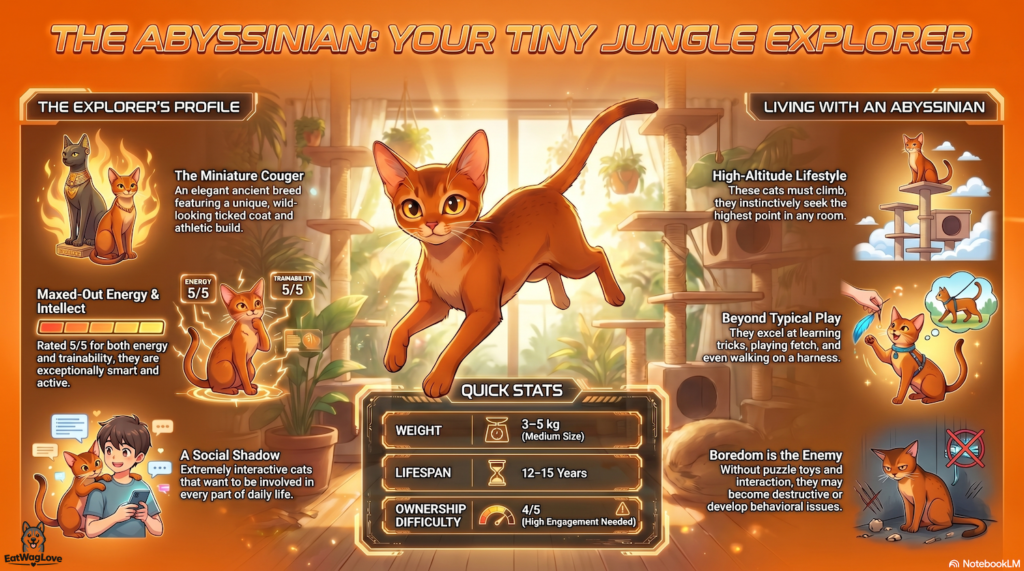
- Temperament: Intelligent, active, curious
- Energy Level: Very high
- Size: Medium
- Good With Families: Yes
- Trainability: High
- Grooming: Low
- Best For: Active households, interactive owners
📚 OVERVIEW
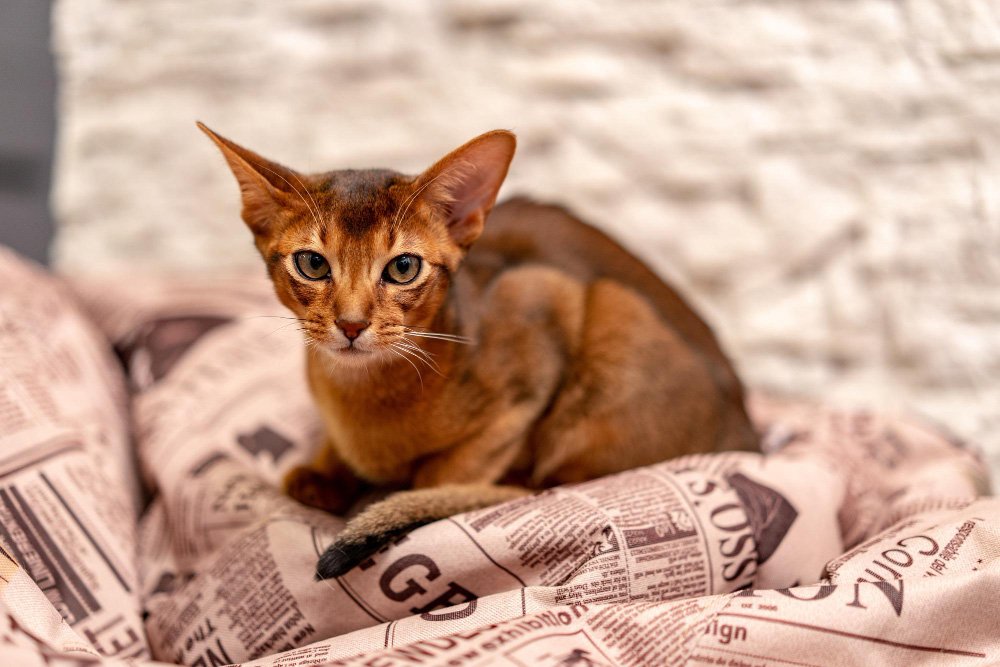
The Abyssinian is one of the oldest and most elegant cat breeds, known for its sleek coat, large ears, and athletic build. They are highly intelligent and energetic cats that love climbing, exploring, and being involved in everything around them.
They thrive in homes where they receive attention, stimulation, and plenty of opportunities to play.
✅ PROS & CONS
Pros
- Extremely intelligent and curious
- Very playful and interactive
- Low grooming requirements
- Elegant, athletic appearance
Cons
- Needs constant stimulation
- Can become bored easily
- Highly active personality
- Not ideal for low-interaction homes
Is an Abyssinian a Good Family Cat?
Yes, the Abyssinian can be an excellent family cat, particularly for active households that want an intelligent and highly interactive companion.
Abyssinians are usually affectionate without necessarily being traditional lap cats. Many prefer following their people around, investigating whatever they’re doing and participating in household activity.
They can be excellent with respectful children and may live successfully with cat-friendly dogs and other cats when properly introduced.
What they generally don’t enjoy is being ignored for long periods.
The Abyssinian isn’t usually content to simply decorate the sofa. It wants to know what you’re doing, why you’re doing it and whether it can help.
Can an Abyssinian Live Indoors or in an Apartment?
Yes, an Abyssinian can live very successfully indoors or in an apartment, provided it receives substantial enrichment and opportunities to exercise.
Vertical space is especially valuable.
Tall cat trees, shelves, window perches and climbing structures allow an Abyssinian to use its natural athleticism without requiring an enormous home.
Puzzle feeders, interactive toys and regular play sessions help prevent boredom.
A secure outdoor enclosure or “catio” can also provide additional stimulation without the risks associated with unrestricted roaming.
For an Abyssinian, the size of the home matters less than how interesting you’ve made it.
How Much Exercise and Play Does an Abyssinian Need?
Abyssinians need considerably more activity and interactive play than the average laid-back cat.
They’re athletic, agile and naturally curious.
Several play sessions throughout the day are ideal, particularly activities involving chasing, climbing, retrieving or problem-solving.
Wand toys, puzzle feeders, climbing towers and food hunts can all help.
Many Abyssinians remain playful well into adulthood rather than becoming dramatically less active with age.
Without sufficient stimulation, that intelligence can be redirected towards opening cupboards, investigating shelves or finding entertainment you hadn’t planned.
With an Abyssinian, “cat-proofing” can occasionally become an ongoing battle between human engineering and feline research.
Is an Abyssinian Easy to Train?
Yes. Abyssinians are generally very intelligent and highly trainable.
Using positive reinforcement, many can learn recall, targeting, retrieving, simple tricks and even walking on a harness.
Their curiosity makes them particularly responsive when training feels like a game.
Clicker training can work extremely well.
Punishment should be avoided because it can damage trust without teaching the cat what behaviour you actually want.
An Abyssinian may learn household routines remarkably quickly — including routines you didn’t deliberately teach.
If opening a particular cupboard produces treats, don’t be surprised if your Abyssinian begins conducting independent research into cupboard-opening technology.
Does an Abyssinian Shed?
Yes, but Abyssinians are generally relatively low-maintenance shedders.
Their short, close-lying coat doesn’t usually require extensive grooming.
Weekly brushing can remove loose hair, distribute natural skin oils and provide an opportunity to check the skin and body for abnormalities.
Shedding may increase seasonally.
Routine care should also include nail trimming, dental care and ear checks.
Abyssinians aren’t considered truly hypoallergenic. Cat allergies are primarily triggered by proteins such as Fel d 1 rather than simply the amount of visible hair a cat loses.
The good news is that maintaining that beautiful coat usually requires far less work than keeping the cat entertained.
What Health Problems Are Common in Abyssinian Cats?
Abyssinians can be affected by several inherited health conditions, making responsible breeding and genetic screening important.
One significant condition is pyruvate kinase deficiency (PK deficiency), an inherited disorder affecting red blood cells that can cause anaemia. DNA testing is available.
Progressive retinal atrophy (PRA) can also occur and may eventually lead to blindness. Genetic screening is available for important inherited forms.
Abyssinians have also been associated with renal amyloidosis, although inheritance and individual risk can be complex.
Dental and periodontal disease deserves attention as well.
Prospective owners should ask breeders about relevant DNA testing, eye health and the health history of their lines rather than relying solely on a kitten’s appearance.
Are Abyssinian Cats Affectionate?
Yes, Abyssinians are generally very affectionate and strongly people-oriented, although they don’t always express affection by sitting motionless on someone’s lap.
An Abyssinian may follow you between rooms, sit beside you, supervise your work, sleep nearby and repeatedly involve itself in whatever you’re doing.
Many prefer this active companionship to prolonged cuddling.
Individual personalities vary, of course, and some Abyssinians are enthusiastic lap cats.
The important distinction is that independent-looking doesn’t mean emotionally distant.
An Abyssinian may love you deeply while simultaneously deciding that sitting still for 45 minutes sounds terribly inefficient.
Do Abyssinian Cats Like Water?
Many Abyssinians have a reputation for being unusually interested in water, although this isn’t universal.
Some investigate dripping taps, play with running water or become fascinated when their owners use a sink or shower.
A drinking fountain can therefore be particularly appealing.
This curiosity shouldn’t be interpreted as meaning every Abyssinian wants to swim or be bathed.
Most cats don’t require routine bathing anyway.
An Abyssinian staring intensely into the sink may simply be doing what Abyssinians do best:
investigating something that appears to be none of its business.
Are Abyssinian Cats Vocal?
Abyssinians can be communicative, but they’re not generally considered as continuously loud or demanding as breeds such as the Siamese.
Many use softer chirps, trills and meows to communicate with their owners.
Body language is equally important.
An Abyssinian may simply appear beside you, stare expectantly and assume you’ve understood the instructions.
Individual cats vary considerably, so some will naturally be more talkative than others.
They’re usually better described as interactive rather than excessively noisy.
Do Abyssinian Cats Get Along With Other Cats and Dogs?
Yes, many Abyssinians can live very successfully with other cats and cat-friendly dogs, particularly when introductions are gradual and properly managed.
Their playful nature can make another compatible animal valuable company.
An energetic Abyssinian may particularly appreciate another pet willing to chase, wrestle and explore.
Temperament matters more than species alone.
A very elderly, quiet cat may not appreciate an energetic young Abyssinian repeatedly requesting games.
Introductions should therefore focus on individual compatibility rather than assuming two animals will become friends simply because they’re both friendly.
Where Does the Abyssinian Cat Come From?
Despite the name, the Abyssinian’s precise ancestry is more complicated than simply saying the breed came from Abyssinia, now Ethiopia.
The breed became established in Britain during the 19th century, and an early cat named Zula, reportedly brought from Abyssinia after the 1868 Abyssinian War, became part of traditional breed history.
However, modern genetic and historical evidence suggests the deeper ancestry of Abyssinian-type cats is likely connected with regions around the Indian Ocean and Southeast Asia, with later development occurring in Britain.
So the name preserves an intriguing historical story, but it doesn’t necessarily provide a simple map of the breed’s genetic origins.
Why Does the Abyssinian’s Coat Look So Unusual?
The Abyssinian’s distinctive appearance comes from its ticked coat.
Instead of having conventional stripes covering the body, individual hairs contain alternating bands of lighter and darker pigment.
This creates a warm, shimmering appearance sometimes described as almost wild or “cougar-like”.
The genetic trait responsible is associated with the agouti pattern.
Some subtle tabby markings can still appear, particularly around the face, legs and tail.
Common recognised colours include ruddy, sorrel or cinnamon, blue and fawn, although terminology and accepted colours vary between registries.
The result is a cat that can appear almost different every time the light catches its coat.