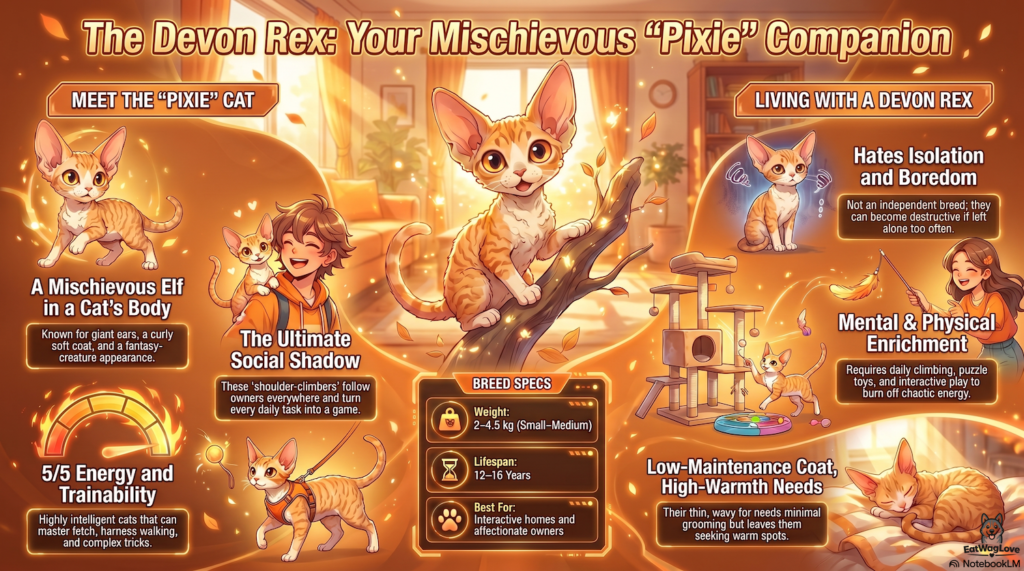
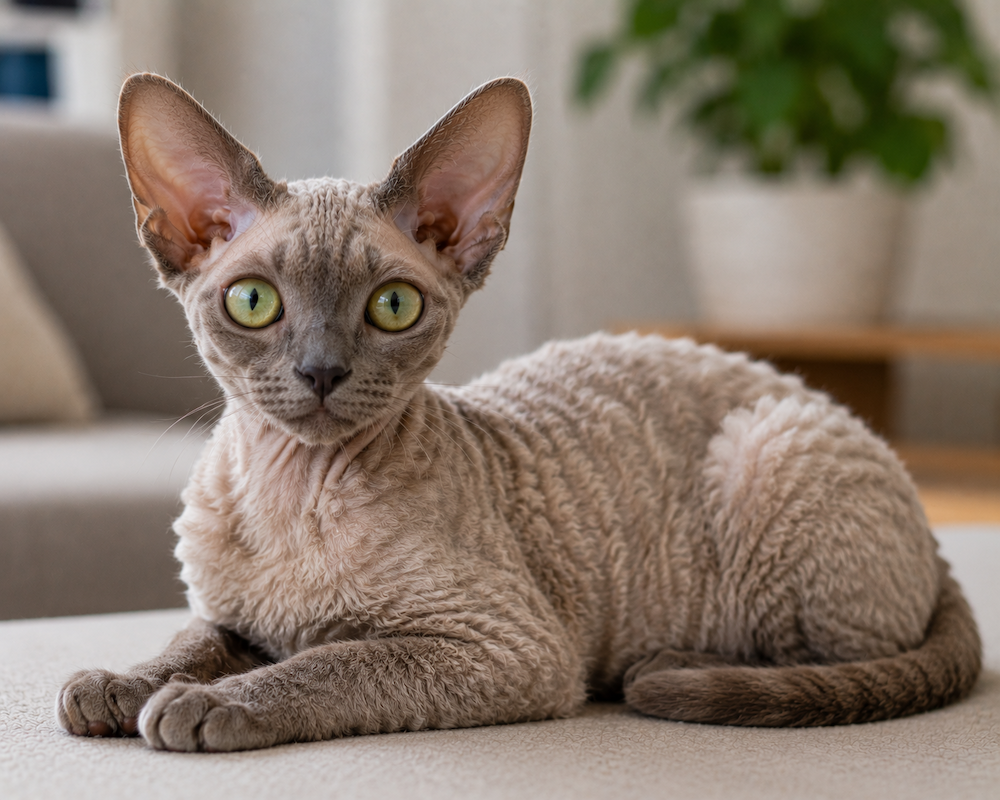







Playful, quirky, and incredibly affectionate — a unique companion with oversized ears and endless personality.
🧠 QUICK SNAPSHOT
- Temperament: Playful, affectionate, intelligent
- Energy Level: High
- Size: Small to medium
- Good With Families: Yes
- Trainability: High
- Grooming: Low
- Best For: Interactive households, indoor companionship
📚 OVERVIEW
The Devon Rex is a distinctive cat breed known for its curly coat, oversized ears, and mischievous personality. They are highly social cats that love attention and enjoy being involved in everything their owners do.
Energetic and playful, they thrive in homes where they receive plenty of interaction and stimulation.
✅ PROS & CONS
Pros
- Extremely affectionate and social
- Unique and eye-catching appearance
- Highly playful and entertaining
- Low shedding coat
Cons
- Can become lonely if left alone often
- Needs regular interaction and stimulation
- Sensitive to cold temperatures
- May be overly energetic for quiet homes
Is a Devon Rex a Good Family Cat?
Yes. The Devon Rex is generally an excellent family cat, especially for households wanting an affectionate, playful and highly interactive companion.
Devon Rex cats are famous for becoming deeply involved in whatever their humans are doing. They often remain kitten-like and mischievous well into adulthood.
They’re usually sociable with respectful children and can thrive in busy households where they receive plenty of attention.
Can a Devon Rex Live Indoors or in an Apartment?
Yes. The Devon Rex is particularly well suited to indoor and apartment living.
They’re relatively small cats and don’t require enormous amounts of floor space, but they do need climbing opportunities, interactive toys and daily play.
Because their unusual coat provides less protection than a conventional cat coat, indoor living also helps protect them from temperature extremes and excessive sun exposure.
How Much Exercise and Play Does a Devon Rex Need?
The Devon Rex is an active and playful breed that benefits from several interactive play sessions each day.
Many love climbing, jumping, chasing toys and investigating anything new.
Puzzle feeders and training provide valuable mental stimulation.
A Devon Rex may eventually become tired — although owners occasionally begin to suspect that this is only a theoretical possibility.
Is a Devon Rex Easy to Train?
Yes. Devon Rex cats are generally intelligent, curious and highly trainable.
Many can learn recall, fetch, targeting, tricks and harness walking using positive reinforcement.
Their strong interest in people and food can make training particularly effective.
They also learn household routines extremely quickly — including routines their owners didn’t deliberately teach them.
Does a Devon Rex Shed?
Yes, but Devon Rex cats generally shed considerably less visible hair than many conventional-coated breeds.
Their coat is fine, short and curly, with relatively sparse guard hairs.
The delicate hairs can break if brushed aggressively.
Gentle grooming with the hands or a soft cloth is often sufficient for many individuals.
Is a Devon Rex Hypoallergenic?
No. The Devon Rex isn’t truly hypoallergenic.
Its low-shedding coat may mean fewer hairs are distributed around the home, but the major cat allergen Fel d 1 is produced primarily in saliva and skin glands.
A person can therefore react strongly to a Devon Rex despite its unusual coat.
Anyone with cat allergies should spend substantial time around the breed before assuming it will be tolerated.
Why Does a Devon Rex Have Curly Hair?
The Devon Rex’s curly coat results from a naturally occurring genetic mutation affecting hair structure.
Instead of producing the conventional straight coat of most cats, the mutation creates soft, wavy or curly hair.
The coat can vary substantially between individuals and even during different stages of the same cat’s life.
Does a Devon Rex Have an Undercoat?
The Devon Rex coat is dominated by soft undercoat and awn-type hairs, while the protective guard hairs found prominently in ordinary cat coats are greatly reduced or abnormal.
This creates the breed’s extraordinarily soft, delicate texture.
The coat isn’t simply an ordinary cat coat curled with a genetic perm — its structure is fundamentally different.
Does a Devon Rex Need Grooming?
Yes, but grooming should usually be gentle and minimal.
The fragile coat can be damaged by vigorous brushing.
Some Devon Rex cats also accumulate skin oils more readily than conventionally coated cats and may occasionally require bathing or careful cleaning.
Ears and nail beds can also accumulate oily debris and should be checked regularly.
Does a Devon Rex Need Baths?
Some Devon Rex cats need occasional bathing, while others rarely do.
Because their unusual coat doesn’t absorb and distribute skin oils in exactly the same way as a conventional coat, some individuals become greasy.
Bathing frequency should depend on the individual rather than following a rigid schedule.
Over-bathing can dry or irritate the skin.
Why Does My Devon Rex Feel Warm?
A Devon Rex may feel unusually warm because its thin coat provides less insulation between your hand and the cat’s skin.
Its normal body temperature isn’t necessarily higher than that of other cats.
You’re simply feeling that warmth more directly.
This is one reason a Devon Rex curled against you can feel like a small living hot-water bottle.
Does a Devon Rex Get Cold Easily?
Yes. Devon Rex cats can be more sensitive to cold because of their sparse, fine coats.
They often actively seek warm places such as blankets, sunny windows, laps and beds.
Indoor temperatures should remain comfortable.
A Devon Rex disappearing beneath the duvet isn’t necessarily being antisocial — it may simply have located the warmest property in the house.
Can a Devon Rex Get Sunburned?
Yes. Areas with sparse hair can be vulnerable to sun damage, particularly in pale-coloured cats.
Extended exposure to strong sunlight should be avoided.
This is another reason indoor living is particularly appropriate for the breed.
Sunlight through windows may still create warm sleeping spots, but owners should consider intensity and duration.
What Health Problems Are Common in Devon Rex Cats?
Potential health concerns include hypertrophic cardiomyopathy (HCM), patellar luxation and Devon Rex myopathy, along with other conditions found in cats generally.
Some blood-type incompatibility issues have also historically been important within breeding programmes.
Responsible breeders should understand the breed’s known inherited conditions and use appropriate health screening.
What Is Devon Rex Myopathy?
Devon Rex myopathy is an inherited neuromuscular disorder historically identified within the breed.
Affected cats can develop muscle weakness, abnormal posture and difficulty holding their heads normally.
Severe cases can interfere with eating or swallowing.
Genetic understanding and responsible breeding have helped reduce the condition, but it’s an important part of the breed’s health history.
How Long Do Devon Rex Cats Live?
Devon Rex cats commonly live around 12–16 years, with some living longer.
Genetics, nutrition, indoor living, dental health and preventive veterinary care all influence lifespan.
Their playful behaviour can persist so long that a middle-aged Devon Rex may still behave suspiciously like a kitten.
How Big Does a Devon Rex Get?
The Devon Rex is generally a small-to-medium-sized cat, commonly weighing around 2.5–4.5 kg.
Despite their relatively light weight, they can feel surprisingly muscular.
Their enormous ears and long legs can also make them appear larger than the number on the scales suggests.
Why Does the Devon Rex Have Such Huge Ears?
Large, low-set ears are one of the Devon Rex’s most distinctive breed characteristics.
Combined with prominent cheekbones and large eyes, they create the breed’s famous elf-like or pixie-like appearance.
The ears weren’t developed for a specialised working function.
They’re part of the unusual natural appearance that breeders preserved after the original mutation was discovered.
Why Does a Devon Rex Look Like an Elf?
The combination of enormous ears, wide cheekbones, large eyes, short muzzle and curly coat gives the Devon Rex an appearance unlike almost any other cat.
They’re regularly described as elves, pixies, aliens or mischievous fantasy creatures.
Their behaviour doesn’t exactly discourage the comparison.
A Devon Rex often manages to look as though it has just thought of something its owner isn’t going to appreciate.
Why Does the Devon Rex Have Curly Whiskers?
The same genetic changes affecting the Devon Rex’s coat can also affect its whiskers and eyebrows.
Whiskers may be short, curly, twisted or fragile.
Some break relatively easily.
Owners should never trim or deliberately remove them because whiskers remain important sensory structures even when they look unconventional.
Can a Devon Rex Have Almost No Hair?
Yes. Coat density varies significantly between Devon Rex cats.
Some have a relatively full covering of soft waves, while others have very sparse areas or temporary bald patches.
Coat thickness can also change with age, hormones and seasons.
However, sudden unexplained hair loss should still be assessed by a veterinarian rather than automatically blamed on the breed.
Is the Devon Rex a Hairless Cat?
No. The Devon Rex isn’t a genuinely hairless breed.
Most have a soft covering of short, curly hair.
They’re sometimes mistaken for hairless cats because their coat can be extremely fine and sparse.
The Sphynx is much closer to what people usually mean when describing a hairless cat.
Is the Devon Rex Related to the Sphynx?
The Devon Rex and Sphynx are distinct breeds with different mutations, although Devon Rex cats played a role in the early development of some Sphynx breeding programmes.
Their sparse coats can create superficial similarities.
However, the genetic basis of the Devon Rex curly coat isn’t simply the same thing as Sphynx hairlessness.
Is the Devon Rex Related to the Cornish Rex?
The Devon Rex and Cornish Rex are both curly-coated British cats, but their characteristic coats result from different genetic mutations.
This was an important discovery in the breeds’ early history.
When early Devon Rex cats were crossed with Cornish Rex cats, the kittens had normal coats rather than the expected curls.
That demonstrated that two different recessive genes were responsible.
What Is the Difference Between a Devon Rex and Cornish Rex?
The Devon Rex generally has a broader head, lower-set enormous ears and a shorter, more irregular coat.
The Cornish Rex typically has a narrower, more egg-shaped head and an extremely soft coat arranged in tighter, more uniform waves.
Their body shapes also differ.
Most importantly, their curly coats arose from different genetic mutations.
They’re separate breeds, not regional versions of the same Rex cat.
Why Are Curly-Haired Cats Called “Rex”?
The term Rex became associated with curly-coated animals through the world of rabbit breeding.
The name was later adopted for naturally occurring curly-coated cat mutations.
That’s why several unrelated cat breeds carry Rex in their names, including the Devon Rex, Cornish Rex, Selkirk Rex and German Rex.
“Rex” doesn’t mean they’re all closely related.
Is a Devon Rex Good With Children?
Yes. Devon Rex cats are generally playful and sociable with respectful children.
Their energetic personalities can make them enthusiastic playmates.
Children should still be taught gentle handling, particularly because the Devon’s coat and whiskers can be delicate.
As with any cat, the Devon should always have somewhere quiet to retreat when it wants a break.
Is a Devon Rex Good With Other Cats?
Yes. Devon Rex cats are often very sociable with other cats, especially when properly introduced.
Many enjoy having another active feline companion.
Their playful style may be overwhelming for extremely quiet or elderly cats, so matching personalities is important.
Gradual introductions remain essential.
Is a Devon Rex Good With Dogs?
Many Devon Rex cats can live successfully with cat-friendly dogs.
Their confidence, curiosity and sociability can make them relatively adaptable to multi-pet households.
Introductions should still be controlled carefully.
A dog with strong predatory behaviour isn’t an appropriate companion simply because the Devon Rex is outgoing.
Can a Devon Rex Be Left Alone?
Devon Rex cats generally don’t enjoy long periods of isolation.
They’re unusually social and often form intense relationships with their humans.
A compatible second cat can provide valuable companionship in households where people are regularly away.
Interactive toys and enrichment help, but they don’t completely replace social contact.
Why Does My Devon Rex Follow Me Everywhere?
Following people is extremely typical Devon Rex behaviour.
These cats are famously people-oriented and often want to participate in whatever their owners are doing.
Cooking, working, showering and making the bed can all apparently become group activities.
Privacy may technically remain available after adopting a Devon Rex, but the cat may choose not to recognise it.
Are Devon Rex Cats Cuddly?
Yes. Many Devon Rex cats are exceptionally cuddly.
They often seek laps, shoulders, blankets and sleeping humans.
Physical closeness provides both social contact and warmth, making people particularly attractive resting places.
Some owners describe their Devon as almost dog-like in its attachment.
Do Devon Rex Cats Sit on Your Shoulders?
Many do.
The Devon Rex has a reputation for climbing onto shoulders and riding around with its owner.
Their light body weight, curiosity and desire to remain close to people make shoulders an attractive observation platform.
Some become so enthusiastic about the habit that owners effectively acquire a small curly parrot disguised as a cat.
Do Devon Rex Cats Like to Sleep Under Blankets?
Many Devon Rex cats love burrowing beneath blankets.
Their thin coats make warmth particularly attractive, while their social personalities encourage them to sleep close to people.
Owners should check bedding before sitting or lying down.
A suspicious lump beneath the duvet may have ears considerably larger than expected.
Are Devon Rex Cats Vocal?
Devon Rex cats can be quite communicative, although they’re not necessarily as loudly vocal as Siamese cats.
Many use chirps, trills, meows and other sounds to interact with their families.
Individual personalities vary considerably.
A Devon Rex that wants something may also discover that persistent eye contact and physical interference work perfectly well without vocal assistance.
Do Devon Rex Cats Play Fetch?
Many Devon Rex cats can learn to retrieve toys, and some naturally initiate games of fetch.
Their intelligence and interest in human interaction make retrieving relatively easy to reinforce.
Small lightweight toys are usually most appealing.
This is one of several behaviours that contribute to the breed’s reputation for being somewhat dog-like.
Do Devon Rex Cats Like Water?
Individual Devon Rex cats vary.
Some are curious about running taps, sinks, showers or water bowls, while others prefer keeping their feet completely dry.
The breed wasn’t developed for any aquatic function.
Water interest is therefore primarily an individual personality trait rather than a defining Devon Rex characteristic.
Are Devon Rex Cats Good Jumpers?
Yes. Devon Rex cats can be excellent jumpers and climbers.
Their light, athletic bodies and long legs allow them to reach surprisingly high places.
Tall cat trees, shelves and vertical climbing opportunities are therefore excellent enrichment.
If something is technically reachable, a Devon Rex may regard that as proof it was intended for cats.
Are Devon Rex Cats Mischievous?
Extremely often.
Devon Rex cats combine intelligence, curiosity, athleticism and a strong interest in humans, which is an excellent recipe for mischief.
They may open cupboards, steal objects, investigate food or climb into places their owners hadn’t considered accessible.
Environmental enrichment helps direct that intelligence towards more acceptable projects.
Why Does My Devon Rex Steal Food?
Devon Rex cats have a reputation for being enthusiastically interested in human food.
Their social confidence means they’re often willing to investigate plates at extremely close range.
Human foods can be unhealthy or toxic to cats, so meals shouldn’t be shared indiscriminately.
Owners may quickly discover that “don’t leave dinner unattended” is one of the unofficial Devon Rex ownership rules.
Does a Devon Rex Eat More Because It Gets Cold?
Some Devon Rex cats appear to have excellent appetites, and maintaining body temperature with a sparse coat may contribute to energy expenditure.
However, appetite varies between individuals.
A large appetite shouldn’t automatically justify unlimited feeding.
Body condition should be monitored because even an energetic Devon Rex can become overweight.
What Colours Can a Devon Rex Be?
Devon Rex cats occur in an enormous range of colours and patterns.
These can include solid colours, tabbies, tortoiseshells, colourpoints, bicolours and many other combinations.
Eye colours also vary.
The curly coat rather than a particular colour defines the breed’s distinctive appearance.
Do Devon Rex Kittens Lose Their Hair?
Some Devon Rex kittens go through periods where their coat becomes very thin or uneven as they develop.
The adult coat may change substantially from the kitten coat.
Hair density can continue fluctuating throughout life.
This can be normal for the breed, although persistent skin problems or unusual hair loss should still receive veterinary attention.
Where Does the Devon Rex Come From?
The Devon Rex originated in Devon, England, during the late 1950s.
A curly-coated male cat was seen living around an abandoned tin mine near Buckfastleigh.
A local woman named Beryl Cox became involved in the story when one of her cats later produced an unusual curly-coated kitten.
That kitten would become enormously important.
Who Was Kirlee the Devon Rex?
Kirlee, born in 1959, is regarded as the foundation cat of the Devon Rex breed.
He was a curly-coated kitten born to a cat owned by Beryl Cox in Devon.
At first, breeders believed Kirlee might carry the same curly-coat mutation as the Cornish Rex.
They were about to discover something much more interesting.
Was the First Devon Rex Found Near a Tin Mine?
The breed’s origin story is linked to a curly-coated male cat living near an abandoned tin mine in Devon.
This cat is believed to have fathered Kirlee, the curly-coated kitten born to Beryl Cox’s cat.
That gives the Devon Rex one of the more unusual pedigree-cat origin stories: its ancestry includes a mysterious curly tom living around a disused English mine.
How Did Breeders Discover the Devon Rex Was Different From the Cornish Rex?
Breeders initially thought Kirlee was another example of the Cornish Rex mutation.
Kirlee was therefore bred with Cornish Rex cats.
If the same recessive gene caused both curly coats, curly kittens should have resulted.
Instead, the kittens had normal coats.
This demonstrated that the Devon and Cornish curls were produced by different genes, establishing the Devon Rex as a separate breed.
Is the Devon Rex a Natural Mutation?
Yes. The Devon Rex began with a spontaneous naturally occurring mutation rather than someone deliberately crossing existing breeds to create curly hair.
Breeders subsequently preserved and developed that mutation through selective breeding.
Many distinctive cat breeds began in exactly this way — nature produced something unusual first, and humans decided to keep it.
Why Was the First Devon Rex Called Kirlee?
Kirlee’s name was inspired by his curly coat.
He became the foundation male around which the new breed developed.
Considering the entire international Devon Rex population ultimately owes an enormous genetic debt to him, Kirlee became one of the most influential individual cats in modern pedigree-cat history.
Is Every Devon Rex Descended From Kirlee?
Modern Devon Rex cats trace their breed foundation back to Kirlee, although additional cats and carefully managed outcrosses were used during breed development to broaden the gene pool.
A breed founded from a single mutation couldn’t responsibly remain genetically dependent on one animal alone.
Nevertheless, Kirlee remains the cat whose extraordinary coat started the recognised Devon Rex breed.
When Was the Devon Rex First Recognised as a Breed?
The Devon Rex developed as a distinct breed during the 1960s, after breeders established that its curly-coat mutation differed from that of the Cornish Rex.
Recognition occurred at different times among cat registries.
The breed subsequently spread internationally and became firmly established as one of the best-known Rex cats.
Why Is the Devon Rex Sometimes Called the Pixie Cat?
The nickname “Pixie Cat” comes from the breed’s extraordinary appearance and personality.
Huge ears, prominent cheekbones, large eyes and a mischievous expression create an almost mythical look.
Their playful, inquisitive behaviour completes the image.
If someone attempted to design a cat specifically to look as though it belonged in an enchanted forest, they might accidentally reinvent the Devon Rex.
What Is the Difference Between a Devon Rex and a Selkirk Rex?
The Devon Rex is generally lighter, finer-boned and much more sparsely coated than the Selkirk Rex.
Selkirk Rex cats have dense, plush curls and a substantially heavier build.
Their curly coats also result from different mutations: the Selkirk mutation is dominant, while the classic Devon Rex mutation is recessive.
The breeds developed independently.
What Is the Difference Between a Devon Rex and a German Rex?
Both have curly coats, but the Devon Rex and German Rex are distinct breeds with different histories and genetic backgrounds.
The German Rex developed from curly-coated cats discovered in Germany.
The Devon Rex originated from Kirlee in Devon.
The existence of multiple unrelated Rex breeds demonstrates something fascinating: curly coats have appeared independently several times in domestic cats.
Why Are Devon Rex Cats So Different From Ordinary Cats?
The Devon Rex combines several unusual traits in one small animal: a naturally mutated curly coat, sparse guard hairs, enormous ears, curled whiskers, an elfin face and an exceptionally people-oriented personality.
Its appearance wasn’t created through generations of extreme reshaping from an ordinary-looking pedigree cat.
The feature that started everything — the curl — appeared spontaneously in a little corner of Devon.
Where Does the Devon Rex Come From?
The Devon Rex comes from Devon in southwest England, where a naturally curly-coated kitten named Kirlee was born in 1959.
Breeders initially believed he was related to the recently established Cornish Rex, only for experimental breeding to reveal that his curls came from an entirely different mutation.
That discovery created a new breed.
From one strange curly kitten linked to a feral tom living near an abandoned tin mine came one of the world’s most recognisable cats — a warm, curly, enormous-eared little troublemaker that looks part cat, part pixie and occasionally behaves as though personal boundaries were never included in the breed standard.