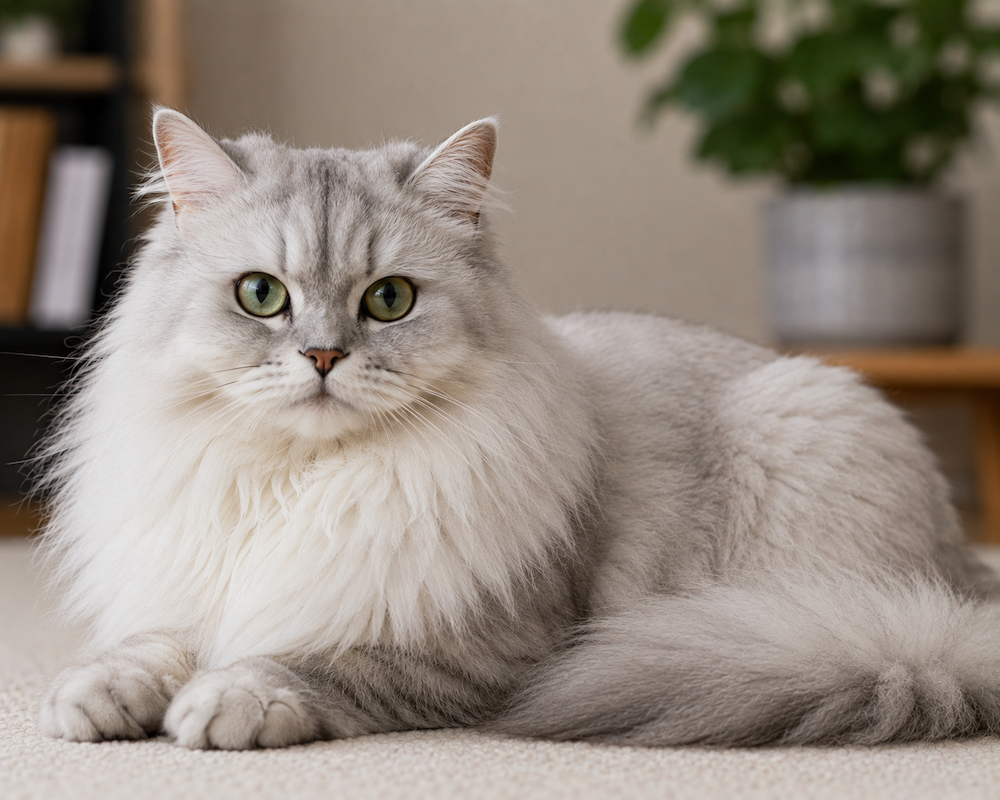






Plush, gentle, and wonderfully relaxed — a beautiful companion with a luxurious coat and calm personality.
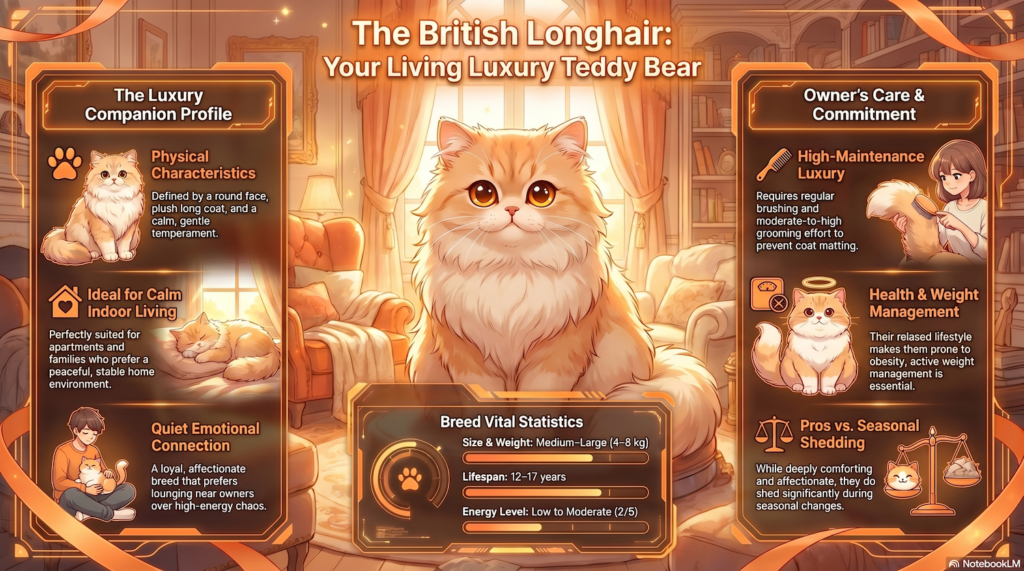
🧠 QUICK SNAPSHOT
- Temperament: Calm, affectionate, easy-going
- Energy Level: Low to moderate
- Size: Medium to large
- Good With Families: Yes
- Trainability: Moderate
- Grooming: Moderate to high
- Best For: Families, indoor living, relaxed households
📚 OVERVIEW
The British Longhair is a beautiful cat breed that combines the calm temperament of the British Shorthair with a luxurious long coat. Known for their round face, plush appearance, and relaxed nature, they make excellent companions for families and individuals alike.
They enjoy spending time with their family but are generally less demanding than some more attention-seeking breeds.
✅ PROS & CONS
Pros
- Calm and affectionate temperament
- Beautiful long, plush coat
- Great family companion
- Adaptable to indoor living
Cons
- Requires regular grooming
- Can be prone to weight gain
- Heavy seasonal shedding
- Less active than some breeds
Is a British Longhair a Good Family Cat?
Yes, the British Longhair is generally an excellent family cat, particularly for households wanting a calm, affectionate companion rather than an extremely demanding one.
British Longhairs tend to enjoy being near their people while retaining a degree of independence. Many are patient with respectful children and can adapt well to relatively peaceful family homes.
They’re often affectionate without constantly demanding attention.
Think of them as the luxurious, long-haired relative of the British Shorthair — with much the same composed personality hidden underneath considerably more fluff.
Can a British Longhair Live Indoors or in an Apartment?
Yes, British Longhairs are very well suited to indoor and apartment living.
They’re generally less intensely active than breeds such as Bengals or Abyssinians and can be content indoors when provided with climbing areas, scratching posts, toys and daily interaction.
Their calm temperament makes them particularly adaptable.
Indoor living can also protect their substantial coat from dirt, parasites and tangles while reducing risks from traffic, predators and infectious disease.
How Much Exercise and Play Does a British Longhair Need?
British Longhairs need daily play and exercise, although they’re generally moderately active rather than hyperactive.
Several short interactive play sessions using wand toys, balls and chasing games can work well.
Exercise is especially important because this sturdy breed can be prone to weight gain.
Food puzzles can provide both physical and mental activity.
Without encouragement, some adults may conclude that watching their humans exercise is an entirely adequate contribution to household fitness.
Is a British Longhair Easy to Train?
Yes, British Longhairs are intelligent cats capable of learning household routines, simple commands and tricks.
Positive reinforcement and food rewards usually work well.
Many can learn to use scratching posts, enter carriers voluntarily or respond to their names.
They’re generally less relentlessly curious than some highly active breeds, so they may not constantly seek training opportunities.
Short, enjoyable sessions are usually most effective.
Does a British Longhair Shed?
Yes. British Longhairs can shed considerably, particularly during seasonal coat changes.
Their dense, plush coat contains substantially more hair than the British Shorthair’s already thick coat.
Regular brushing helps remove loose hair before it becomes tangled or ends up around the home.
During heavier shedding periods, grooming may need to become more frequent.
This definitely isn’t a low-shedding or hypoallergenic cat.
How Often Should You Groom a British Longhair?
A British Longhair should generally be brushed several times each week, with more frequent grooming during seasonal shedding.
Particular attention should be given to areas where friction encourages tangles, such as behind the ears, beneath the legs and around the hindquarters.
Introducing grooming during kittenhood can make coat care much easier throughout life.
Regular grooming also provides an opportunity to check the skin, ears, claws and overall body condition.
That spectacular coat is beautiful, but it doesn’t maintain itself.
What Health Problems Are Common in British Longhair Cats?
British Longhairs can be affected by some of the same health problems seen in their British Shorthair ancestry.
Hypertrophic cardiomyopathy (HCM) is an important cardiac concern within many cat populations, including British-type cats.
Polycystic kidney disease (PKD) has also historically been a concern because Persian ancestry entered the breed’s development. DNA testing has made responsible breeding against PKD much easier.
Obesity and dental disease are additional concerns.
Responsible breeders should understand the health history of their lines and use appropriate screening.
How Long Do British Longhair Cats Live?
British Longhairs commonly live around 12–15 years, with some reaching their later teens.
Genetics, nutrition, body condition, dental care and preventive veterinary treatment all influence lifespan.
Indoor cats protected from outdoor hazards may have opportunities for greater longevity.
Keeping the cat lean is particularly important because the dense coat can disguise gradual weight gain.
Owners should assess body condition by touch as well as appearance.
How Big Does a British Longhair Get?
The British Longhair is a medium-to-large, strongly built cat.
Adults commonly weigh approximately 4–8 kg, with males generally larger than females.
Their dense coat makes them look even more substantial.
The breed should have a broad chest, sturdy body, rounded head and relatively short, strong legs.
A mature British Longhair can look remarkably like a very plush teddy bear that has somehow become a cat.
Are British Longhair Cats Affectionate?
Yes, British Longhairs are generally affectionate and devoted to their families, although many aren’t excessively demanding.
They often enjoy sitting beside their owners rather than constantly climbing onto them.
Some become genuine lap cats, while others prefer maintaining a small amount of personal space.
Their affection tends to be calm and understated.
This can make them particularly appealing to people wanting companionship without a cat that demands attention every few minutes.
Do British Longhair Cats Like to Be Held?
Many British Longhairs prefer keeping their feet on a stable surface rather than being carried for long periods.
Individual cats vary enormously, and some enjoy being held.
However, the British family of cats is often affectionate without necessarily being enthusiastic about constant handling.
Allowing the cat to choose when and how it interacts generally builds greater trust.
A British Longhair may love you deeply while remaining unconvinced that love requires being carried around the house.
Are British Longhair Cats Good With Other Cats?
Yes, British Longhairs are generally good with other cats when introductions are handled properly.
Their calm, relatively tolerant temperament can work well in multi-cat households.
Compatibility still depends on individual personalities, available space and resources.
Each cat should have access to appropriate litter trays, food stations, resting areas and escape routes.
Slow introductions are considerably more successful than simply placing unfamiliar cats together and hoping they negotiate the arrangement themselves.
Are British Longhair Cats Good With Dogs?
British Longhairs can often live successfully with calm, cat-friendly dogs.
Their confident but relatively relaxed temperament can help them adapt to canine housemates.
Introductions should be gradual and controlled, particularly with energetic dogs.
The cat should always have elevated areas and dog-free spaces available.
A British Longhair may eventually become remarkably relaxed around a familiar dog, provided the dog understands that chasing isn’t part of the relationship.
Are British Longhair Cats Vocal?
British Longhairs are generally fairly quiet cats.
They may communicate with soft meows, chirps or purrs, but they aren’t usually as talkative as breeds such as the Siamese or Oriental Shorthair.
Individual personalities vary, of course.
Many prefer using body language, strategic staring or quietly appearing beside the food bowl to communicate important household matters.
What Is the Difference Between a British Longhair and a British Shorthair?
The most obvious difference is coat length.
British Longhairs have semi-long, dense coats, while British Shorthairs have short, extremely plush coats.
Otherwise, the two share very similar ancestry, body type and temperament.
Both typically have sturdy bodies, round heads, broad faces and calm personalities.
In some cat registries, they’re effectively treated as long-haired and short-haired versions of closely related British cats.
Is a British Longhair the Same as a Highlander Cat?
Not necessarily. “Highlander” can refer to different cats depending on the country or registry, which can make the terminology confusing.
British Longhairs have sometimes historically been called names such as Highlander or Britannica in certain contexts.
However, there is also a completely different modern cat breed called the Highlander, known for features including curled ears in many individuals.
For clarity, British Longhair is the better name when referring to the long-haired counterpart of the British Shorthair.
Is the British Longhair Related to the Persian Cat?
Yes. Persian cats played an important role in the development of the British Longhair.
British Shorthairs were historically crossed with Persians, particularly when breeders were rebuilding British cat populations during and after the World Wars.
Persians contributed the recessive gene for long hair.
Because long hair is recessive, two apparently short-haired British cats carrying the gene could sometimes produce long-haired kittens.
Those kittens eventually became recognised as the British Longhair by various cat organisations.
Why Does a British Longhair Have Long Hair?
The British Longhair’s coat results from recessive long-hair genetics introduced largely through Persian ancestry.
A cat generally needs to inherit the relevant long-hair variant from both parents to express the long-haired coat.
For many years, long-haired kittens could unexpectedly appear in British Shorthair breeding programmes when both parents carried the recessive gene.
What was once considered an inconvenient surprise eventually became the defining feature of a breed in its own right.
What Colours Can British Longhair Cats Be?
British Longhairs occur in an enormous variety of colours and patterns.
These can include blue, black, white, cream, red, chocolate and lilac, along with tabby, tortoiseshell, colourpoint, shaded, silver, golden and bicolour patterns depending on the registry.
The classic British blue colouring remains especially recognisable, but blue is only one possibility.
Eye colour also varies with coat colour and pattern.
Are All British Longhair Cats Blue?
No. British Longhairs can appear in many colours besides blue.
The blue-grey coat is strongly associated with British cats because it became one of the most famous colours of the British Shorthair.
However, British Longhairs may be black, white, cream, red, lilac, chocolate, silver, golden or patterned in numerous ways.
A cat doesn’t need to be blue to be a genuine British Longhair.
Why Does the British Longhair Have Such a Round Face?
The British Longhair’s round head, full cheeks and broad muzzle are inherited from its British Shorthair background and reinforced historically by Persian influence.
Adult males can develop particularly impressive cheeks.
Small rounded ears and large round eyes further enhance the characteristic expression.
Responsible breeding should maintain this recognisable appearance without exaggerating facial structure to the point that normal breathing, dental alignment or eye health is compromised.
Why Is the British Longhair So Fluffy?
The British Longhair has a dense semi-long coat with substantial undercoat, creating its famously plush appearance.
Its British Shorthair ancestors were already known for unusually dense coats.
Add the long-hair genetics introduced through Persian ancestry and the result is an exceptionally substantial coat.
The tail can become particularly impressive, giving the cat an almost plume-like appearance.
Much of what looks like an enormous cat is actually an impressive quantity of strategically arranged fur.
Is the British Longhair a Natural Breed?
The British Longhair isn’t a completely separate ancient natural breed.
It developed from British Shorthair breeding lines carrying recessive long-hair genes, largely resulting from historical crosses with Persians.
Long-haired kittens appeared within British breeding programmes for generations.
Over time, breeders and cat registries increasingly recognised these cats as a distinct long-haired variety or breed.
Recognition still varies somewhat between feline organisations internationally.
Where Does the British Longhair Come From?
The British Longhair was developed primarily in Britain from British Shorthair lines with Persian ancestry.
The story is closely connected with the development and survival of the British Shorthair itself.
British cat populations were severely affected by the two World Wars, and breeders used other breeds, including Persians, while rebuilding breeding programmes. This introduced or reinforced genes for long hair.
Long-haired kittens subsequently continued appearing in British lines.
Rather than treating those fluffy kittens simply as unexpected British Shorthairs, breeders eventually developed and promoted them as the British Longhair — essentially the luxurious long-coated member of the British cat family.