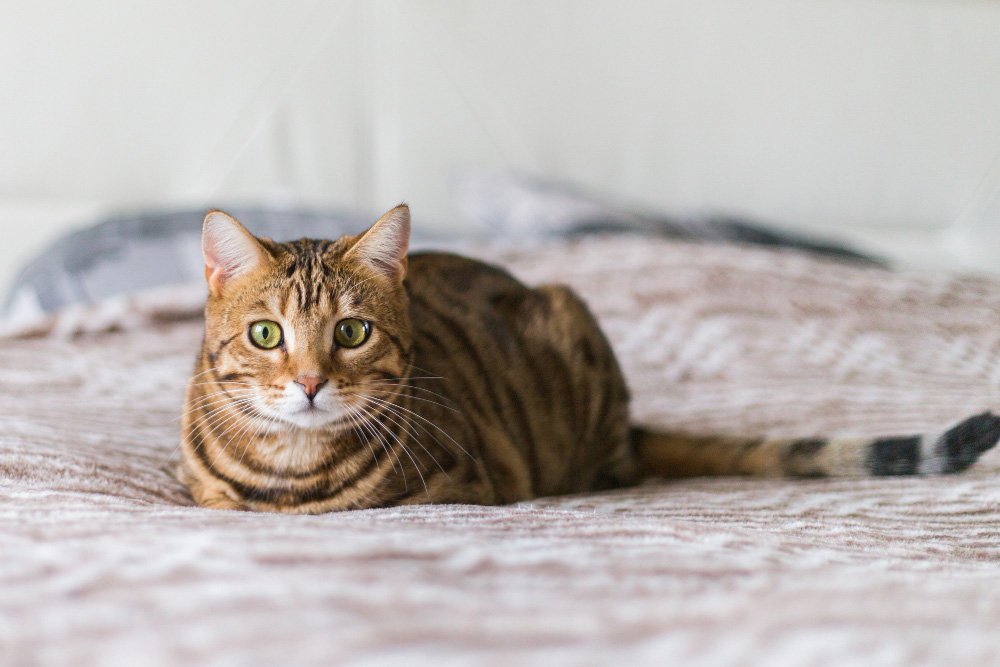






Friendly, adaptable, and easy-going — a classic family cat with a relaxed and affectionate personality.
🧠 QUICK SNAPSHOT
- Temperament: Friendly, adaptable, affectionate
- Energy Level: Moderate
- Size: Medium to large
- Good With Families: Yes
- Trainability: Moderate
- Grooming: Low
- Best For: Families, indoor living, first-time cat owners
📚 OVERVIEW
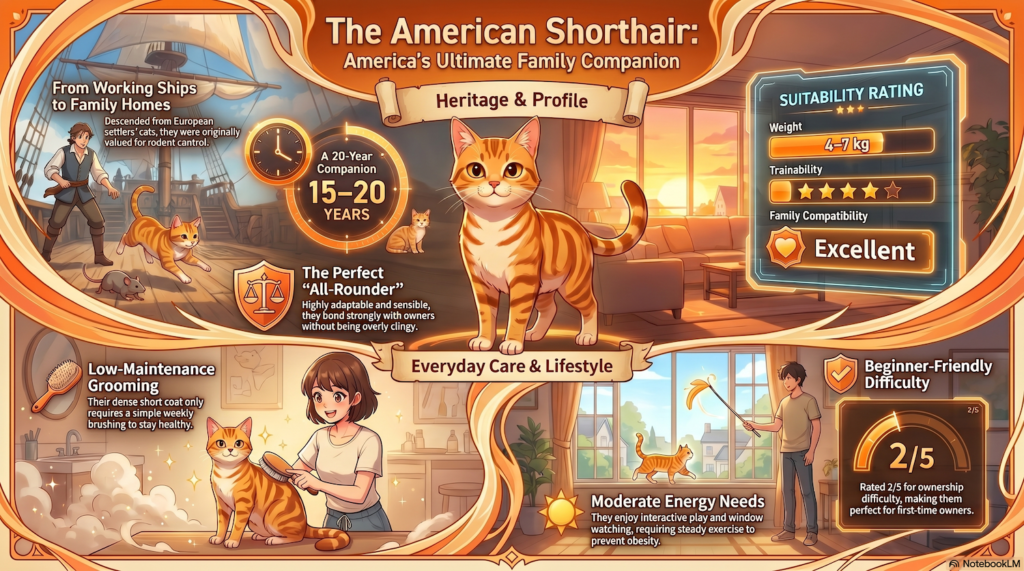
The American Shorthair is one of the most popular and versatile cat breeds in the world. Originally valued as a working cat for controlling rodents, it has evolved into a beloved family companion known for its calm temperament and sturdy build.
They are affectionate without being overly demanding and adapt well to a wide variety of households.
✅ PROS & CONS
Pros
- Friendly and easy-going personality
- Great with families and children
- Low grooming requirements
- Adaptable to different lifestyles
Cons
- Can be prone to weight gain
- Needs regular play to stay active
- May not enjoy constant handling
- Can become bored without enrichment
Is an American Shorthair a Good Family Cat?
Yes, the American Shorthair is generally an excellent family cat thanks to its adaptable, affectionate and easygoing personality.
These cats often enjoy spending time with their people without demanding constant attention. Many are happy to sit nearby rather than insisting on occupying someone’s lap all day.
They usually do well with respectful children and can adapt to busy households.
Their combination of independence and affection makes them particularly appealing to families wanting an interactive cat that can also entertain itself.
The American Shorthair tends to approach family life with a simple philosophy: include me in everything, but don’t assume I need help with everything.
Can an American Shorthair Live Indoors or in an Apartment?
Yes, American Shorthairs can live very successfully as indoor and apartment cats when provided with enough enrichment.
Their moderate energy level makes them easier to accommodate than some extremely active breeds.
Cat trees, scratching posts, window perches, puzzle feeders and interactive toys can help create an interesting indoor environment.
They’re also accomplished hunters, so games that imitate stalking and chasing can be particularly satisfying.
Apartment size matters less than how effectively the available space is used. Vertical territory can dramatically increase the usable environment for a cat.
A comfortable window seat may quickly become the American Shorthair’s personal neighbourhood surveillance station.
How Much Exercise and Play Does an American Shorthair Need?
American Shorthairs need daily interactive play and opportunities to remain physically active, although they’re generally moderate rather than extreme in their exercise requirements.
Several short play sessions throughout the day can work particularly well.
Wand toys, balls, toy mice and activities involving stalking and pouncing tap into their strong hunting instincts.
Maintaining activity is especially important because American Shorthairs can be enthusiastic eaters and may gain excess weight if food intake exceeds their activity level.
Puzzle feeders can combine mental stimulation with physical activity.
Their ancestors earned their keep catching rodents, so there is still a surprisingly serious hunter underneath that relaxed household-cat exterior.
Is an American Shorthair Easy to Train?
Yes, American Shorthairs are intelligent cats capable of learning household routines, tricks and useful behaviours.
Positive reinforcement using treats, toys or praise usually works best.
Many can learn to come when called, use scratching posts reliably, enter a carrier voluntarily or perform simple tricks.
Clicker training can provide additional mental stimulation.
They’re generally adaptable cats, which can make establishing household routines easier.
However, like most cats, they respond better to cooperation than force.
The secret isn’t convincing an American Shorthair that you’re in charge.
It’s arranging things so the cat concludes your idea was worth doing anyway.
Does an American Shorthair Shed?
Yes, American Shorthairs shed a moderate amount.
Their short, dense coat is relatively easy to maintain and normally benefits from brushing about once a week.
Shedding may increase during seasonal coat changes.
Regular brushing removes loose hair, helps reduce hair ingestion during grooming and provides an opportunity to check the skin for abnormalities.
Their grooming requirements are considerably lower than those of long-haired breeds.
However, the American Shorthair isn’t hypoallergenic. Cat allergies are primarily triggered by proteins produced by the cat rather than simply the length or amount of fur.
What Health Problems Are Common in American Shorthair Cats?
American Shorthairs are generally considered robust cats, but they can still develop inherited and acquired health conditions.
Hypertrophic cardiomyopathy (HCM), a disease involving abnormal thickening of the heart muscle, has been reported in the breed.
Obesity is another important concern. Their sturdy build can make excess weight less immediately obvious, so owners should monitor body condition rather than relying solely on the number on the scales.
Dental disease can also affect American Shorthairs, as it can most domestic cats.
Regular veterinary examinations, appropriate nutrition, dental care and maintaining a healthy body weight can help support long-term health.
How Long Do American Shorthair Cats Live?
American Shorthairs commonly live around 15–20 years, particularly when kept safely indoors and provided with good veterinary care.
Individual lifespan depends on genetics, diet, body condition, lifestyle and access to preventive healthcare.
Their potential longevity is an important consideration before bringing one home.
Maintaining a healthy weight becomes particularly important as cats age because obesity increases the risk of several health problems.
With appropriate care, an American Shorthair can remain part of the household for a substantial portion of a person’s life.
Are American Shorthair Cats Affectionate?
Yes, American Shorthairs are typically affectionate without being excessively demanding.
Many enjoy sitting beside their owners, following family activity or accepting attention when it suits them.
Some are enthusiastic lap cats, while others prefer being nearby without constant physical contact.
This balance is one of the breed’s most attractive characteristics.
They tend to form strong relationships with their families while retaining enough independence to cope when their owners are occupied.
Think of the American Shorthair as a cat that loves your company but doesn’t necessarily require a formal meeting every time you enter the room.
Are American Shorthairs Good With Dogs and Other Cats?
American Shorthairs can generally live successfully with other cats and cat-friendly dogs when introductions are handled carefully.
Their adaptable temperament can make them good candidates for multi-pet households.
Introductions should still be gradual rather than simply placing unfamiliar animals together and expecting them to work things out.
Because American Shorthairs retain strong hunting instincts, small pets such as rodents and birds require secure separation.
A cat can be perfectly friendly toward another cat while holding entirely different opinions about the household hamster.
Are American Shorthair Cats Vocal?
American Shorthairs are generally moderately vocal rather than exceptionally talkative.
They may meow, chirp or make other sounds when greeting their owners, requesting food or seeking attention, but they’re not usually known for constant conversation.
Individual personality makes a considerable difference.
Compared with highly vocal breeds such as the Siamese or Oriental Shorthair, the American Shorthair tends to communicate more quietly.
That doesn’t mean it won’t make its opinion perfectly clear when dinner is late.
What Is the Difference Between an American Shorthair and a Domestic Shorthair?
An American Shorthair is a recognised pedigree breed, while “Domestic Shorthair” is a general description for a mixed-ancestry cat with short hair.
Domestic Shorthairs can come in virtually any body type, colour, pattern and temperament because they don’t conform to a particular pedigree breed standard.
American Shorthairs are selectively bred for consistent characteristics, including a sturdy, muscular build, rounded head and dense short coat.
The confusion is understandable because the breed developed from ordinary working cats in North America.
So while an American Shorthair can certainly look like the cat next door, having short hair and living in America doesn’t automatically make a cat an American Shorthair.
Where Does the American Shorthair Come From?
The American Shorthair developed from working cats brought to North America by European settlers.
Cats travelled aboard ships because they were extremely valuable for controlling rats and mice that threatened food supplies and cargo.
Once ashore, these cats continued working around farms, homes and businesses.
Over generations, cats suited to North American conditions formed the foundation of what eventually became a formally recognised breed.
Selective breeding later standardised its appearance while preserving the sturdy physical characteristics associated with those early working cats.
The American Shorthair therefore has unusually practical roots:
before becoming a pedigree show cat, its ancestors were essentially professional pest-control specialists.
Did American Shorthair Ancestors Arrive on the Mayflower?
Cats almost certainly travelled aboard many ships crossing the Atlantic to North America, and cats are traditionally associated with the Mayflower’s 1620 voyage, but claims that today’s American Shorthair can be specifically traced to documented individual Mayflower cats should be treated cautiously.
Shipboard cats were commonly used for rodent control, making their presence on colonial vessels entirely plausible.
The American Shorthair developed from a broader population of European cats brought to North America over many generations rather than from one known group of founders.
The Mayflower story is therefore a memorable part of the breed’s popular history, but the broader story is even more important: working cats accompanied generations of settlers across the Atlantic.
Why Were American Shorthairs Such Valuable Working Cats?
American Shorthair ancestors were valuable because they were exceptionally useful hunters of rats and mice.
Rodents could destroy stored food, contaminate supplies and damage cargo aboard ships and on farms.
Keeping an effective cat therefore had genuine economic value.
This working history helped favour strong, adaptable cats with good hunting instincts.
Modern American Shorthairs may receive their meals in bowls rather than earning them in barns, but many still display an impressive instinct for stalking, pouncing and chasing.
A toy mouse may seem like entertainment to us.
To the American Shorthair, it can look suspiciously like an opportunity to return to the family business.
What Colours Can an American Shorthair Be?
American Shorthairs occur in many different colours and patterns, but the silver classic tabby is probably the breed’s most famous appearance.
The striking silver coat with bold black markings has become strongly associated with the breed in advertising, cat shows and photography.
However, American Shorthairs can also appear in numerous other recognised colours and patterns, including brown tabby, black, white and various combinations depending on the registry.
Eye colour can also vary with coat colour.
So while the silver tabby may be the breed’s unofficial poster cat, American Shorthair doesn’t mean silver tabby exclusively.