





Exotic, athletic, and incredibly intelligent — a striking companion with a wild appearance and an adventurous spirit.
🧠 QUICK SNAPSHOT
- Temperament: Intelligent, active, confident
- Energy Level: Very high
- Size: Large
- Good With Families: Yes
- Trainability: High
- Grooming: Low
- Best For: Active households, experienced cat owners
📚 OVERVIEW
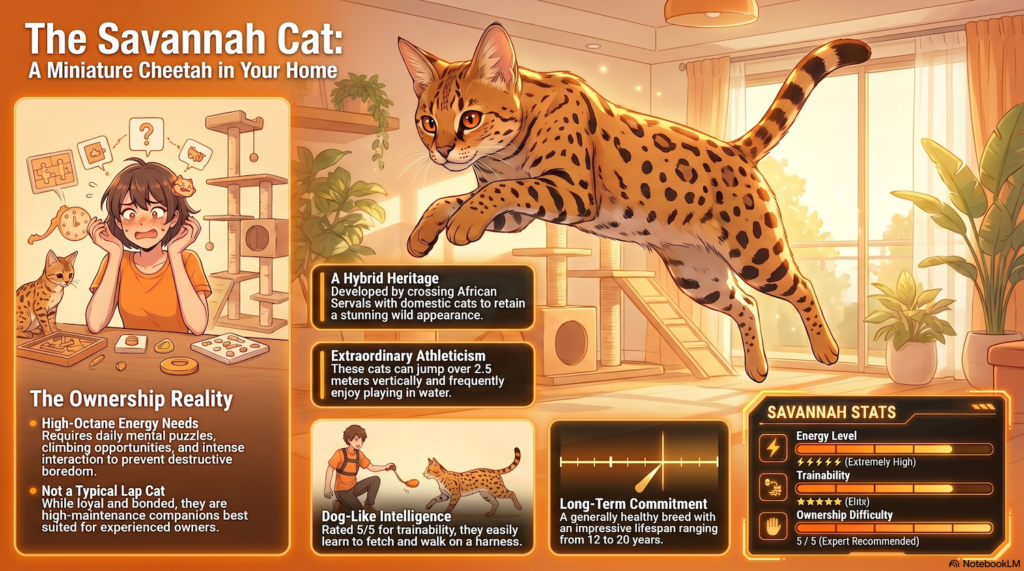
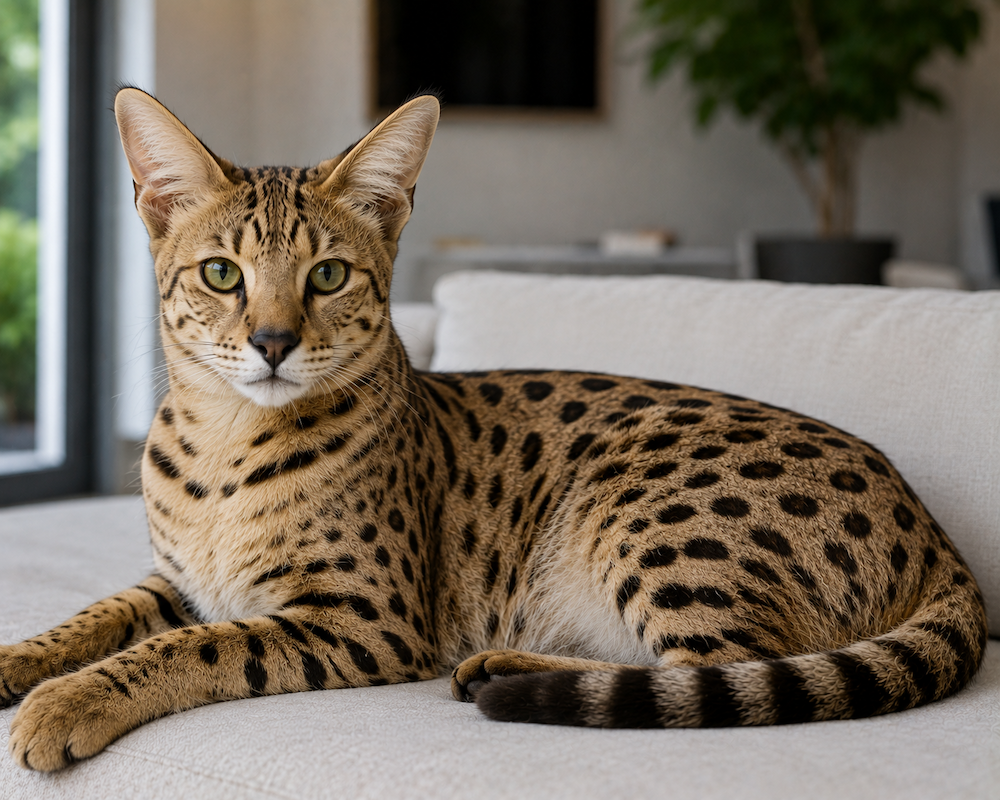
The Savannah is an exotic-looking cat breed created by crossing domestic cats with the African serval. Known for its tall build, spotted coat, and incredible athleticism, the Savannah has a truly unique appearance.
These cats are highly intelligent, curious, and energetic. They love climbing, exploring, and interacting with their environment, making them one of the most active cat breeds in the world.
✅ PROS & CONS
Pros
- Stunning wild appearance
- Extremely intelligent and trainable
- Highly active and entertaining
- Strong bond with owners
Cons
- Very high energy requirements
- Needs significant mental stimulation
- Can be too active for some households
- Requires plenty of space and enrichment
Is a Savannah Cat a Good Family Cat?
Yes, but Savannah cats are best suited to families prepared for a highly active, intelligent and demanding cat.
They can form extremely strong bonds with their owners and enjoy being involved in family life. However, they’re generally much more energetic and intense than typical domestic cats.
Their suitability also varies considerably according to generation, individual temperament and socialisation.
Are Savannah Cats Good With Children?
Savannah cats can be good with respectful older children, particularly when properly socialised.
Their energetic play and athleticism can be overwhelming for very young children.
Children should understand that Savannahs need appropriate handling and shouldn’t be chased, grabbed or forced to interact.
Are Savannah Cats Affectionate?
Yes. Savannahs can be extremely affectionate with people they trust.
Many follow their owners around the house, greet them enthusiastically and want to participate in whatever is happening.
Their affection isn’t always expressed by sitting quietly on a lap — a Savannah may prefer following, playing and interacting.
How Much Exercise Does a Savannah Cat Need?
Savannahs need considerably more exercise and stimulation than the average domestic cat.
Daily interactive play, climbing opportunities, puzzle feeders and exploration are important.
Some Savannahs can also be trained to walk on a harness, providing another safe outlet for their energy and curiosity.
Are Savannah Cats Easy to Train?
Yes. Savannah cats are exceptionally intelligent and can respond very well to positive reinforcement.
Many can learn to come when called, retrieve toys, walk on a harness and perform simple tricks.
Their intelligence can also work against an unprepared owner because a bored Savannah may invent its own entertainment.
How High Can a Savannah Cat Jump?
Savannah cats are extraordinary jumpers and can leap well over two metres vertically in some circumstances.
Their long legs and athletic bodies allow them to reach shelves, cupboards and other places owners may assume are safely inaccessible.
Savannah-proofing a home often requires thinking vertically rather than simply keeping objects off the floor.
Do Savannah Cats Shed a Lot?
Savannah cats generally shed low-to-moderate amounts.
Their short coat is relatively easy to maintain, and weekly brushing is usually sufficient.
Seasonal changes and individual genetics can affect how much a particular cat sheds.
Are Savannah Cats Hypoallergenic?
No. Savannah cats aren’t considered hypoallergenic.
Their relatively short coat and modest shedding don’t prevent them from producing the proteins responsible for cat allergies.
Someone with significant allergies should spend time around Savannahs before considering ownership.
How Often Should You Groom a Savannah Cat?
Savannahs are relatively low-maintenance cats to groom.
Weekly brushing is generally enough to remove loose hair and maintain their short coat.
Routine nail trimming, dental care and ear checks should also be included in their care.
What Health Problems Are Common in Savannah Cats?
Savannah cats are generally athletic animals, but they can still develop health problems seen in domestic cats, including heart disease, dental problems and other inherited or acquired conditions.
Because Savannah breeding involves hybrid ancestry and multiple generations, health risks can vary between breeding lines.
Choosing a responsible breeder who performs appropriate health screening is important.
How Long Do Savannah Cats Live?
Savannah cats commonly live around 12–20 years, although reliable lifespan data for different generations remain limited.
Genetics, diet, indoor safety, healthy weight and veterinary care all influence lifespan.
Potential owners should therefore regard a Savannah as a long-term commitment.
How Big Does a Savannah Cat Get?
Savannah size varies substantially according to generation and genetics.
Early-generation males can sometimes weigh 7–11 kg or more, while later-generation Savannahs are often considerably smaller.
Their unusually long legs and tall, lean build can also make them appear much larger than their actual weight suggests.
What Do F1, F2, F3 and F4 Mean in Savannah Cats?
The “F” number describes a Savannah’s generation from its serval ancestry.
An F1 Savannah has a serval parent. F2 cats are another generation removed, followed by F3, F4 and later generations.
Individual ancestry percentages aren’t identical simply because two cats share the same F-generation label, but earlier generations generally have greater serval influence.
What Is the Difference Between an F1 and F5 Savannah Cat?
An F1 Savannah is directly descended from a serval parent and typically shows much stronger physical and behavioural influence from its wild ancestry.
An F5 is several generations removed and generally behaves more like a conventional domestic cat, although it may remain exceptionally athletic and active.
Earlier generations also tend to face more ownership restrictions.
Can Savannah Cats Live Indoors?
Yes, and secure indoor living is generally the safest option.
However, Savannahs need an enriched environment with substantial vertical space, climbing structures, interactive toys and regular human involvement.
A small, unstimulating indoor environment is unlikely to suit an energetic Savannah.
Secure outdoor enclosures can provide additional enrichment.
Can Savannah Cats Be Left Alone?
Savannah cats generally don’t thrive when routinely left alone without stimulation for long periods.
They’re intelligent, active and often strongly attached to their owners.
Environmental enrichment and compatible animal companionship may help, but owners should expect to spend significant time interacting with them.
Are Savannah Cats Good With Other Cats?
Many Savannahs can live successfully with other cats, particularly when appropriately introduced.
Their energetic play style can overwhelm quiet or elderly cats, however.
Another active and confident cat may be a better match than a companion that prefers a peaceful life.
Are Savannah Cats Good With Dogs?
Savannahs can be surprisingly compatible with cat-friendly dogs, especially when raised alongside them.
Their confidence and energetic play can sometimes make an active dog a suitable companion.
Introductions should still be gradual and carefully supervised.
Can Savannah Cats Live With Small Pets?
Considerable caution is required.
Savannahs retain strong hunting instincts, and small animals such as rodents, birds and reptiles can trigger predatory behaviour.
Secure cages alone shouldn’t automatically be assumed to make small pets safe from an intelligent and determined Savannah.
Do Savannah Cats Like Water?
Many Savannah cats show an unusual interest in water.
Some will play with running taps, investigate showers, splash in water dishes or even enter shallow water voluntarily.
Not every Savannah enjoys water, but fascination with it is frequently reported by owners.
Are Savannah Cats Vocal?
Savannahs can be quite communicative.
They may meow, chirp and make other sounds, and some early-generation cats can produce vocalisations influenced by their serval ancestry.
The amount of vocalisation varies significantly between individuals.
What Does a Savannah Cat Look Like?
Savannahs are tall, lean and athletic cats with long legs, large upright ears and a spotted coat.
Their appearance deliberately reflects some characteristics of the African serval while retaining domestic-cat ancestry.
Their long limbs can make even moderately weighted Savannahs look unusually large.
What Is the Difference Between a Savannah Cat and a Bengal Cat?
Both have exotic-looking coats and high activity levels, but they’re very different hybrids.
The Savannah was developed using the African serval, while the Bengal’s wild ancestry comes from the Asian leopard cat.
Savannahs are typically taller and longer-legged, while Bengals generally have a more compact, muscular build.
Is a Savannah Cat the Same as a Serval?
No.
A serval is a wild African cat species (Leptailurus serval), while a Savannah is a hybrid breed descended from servals and domestic cats.
Early-generation Savannahs can retain substantial serval characteristics, but they’re not simply domesticated servals.
Are Savannah Cats Legal to Own?
Savannah cat ownership depends on where you live and sometimes on the cat’s generation.
Some countries, states and local jurisdictions restrict or prohibit ownership because of their serval ancestry.
Prospective owners should check current national, state and local regulations before purchasing or importing a Savannah.
Are Savannah Cats Legal in Australia?
Savannah cats are effectively prohibited from importation into Australia because of their hybrid wild-cat ancestry and concerns about their potential environmental impact.
Australia has strict controls surrounding hybrid exotic animals.
Anyone considering an exotic or hybrid cat should check current Australian government regulations rather than relying on overseas breeder information.
Where Does the Savannah Cat Come From?
The Savannah originated in the United States during the 1980s through breeding between an African serval and a domestic cat.
A kitten named Savannah, born in 1986, became associated with the beginnings of the breed.
Further breeding eventually established the distinctive hybrid cat recognised today.
Is a Savannah Cat a Good First Cat?
Usually not.
Savannahs are high-energy, highly intelligent and potentially challenging cats, particularly in the earlier generations.
Their exercise requirements, prey drive, climbing ability, need for enrichment and possible legal restrictions make them considerably more demanding than typical domestic cats.
Experienced, well-prepared owners are generally a better fit.
What Makes the Savannah Cat Unique?
The Savannah is one of the most visually extraordinary domestic-cat breeds because part of its ancestry comes from the African serval — the tall, long-legged wild cat of African grasslands.
That heritage explains the Savannah’s enormous ears, spotted coat, extraordinary jumping ability and unusually athletic build.
It also explains why describing one simply as a “large house cat” misses the point.
Savannahs can learn tricks, walk on harnesses, retrieve toys, investigate water and work out how to reach places their owners were absolutely certain were inaccessible.
And then there are the legs.
A Savannah doesn’t necessarily look enormous because it’s extremely heavy. It looks enormous because someone appears to have taken a domestic cat and turned the leg setting up several notches.
That combination of intelligence, athleticism and wild ancestry makes the Savannah fascinating.
It also makes one thing clear:
this is definitely not a cat for someone whose idea of cat-proofing is moving something to the top shelf.