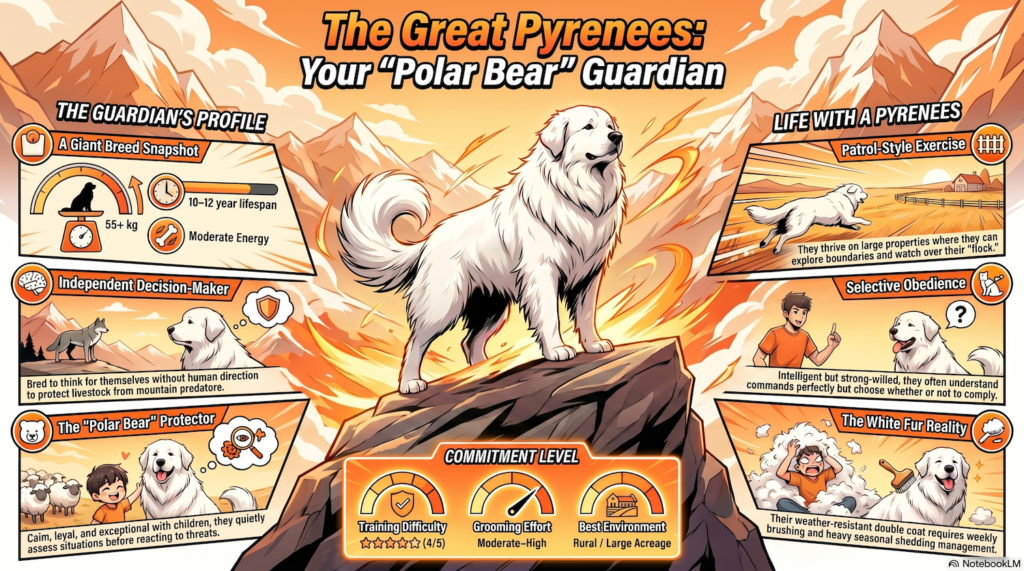







Gentle, majestic, and fiercely loyal — a calm giant bred to protect and watch over those it loves.
🧠 QUICK SNAPSHOT
- Temperament: Calm, protective, gentle
- Energy Level: Moderate
- Size: Giant
- Good With Families: Yes
- Trainability: Moderate
- Grooming: High
- Best For: Families with space, rural properties, experienced owners
📚 OVERVIEW
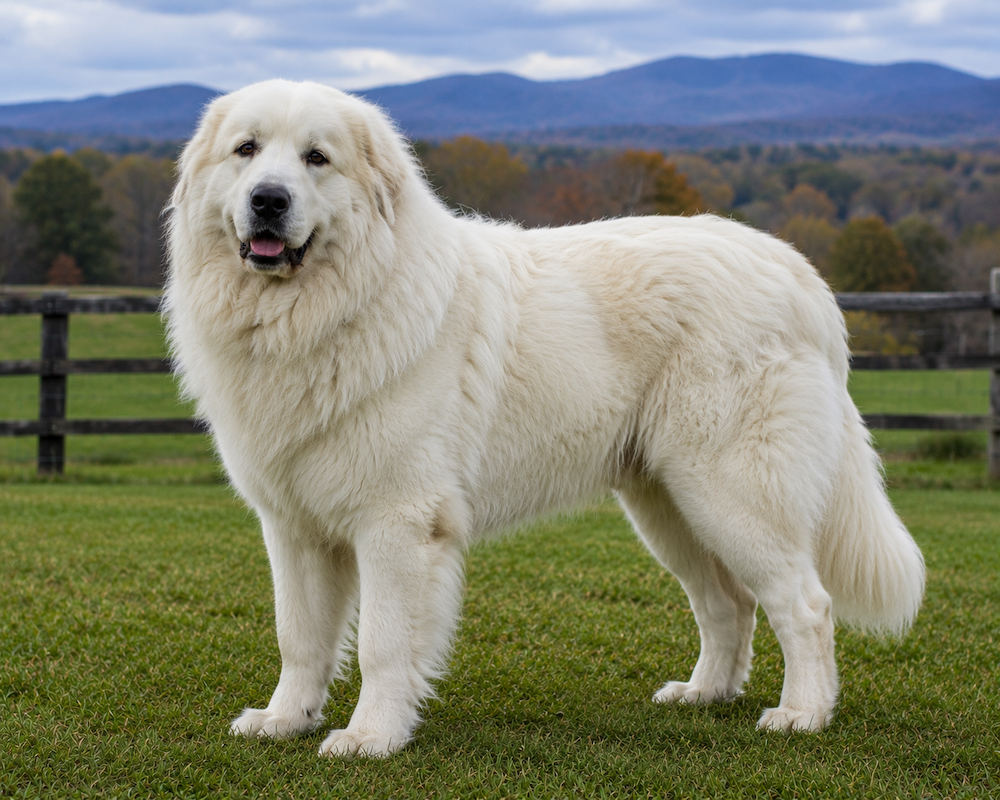
The Great Pyrenees is a magnificent livestock guardian breed originally developed to protect sheep in the mountains between France and Spain. Known for its impressive size, thick white coat, and calm demeanour, this breed combines gentleness with a powerful protective instinct.
Despite their guardian heritage, Great Pyrenees are affectionate family companions that are patient with children and deeply devoted to their household.
✅ PROS & CONS
Pros
- Gentle and affectionate with family
- Excellent natural guardian
- Calm and patient temperament
- Great with children
Cons
- Heavy shedding throughout the year
- Requires space to thrive
- Can be independent and stubborn
- May bark frequently at perceived threats
Is a Great Pyrenees a Good Family Dog?
Yes. The Great Pyrenees can be a gentle, devoted and remarkably calm family dog, particularly in homes that understand livestock guardian breeds.
They’re usually affectionate with their family and often patient with children. However, they’re independent thinkers bred to make decisions without constant human direction.
Their enormous size, heavy shedding, barking and protective instincts make them very different from an oversized Golden Retriever.
How Much Exercise Does a Great Pyrenees Need?
Most adult Great Pyrenees need around 45–60 minutes of moderate daily exercise.
They’re not usually hyperactive dogs. Their traditional work required conserving energy while remaining alert for predators over long periods.
Walks, exploration and access to secure outdoor space generally suit them better than repetitive high-intensity exercise.
Is a Great Pyrenees Easy to Train?
Great Pyrenees are intelligent but famously independent.
They were bred to guard livestock without waiting for a shepherd to tell them what to do. Consequently, they may understand a command perfectly and still decide whether complying makes sense.
Positive reinforcement, patience and consistency work much better than forceful training.
Does a Great Pyrenees Shed?
Yes — very heavily.
The breed has a thick double coat designed for harsh mountain weather and sheds throughout the year, with substantial seasonal coat blows.
Regular brushing helps, but anyone wanting a Great Pyrenees should become comfortable with white hair appearing in locations where no dog has apparently been.
Is a Great Pyrenees Hypoallergenic?
No. Great Pyrenees aren’t hypoallergenic.
They produce normal canine allergens and shed enormous quantities of hair and dander.
They’re one of the least suitable choices for someone specifically seeking a low-shedding dog.
How Often Should You Groom a Great Pyrenees?
Most need a thorough brushing at least once or twice a week, increasing during heavy seasonal shedding.
Their coat can develop mats, particularly behind the ears and around feathering.
Nails, ears and teeth also require routine care.
Should You Shave a Great Pyrenees?
Generally, no.
Their double coat provides insulation and environmental protection.
Routine shaving can interfere with normal coat function and regrowth and doesn’t turn the dog into a heat-adapted breed.
Removing dead undercoat through regular grooming is generally preferable unless clipping is medically necessary.
What Health Problems Are Common in Great Pyrenees?
Potential concerns include hip and elbow dysplasia, patellar problems, eye disease, gastric dilatation-volvulus, certain cancers and neurological conditions.
As with other giant breeds, skeletal development and body condition are particularly important.
Responsible breeders should screen breeding dogs for relevant inherited problems.
Are Great Pyrenees Prone to Hip Dysplasia?
Yes.
Hip dysplasia can occur in Great Pyrenees and may eventually cause pain, lameness and arthritis.
Formal hip assessment of breeding animals is important.
Maintaining a lean body condition also reduces unnecessary stress on the joints.
Are Great Pyrenees Prone to Bloat?
They can be.
Their large, deep-chested structure creates a risk of gastric dilatation-volvulus (GDV).
Repeated unsuccessful attempts to vomit, severe restlessness, abdominal enlargement, excessive drooling or collapse require immediate emergency veterinary treatment.
How Long Does a Great Pyrenees Live?
Great Pyrenees commonly live around 10–12 years, which is relatively respectable for such a large dog.
Individual longevity depends on genetics, joint health, cancer risk, body condition and veterinary care.
How Big Does a Great Pyrenees Get?
The Great Pyrenees is a large to giant dog.
Males commonly stand around 69–81 cm at the shoulder, with females approximately 64–74 cm.
Adults frequently weigh around 39–54 kg, although large males can exceed this.
Can a Great Pyrenees Live in an Apartment?
It’s possible, but generally challenging.
Adult Great Pyrenees can be calm indoors, but they’re very large, heavily coated and naturally inclined to patrol and bark.
Their vocal guarding behaviour can be particularly difficult in apartments and closely packed neighbourhoods.
Can a Great Pyrenees Be Left Alone?
They’re unusually capable of working independently, but that doesn’t mean a companion Great Pyrenees should be routinely isolated for very long periods.
Historically, these dogs often spent substantial time living with livestock rather than constantly beside humans.
A bored suburban Pyr may create its own security duties.
Are Great Pyrenees Velcro Dogs?
Usually not in the same way as Golden Retrievers or Vizslas.
Many Great Pyrenees are affectionate but retain a degree of emotional and behavioural independence.
They may happily lie near their family while simultaneously monitoring the house, garden and apparently suspicious activities occurring three streets away.
Are Great Pyrenees Cuddly?
Many are extremely affectionate with people they trust.
Their enormous fluffy coats make them particularly impressive cuddling companions.
However, some prefer to remain near their family rather than constantly on top of them.
Individual personality varies.
Are Great Pyrenees Good With Children?
Generally, yes.
The breed is often gentle, patient and protective around children within its family.
Their enormous size still requires supervision.
Children should never climb on, ride or roughly handle a Great Pyrenees simply because the dog appears tolerant.
Are Great Pyrenees Good With Other Dogs?
They can be, particularly when properly socialised.
However, mature livestock guardians can become territorial or selective around unfamiliar dogs, especially dogs they perceive as threats.
Same-sex conflict can also occur in some individuals.
Are Great Pyrenees Good With Cats?
Often, yes.
Livestock guardian dogs were specifically developed to live peacefully among animals they considered part of their flock.
Many Great Pyrenees can therefore coexist exceptionally well with cats and other household animals when properly introduced.
Are Great Pyrenees Good With Chickens?
They can be excellent poultry guardians.
A properly raised Great Pyrenees may learn to regard chickens as animals requiring protection rather than prey.
Young dogs still need careful supervision and training, because playful behaviour from a giant adolescent can injure birds even without predatory intent.
Are Great Pyrenees Good With Sheep?
Yes. Protecting sheep is one of the breed’s classic traditional roles.
The dog lives among the flock and develops a strong attachment to the animals.
Rather than herding sheep, it guards them against predators.
This distinction is fundamental to understanding the Great Pyrenees.
Does a Great Pyrenees Herd Sheep?
No — not in the way a Border Collie does.
A herding dog moves and controls livestock.
A livestock guardian such as the Great Pyrenees stays with the animals and protects them.
Trying to judge a Great Pyrenees by sheep-herding obedience misses the point of what it was created to do.
What Is a Livestock Guardian Dog?
A livestock guardian dog, or LGD, is bred to live with livestock and deter predators.
Rather than constantly taking commands from a shepherd, the dog independently monitors its surroundings and decides when something represents a threat.
This explains much of the Great Pyrenees’ independence, barking and territorial behaviour.
Are Great Pyrenees Protective?
Yes. Protection is one of the breed’s fundamental characteristics.
Great Pyrenees were bred for centuries to detect and deter threats to livestock.
Modern dogs often extend this instinct to their family, property and other household animals.
Good guardians should be calm and discerning rather than indiscriminately aggressive.
Are Great Pyrenees Good Guard Dogs?
Yes, but their guarding style differs from many personal-protection breeds.
They typically rely on size, confidence, barking, territorial presence and escalation when genuinely necessary.
A Great Pyrenees often prefers convincing a threat to leave rather than immediately attacking it.
Are Great Pyrenees Aggressive?
They shouldn’t be indiscriminately aggressive.
A well-bred Great Pyrenees should ideally be calm, confident and capable of distinguishing ordinary activity from genuine threats.
However, this is a powerful guardian breed. Poor socialisation, irresponsible breeding or inadequate management can create serious behavioural problems.
Are Great Pyrenees Good With Strangers?
Many are reserved or watchful with unfamiliar people.
Some are socially friendly once introduced, while others remain politely distant.
Their guardian heritage means immediate enthusiasm towards every stranger isn’t necessarily expected.
Early socialisation helps them develop appropriate judgement.
Why Does My Great Pyrenees Bark So Much?
Because barking was an important part of its job.
A livestock guardian could warn predators that a large protective dog was present without needing to physically confront them.
Barking also alerted shepherds and other guardian dogs.
From an evolutionary job-performance perspective, a barking Pyr was often doing exactly what humans wanted.
Do Great Pyrenees Bark at Night?
Frequently.
Many livestock predators are most active around dusk, night and dawn, so Great Pyrenees developed strong nocturnal vigilance.
A suburban Pyr may therefore spend the night announcing possums, foxes, neighbours, car doors and mysterious noises detectable only to itself.
Can You Train a Great Pyrenees Not to Bark?
You can teach reasonable barking boundaries, but completely eliminating alert barking is unrealistic.
The behaviour has been deliberately selected for generations.
Management, sufficient exercise and teaching a reliable “quiet” cue can help, but owners should choose the breed expecting some vocal guarding.
Why Does My Great Pyrenees Bark at Nothing?
It’s probably reacting to something humans haven’t noticed.
Dogs have much more sensitive hearing and smell than people.
A guardian breed is also genetically inclined to investigate distant or unfamiliar stimuli.
What appears to be “nothing” may be wildlife, another dog, a distant sound or scent.
Do Great Pyrenees Roam?
Yes. Roaming can be a significant issue.
Livestock guardians historically needed to patrol substantial territories, and Great Pyrenees may naturally expand the area they consider worth investigating.
Secure fencing is extremely important.
A Pyr that discovers an escape route may begin conducting security inspections of the entire neighbourhood.
Are Great Pyrenees Escape Artists?
They can be.
Their combination of independence, strength, digging ability and territorial curiosity can make inadequate fencing ineffective.
Some will climb, dig or push through weak points.
Secure fencing should be designed for a large, determined guardian rather than an average companion dog.
Can a Great Pyrenees Be Trusted Off Leash?
They’re generally more challenging off leash than highly handler-focused breeds.
A Great Pyrenees may understand recall perfectly but decide that investigating a distant boundary is currently more important.
Secure areas are usually the safest option.
Why Are Great Pyrenees So Independent?
Independence was essential to their original work.
A dog guarding sheep in remote mountain country couldn’t constantly ask a shepherd, “What should I do now?”
It needed to evaluate situations and make decisions alone.
Modern owners sometimes call this stubbornness; historically, it was professional competence.
Are Great Pyrenees Stubborn?
They certainly can appear stubborn.
The breed is intelligent but doesn’t possess the same automatic desire for human direction seen in many herding or retrieving breeds.
A Great Pyrenees may understand the command and simply have a different opinion about its current priority.
Are Great Pyrenees Intelligent?
Yes, but their intelligence is highly independent and problem-solving oriented.
Traditional obedience tests tend to reward rapid compliance with human commands.
That isn’t the type of intelligence livestock guardians were selected for.
Their job required judgement, environmental awareness and autonomous decision-making.
Why Does My Great Pyrenees Put a Paw on Me?
Many Great Pyrenees use their enormous paws to seek attention or physical contact.
Owners sometimes call this the “Pyr paw.”
It can be affectionate and endearing — although receiving a giant paw directly to the face provides a useful reminder that affection also has mass.
What Is the “Pyr Paw”?
“Pyr paw” is an informal owner term for the breed’s tendency to place or swipe a front paw at people when seeking attention.
It isn’t unique to Great Pyrenees, but owners mention it frequently enough to have become part of the breed’s folklore.
Training polite alternatives can prevent accidental scratches.
Why Does My Great Pyrenees Lean on Me?
Leaning generally indicates affection, reassurance or a desire for contact.
Despite their independent working style, many Pyrs are extremely loving towards their family.
The dog’s enormous body makes a perfectly ordinary canine lean considerably more noticeable.
Why Does My Great Pyrenees Sleep Near the Door?
Doorways provide an excellent position from which to monitor movement into and out of an area.
Guardian dogs often choose locations offering good visibility and strategic control.
The coolest part of the floor may also happen to be near the door.
Why Does My Great Pyrenees Patrol the House or Yard?
Patrolling is deeply connected with livestock guardian behaviour.
The dog checks boundaries, investigates changes and monitors potential threats.
A suburban yard may be considerably smaller than a mountain pasture, but the internal job description hasn’t necessarily been updated.
Why Does My Great Pyrenees Dig Holes?
Digging can provide cool ground, comfortable resting places or simple entertainment.
Livestock guardians working outdoors may naturally create shallow resting depressions.
In hot weather, cooler soil can be particularly attractive beneath that enormous coat.
Are Great Pyrenees Good in Cold Weather?
Excellent.
Their dense double coat was developed for cold mountainous conditions, providing exceptional insulation against snow, wind and low temperatures.
Many Great Pyrenees become noticeably more energetic in cool weather.
Can Great Pyrenees Handle Hot Weather?
They can live in warmer climates with careful management, but they’re far better adapted to cold conditions.
Shade, constant water, air-conditioned indoor access and avoiding exercise during hot parts of the day are important.
This is particularly relevant in hot Australian summers.
Do Great Pyrenees Like Snow?
Many absolutely love it.
Their thick coat, large body and mountain heritage make them extremely comfortable in cold conditions.
A Great Pyrenees lying contentedly in snow may look far more comfortable than the human standing beside it wondering why the dog refuses to come inside.
Do Great Pyrenees Like Water?
Some enjoy swimming, while others show relatively little interest.
Unlike Retrievers, the Great Pyrenees wasn’t developed primarily for water work.
Individual preference matters much more than breed expectation.
Are Great Pyrenees Good Hiking Dogs?
Healthy adult Pyrs can enjoy hiking, particularly in cool weather and at moderate speeds.
They’re built for steady movement and endurance rather than high-speed athletic work.
Heat, terrain and giant-breed joint considerations should be taken seriously.
Are Great Pyrenees Fast?
They can move surprisingly quickly when necessary.
Livestock guardians needed enough speed to respond to predators approaching their flock.
However, the breed’s typical style is economical movement and watchfulness rather than constant sprinting.
What Does a Great Pyrenees Look Like?
The Great Pyrenees is a large, powerful dog with a predominantly white double coat, substantial neck, plumed tail, dark eyes and relatively small triangular drop ears.
Despite its size, the breed should appear balanced and capable of moving efficiently across difficult terrain.
Why Are Great Pyrenees White?
The predominantly white coat likely helped shepherds distinguish guardian dogs from darker predators, particularly at a distance.
White livestock guardian dogs occur in several European traditions.
The colour also allows the dog to blend visually with sheep.
Are All Great Pyrenees Completely White?
No.
Great Pyrenees may have markings in shades such as grey, badger, reddish-brown or tan, depending on the breed standard.
Markings commonly occur around the head and ears and sometimes elsewhere on the body.
Predominantly white remains characteristic.
What Are Badger Markings on a Great Pyrenees?
“Badger” describes greyish, tan or mixed-colour markings, often seen around the head and ears.
Puppies can be born with fairly obvious markings that become lighter as they mature.
A marked puppy is still completely normal for the breed.
Do Great Pyrenees Markings Fade?
They can.
Head and body markings may become considerably lighter with age, particularly certain grey or badger shades.
A strongly marked puppy can therefore appear much whiter as an adult.
Do Great Pyrenees Have Double Dewclaws?
Yes. One of the breed’s distinctive physical characteristics is double dewclaws on the hind legs.
These additional toes are specifically required under major breed standards.
They should be maintained like other nails because they don’t necessarily wear down naturally.
Why Do Great Pyrenees Have Double Dewclaws?
Their exact historical functional advantage isn’t definitively established.
They’re sometimes claimed to improve traction and stability on mountainous terrain, which is plausible but difficult to prove conclusively.
What is certain is that double rear dewclaws became a defining characteristic preserved through breed selection.
Should Great Pyrenees Double Dewclaws Be Removed?
Routine removal is generally unnecessary unless there’s a specific veterinary reason.
They’re a normal anatomical characteristic of the breed rather than an abnormal defect.
Their nails simply need regular checking and trimming.
Why Does a Great Pyrenees Have a Plumed Tail?
The heavily coated tail is part of the breed’s cold-weather adaptation and characteristic appearance.
When alert or moving, the tail may curve upward over the back.
When relaxed, it often hangs lower.
What Is the “Shepherd’s Crook” in a Great Pyrenees Tail?
Breed descriptions sometimes refer to a crook or hook at the end of the tail.
This slight curve is a traditional characteristic associated with the breed.
It shouldn’t be confused with a tightly curled Spitz tail.
Is a Great Pyrenees the Same as a Pyrenean Mountain Dog?
Yes.
Great Pyrenees is the name commonly used in North America.
Pyrenean Mountain Dog is widely used in Britain, Australia and other countries.
Both names refer to the same breed.
Why Is It Called the Great Pyrenees?
The name refers to the Pyrenees mountain range between France and Spain, where dogs of this general livestock guardian type developed.
“Great Pyrenees” became particularly established as the North American breed name.
Is the Great Pyrenees French or Spanish?
The breed’s history belongs to the Pyrenean region spanning modern France and Spain, although the modern pedigree breed became particularly associated with France.
The mountains existed as a working environment long before today’s national breed boundaries were formalised.
What Is the Difference Between a Great Pyrenees and a Pyrenean Mastiff?
They’re separate breeds.
The Pyrenean Mastiff developed primarily on the Spanish side of the Pyrenees and is generally heavier and more Mastiff-like.
The Great Pyrenees/Pyrenean Mountain Dog is associated especially with the French side and has a more refined mountain-dog appearance.
What Is the Difference Between a Great Pyrenees and a Maremma Sheepdog?
Both are large white livestock guardian breeds.
The Maremma Sheepdog originated in Italy, while the Great Pyrenees is associated with the Pyrenees between France and Spain.
Their appearance and working behaviour can be similar, but they’re distinct breeds with separate histories.
What Is the Difference Between a Great Pyrenees and a Kuvasz?
The Kuvasz is a Hungarian livestock guardian breed.
Both are large, predominantly white guardian dogs, but the Kuvasz typically has a more uniformly white, wavier coat and different structure.
They’re separate regional solutions to a similar livestock-protection problem.
What Is the Difference Between a Great Pyrenees and an Anatolian Shepherd?
Both are livestock guardians, but their origins and appearance differ significantly.
The Anatolian/Kangal-type dogs developed in Türkiye, while the Great Pyrenees developed in the Pyrenean region.
Anatolian-type dogs generally have shorter coats and are better suited to hotter, drier conditions.
What Predators Did Great Pyrenees Protect Livestock From?
Historically, they helped protect flocks against predators including wolves and bears.
The objective wasn’t necessarily to fight every predator physically.
Their barking, scent, enormous size and confident presence could deter predators before direct confrontation became necessary.
Could a Great Pyrenees Kill a Wolf?
A large livestock guardian is physically capable of fighting a predator, but portraying the breed as a specialised wolf-killing machine is misleading.
Successful livestock protection is largely about deterrence, vigilance and often cooperation between multiple guardian dogs.
Avoiding injury is preferable to fighting.
Did Great Pyrenees Fight Bears?
Historical livestock guardians could confront or help deter bears threatening livestock.
However, their job wasn’t recreational bear fighting.
Their size, barking and courage formed part of a broader predator-deterrence strategy.
Direct encounters with large predators could be extremely dangerous.
Do Great Pyrenees Work in Teams?
Yes. Livestock guardians are often used in pairs or groups, particularly where predator pressure is substantial.
Multiple dogs can patrol a larger area and provide a stronger deterrent.
Their ability to cooperate while independently evaluating threats is part of what makes livestock guardian dogs effective.
Are Great Pyrenees Still Used to Guard Livestock?
Absolutely.
Great Pyrenees continue working on farms and ranches around the world, protecting sheep, goats, poultry and other livestock.
Their ancient occupation remains commercially useful even in the age of electric fencing and modern agricultural technology.
Can Great Pyrenees Protect Livestock From Coyotes?
Yes. In regions where coyotes are present, Great Pyrenees are commonly used as livestock guardians.
Their size, territorial behaviour, barking and scent presence can discourage predators from approaching livestock.
Effectiveness depends on the environment, number of dogs and predator pressure.
Are Great Pyrenees Born Knowing How to Guard Livestock?
They possess strong inherited guardian tendencies, but a puppy isn’t a fully trained livestock guardian.
Young dogs require appropriate socialisation with livestock, supervision and maturity.
Adolescent play behaviour can be problematic around vulnerable animals.
Reliable working behaviour develops through both genetics and experience.
Why Do Great Pyrenees Bond With Livestock?
Generations of selective breeding favoured dogs that were socially tolerant towards livestock while suspicious of potential predators.
Puppies raised appropriately among sheep, goats or other animals can develop strong social attachment to them.
The livestock effectively becomes the dog’s family group.
Where Did the Great Pyrenees Come From?
The Great Pyrenees developed as a livestock guardian in the Pyrenees Mountains, the rugged range separating France and Spain.
Large white guardian dogs lived alongside shepherds and flocks, protecting livestock from predators including wolves and bears. Their job demanded independence, patience, courage and the ability to remain outside with animals in severe mountain weather.
The precise ancient ancestry of Pyrenean guardian dogs can’t be reconstructed with modern pedigree certainty. The recognisable breed was gradually standardised much later from regional working populations.
Is the Great Pyrenees an Ancient Breed?
Its livestock guardian tradition is extremely old, but claims that the modern breed has remained genetically unchanged for thousands of years should be treated cautiously.
Large guardian dogs have existed across European pastoral cultures for centuries.
The modern pedigree Great Pyrenees was standardised far more recently.
Did Great Pyrenees Come From Tibetan Mastiffs?
Older breed histories often proposed that many European mountain dogs descended directly from Tibetan Mastiff-type ancestors migrating westward.
Modern canine history and genetics are more complicated than that simple family tree.
It’s safer to view Great Pyrenees as part of a broad Eurasian history of large livestock guardian dogs rather than claiming a proven direct Tibetan Mastiff descent.
Were Great Pyrenees Dogs Used in Medieval Europe?
Large Pyrenean guardian dogs have a long regional history, although precise medieval pedigrees obviously don’t exist.
Dogs resembling the modern type were associated with pastoral life and protection of livestock long before organised kennel clubs appeared.
Their later association with aristocracy is much better documented.
Did Great Pyrenees Guard French Castles?
Great Pyrenees became associated with estates and châteaux as well as livestock protection.
Their imposing size and natural watchfulness made them useful guardians.
However, castle-guard stories shouldn’t overshadow their fundamental identity as working livestock guardian dogs.
Was the Great Pyrenees the Royal Dog of France?
The breed is famously associated with a tradition that the Great Pyrenees was declared the Royal Dog of France during the reign of Louis XIV in the 17th century.
This royal association is widely repeated in breed histories.
Whatever the precise wording of historical recognition, Pyrenean dogs clearly became prestigious among French nobility.
Were Great Pyrenees Kept at the French Royal Court?
Pyrenean mountain dogs gained considerable prestige among French aristocratic households.
Their striking white coats, enormous size and guardian reputation made them desirable beyond their original shepherding role.
This helped transform a rugged mountain worker into an aristocratic status symbol.
Did Queen Victoria Own a Great Pyrenees?
Queen Victoria is reported to have owned a Pyrenean Mountain Dog during the 19th century, helping increase awareness of the breed in Britain.
Royal ownership frequently influenced dog-breed fashion during the Victorian period.
Who Helped Preserve the Modern Great Pyrenees?
By the late 19th and early 20th centuries, enthusiasts became concerned about preserving authentic Pyrenean dogs.
French breeders and breed clubs began surveying mountain populations, defining standards and selecting dogs representative of traditional types.
This work helped create the modern pedigree breed.
Who Was Bernard Sénac-Lagrange?
Bernard Sénac-Lagrange was an important figure in the early 20th-century preservation and standardisation of the Pyrenean Mountain Dog.
He was involved in efforts to identify and promote traditional examples of the breed.
His work contributed significantly to the modern French breed standard.
Why Did Great Pyrenees Numbers Decline?
Changes in agriculture and predator populations reduced the need for traditional livestock guardians in some regions.
The disruptions of war and economic hardship also affected European dog populations.
Breed enthusiasts helped preserve and rebuild the Great Pyrenees as both a working dog and companion.
When Did Great Pyrenees Come to North America?
Dogs of Pyrenean type were known in North America earlier, but organised establishment of the modern breed accelerated during the early 20th century.
American enthusiasts imported European dogs and developed dedicated breeding programmes.
The name Great Pyrenees became firmly established in North America.
Were Great Pyrenees Used to Help Create the Newfoundland?
Historical claims have connected Pyrenean dogs brought to Newfoundland with the ancestry of local working dogs.
The exact contribution is difficult to establish with certainty because early dog populations weren’t documented like modern pedigrees.
Claims of a simple Great Pyrenees-to-Newfoundland lineage should therefore be treated cautiously.
Why Did Great Pyrenees Become Popular Farm Dogs?
They offer something technology still struggles to duplicate: a mobile, intelligent guardian living continuously among livestock.
A Great Pyrenees can detect unusual activity, bark, patrol and respond independently at any hour.
The breed essentially provides a security system that eats, sheds and occasionally ignores instructions.
Are Great Pyrenees Rare?
They’re not among the world’s rarest breeds, but they’re far less common than mainstream family breeds such as Labradors and Golden Retrievers.
Working populations remain important in farming regions.
Their enormous size, barking and independence naturally limit their suitability for many suburban homes.
Is a Great Pyrenees a Good First Dog?
It can be, but it isn’t usually one of the easiest choices.
A first-time owner needs to understand guardian behaviour, barking, roaming, independence, giant size and heavy shedding.
Someone expecting Retriever-style obedience may find the breed frustrating.
Someone who appreciates independent working dogs may find them extraordinary companions.
Where Does the Great Pyrenees Come From?
The Great Pyrenees — known in Australia and Britain as the Pyrenean Mountain Dog — comes from the Pyrenees Mountains between France and Spain, where large white dogs spent generations guarding livestock against predators.
Unlike herding dogs, they weren’t expected to wait beside a shepherd for instructions. They lived with the flock, watched the surrounding country and independently decided when something represented a threat. That explains virtually everything about the modern breed: the enormous white coat, nighttime barking, territorial patrols, independence, courage and deep attachment to the animals and people it considers its own.
It also explains the Great Pyrenees owner’s occasional frustration. When a Pyr looks directly at you after hearing a command and then walks away, it may not have failed obedience training.
It may simply be reminding you that its ancestors were trusted to make life-and-death decisions on a mountain — and nobody consulted them about “sit.”