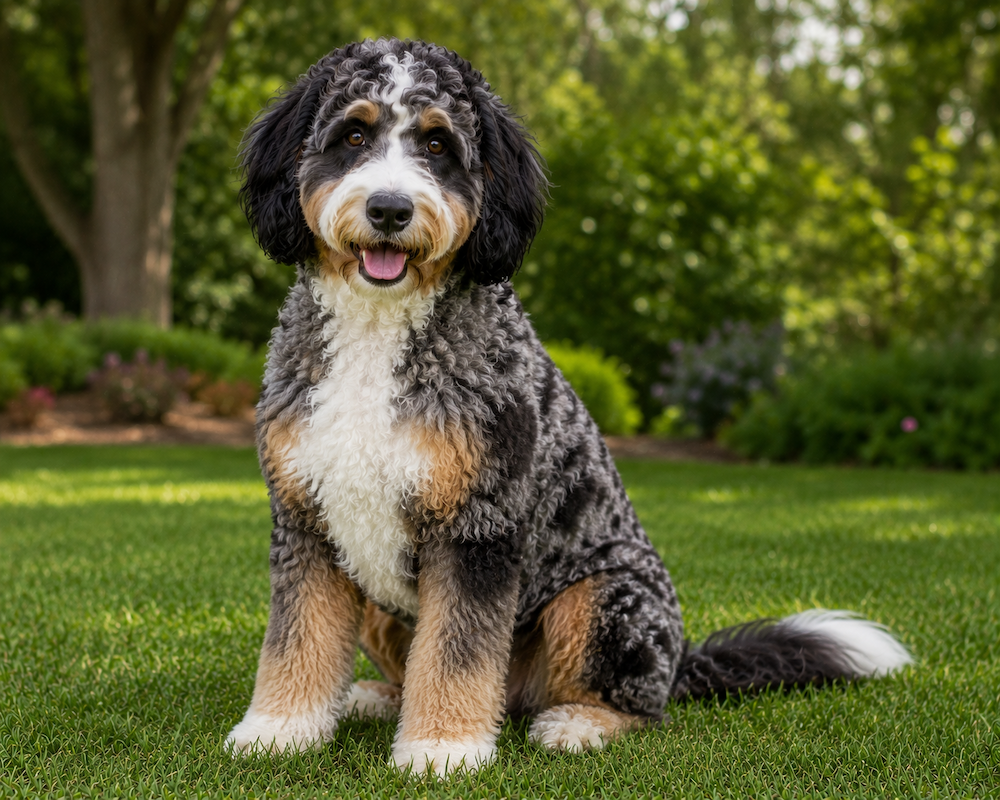






Smart, energetic, and full of personality — a playful companion that combines intelligence with endless enthusiasm.
🧠 QUICK SNAPSHOT
- Temperament: Intelligent, affectionate, energetic
- Energy Level: High
- Size: Medium
- Good With Families: Yes
- Trainability: Very high
- Grooming: Moderate to high
- Best For: Active families, outdoor lifestyles, training enthusiasts
📚 OVERVIEW
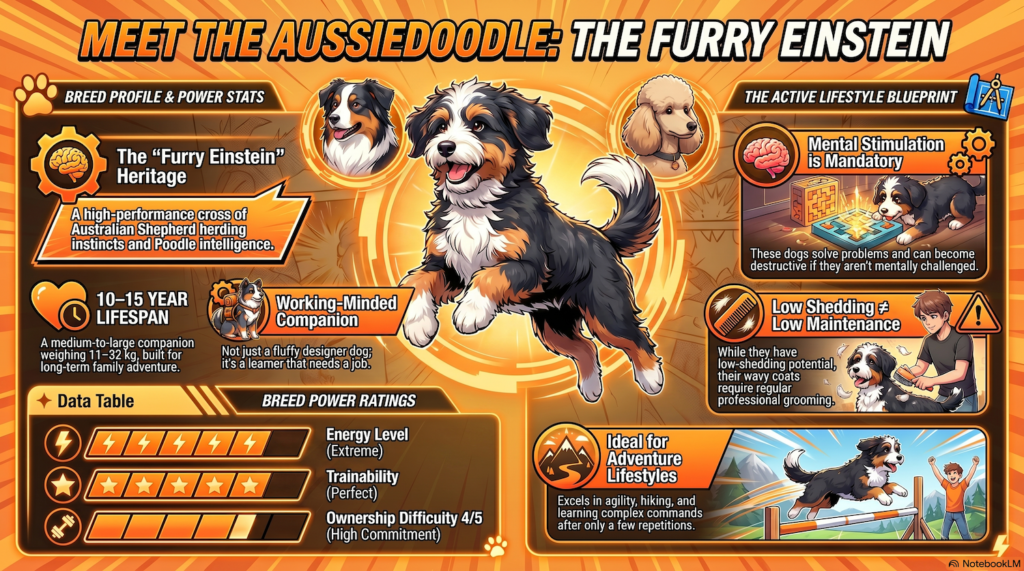
The Aussiedoodle is a cross between an Australian Shepherd and a Poodle, creating an intelligent, energetic, and highly trainable companion. Known for their playful personalities and striking appearance, Aussiedoodles thrive in active homes where they can be part of daily adventures.
They form strong bonds with their family and enjoy both physical activity and mental challenges, making them a popular choice for owners looking for an interactive companion.
✅ PROS & CONS
Pros
- Extremely intelligent and easy to train
- Affectionate and family-oriented
- Often low shedding depending on coat type
- Excels in dog sports and activities
Cons
- Requires significant exercise and stimulation
- Can become bored if left inactive
- Needs regular grooming
- May develop separation anxiety if left alone too often
Is an Aussiedoodle a Good Family Dog?
Yes, an Aussiedoodle can be an excellent family dog for an active household prepared to provide plenty of exercise, training and mental stimulation.
Aussiedoodles combine Australian Shepherd and Poodle ancestry, two breeds known for intelligence and strong relationships with their owners. Many Aussiedoodles are affectionate, playful and highly involved in family life.
They can be very good with children, although Australian Shepherd herding instincts sometimes appear as chasing or attempting to herd running children.
Individual temperament varies because the Aussiedoodle is a crossbreed rather than a standardised breed.
For the right family, an Aussiedoodle can be enormously entertaining — but you’re potentially combining two very clever dogs into one very fluffy problem-solver.
How Much Exercise Does an Aussiedoodle Need?
Most adult Aussiedoodles need around 60–90 minutes of exercise each day, with particularly energetic individuals requiring more.
Daily walks alone may not be enough.
Many enjoy running, hiking, retrieving, swimming, agility and other activities that allow them to exercise both physically and mentally.
Their Australian Shepherd ancestry can contribute considerable working energy, while Poodles are also athletic dogs originally developed for retrieving.
Mental stimulation is equally important. Puzzle toys, scent games and regular training can help prevent boredom.
An Aussiedoodle that isn’t given anything interesting to do may simply use its considerable intelligence to create an activity you hadn’t planned.
Is an Aussiedoodle Easy to Train?
Aussiedoodles are generally highly trainable because both Australian Shepherds and Poodles rank among the most intelligent and responsive dog breeds.
Many learn commands remarkably quickly and excel with positive reinforcement.
However, intelligence doesn’t automatically make a dog effortless to own.
Aussiedoodles can also learn unwanted behaviours quickly, and some may become bored with repetitive training.
Early socialisation, recall training, loose-lead walking and impulse control are particularly valuable.
Many Aussiedoodles also excel at advanced tricks and dog sports.
If you’re looking for a dog capable of learning impressive things, the Aussiedoodle certainly qualifies.
Just remember that clever dogs learn your mistakes as quickly as your commands.
Does an Aussiedoodle Shed?
An Aussiedoodle may shed very little, moderately or occasionally quite heavily, depending on the coat it inherits.
Poodles have tightly curled, continuously growing coats that shed relatively little, while Australian Shepherds have shedding double coats.
An Aussiedoodle can inherit characteristics anywhere between those extremes.
Curlier-coated dogs often shed less but typically require substantially more grooming to prevent matting.
Straighter or wavier coats may be easier to brush but can shed more.
Even within the same litter, coat characteristics can vary.
Anyone choosing an Aussiedoodle specifically because they’ve been promised a completely non-shedding dog should understand that crossbreeding doesn’t come with a coat guarantee.
Are Aussiedoodles Hypoallergenic?
No dog is completely hypoallergenic, and an Aussiedoodle cannot reliably be guaranteed to be suitable for someone with dog allergies.
Some Aussiedoodles inherit a low-shedding Poodle-like coat and may release less loose hair around the home.
However, dog allergies are caused primarily by proteins found in skin flakes, saliva and other secretions rather than hair itself.
An Aussiedoodle can still produce these allergens regardless of coat type.
Because coat inheritance varies considerably in crossbred dogs, one Aussiedoodle may affect an allergy sufferer differently from another.
Anyone with significant allergies should spend time around the individual dog before making a long-term commitment.
How Often Does an Aussiedoodle Need Grooming?
Most Aussiedoodles need considerable regular grooming, particularly those with curly or dense coats.
Brushing may be required several times each week — and sometimes daily — to prevent knots and mats from developing close to the skin.
Many need professional grooming approximately every six to eight weeks, depending on coat length and texture.
Particular attention should be paid behind the ears, under the legs, around the collar and other high-friction areas where mats commonly form.
Ears, nails and teeth also need routine care.
The teddy-bear appearance is undeniably cute.
Unfortunately, teddy bears don’t normally require appointments with a professional groomer every two months.
What Health Problems Are Common in Aussiedoodles?
Aussiedoodles can inherit health conditions associated with both Australian Shepherds and Poodles.
Potential concerns include hip dysplasia, elbow problems and inherited eye diseases such as progressive retinal atrophy.
Some Australian Shepherd lines carry variants of the MDR1 gene, which can make affected dogs unusually sensitive to certain medications.
Epilepsy can also occur in Australian Shepherd ancestry, while conditions found in Poodle lines vary according to the Poodle size involved.
Responsible Aussiedoodle breeders should health-test the parent dogs for conditions relevant to both breeds, rather than assuming crossbreeding automatically eliminates inherited disease.
“Hybrid vigour” isn’t a substitute for responsible genetic screening.
How Long Do Aussiedoodles Live?
Aussiedoodles commonly live around 10–15 years, although size, genetics and overall health influence lifespan.
Smaller Aussiedoodles may potentially live longer than particularly large individuals, reflecting the broader tendency for smaller dogs to have greater longevity.
Good nutrition, maintaining a healthy weight, appropriate exercise, dental care and regular veterinary examinations can all support long-term health.
Because Aussiedoodles aren’t a standardised breed, there isn’t one precise lifespan that applies to every dog carrying the name.
How Big Does an Aussiedoodle Get?
Aussiedoodle size can vary dramatically, largely because different sizes of Poodle may be used in the cross.
Standard Aussiedoodles can become medium to fairly large dogs, commonly weighing somewhere around 18–32 kg, although individuals may fall outside that range.
Mini Aussiedoodles are considerably smaller and are usually produced using a Miniature Poodle parent.
Terms such as “Toy,” “Mini” and “Standard” Aussiedoodle aren’t necessarily defined consistently between breeders.
Prospective owners should therefore ask about the actual sizes of the parent dogs rather than relying entirely on a marketing label.
With an Aussiedoodle puppy, “Mini” isn’t a universally standardised unit of measurement.
Can an Aussiedoodle Live in an Apartment?
An Aussiedoodle can live in an apartment, particularly a smaller individual, but its exercise and mental-stimulation requirements remain significant.
Size isn’t necessarily the biggest issue.
An intelligent, energetic Aussiedoodle that receives insufficient activity can become restless, destructive or excessively vocal regardless of how large the home is.
Daily outdoor exercise, training and enrichment are essential.
Access to parks and other appropriate exercise areas can make apartment living considerably easier.
A well-exercised Aussiedoodle can settle nicely indoors.
A bored one may begin investigating whether your furniture can be redesigned.
Can an Aussiedoodle Be Left Alone?
Aussiedoodles often form very strong attachments to their owners and may not cope well with routinely being left alone for long periods.
Both parent breeds were developed to work closely with humans.
Some Aussiedoodles can develop separation-related behaviours such as barking, pacing or destructive chewing.
Puppies should gradually learn that spending reasonable periods alone is normal and safe.
Exercise and enrichment before absences can also help.
The breed is generally better suited to households where the dog receives substantial daily interaction than to a lifestyle where it will regularly spend the entire day alone.
Do Aussiedoodles Have a Strong Herding Instinct?
Some Aussiedoodles inherit a strong herding instinct from the Australian Shepherd side of their ancestry.
This can appear as chasing, circling or attempting to control the movement of children, other dogs or even adults.
Occasionally, a dog may nip toward heels as part of this behaviour.
These behaviours shouldn’t be encouraged simply because they’re instinctive.
Training can redirect that energy into appropriate activities such as structured games, agility or herding-based dog sports.
Not every Aussiedoodle displays strong herding behaviour, but prospective owners should understand that putting a Poodle coat on Australian Shepherd genetics doesn’t necessarily make the sheepdog programming disappear.
Are Aussiedoodles Good With Other Dogs?
Aussiedoodles are generally capable of getting along very well with other dogs, particularly when properly socialised from puppyhood.
Many are playful and enjoy canine companionship.
Individual temperament still matters, and the behaviour of both parent breeds can influence the result.
Early positive experiences with different dogs can help puppies develop appropriate social skills.
Their high energy can sometimes overwhelm quieter dogs, so matching play styles is important.
What Is an F1, F1B or F2 Aussiedoodle?
These terms describe different generations of Aussiedoodle breeding.
An F1 Aussiedoodle is typically produced by crossing an Australian Shepherd with a Poodle.
An F1B usually results from breeding an F1 Aussiedoodle back to one of the parent breeds, most commonly a Poodle. This is often done in an attempt to increase the likelihood of a curlier, lower-shedding coat.
An F2 generally results from breeding two F1 Aussiedoodles together.
These labels describe ancestry, not guaranteed characteristics.
Even puppies from the same generation can vary considerably in coat, size and temperament.
An F1B label therefore isn’t a guarantee of no shedding, no allergies or a particular personality.
Is an Aussiedoodle a Recognised Dog Breed?
The Aussiedoodle is generally considered a designer crossbreed rather than a formally standardised pedigree breed by major international kennel clubs.
It’s produced primarily from Australian Shepherd and Poodle ancestry.
Because there isn’t one universally accepted breed standard, Aussiedoodles can vary considerably in size, coat, colour, appearance and temperament.
That variation isn’t necessarily a problem, but prospective owners should understand what they’re buying.
The reputation of the breeder and health testing of the parent dogs are often more useful than fashionable terms describing colour, size or generation.
Where Did the Aussiedoodle Come From?
The precise origin of the Aussiedoodle is not particularly well documented, but the cross became increasingly popular during the designer-dog movement that expanded from the late 20th century into the 2000s.
The idea was appealing: combine the intelligence and potentially lower-shedding coat of the Poodle with the athleticism, trainability and striking appearance of the Australian Shepherd.
It’s important to remember that crossing two breeds doesn’t automatically produce an exact 50/50 blend of their most desirable traits.
Genetics doesn’t work like selecting features from a menu.
Every Aussiedoodle is its own combination — which is part of both the appeal and the unpredictability of the cross.