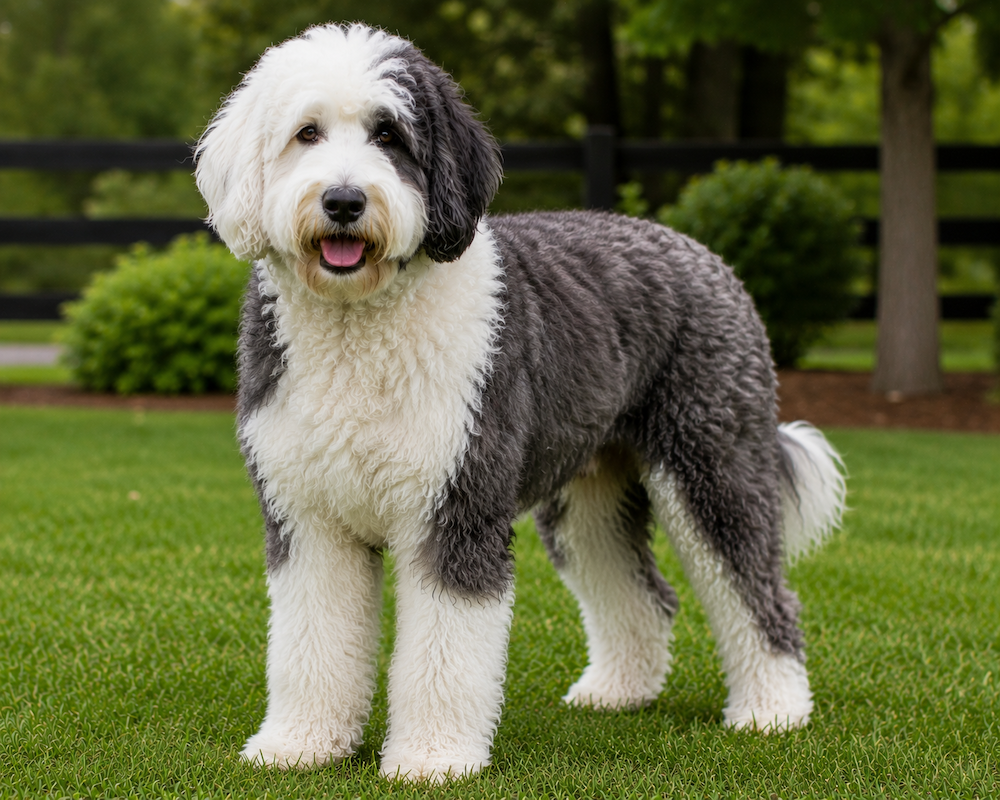






Intelligent, affectionate, and wonderfully fluffy — a fun-loving companion that combines loyalty with a playful spirit.
🧠 QUICK SNAPSHOT
- Temperament: Friendly, intelligent, affectionate
- Energy Level: Moderate to high
- Size: Large
- Good With Families: Yes
- Trainability: High
- Grooming: High
- Best For: Families, active households, companionship
📚 OVERVIEW
The Sheepadoodle is a cross between an Old English Sheepdog and a Poodle, combining intelligence, affection, and a distinctive fluffy appearance. Known for their friendly personalities and strong family bonds, Sheepadoodles have become one of the most popular doodle breeds.
They are social, playful dogs that enjoy being around people and thrive in homes where they receive plenty of interaction, exercise, and mental stimulation.
✅ PROS & CONS
Pros
- Extremely affectionate and family-oriented
- Highly intelligent and trainable
- Often low shedding depending on coat type
- Great with children and families
Cons
- Requires regular grooming and coat maintenance
- Needs companionship and attention
- Can develop separation anxiety
- Requires daily exercise and mental stimulation
Is a Sheepadoodle a Good Family Dog?
Yes. Sheepadoodles can make affectionate, intelligent and playful family dogs.
As a cross between an Old English Sheepdog and a Poodle, they often combine a sociable personality with considerable intelligence and energy.
Temperament can vary between individuals, however, because crossbred dogs don’t inherit an exact 50/50 mixture of their parents’ characteristics.
Are Sheepadoodles Good With Children?
Generally, yes. Many Sheepadoodles are affectionate and playful with children.
However, larger Sheepadoodles can be enthusiastic and may accidentally knock over small children.
Some can also inherit herding behaviour from the Old English Sheepdog, including attempting to chase or steer running children, so early training is important.
How Much Exercise Does a Sheepadoodle Need?
Most adult Sheepadoodles need around 60–90 minutes of daily exercise, although requirements vary with size, age and temperament.
Walks, games, swimming, training and interactive activities can all be useful.
Mental stimulation is particularly important because both parent breeds are intelligent working dogs.
Are Sheepadoodles Easy to Train?
Usually, yes.
Sheepadoodles can inherit the Poodle’s exceptional trainability and the Old English Sheepdog’s working intelligence.
They generally respond well to positive reinforcement, although some individuals can be independent or easily distracted.
Starting training early is particularly useful with larger Sheepadoodles.
Do Sheepadoodles Shed?
Many Sheepadoodles are relatively low-shedding, but low shedding isn’t guaranteed.
A puppy may inherit a curlier Poodle-like coat, a coat more reminiscent of the Old English Sheepdog or something between the two.
Coat characteristics can vary significantly even between puppies from the same litter.
Are Sheepadoodles Hypoallergenic?
No dog is completely hypoallergenic, and Sheepadoodles cannot be guaranteed to be allergy-friendly.
Some inherit a low-shedding coat and may be better tolerated by certain people with allergies.
However, allergens are also present in saliva and skin secretions, so having a Poodle parent doesn’t automatically make a Sheepadoodle hypoallergenic.
How Often Should You Groom a Sheepadoodle?
Sheepadoodles usually require substantial grooming.
Most need brushing several times a week — potentially daily with longer coats — plus professional grooming approximately every six to eight weeks.
Their thick, wavy or curly coats can develop painful mats surprisingly quickly if neglected.
What Health Problems Are Common in Sheepadoodles?
Potential health concerns can include hip dysplasia, eye disorders, thyroid disease, skin problems and certain inherited conditions found in either parent breed.
Some larger Sheepadoodles may also be vulnerable to gastric dilatation-volvulus (bloat).
Crossbreeding doesn’t automatically eliminate inherited disease, so health testing of both parents remains important.
How Long Do Sheepadoodles Live?
Sheepadoodles commonly live around 10–15 years, although size can significantly influence lifespan.
Mini Sheepadoodles may potentially live longer than very large individuals.
Genetics, weight, diet, exercise and preventive veterinary care also influence longevity.
How Big Does a Sheepadoodle Get?
Sheepadoodle size can vary considerably.
Standard Sheepadoodles commonly weigh around 25–40 kg or more, while Mini Sheepadoodles can be substantially smaller.
Because Sheepadoodles aren’t a standardised breed, the size of the actual parent dogs is more useful than relying solely on labels such as “Mini” or “Standard.”
What Is a Mini Sheepadoodle?
A Mini Sheepadoodle is generally produced using Old English Sheepdog ancestry and a Miniature Poodle, sometimes through multigenerational breeding.
The aim is to produce a smaller Sheepadoodle, but there isn’t a universally defined size standard.
Prospective owners should therefore ask for the actual adult sizes of the parents rather than relying on the word “Mini.”
When Is a Sheepadoodle Fully Grown?
Larger Sheepadoodles may continue developing until around 18–24 months, while smaller individuals may reach maturity earlier.
Height is often reached before the dog completely fills out.
The enormous variation in Sheepadoodle size means there isn’t one growth timetable applicable to every dog.
Can a Sheepadoodle Live in an Apartment?
Smaller Sheepadoodles may adapt to apartment living if they receive enough exercise and mental stimulation.
Standard Sheepadoodles are large, active dogs and generally benefit from more space.
Regardless of home size, daily exercise is more important than simply having access to a backyard.
Can Sheepadoodles Be Left Alone?
Adult Sheepadoodles can learn to tolerate reasonable periods alone, but many are highly people-oriented dogs.
Long periods without companionship, exercise or stimulation can contribute to barking, chewing and other unwanted behaviours.
Gradual alone-time training from puppyhood can be helpful.
Do Sheepadoodles Bark a Lot?
It varies.
Some Sheepadoodles are relatively quiet, while others inherit greater alertness and vocal behaviour from their parent breeds.
Exercise, training, socialisation and boredom can all influence barking.
Are Sheepadoodles Affectionate?
Yes. Many Sheepadoodles are extremely affectionate and strongly attached to their families.
They often enjoy physical contact and following their favourite people around the home.
Their combination of size, fluffiness and affection has contributed considerably to their popularity as family companions.
Are Sheepadoodles Good With Other Dogs?
Generally, yes.
Properly socialised Sheepadoodles are often playful and sociable with other dogs.
Their energetic play style can occasionally overwhelm very small, elderly or particularly quiet dogs, so compatible personalities matter.
Are Sheepadoodles Good With Cats?
Many Sheepadoodles can live successfully with cats, particularly when introduced appropriately.
Some may inherit herding behaviour and attempt to chase or control a moving cat.
Early training can help establish appropriate boundaries.
Do Sheepadoodles Have Herding Instincts?
Some do.
The Old English Sheepdog was developed as a working droving and herding-type dog, and Sheepadoodles can inherit behaviours such as following, circling or attempting to control movement.
The strength of these instincts varies considerably between individuals.
Are Sheepadoodles High-Energy Dogs?
Most Sheepadoodles are moderately to highly energetic, particularly when young.
They usually need considerably more than a short daily walk.
Exercise combined with training, scent games, puzzle toys and other mental challenges helps keep an intelligent Sheepadoodle occupied.
Are Sheepadoodles Smart?
Yes. Sheepadoodles can be exceptionally intelligent.
Poodles are famous for their learning ability, while Old English Sheepdogs were developed to perform demanding working roles.
That combination can produce a dog that learns commands quickly — but also learns exactly where food is stored and which household rules aren’t consistently enforced.
What Is an F1 Sheepadoodle?
An F1 Sheepadoodle is a first-generation cross between an Old English Sheepdog and a Poodle.
The label describes parentage, not guaranteed characteristics.
An F1 puppy isn’t guaranteed to inherit exactly half of each parent’s appearance, coat type, shedding level or temperament.
What Is an F1B Sheepadoodle?
An F1B Sheepadoodle is usually produced by breeding an F1 Sheepadoodle back to a Poodle.
This can increase the likelihood of certain Poodle-like coat characteristics, but doesn’t guarantee a non-shedding or hypoallergenic dog.
Genetic inheritance remains variable.
What Is the Difference Between a Sheepadoodle and a Bernedoodle?
A Sheepadoodle combines Old English Sheepdog and Poodle ancestry, while a Bernedoodle combines Bernese Mountain Dog and Poodle ancestry.
Both can be large, fluffy family dogs, but Sheepadoodles may display stronger herding or movement-controlling behaviours.
Individual temperament varies considerably in both crosses.
What Is the Difference Between a Sheepadoodle and a Goldendoodle?
A Goldendoodle combines Golden Retriever and Poodle ancestry, while a Sheepadoodle combines Old English Sheepdog and Poodle ancestry.
Goldendoodles may display more retriever-related characteristics, while Sheepadoodles can inherit stronger herding instincts.
Both require significant grooming when they inherit thick, continuously growing coats.
Is a Sheepadoodle a Recognised Dog Breed?
The Sheepadoodle isn’t generally recognised as a standardised pedigree breed by major international kennel clubs.
It’s a cross between an Old English Sheepdog and a Poodle.
Consequently, size, coat, appearance and temperament can be less predictable than in a long-established breed with a defined standard.
Where Did the Sheepadoodle Come From?
Old English Sheepdog–Poodle crosses have existed for decades, but intentionally bred Sheepadoodles became increasingly popular during the wider rise of Poodle crosses.
There isn’t a reliably documented single creator or precise date when the Sheepadoodle was first developed.
Claims assigning the cross to one definitive founder should therefore be treated cautiously.
Is a Sheepadoodle a Good First Dog?
A Sheepadoodle can be a good first dog for an owner prepared for its requirements.
They’re often intelligent, affectionate and trainable, but grooming can be demanding and larger Sheepadoodles require substantial exercise and early training.
Their cute teddy-bear appearance shouldn’t obscure the fact that both sides of their ancestry come from capable working dogs.
What Makes the Sheepadoodle Unique?
A Sheepadoodle can look like an enormous black-and-white teddy bear.
That’s slightly misleading.
Underneath all that fluff are two highly intelligent working-dog backgrounds.
The Old English Sheepdog developed around livestock and droving work, while the Poodle’s ancestors were highly capable water retrievers.
So while a Sheepadoodle may look as though its main purpose is being hugged on the sofa, its brain may have other plans.
It may learn tricks quickly, follow you everywhere, investigate everything you’re doing and occasionally decide that moving family members need to be organised into a more efficient formation.
And then there’s the coat.
The popular assumption that mixing anything with a Poodle automatically creates a non-shedding, hypoallergenic dog simply isn’t reliable.
With a Sheepadoodle, the teddy-bear appearance may be predictable. Exactly what lies beneath all that fluff is considerably less so.